
Tag Archives: Debt

Why do so many people vote for the Democrat party?

ECM sent me this article from National Review that explains why so many people vote Democrat.

Excerpt:

First, we should recognize that the War on Poverty is now a huge budget item. According to calculations by the Congressional Research Service and the Senate Budget Committee, taxpayers coughed up over $1 trillion in federal and state-provided benefits in 2011. These benefits flow to tens of millions of voters and cover the waterfront, offering low-income Americans everything from cash assistance to food, housing, and medical care, not to mention help with education, transportation, home-heating costs, and child care. Spending on these programs has soared more than 40 percent since 2007. That’s an unsustainable trajectory.

Then we get some facts from a Wall Street Journal article on the topic:

  • The percentage of the American labor force drawing disability benefits from the government has doubled since 1992, from 3 percent to 6 percent. They further note: “The number of workers qualifying for disability since the recession ended in 2009 has grown twice as fast as private employment.”
  • During the last four years, the Obama administration’s aggressive promotion of the food-stamp program has increased the number of recipients by 18.5 million.
  • Unemployment insurance that lasted no longer than 55 weeks in 1980 and 72 weeks in 1992 now can last 99 weeks. Some 40 percent of unemployed workers have been out of work for more than half a year.

And how does it affect voting?:

The Battleground Polls conducted by the Tarrance Group on behalf of George Washington University and Politico make this level of detail readily available. The poll helpfully divides its sample of likely voters into, among other things, those who self-identify as either “low income” or “middle class.”

So, what do we know about these voters?

  • Those who self-identify as “low income” are more likely to be unemployed, frustrated over the state of the economy, and pessimistic over the general direction of our country than are those with higher incomes. Yet the Battleground Poll indicates they are more Why do people likely than those who identify as middle class to believe the country is heading in the right direction (42 percent vs. 35 percent).
  • Do welfare benefits insulate these voters from the sort of economic concerns that plague middle-class voters? Apparently so. Compared with their middle-class counterparts, far fewer low-income voters cite pocketbook issues as their number-one concern (53 percent vs.74 percent). Middle-class voters are, almost by definition, far more likely to pay taxes than low-income voters. Unsurprisingly, they are much more likely to list the economy and the level of spending and deficits as their most important concern (28 percent and 17 percent, respectively) than low-income Americans. Among the latter group, only 20 percent say the economy is most important, and a mere 7 percent worry about spending and deficits. Again, this is not surprising, considering that, for most low-income Americans, government benefits come with no strings attached, and at little or no cost in taxes.
  • In contrast, low-income Americans cite Medicare, Social Security, and education benefits as their number-one issue (29 percent in all) more than twice as frequently as do middle-class voters (only 13 percent).
  • If the receipt of welfare benefits affects voters’ views of the economy and alters the equation they use to judge candidates, one would expect them to give the president high marks for how he has handled the most stagnant and underperforming economy in over half a century. And, indeed, that is the case. By a margin of 51 percent to 37 percent low-income voters prefer Obama over Romney on this measure. They prefer Obama by an even more lopsided margin, 55 percent to 37 percent, on the issue of jobs. In contrast, Romney wins big among middle-class voters on these concerns (56 percent to 41 percent on handling the economy, and 54 percent to 43 percent on jobs).

These people aren’t voting for any high and noble reason. They want money. It’s just greed. Greed is why people vote Democrat.

Elusive Wapiti adds:

It makes sense, really. The 47% vote their pocketbook too… the issue comes from the pocketbook being oriented in the opposite direction. Government largesse fills their wallet, whilst draining the bankbooks of the 53%. They are the “zero liability” voter; they are insulated from the costs of the programs and candidates they vote for… but they are understandably quite concerned with ensuring the payouts continue.

You need to get out there today and vote for Mitt Romney to stop the downward spiral into dependency and bankruptcy that we can see in countries like Greece, Spain and Italy. We can see it happening over there, don’t let it happen here.
U.S. per person debt now $53,378 – 35% higher than in Greece

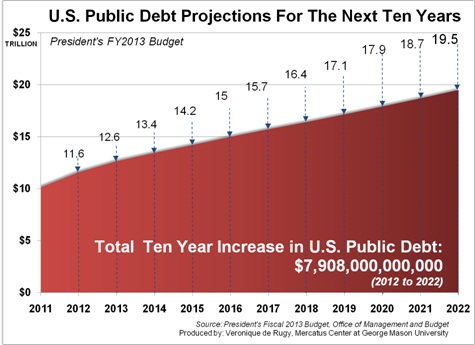
Obama 2013 Budget Debt Projection

From the Weekly Standard. (H/T WGB)

Excerpt:

“According to estimates from the International Monetary Fund, America’s total government debt will be $16.8 trillion by the end of the calendar year, compared to $441 billion for Greece,” the Republican side of the Senate Budget Committee explains.

“On a per person basis, that means U.S. debt is $53,400 for every man, woman, and child, compared to $39,400 for every man, woman, and child in Greece. The disparity between per capita debt in the U.S. and Greece has grown 40 percent (roughly $8,400) since 2011. Now, U.S. per person debt is 35 percent higher than that of Greece, and is also higher than per capita debt in Portugal, Italy, or Spain (which together with Greece make up the so-called PIGS countries).”

That’s based on total government debt.

And from CNS News, this for Americans under the age of 18:

If Americans under the age of 18 were required as a group to pay off the entirety of the federal government’s debt in equal shares, each would now need to pay about $218,676.

That is more than the $130,468 average price tag for four years at a private college or the $173,100 median price for an existing one-family home in the United States.

During the time Barack Obama has been president, the U.S. government debt has increased from approximately $143,255 per American under 18 to approximately $218,676 per American under 18–a climb of $75,421 or about 53 percent.

If you know anyone under the age of 18, it might worth explaining this to them.

UPDATE:

H/T The Elusive Wapiti.

Conservative MP Iain Duncan Smith proposes reforms to the UK welfare state

Dina sent me this exciting article from the UK Daily Mail about our favorite conservative MP.

Excerpt:

Jobless couples with more than two children should have benefit payments limited, Iain Duncan Smith suggested yesterday.

The Work and Pensions Secretary said there were ‘large numbers’ of couples on welfare having big families – unlike middle-income parents who had to weigh up if they could afford to have another child.

Mr Duncan Smith condemned the ‘madness’ of the state subsidising large workless families – saying it would be fairer to the ‘vast majority’ of responsible taxpayers if benefits were limited to the first two children in future.

He has agreed to find another £10billion in welfare savings by 2016, having already slashed £18billion from a vast budget that grew by 60 per cent under Labour.

As well as cuts to child benefit and tax credits for large workless families, he suggested housing benefit could be stripped for those who expected to go straight from school on to welfare and a state-subsidised house.

[…]He [insisted] the real cruelty was leaving people languishing on welfare for years. ‘We have accepted for far too long in this country that it is possible for people to just stay on benefits,’ he said. ‘It is all about saying, we will give you massive support to find work… But also, we have an expectation, as the taxpayer pays for these bills, that you try your hardest to find work.’

Most controversially, Mr Duncan Smith suggested the present system encouraged poorer families to have large numbers of children without worrying about the cost.

‘When you look at families across the board, at all incomes, you find the vast, vast majority make decisions about the kind of numbers of children they have, the families they want, based on what they think they can afford,’ he said.

‘Where you see the clustering of the large families is really down at the very lowest incomes, those on significant levels of welfare, and those on the very top incomes. In other words, the problem for those who are paying the taxes, paying the bills – they make the decisions about their lives, even if they sometimes would like to maybe have extra children, they make decisions.

‘People who are having support through welfare are often free from that decision. We want to support people if they have children when they are out of work, of course.

‘But can there not be a limit to the fact that really you need to remember you need to cut your cloth in accordance with what capabilities and what finances you have?’

The UK Telegraph added:

Official figures show that 120,000 of the most troubled and difficult families cost the taxpayer about £9 billion a year. Every household is now spending the equivalent of £3,000 a year in tax for welfare payments.

There are about one in five households where no one works and 1.5 million children are growing up with a parent addicted to drugs or alcohol.

[…]Mr Duncan Smith will say that the poor use of government money in recent times has led to people being “written off”.

“Our failure to make each pound count has cost us again and again over the years, Not only in terms of a financial cost – higher taxes, inflated welfare bills and lower productivity, as people sit on benefits long term. But also the social cost of a fundamentally divided Britain – one in which a section of society has been left behind. We must no longer allow ourselves to accept that some people are written off.”

[…]The Liberal Democrats are threatening to block further cuts in benefits unless the Coalition also introduces new taxes on the rich.

The article notes that members of the British socialist party (the Labor Party) British communist party (the Liberal Democrats) oppose the cuts to welfare. Of course! That’s how they get their votes – by redistributing money from working people to many more people who don’t work.