
Tag Archives: Debt

Puerto Rico debt crisis will impact U.S. investors

Which financial companies hold Puerto Rica debt?
Which financial companies hold Puerto Rico debt?

Pay attention to this article from Investors Business Daily if you have investments.

It says:

With the financial world transfixed by Greece’s debt-driven meltdown, Puerto Rico announces it can’t pay its $73 billion in debt. Once again, we’re learning that welfare statism is no replacement for fiscal responsibility.

Compared to Greece’s $353 billion in debt, Puerto Rico’s $73 billion doesn’t sound so big. On a per capita basis, it’s about a third less.

But appearances deceive. Puerto Rico is in deep, owing actually much more than that amount.

We learned this after a report on Monday, co-authored by former International Monetary Fund No. 2 Anne Krueger, revealed the island’s finances are a shambles.

The devastating analysis noted that some 150 agencies ran up deficits that couldn’t even be accurately counted, so the true indebtedness might be even higher — as much as $100 billion by some estimates.

Now Republicans favor privatizing state-owned organizations because the private sector is more efficient. Democrats want to nationalize private sector services so that they can control access to it and use their monopoly to buy votes.

What does Puerto Rico do?

The government has funneled public money to state-owned enterprises that are supposed to be financially independent. Worse, the report said, many workers no longer even look for jobs, since welfare benefits pay more than actual work.

Now guess whether a Republican or a Democrat is to blame for this. Which party likes to borrow money from future generations in order to buy votes with spending right now?

In short, the government has been horrendously mismanaged.

[…]The problem is, Puerto Rico’s dysfunctional economy means the debts only piled higher, with no way to pay them. Deficits grew, too, since spending was never really cut.

Now, as a commonwealth, it can’t declare bankruptcy. It can default, however. That would be messy, creating a financial crisis in the territory, causing businesses to close and sending thousands fleeing to the U.S. mainland. Yet the Democrat-led government has said that, while it hopes to avoid default, it won’t cut either pensions or spending. So disaster looms.

Wow, just like Greece – they refused to cut pensions, raise retirement ages and cut spending, too. There is some good news – we probably won’t have to bail them out:

A bailout? Even President Obama rules that out. If the White House couldn’t bail out union-run Detroit, it sure couldn’t do it for Puerto Rico.

And, despite Padilla’s denials, politics is very much a part of the equation. Just like Greece and dozens of other financial basket cases, Puerto Rico has become a welfare state run by leftist bureaucrats and politicians that overspends on public pensions without having the money to pay for it all.

It’s a story repeated over and over around the world.

If Puerto Rico defaults, it won’t suffer alone, however. As the New York Times notes, “much of Puerto Rico’s debt is widely held by individual investors on the United States mainland, in mutual funds or other investment accounts, and they may not be aware of it.”

So better check your 401(k). Or your hedge fund. Because virtually all of that $73 billion is held by the U.S.

This is not to time for you to quit your job and go on vacations or focus on fun in any way. There is a world-wide financial crisis brewing. It’s nothing to panic over, but this is serious enough for us all to focus on our careers and savings, and cut our own spending. It’s not just Greece or Puerto Rico either, there are other warning signs from other countries, e.g. – China, Japan, etc.

Look:

Meanwhile, across the globe, we’re headed toward a reckoning on excessive debt, and it won’t be pretty. The welfare state model with big pensions for all and lavish unemployment benefits is dead. We’re watching its death throes now. Only the politicians don’t get it.

Even here, many states have severe debt problems with underfunded public sector obligations, as well as other problems. There’s just this problem with people wanting to depend on government. There are too many people wanting a free ride, and too few people willing to work and raise the next generation of workers.
What happens to crime rates if we punish police officers for stopping crime?

This story from Heather MacDonald in the Wall Street Journal is scary.

She writes:

The nation’s two-decades-long crime decline may be over. Gun violence in particular is spiraling upward in cities across America. In Baltimore, the most pressing question every morning is how many people were shot the previous night. Gun violence is up more than 60% compared with this time last year, according to Baltimore police, with 32 shootings over Memorial Day weekend. May has been the most violent month the city has seen in 15 years.

In Milwaukee, homicides were up 180% by May 17 over the same period the previous year. Through April, shootings in St. Louis were up 39%, robberies 43%, and homicides 25%. “Crime is the worst I’ve ever seen it,” said St. Louis Alderman Joe Vacarro at a May 7 City Hall hearing.

Murders in Atlanta were up 32% as of mid-May. Shootings in Chicago had increased 24% and homicides 17%. Shootings and other violent felonies in Los Angeles had spiked by 25%; in New York, murder was up nearly 13%, and gun violence 7%.

Those citywide statistics from law-enforcement officials mask even more startling neighborhood-level increases. Shooting incidents are up 500% in an East Harlem precinct compared with last year; in a South Central Los Angeles police division, shooting victims are up 100%.

By contrast, the first six months of 2014 continued a 20-year pattern of growing public safety. Violent crime in the first half of last year dropped 4.6% nationally and property crime was down 7.5%. Though comparable national figures for the first half of 2015 won’t be available for another year, the January through June 2014 crime decline is unlikely to be repeated.

What could the cause of this be? Well, it’s the backlash against police officers who defend themselves from assault by criminals who attack them:

Since last summer, the airwaves have been dominated by suggestions that the police are the biggest threat facing young black males today. A handful of highly publicized deaths of unarmed black men, often following a resisted arrest—including Eric Garner in Staten Island, N.Y., in July 2014, Michael Brown in Ferguson, Mo., in August 2014 and Freddie Gray in Baltimore last month—have led to riots, violent protests and attacks on the police. Murders of officers jumped 89% in 2014, to 51 from 27.

The state’s attorney general, Eric Schneiderman, wants to create a special state prosecutor dedicated solely to prosecuting cops who use lethal force. New York Gov.Andrew Cuomo would appoint an independent monitor whenever a grand jury fails to indict an officer for homicide and there are “doubts” about the fairness of the proceeding (read: in every instance of a non-indictment); the governor could then turn over the case to a special prosecutor for a second grand jury proceeding.

This incessant drumbeat against the police has resulted in what St. Louis police chiefSam Dotson last November called the “Ferguson effect.” Cops are disengaging from discretionary enforcement activity and the “criminal element is feeling empowered,” Mr. Dotson reported. Arrests in St. Louis city and county by that point had dropped a third since the shooting of Michael Brown in August. Not surprisingly, homicides in the city surged 47% by early November and robberies in the county were up 82%.

Similar “Ferguson effects” are happening across the country as officers scale back on proactive policing under the onslaught of anti-cop rhetoric. Arrests in Baltimore were down 56% in May compared with 2014.

But there’s more – there’s also leniency towards property and drug crime, and criminals are getting the message:

As attorney general, Eric Holder pressed the cause of ending “mass incarceration” on racial grounds; elected officials across the political spectrum have jumped on board. A 2014 California voter initiative has retroactively downgraded a range of property and drug felonies to misdemeanors, including forcible theft of guns, purses and laptops. More than 3,000 felons have already been released from California prisons, according to the Association of Deputy District Attorneys in Los Angeles County. Burglary, larceny and car theft have surged in the county, the association reports.

“There are no real consequences for committing property crimes anymore,” Los Angeles Police Lt. Armando Munoz told Downtown News earlier this month, “and the criminals know this.” The Milwaukee district attorney, John Chisholm, is diverting many property and drug criminals to rehabilitation programs to reduce the number of blacks in Wisconsin prisons; critics see the rise in Milwaukee crime as one result.

Yes, this is what happens with the leftist mainstream media and the Democrats who run big cities like Baltimore, Ferguson, New York, Cleveland, Seattle, etc. get together and decide that they are more opposed to police officers than they are to criminals. If we as a society choose to intimidate and persecute the police for doing their jobs, then crime goes up. What’s my counter to this? Well, it might be time to start thinking about moving out of big cities, especially ones that are run by Democrats. I just don’t see how this is going to get fixed in the near-term, given that Obama rolled back welfare reform, and welfare is what causes women to have children before they get married. Fatherless children are more likely to become criminals. The decline of marriage and family that everyone seems to be celebrating as “tolerance” will just make more delinquent children. So, just when we most need the police (since we insist on attack marriage with welfare, no-fault divorce and same-sex marriage) we are actively working to undermine them.

But that’s not all I am seeing that troubles me. I see a lot of support for amnesty, and that means a lot more Democrat voters in the future, especially in states with a high concentration of illegal immigrants. Not only that, but there are problems of underfunded pensions at the state level, and the trillion dollar student loan bubble, and the problem of continued funding of entitlement programs like Social Security. And of course we have the $10 trillion that the Democrats added to the debt, and the problems in so many countries in the Middle East, like Iran, Iraq, Libya, Yemen and Syria. The whole Middle East is on fire, and this is bound to affect us as our defense spending declines.

How to respond to this? I think having earnings and savings is key, and maybe trying to move away from areas that are likely to have high crime, and strains on state and local budgets from illegal immigrants, pension obligations, etc. I really have no answer to the student loan bubble, the entitlements, the debt and the foreign policy threats. What I am doing is focusing on earning money (through work) and saving it by restricting spending on luxury items, e.g. – travel, fun, etc.

How well is the Tspiras-Syriza “austerity is over” plan working out for Greece?

Greece debt repayment schedule

First, let’s recall what the socialist leader Tsipras said after he was elected to save nearly bankrupt Greece.

Look how the radically leftist UK Guardian gushed when Tsipras took office:

In a dramatic start to his tenure in office, Greece’s new prime minister, Alexis Tsipras, has begun unpicking the deeply unpopular austerity policies underpinning the debt-stricken country’s bailout programme.

[…]“We won’t get into a mutually destructive clash, but we will not continue a policy of subjection,” said Tsipras, who at 40 is Greece’s youngest postwar leader.

[…]Earlier, the energy minister, Panagiotis Lafazanis, called a halt to the privatisation programme that the EU and IMF have demanded in exchange for the €240bn in aid keeping Greece afloat. Plans to sell off the country’s dominant power corporation, PPC, were to be frozen with immediate effect. “We will immediately stop any privatisation of PPC,” said the politician, who heads Syriza’s militant Left Platform. A proposed scheme to privatise the port of Pireaus, the country’s largest docks, were also put on hold.

Yes, only nasty conservatives like me think that private industry is cheaper, more efficient and less corrupt than big government for handling big projects.

More:

After that, ministers announced more measures: the scrapping of fees for prescriptions and hospital visits, the restoration of collective work agreements, the rehiring of workers laid off in the public sector, the granting of citizenship to migrant children born and raised in Greece. On his first day in office – barely 48 hours after storming to power – Tsipras got to work. The biting austerity his Syriza party had fought so long to annul now belonged to the past, and this was the beginning not of a new chapter but a book for the country long on the frontline of the euro crisis.

“A new era has begun, a government of national salvation has arrived,” he declared as cameras rolled and the cabinet session began. “We will continue with our plan. We don’t have the right to disappoint our voters.”

If Athens’s troika of creditors at the EU, ECB and IMF were in any doubt that Syriza meant business it was crushingly dispelled on Wednesday . With lightning speed, Europe’s first hard-left government moved to dismantle the punishing policies Athens has been forced to enact in return for emergency aid.

Measures that had pushed Greeks on to the streets – and pushed the country into its worst slump on record – were consigned to the dustbin of history, just as the leftists had promised.

Yes, everything is going to be sunshine and roses, because a 40-year-old know-nothing with no experience says it will be. Economics? That dismal science belongs in the dustbin of history. We can unilaterally reverse the policies our creditors demanded, and then they will of course keep lending us money anyway.

Another leftist UK Guardian article has more happy rhetoric and socialist policies:

Dismantling the EU-IMF mandated measures that had plunged Greece into poverty and despair would, declared Panos Skourletis, the labour minister, be his single greatest priority.

“The reinstatement of the minimum wage to €751 (£560) [a month] will be among the government’s first bills,” Skourletis announced on Antenna TV.

Under international stewardship, Athens had been forced to pare back the minimum wage to under €500, ostensibly to increase competitiveness and make the labour market more attractive. Skourletis, formerly Syriza’s hard-nosed spokesman, said plans were similarly under way to bring back collective work agreements – a major demand of unions – and to annul the enforced mobilisation of workers protesting against cuts.

Everything is awesome! Well, those two articles were from January 2015. Let’s see what’s happening now.

Everything is awesome! Lets have fun!

This is from UK Telegraph:

Greece’s “war cabinet” has resolved to defy the European creditor powers after a nine-hour meeting on Sunday, ensuring a crescendo of brinkmanship as the increasingly bitter fight comes to a head this month.

Premier Alexis Tsipras and the leading figures of his Syriza movement agreed to defend their “red lines” on pensions and collective bargaining and prepare for battle whatever the consequences, deeming the olive-branch policy of recent weeks to have reached a dead end.

“We have agreed on a tougher strategy to stop making compromises. We were unified and we have a spring our step once again,” said one participant.

The Syriza government knows that this an extremely high-risk strategy. The Greek treasury is already empty and emergency funds seized from local authorities and state entities will soon run out.

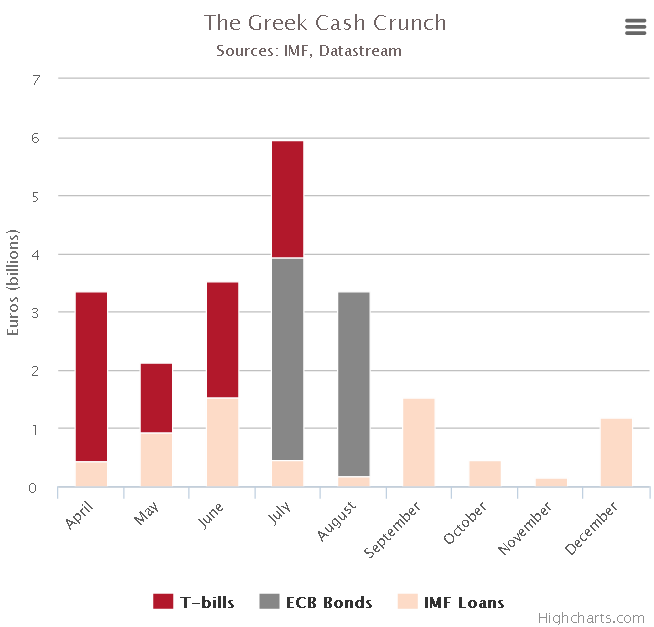
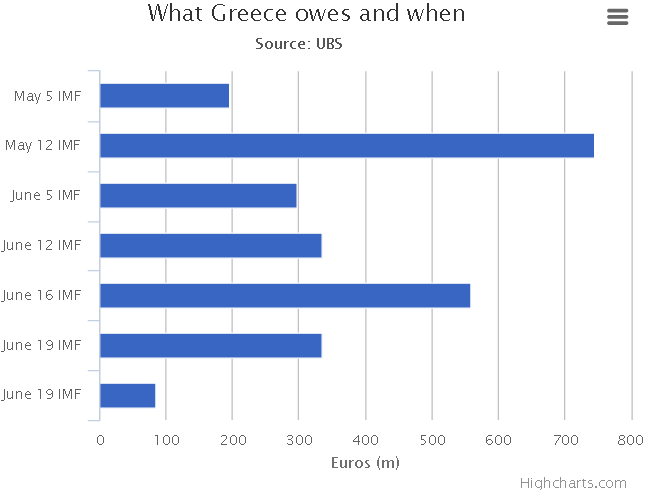
Greece’s mayors warned over the weekend that they would not release any more funds to the central government. The Greek finance ministry must pay the International Monetary Fund €750m (£544m) on Tuesday, the first of an escalating set of deadlines running into August.

“We have enough money to pay the IMF this week but not enough to get through to the end of the month. We all know that,” said one minister, speaking to The Telegraph immediately after the emotional conclave.

If there’s one thing that makes me feel better about all the crap that is happening in this world, it’s the wonderful truth that eventually, bad economics meets with reality. You can imagine anything you want today that makes you feel good, and imagine that it will all be paid for somehow in the future. I really like it when people who don’t have any money make these elaborate future plans and then bet their futures on it. Because when reality comes, we all find out that there is justice in the world after all. There is no path to prosperity that involves doing whatever you want and being happy all the time – that is a myth that children have about life. Anyway, pass me the popcorn and let’s see how the Peter Pan plans of these inexperienced children work out. We won’t have to wait long. Mmm, this popcorn tastes schadenfreudelicious.