
Tag Archives: Debate

Is belief in a Creator / Designer compatible with belief in Darwinian evolution?

Sherlock Holmes and John Watson: let's take a look at the facts
Sherlock Holmes and John Watson: let’s take a look at the facts

What should we make of theistic evolutionists telling us that you can believe in God, while still knowing that matter, law and chance fully explain the development of all of biological life?

Consider this quotation from Phillip E. Johnson.

Quote:

The National Academy’s way of dealing with the religious implications of evolution is akin to the two-platoon system in American football. When the leading figures of evolutionary science feel free to say what they really believe, writers such as Edward O. Wilson, Richard Dawkins, Daniel Dennett, Carl Sagan, Steven Pinker, Stephen Jay Gould, Richard Lewontin and others state the “God is dead” thesis aggressively, invoking the authority of science to silence any theistic protest. That is the offensive platoon, and the National Academy never raises any objection to its promoting this worldview.

At other times, however, the scientific elite has to protect the teaching of the “fact of evolution” from objections by religious conservatives who know what the offensive platoon is saying and who argue that the science educators are insinuating a worldview that goes far beyond the data. When the objectors are too numerous or influential to be ignored, the defensive platoon takes the field. That is when we read those spin-doctored reassurances saying that many scientists are religious (in some sense), that science does not claim to have proved that God does not exist (but merely that he does not affect the natural world), and that science and religion are separate realms which should never be mixed (unless it is the materialists who are doing the mixing). Once the defensive platoon has done its job it leaves the field, and the offensive platoon goes right back to telling the public that science has shown that “God” is permanently out of business.

(Phillip E. Johnson: “The Wedge of Truth”, IVP 2000, pp. 88-89).

So what naturalistic scientists believe is that God didn’t do anything to create the diversity of life – that nature does all of its own creating without God. In fact, it doesn’t matter if the best naturalistic explanation is improbable or implausible – naturalists must bitterly cling to materialistic explanations of natural phenomena. Any doubts about the efficacy of naturalistic mechanisms get met by “theistic evolutionists” – scientists who think that science shows that God didn’t do anything in the history of life.

When it comes to discussing origins, you have to be very careful with theistic evolutionists. The one question they want to avoid is whether science, done in the ordinary naturalistic way, can discover evidence of intelligent agency in the history of the development of life. And that’s why you have to ask them that question first. “Is there any scientific evidence that intelligent causes were active during the history of the development of life on this planet?” Their answer to that is the same as atheists, namely: “there is no scientific evidence that intelligent causes are responsible for the effects we see in the history of life on Earth”. Theistic evolutionists and atheists agree on that: as far as pure scientific evidence is concerned, nature can do its own creating without any intelligence writing genetic code or engineering animal body plans.

Now, take a look at this article by Jay Richards. He cites some theistic evolutionists.

Excerpt:

Biologist Ken Miller:

For his part, [Ken] Miller, a biologist, has no qualms about telling us what God would do: “And in Catholicism, he said, God wouldn’t micromanage that way. ‘Surely he can set things up without having to violate his own laws.'”

I am unaware of any tenet of Catholic theology that requires God not to micromanage. It is, however, a tenet of deism.

Got that? What really happened is that God didn’t do anything. How does he know that? From the science? No. Because he assumes naturalism. Oh, it’s true that he says that God is lurking somewhere behind the material processes that created life. But God’s agency is undetectable by the methods of science. And he is hoping that you will accept his subjective pious God-talk as proof that a fundamentally atheistic reality is somehow reconcilable with a robust conception of theism.

More from Richards:

Then we get Stephen Barr offering his private definition of “chance.”

It is possible to believe simultaneously in a world that is shaped by chance and one following a divine plan. “God is in charge and there’s a lot of accident,” said Barr, also a Catholic. “It’s all part of a plan. . . . God may have known where every molecule was going to move.”

What does Barr really believe? He believes that what science shows is that nature created life without any interference by an intelligent agent. Barr then offers believers his subjective pious God-talk to reassure them that evolution is compatible with religion. He has a personal belief – NOT BASED ON SCIENCE – that the material processes that created all of life are “all part of a plan”. He cannot demonstrate that from science – it’s his faith commitment. And more speculations: “God may have known…”. He can’t demonstrate that God did know anything from science. He is just offering a personal opinion about what God “could have” done. The purpose of these subjective opinions is to appease those who ask questions about what natural mechanisms can really create. Can natural causes really account for the development of functional proteins? Never mind that – look at my shiny spiritual-sounding testimony!

That’s theistic evolution. What really happened is that no intelligent causes are needed to explain life. What they say is “God could” and “God might” and “I pray” and “I attend this church” and “I received a Christian award” and “I sing praise hymns in church”. None of these religious opinions and speculations are relevant to the science – they are just opinions, speculations and biographical trivia. Atheists and theistic evolutionists agree on what science shows about the diversity of life – intelligent causes didn’t do anything.

Front-loading?

One of the ways that theistic evolutionists try to affirm design is by insisting that the design is “front-loaded”. The design for all the information and body plans is somehow embedded in matter.

Here is Stephen C. Meyer to assess that:

It’s very important to understand that there is no scientific evidence for design (information) being front-loaded. So although the theistic evolutionists are talking about design, it’s still in the realm of faith – not detectable to scientific investigation. And as Dr. Meyer explained, it doesn’t work to explain design anyway.

I attended a Wheaton College philosophy conference where Dr. Michael Murray read a paper advocating for this front-loaded view of design. I raised my hand to ask him a question, “hey, philosophy guy, did God front-load the information in that paper you’re reading, or did you write it yourself?” But the philosophy moderators must have known that I was an engineer, and would talk sense into him, because they never called on me. However, I did e-mail him later and asked him if he had any evidence for this front-loading theory, and couldn’t God write sequence information in time the same way he had sequenced information in his essay. He replied and said that front-loading was more emotionally satisfying for him. That’s philosophy, I guess. Thank goodness an engineer wrote his e-mail program so that he could at least come clean about his silly view.

The quickest way to disarm a theistic evolutionist is to ask them for a naturalistic explanation of the origin of life. And for a naturalistic explanation of the Cambrian explosion. And so on. Focus on the science – don’t let them turn the conversation to their personal beliefs, or to the Bible, or to religion. No one cares about the psychology of the theistic evolutionist. We only care what science can show.

Who won the debate last night? Winners and losers from the Fox News debate

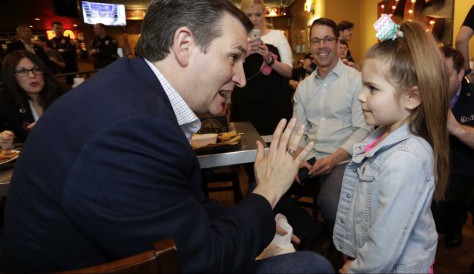
Ted Cruz explains policy to little girl who wants to be President

Ted Cruz explains public policy to little girl who wants to be President

The Weekly Standard, which I think favors Rubio slightly over Ted Cruz, posted this:

What Cruz did at the debate was make three parallel cases:

  1. Trump is a fraud who can’t be trusted to keep his word.
  2. Trump is not either conservative or Republican in any meaningful way.
  3. Trump actually is the corruption that he decries.

He advanced these arguments not one at a time, but by interweaving them with specific attacks:

* He positively crushed Trump on the use of foreign labor at Mar-a-Lago. He didn’t just bring up the fact that hundreds of applicants applied for these jobs but that Trump prefers to hire foreigners instead, but included Trump’s line from the last post-debate interview where he claimed that these were jobs American workers couldn’t and wouldn’t do.

* He thoroughly prosecuted Trump on the question of Trump’s off-the-record New York Times interview, which Trump steadfastly refuses to release.

* At the end of the segment on Trump University—where Trump’s best defense was telling voters that they should “wait a few years” to see whether or not he committed fraud, Cruz flashed in with a rapier: “Megyn, let me ask the voters at home, is this the debate you want playing out in the general election?” It was brutal.

* When Trump went to his poll numbers—as he always does—Cruz was ready. Trump touted a terrible CNN poll showing him at 49 percent support. Cruz waited for Trump to double down and defend the integrity of the poll. And then he noted that this same poll also showed Trump losing to Clinton and Cruz beating her.

* When the Second Amendment came up, Trump made a gauzy statement of general support. Cruz then dropped the hammer:

It is easy for political candidates to have rhetoric and say, “I support the Second Amendment.” But you cannot say that and at the same time say what Donald just said, which is that on the question of Supreme Court nominees he wants to compromise and reach a middle ground with Harry Reid and Chuck Schumer. That’s what he said in the last debate. . . . And I would point out, Harry Reid and Chuck Schumer are both Democrats that Mr. Trump has written checks to repeatedly. Any justice that those two sign off on is going to be a left-wing judicial activist who will undermine religious liberty, and we are one vote away from the Heller decision being overturned, which would effectively erase the Second Amendment from the Bill of Rights. Amendment rights, but when you say you’d compromise with Harry Reid, you put that in jeopardy.

* Cruz’s most devastating line was probably this summation:

I understand the folks who are supporting Donald right now. You’re angry. You’re angry at Washington, and he uses angry rhetoric. But for 40 years, Donald has been part of the corruption in Washington that you’re angry about. And you’re not going to stop the corruption in Washington by supporting someone who has supported liberal Democrats for four decades, from Jimmy Carter to John Kerry to Hillary Clinton. You’re not going to stop the corruption and the cronyism by supporting someone who has used government power for private gain.

The question is what Cruz’s performance gets him. Maybe nothing. The terrain ahead could simply be too tough. But maybe not.

Watch this:

Someone has been teaching Cruz how to speak more concisely. Ted and Marco didn’t attack each other much last night, just like in the last debate. And it worked!

Red State, which is a grassroots conservative web site whose contributors back all different candidates, said:

WINNERS

Senator Ted Cruz: Tonight’s big winner was clearly and indisputably Ted Cruz. Cruz showed the most substance and had the strongest answers. His line about charging Snowden with treason, like his answers on ethanol before the Iowa caucus, showed he’s able to give tough, definitive answers to questions that are controversial even within the party. His touting of his Supreme Court credentials was not only a great case but a timely one.

And when Megyn Kelly eviscerated Trump over his disastrous Trump University failure, it seemed the smoking corpse couldn’t possibly suffer more abuse. But Ted Cruz stepped in and in a few sentences buried that corpse, salted the earth, and wiped the name and location from this history books. Utterly. Destroyed.

But best of all was that Cruz masterfully avoided being in the line of fire, and above the fray in Trump and Rubio’s heated exchanges. Sometimes that doesn’t play well. Sometimes it makes you the winner. This is one of the latter times.

Senator Marco Rubio: Rubio was also a winner tonight. He has proved beyond the shadow of doubt how weak Donald Trump is before attacks on his tremendous, yuge vanity. He crumples. He falls apart. He talks about his ding dong. The extent to which Marco can easily send Trump into a panic by mentioning his hands or tan is just a shadow of how easily the Democrats will handle him. They won’t have to mention policy. Just his hair. Or his stump fingers. He’ll fall apart.

Marco also crushed Trump’s lack of substance on foreign policy, asking him if he would ever offer any policy details in answer to a foreign policy question. Predictably, Trump responded by taking a petty swipe at Rubio. Yet another point for Marco and against Donald.

LOSERS

Donald Trump: Trump is the obvious, clear loser tonight. It wasn’t even close. He was clownish, he changed his mind over the course of the debate, he had his butt handed to him over and over by both Marco and Ted. He was found to be making false statements, his economic policy was proved not only to be a disaster, but it was shown that he himself couldn’t even articulate it, much less a defense of it. He couldn’t even muster a strong response to the Romney question. On the scale of fail he hit a solid ten: total dumpster fire.

Except for one thing. Donald promised to support the nominee of the party no matter who it is. That was a good line for him, even if he doesn’t mean it, and will play well for him.

And Erick Erickson, another grassroots conservative, says at The Resurgent that Cruz was the clear winner of the debate:

Wow. That was one heck of a debate performance by Ted Cruz. That was just amazing. He ran circles around Trump. Trump looked like he was worn out. He was low energy. He was a loser.

In the last debate, Rubio was assisted by Cruz. In this debate, Cruz was assisted by Rubio. It shows what a unity ticket between the two could do.

It was a remarkable performance that had Cruz and Rubio shaking hands during commercial break.

Tonight was Ted Cruz’s night and it was a nearly flawless debate on his part.

PJ Media listed out 5 of Cruz’s best moments in the debate.

Here’s one of them:

5. Detroit…Has Been Utterly Decimated By Failed Left-Wing Policies Although most of Cruz’s standout moments came in opposition to Trump, one of his finest successes centered around discussing the city of Detroit. “Detroit is a great city, with a magnificent legacy, that has been utterly decimated by 60 years of failed left-wing policies,” Cruz declared. He praised Detroit for “funding the arsenals of democracy” in World War II, and added that “in the 1960s, Detroit was the Silicon Valley of America — it had the highest per capita income in the country.” Then the kicker: “And then for 50 years, left-wing Democrats have pursued destructive tax policies, weak crime policies, and have driven the citizens out.” Cruz then detailed how he would bring manufacturing jobs back to the U.S. and Detroit specifically. This strong answer bolstered Cruz in the eyes of Luntz’s focus group, scoring a 96 percent.

Trump tried to get Marco and Ted off his chest by citing GOP primary poll numbers, but Cruz had an answer for that, too. Trump cited a poll from CNN showing him in the lead. Cruz responded by pointing out that the CNN poll also shows Trump losing to Hillary Clinton by 8 POINTS. The same poll shows Cruz beating Hillary Clinton head-to-head. I have never met a Trump supporter who was aware of these head-to-head polls that show Trump losing to Clinton. But the liberal media is well aware of them, and that’s why they are so supportive of Trump – they want the weakest candidate to be the Republican nominee.

One of the differences between Trump and Cruz is that Trump talks about himself and makes promises without providing details. He oversimplifies problems, and has more confidence than experience. Cruz talks about specific policies and the results of those policies in different times and places. He actually knows what works and what doesn’t work, and has a record of solving actual problems.

Richard Bauckham defends the divinity of Jesus against James Crossley

Two horses fight it out, may the best horse win!

Richard is very thorough and works only with minimal facts that skeptical scholars will agree with. James Crossley is an excellent atheist, knowledgeable and respectful.

The debate goes for 80 minutes. I wrote a summary so you can follow along as you listen. This summary is rated “N” for Not Snarky.

Summary

Main topic:
– was belief in Jesus’ divinity develop late, or was it there from the beginning?
– how did the early Jewish community reconcile the idea of Jesus’ divinity with monotheism?

Moderator:
– was the the worship of Jesus as God a late development in history
– was it accepted by converts from the Jewish community

Bauckham:
– high Christology was not a result of pagan influences
– Jews reconciled Jesus’ divinity with their Jewish monotheism

Moderator:
– is the degree of Christology a historian is willing to accept just the result of bias?

Crossley:
– bias is always a factor in what individual people think
– but in a public discussion, what matters is the evidence

Moderator:
– High-Christology is used by Christians as an argument for the resurrection
– Christians ask: what cause could account for the effect of early high Christology?

Crossley:
– we agree that the first Christians witnessed something after Jesus’ death
– what they witnessed had a role in their forming their high opinion of Jesus
– the high opinion was because they believed he had been resurrected (1 Cor 15)
– whether he was or not is a separate question

Moderator:
– is a high Christology a good argument for inferring the resurrection?

Bauckham:
– the resurrection makes people think Jesus is unique, but not necessarily divine
– it was really the belief in the exaltation of Jesus to God’s right hand that did it
– what God does in Judaism is to create the universe and rule over the universe
– if Jesus is seated at God’s right hand, then is participating in ruling creation
– so Jesus is being identified with God very early
– the exaltation might have been caused by post-mortem visions of Jesus, e.g. – Stephen

Moderator:
– how were early monotheistic Jews able to reconcile the divinity of Jesus with monotheism?

Crossley:
– the high Christology may not be early because disputes about it are going on in John
– there were other figures in Judaism like the Word of God and Wisdom that were very high
– maybe Paul’s Christology is not as high and he is thinking something high but not deity
– and in John the Christology is being pushed higher to deity, and then there are disputes

Moderator:
– Phillipians and 1 Corinthians are the first evidences of what people thought about Jesus
– John is actually much later

Crossley:
– it may be that Paul’s Christology is high and that he just never got into any disputes

Bauckham:
– in Phillipians, Paul incorporates Jesus into the shema, the core of Jewish monotheism
– in 1 Corinthians, he does the same thing

Moderator:
– is this evidence consistent with the idea that Jesus is more like Wisdom or the Word of God

Crossley:
– in Paul’s letters, there are no conflicts about Jesus’ divinity, they appear later in John
– if Paul’s letters taught a divine Jesus, there would be conflicts in the letters
– so there is possibly an evolving Christology from very high to divine

Bauckham:
– the Word and Wisdom of God are different from exalted figures – they are separate
– the Word and Wisdom of God are intrinsic to God’s own identity
– and so Word and Wisdom are divine in the sense that they below to God’s identity

Moderator:
– is Jesus an exalted human figure or someone identified with God?
– is the identification of Jesus with divinity compatible with Jewish monotheism?
– or was this concept developed later in a pagan context where one more God would not matter?

Bauckham:
– NT scholars typically separate functional Christology and ontic Christology
– but I say that there is no such disctinction
– if Jesus does the functions of God (like ruling), then it means he is identified with God
– there is a distinction between who God is (identity) and what God is (nature)
– Jews were not as concerned with the identification of a man with the God
– Jews were disturbed by the idea that THIS shamed and crucified man would be identified with God

Moderator:
– is this high Christology too much of a sharp break with Jewish monotheism to have been early?

Crossley:
– the Phillipians passage is a strong early passage for Richard’s view
– definitely the crucifixion is a major problem for the early Jewish monotheists
– but the deification of a human being is also a strong problem in spite of what Richard says
– both Jews and Muslims will have objections to identifying Jesus with the divine

Moderator:
– How can Paul write something like this when he was such a high-ranking Jew?

Bauckham:
– Jewish monotheism could accomodate something surprising like this without surrendering anything
– John starts his gospel at the creation of the universe to say Jesus was there as “the Word”

Moderator:
– was the early church thinking of Jesus the same way that the church today does?

Crossley:
– it’s hard to say because the language today reflects a lot of development
– in the early church people were still thinking about what to make of Jesus

Moderator:
– what about in the other gospels, do they indicate a strong notion of Jesus as divine?

Crossley:
– nothing as strong as Paul’s letters and John, especiall the disputes with the Jews

Moderator:
– so did the writers of the other gospels have different views of Jesus’ divinity than Paul and John?

Crossley:
– well the same claims are not there in the text, the claims are not as grand as in Paul and John

Bauckham:
– but in Mark, the earliest gospel, Jesus forgives sins and calms storm – acting as God acts
– Jesus also asks “why do call me good, only God is good”
– the “seated at the right hand of God” and “coming on the clouds” passages

Crossley:
– I don’t think those claims are as high as John, because Moses controls nature as well
– the other actions may be more that Jesus has authority to do these things

Moderator:
– but the author of Mark writes that the disciples are catching on that Jesus was more than a man

Bauckham:
– Jews were not as concerned with the unitary nature of God, but there is only one God (being)
– there can’t really be any evolution from Jesus as a created being to Jesus as divine
– in paganism, there are lower divinities, but that is not the case in Jewish monotheism

Moderator:
– the fact that Jesus was worshiped by Jews means he was already viewed as divine

Crossley:
– that point is debatable, but can be sustained with a careful exegesis like Richard does
– there is some room there for an evolving Christology – the gap may not be as big as Richard says

Moderator:
– do you think that the worship of Jesus was the result of increasing Christology over time?

Crossley:
– it may not have been conscious, but John is the clearest statement and it is the latest gospel
– it may be that a dispute with Jews was required to spell it out even if it was present before

Moderator:
– what about idea that the early church worshiped him because they just though it was a new revelation?

Bauckham:
– the early Christians worshiped as Jews and then met separately afterward to worship Jesus
– worship is about distinguishing God from the created world
– you wouldn’t worship Jesus without some idea of what you were doing

Crossley:
– other things that set Jesus apart were the exorcisms and the vision to Paul that converted him