Tag Archives: Darwinism

New study: hobbit fossil re-classified as modern human

From Phys.org, a sober revision about a fossil discovery that received a lot of attention when it was announced. (H/T Lindsay)

Excerpt:

In October 2004, excavation of fragmentary skeletal remains from the island of Flores in Indonesia yielded what was called “the most important find in human evolution for 100 years.” Its discoverers dubbed the find Homo floresiensis, a name suggesting a previously unknown species of human.

Now detailed reanalysis by an international team of researchers including Robert B. Eckhardt, professor of developmental genetics and evolution at Penn State, Maciej Henneberg, professor of anatomy and pathology at the University of Adelaide, and Kenneth Hsü, a Chinese geologist and paleoclimatologist, suggests that the single specimen on which the new designation depends, known as LB1, does not represent a new species. Instead, it is the skeleton of a developmentally abnormal human and, according to the researchers, contains important features most consistent with a diagnosis of Down syndrome.

“The skeletal sample from Liang Bua cave contains fragmentary remains of several individuals,” Eckhardt said. “LB1 has the only skull and thigh bones in the entire sample.”

No substantial new bone discoveries have been made in the cave since the finding of LB1.

Initial descriptions of Homo floresiensis focused on LB1’s unusual anatomical characteristics: a cranial volume reported as only 380 milliliters (23.2 cubic inches), suggesting a brain less than one third the size of an average modern human’s and short thigh bones, which were used to reconstruct a creature standing 1.06 meters (about 3.5 feet tall). Although LB1 lived only 15,000 years ago, comparisons were made to earlier hominins, including Homo erectus and Australopithecus. Other traits were characterized as unique and therefore indicative of a new species.

A thorough reexamination of the available evidence in the context of clinical studies, the researchers said, suggests a different explanation.

The researchers report their findings in two papers published today (Aug. 4) in the Proceedings of the National Academy of Sciences.

So, it used to be a hobbit, but further study shows it’s a modern human.

Let’s take a look at what the atheist naturalist Darwinists on talkorgins.org think it is.

They write:

Modern humans arrived on Flores between 55,000 and 35,000 years ago, and presumably interacted with floresiensis, though there is no evidence of this at Liang Bua. However Indonesian folklore tells of creatures called Ebu Gogo which were small, inarticulate, and walked with an odd gait. This sounds remarkably suggestive of floresiensis, but it could easily be coincidence – if floresiensis had been found in Ireland, we’d possibly be wondering if they were leprechauns.

[…]Some creationists are predicting that [further studies] will show floresiensis to be modern humans, but if, as Brown et al. believe, they descended from Homo erectus, the mtDNA of floresiensis should be even more different from modern humans than the Neandertals were.

Talk Origins Dot Org. Folklore. Leprechauns. Star Trek.

UPDATE: Evolution News has more, and it’s even worse than I implied here.
Stephen C. Meyer discusses his book “Darwin’s Doubt” on the Michael Medved show

The new paperback edition of Darwin’s Doubt is now out (June 2014), and has a new epilogue responding to criticisms of the hardcover first edition. If you don’t have the book, now’s the time to grab it.

Here is a radio interview that Dr. Meyer did about the book, courtesy of the Intelligent Design: The Future podcast.

The MP3 file is available for download. (38 minutes)

The description is:

On this episode of ID the Future, the Michael Medved Show welcomes Dr. Stephen Meyer to talk about his new bestselling book, Darwin’s Doubt: The Explosive Origin of Animal Life and the Case for Intelligent Design. Listen in as Meyer and Medved discuss the mysteries of the Cambrian explosion and why this phenomenon continues to stump Darwinian evolutionists.

Each week, leading fellows from Discovery Institute will join Michael Medved to talk about the intersection of science and culture. Listen in live online or on your local Medved station, or stay tuned at ID the Future for the weekly podcast.

Topics:

  • Darwinism offers a materialistic account of where humans and animals came from, but is that all human beings are?
  • Darwin was the first to have doubt about his theory of evolution because of the sudden origin if many different animal forms in the Cambrian era
  • The book is about the sudden origin of these animal forms and more generally about how much information is needed to make an animal genome
  • An animal is not just the form or the organs it is also the information to make new proteins and the instructions to make proteins are in the DNA
  • At least 20 new phyla appear suddenly in the Cambrian fossils and the question is what is capable of creating all of that new information
  • Mathematicians and computer scientists are especially likely to doubt evolution as a way of making new features because they know that random changes to the code base of an application are more likely to break things and degrade performance
  • Naturalists have tried to explain the Cambrian explosion as being a case of the transitional fossils being not yet discovered
  • The consensus of science at this time is that there is no known naturalistic explanation for the sudden origin of these animal types
  • Caller: how abrupt are we talking about for the introduction of these new animal forms?
  • Meyer: We can calculate the amount of time that is needed to generate change, and the period of time that is needed to generate new forms of life exceeds the time available
  • Caller: is it possible that meteors, asteroids and comets could transport biological components to the Earth to shorten the development time?
  • Meyer: that’s related to my first book on the origin of the first living cell “Signature in the Cell”, and that life-from-space hypothesis would only get you building blocks, but not the bio-molecules that have the building blocks sequences – it’s the difference between a pile of Scrabble letters and a Shakespearean play – it’s the arranging of the components that is the problem
  • Medved: The book has a lot of endorsements from scientists who are working at good universities and institutions
  • Meyer: the strange thing about exploring the limits of evolution is that you can cite mainstream papers to criticize the Darwinian mechanisms, and then the proponents of Darwinism just assert that no criticism of Darwinian evolution is allowed
  • Caller Greg: are you saying that all the phyla came in during the Cambrian explosion?
  • Meyer: No, of the 26 phyla that we see in the fossil record, 20 come in during the Cambrian explosion
  • Caller Greg: But there are some sponges that existed before the Cambrian explosion, so maybe all the Cambrian phyla came from sponges?
  • Meyer: There are 3 phyla present in the pre-Cambrian but they are not ancestral to the 20 Cambrian phyla, the sponges are very simple – 6-10 cell types, arthropods have 60-90 cell types – you can’t go from sponges to compound eyes in just 5-10 million years
  • Meyer: even the sponges in the pre-Cambrian appear abrutly at the end of the pre-Cambrian
  • Caller Greg: but there are complex worms in the Pre-Cambrian as well, and maybe those are ancestral to the 20 new phyla that appear suddenly in the Cambrian explosion
  • Caller Greg: what you’re saying is that we scientists don’t understand what happened so an intelligence did it
  • Meyer: No, what I am saying is that the Cambrian explosion involves massive amounts of new biological information, and none of the naturalistic Darwinian mechanisms can create that much new information in that short of the time
  • Caller Greg: it’s magic!
  • Meyer: there are two points in the development of life forms where intelligence is needed: the origin of life and the Cambrian explosion, and this is because of the new information that is being added
  • Caller Greg: new information is added by Hox Gene duplication
  • Caller: don’t we have to look a bit more at epistemology when discussing these issues?
  • Meyer: Yes, we have to highlight that many people reject intelligent design because of a pre-supposition of naturalism that prevents them from seeing that intelligence explains anything regardless of the evidence
  • Caller: well if you define evolution as change over time, then evolution happened, and who cares about the details like the origin of life and Cambrian explosion?
  • Meyer: well there are many definitions of evolution: 1) change over time, 2) universal common ancestry, 3) undirected random process can explain the origin of life and the explosion of new animal forms in the fossil record
  • Meyer: I accept 1) and I am skeptical of 2) and 3)

You can read more about caller Greg and Hox gene duplication at Evolution News.

The best explanation for the design of bird wings is intelligent design

A great post from Evolution News about my favorite animals in the whole world – BIRDS!

Excerpt:

How hard can it be to make a flexible wing flap for an airplane? Almost all aircraft today use rigid wings with rigid landing flaps. They work, but they waste fuel. German engineers embarked on a mission to reduce kerosene consumption by 6%: “integrating flexible landing devices into aircraft wings is one step towards that target,” a news item from Fraunhofer says. They’ve named the project SARISTU, for Smart Intelligent Aircraft Structures.

Birds are way ahead of them:

While birds are able to position their feathers to suit the airflow, aircraft wing components have so far only been rigid. As the name suggests, landing flaps at the trailing edge of the wing are extended for landing. This flap, too, is rigid, its movement being limited to rotation around an axis. This is set to change in the SARISTU project. “Landing flaps should one day be able to adjust to the air flow and so enhance the aerodynamics of the aircraft,” explains Martin Schüller, researcher at the Fraunhofer Institute for Electronic Nano Systems ENAS in Chemnitz. (Emphasis added.)

What are some of the challenges in building a flexible wing?

  1. Knowing where to flex: The flap can’t be flexible all over, or it would be hard to control. The designers made “five hard and three soft zones, enclosed within a silicon skin cover extending over the top.”
  2. Finding stretchy skin: When the soft zone moves, the skin of the aircraft has to stretch with it. “The mechanism that allows the landing flap to change shape can only function if the skin of the landing flap can be stretched as it moves, a problem tackled by researchers from the Fraunhofer Institute for Manufacturing Technology and Advanced MaterialsIFAM in Bremen.”
  3. Covering the air gap: “Any gap between the flap and the fixed aircraft wingwould cancel out any positive effect,” the article notes. “This led us to develop an elastic connecting element, and this work already covers everything from the chemical makeup to the process technology andmanufacture of the component,” an engineer says.
  4. Designing the material to tolerances: “The mechanism sits underneath the soft zones, the areas that are most distended. While the novel design is noteworthy, it is the material itself that stands out, since the flexible parts are made of elastomeric foam that retain their elasticity even attemperatures ranging from minus 55 to 80 degrees Celsius.”

No feathers, but it’s a start. The team showed off their prototype at the ILA Berlin Air Show in May. Apparently it was not quite ready for takeoff:

When the prototype takes off for the first time it will benefit from a development known as SARISTU, a deformable wing which is currently the subject of intensive research by Fraunhofer Gesellschaft. In future the landing flaps will be designed to adapt in flight to the air flow conditions, thereby always ensuring the best possible aerodynamics.

We celebrate this advance, but you know where we’re going. Birds had it all figured out long ago: the right shape, the right material, the control of airflow, and much more. As Dr. Timothy Standish says in the film Flight: The Genius of Birds, “Feathers do a number of jobs remarkably well.” They are individually controllable, they flex, they insulate, they save on weight, and they can handle the temperature requirements of avian flight. That’s just a partial list achievements in powered flight that surpass anything man has yet designed.

If you want to get hold of that DVD on “Flight” that they mentioned, it’s right here on Amazon.com. I highly recommend it.

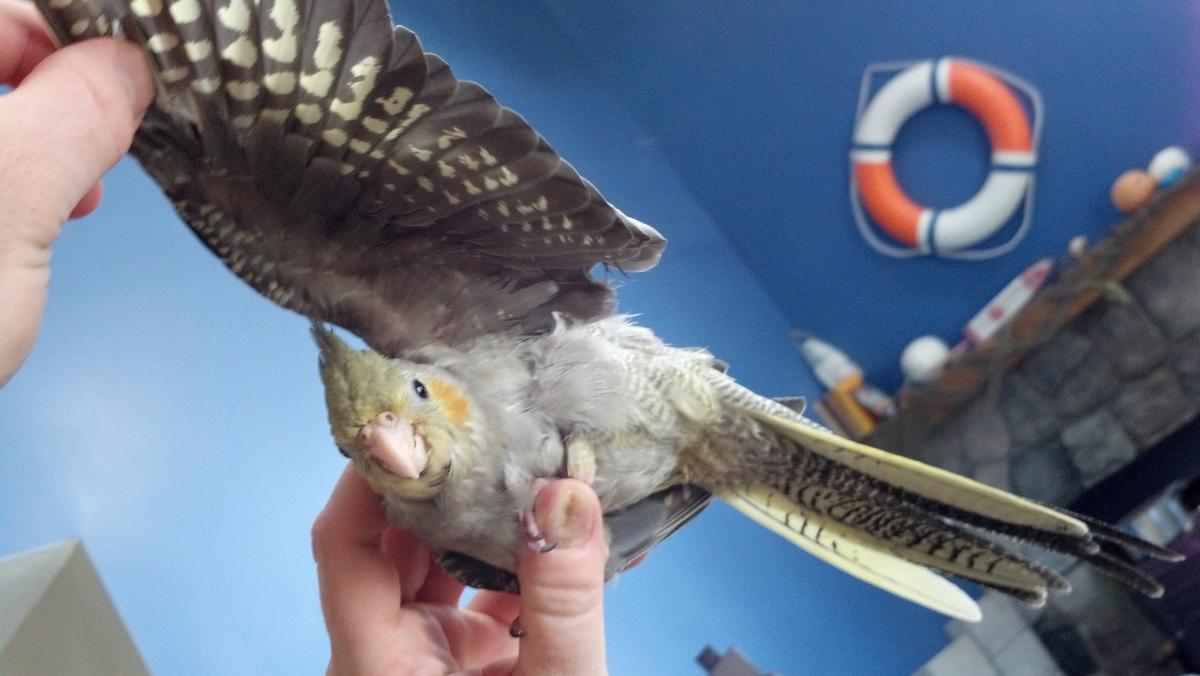
I also highly recommend owning birds – because if you work really hard at caring for one for a long time, they might grow to trust you. There is nothing quite like a tiny little bird trusting you enough to let you gently pull open his or her wing for a closer look at how it works:

Cockatiel lets a trusted friend see her wing
Awww! Cockatiel lets a trusted friend see under her wing

There’s more to birds than just well-designed wings. There’s a well-designed heart in there, too! That might even be more amazing than the design of the wing. It is to me.

Note: although this post does not provide a rigorous case for intelligent design, that can be found by looking at the work of Stephen C. Meyer on the origin of life and on the Cambrian explosion. The books that demonstrate the superiority of the intelligent design hypothesis are “Signature in the Cell” and “Darwin’s Doubt“. If you’d like to see a good popular-level presentation of intelligent design related to the origin of life, click here for a lecture.