
Tag Archives: Cosmology

How the discovery of the cosmic microwave background radiation falsified atheism

Prior to certain scientific discoveries, most people thought that the universe had always been here, and no need to ask who or what may have caused it. But today, that’s all changed. Today, the standard model of the origin of the universe is that all the matter and energy in the universe came into being in an event scientists call “The Big Bang”. At the creation event, space and time themselves began to exist, and there is no material reality that preceded them.

So a couple of quotes to show that.

An initial cosmological singularity… forms a past temporal extremity to the universe. We cannot continue physical reasoning, or even the concept of spacetime, through such an extremity… On this view the big bang represents the creation event; the creation not only of all the matter and energy in the universe, but also of spacetime itself.

Source: P. C. W. Davies, “Spacetime Singularities in Cosmology,” in The Study of Time III, ed. J. T. Fraser (Berlin: Springer Verlag ).

And another quote:

[A]lmost everyone now believes that the universe, and time itself, had a beginning at the big bang.

Source: Stephen Hawking and Roger Penrose, The Nature of Space and Time, The Isaac Newton Institute Series of Lectures (Princeton, N. J.: Princeton University Press, 1996), p. 20.

So, there are several scientific discoveries that led scientists to accept the creation event, and one of the most interesting and famous is the discovery of the cosmic microwave background radiation.

Here’s the history of how that discovery happened, from the American Physical Society web site:

Bell Labs radio astronomers Arno Penzias and Robert Wilson were using a large horn antenna in 1964 and 1965 to map signals from the Milky Way, when they serendipitously discovered the CMB. As written in the citation, “This unexpected discovery, offering strong evidence that the universe began with the Big Bang, ushered in experimental cosmology.” Penzias and Wilson shared the Nobel Prize in Physics in 1978 in honor of their findings.

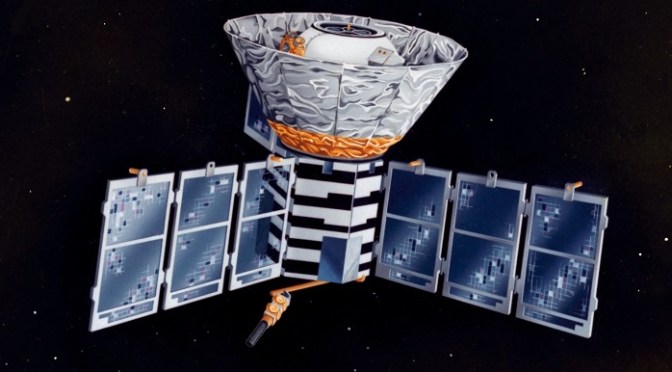
The CMB is “noise” leftover from the creation of the Universe. The microwave radiation is only 3 degrees above Absolute Zero or -270 degrees C,1 and is uniformly perceptible from all directions. Its presence demonstrates that that our universe began in an extremely hot and violent explosion, called the Big Bang, 13.7 billion years ago.

In 1960, Bell Labs built a 20-foot horn-shaped antenna in Holmdel, NJ to be used with an early satellite system called Echo. The intention was to collect and amplify radio signals to send them across long distances, but within a few years, another satellite was launched and Echo became obsolete.2

With the antenna no longer tied to commercial applications, it was now free for research. Penzias and Wilson jumped at the chance to use it to analyze radio signals from the spaces between galaxies.3 But when they began to employ it, they encountered a persistent “noise” of microwaves that came from every direction. If they were to conduct experiments with the antenna, they would have to find a way to remove the static.

Penzias and Wilson tested everything they could think of to rule out the source of the radiation racket. They knew it wasn’t radiation from the Milky Way or extraterrestrial radio sources. They pointed the antenna towards New York City to rule out “urban interference”, and did analysis to dismiss possible military testing from their list.4

Then they found droppings of pigeons nesting in the antenna. They cleaned out the mess and tried removing the birds and discouraging them from roosting, but they kept flying back. “To get rid of them, we finally found the most humane thing was to get a shot gun…and at very close range [we] just killed them instantly. It’s not something I’m happy about, but that seemed like the only way out of our dilemma,” said Penzias.5 “And so the pigeons left with a smaller bang, but the noise remained, coming from every direction.”6

At the same time, the two astronomers learned that Princeton University physicist Robert Dicke had predicted that if the Big Bang had occurred, there would be low level radiation found throughout the universe. Dicke was about to design an experiment to test this hypothesis when he was contacted by Penzias. Upon hearing of Penzias’ and Wilson’s discovery, Dicke turned to his laboratory colleagues and said “well boys, we’ve been scooped.”7

Although both groups published their results in Astrophysical Journal Letters, only Penzias and Wilson received the Nobel Prize for the discovery of the CMB.

The horn antenna was designated a National Historic Landmark in 1990. Its significance in fostering a new appreciation for the field of cosmology and a better understanding of our origins can be summed up by the following: “Scientists have labeled the discovery [of the CMB] the greatest scientific discovery of the 20th century.”8

It’s the greatest scientific discovery of the 20th century.

In the New York Times, Arno Penzias commented on his discovery – the greatest discovery of the 20th century – so:

The best data we have [concerning the Big Bang] are exactly what I would have predicted, had I nothing to go on but the five books of Moses, the Psalms, the bible as a whole.

Just one problem with the greatest scientific discovery of the 20th century: atheists don’t accept it. Why not?

Here’s a statement from the Secular Humanist Manifesto, which explains what atheists believe about the universe:

Religious humanists regard the universe as self-existing and not created.

For a couple of examples of how atheistic scientists respond to the evidence for a cosmic beginning, you can check out this post, where we get responses from cosmologist Lawrence Krauss, and physical chemist Peter Atkins.

You cannot have the creation of the universe be true AND a self-existing, eternal universe ALSO be true. Someone has to be wrong. Either the science is wrong, or the atheist manifesto is wrong. I know where I stand.

Positive arguments for Christian theism

Is the Big Bang cosmology a theistic or atheistic theory of cosmic origins?

Dr. Michael Strauss is a practicing particle physics employed as a professor at University of Oklahoma. He does research in particle physics at CERN, a large hadron collider. It’s safe to assume that he knows something about experimental physics.

Here’s what he writes about Christians and the Big Bang at his new blog:

When my children were young, I would often drive to the home of the person babysitting my kids, usually a young teenage girl, pick her up, then drive her back to my house.  In the car I would ask questions about her interests or her school.  In addition, I would sometimes ask a question that intrigued me since I am a scientist and a Christian, “Do you think the Big Bang is a theistic theory or an atheistic theory?”  Now that question is not on most people’s list of babysitter interview questions, but I was interested to know their answer even though it would not affect their monetary tip. Every time I asked this question I always got the same answer, that the Big Bang is an atheistic theory.  This is just one example of the fact that many kids growing up in an evangelical church environment have the perception that the Big Bang is an idea which removes God as the creator.  It seems that many Christians may disdain the Big Bang.

Subsequent conversations with people of all ages have shown me that many individuals (1) don’t really understand what the Big Bang is, (2) don’t know the scientific evidence for the Big Bang, and (3) don’t comprehend the theistic significance of the Big Bang.   So let’s explore these ideas a little bit.

Here is his overview of the scientific evidence for the Big Bang:

There are three primary observations that are best explained by the Big Bang.  First, the universe is expanding so that it must have had a beginning of expansion in the past.  Second, because the universe was once very hot, we can still see the remnants of that heat in the Cosmic Microwave Background (CMB) radiation.  The latest measurements of the CMB spectrum made by the Planck satellite (shown above) agrees almost perfectly with theoretical calculations using the standard Big Bang cosmological model (see the plot at the end of this post).  Third, the theory predicts the amount of primordial light elements that should have been created in the first few minutes of the Big Bang, like hydrogen and helium.  Again the observations and the theoretical calculations align almost exactly.   A few other observations are supported by Big Bang predictions, like the distribution of galaxies and primordial gas.  The agreement between what we measure and what is expected from a Big Bang is so remarkable that just about all scientists accept the Big Bang as the origin of our universe, despite its implication that the universe had a beginning.

Does this scientific evidence support theism, or atheism?

Because we don’t have any observations that tell us exactly what happened “in the beginning” of our universe, we can only speculate.  But let me point out the obvious.  All of the observations we do have, and all the theoretical calculations, and even some projective calculations like the Borde-Guth-Vilenkin theorem… give credence to the conclusion that all of the space, time, matter, and energy of this universe had a beginning.  The Big Bang is a misnomer for it is not some kind of explosion since there was nothing that existed to explode.  It is the origin of the universe.  So if this universe had a beginning, then the cause of the universe can not be a part of the universe.  The cause must be transcendent, like the Christian idea of God.  Is the fact that all the evidence points to our universe having a transcendent cause proof for God?  No, but it is extremely powerful evidence.  If one hundred years ago you had predicted that scientists would obtain unambiguous evidence about the history of the universe for 13.8 billion years, all of its lifetime except the first fraction of a second, and that all of the evidence would point to an actual beginning consistent with a transcendent cause, I don’t think anyone would have taken you seriously.  But that is exactly what has happened.  Theists could not have outlined a better scenario to support theism.  The scientific facts are completely consistent with the statement, “In the beginning God created the heavens and the earth.”

I know how I account for this scientific discovery in my worldview: a non-physical mind that existed eternally created the physical universe at time t=0. But how do atheists, who can only explain the world by appealing to matter, explain the origin of matter itself?

Here’s Oxford University professor of physical chemistry (and atheist) Peter Atkins explaining how he grounds the Big Bang cosmology:

Easy! Nothing actually exists, according to Peter Atkins.

What about a theoretical physicist, like Lawrence Krauss? Well, he just redefines the nothing that causally preceded the origin of the universe so that it is actually something. Pure speculation, and it goes against the experimental scientific evidence we have. Exactly what you’d expect from a man who wrote a book about “the physics of Star Trek”.

Each of us has to come to terms with this scientific evidence. What could have caused the beginning of the universe? It can’t be matter, because this was the beginning of all the matter in the universe. It has to be a mind.

Although most theists have no problem with this scientific evidence, atheists really hate it. When I tell them about this evidence, they tell me that in a few years or decades, all the evidence for a beginning we have now will have gone away. “How do you know that?” I ask. We have faith” they reply. I don’t think anyone should deny the objective reality we all share just because it’s what they want to believe.

Alexander Vilenkin: “All the evidence we have says that the universe had a beginning”

I’ve decided to explain why physicists believe that there was a creation event in this post. That is to say, I’ve decided to let famous cosmologist Alexander Vilenkin do it.

From Uncommon Descent.

Excerpt:

Did the cosmos have a beginning? The Big Bang theory seems to suggest it did, but in recent decades, cosmologists have concocted elaborate theories – for example, an eternally inflating universe or a cyclic universe – which claim to avoid the need for a beginning of the cosmos. Now it appears that the universe really had a beginning after all, even if it wasn’t necessarily the Big Bang.

At a meeting of scientists – titled “State of the Universe” – convened last week at Cambridge University to honor Stephen Hawking’s 70th birthday, cosmologist Alexander Vilenkin of Tufts University in Boston presented evidence that the universe is not eternal after all, leaving scientists at a loss to explain how the cosmos got started without a supernatural creator. The meeting was reported in New Scientist magazine (Why physicists can’t avoid a creation event, 11 January 2012).

[…]In his presentation, Professor Vilenkin discussed three theories which claim to avoid the need for a beginning of the cosmos.

The three theories are chaotic inflationary model, the oscillating model and quantum gravity model. Regular readers will know that those have all been addressed in William Lane Craig’s peer-reviewed paper that evaluates alternatives to the standard Big Bang cosmology.

But let’s see what Vilenkin said.

More:

One popular theory is eternal inflation. Most readers will be familiar with the theory of inflation, which says that the universe increased in volume by a factor of at least 10^78 in its very early stages (from 10^−36 seconds after the Big Bang to sometime between 10^−33 and 10^−32 seconds), before settling into the slower rate of expansion that we see today. The theory of eternal inflation goes further, and holds that the universe is constantly giving birth to smaller “bubble” universes within an ever-expanding multiverse. Each bubble universe undergoes its own initial period of inflation. In some versions of the theory, the bubbles go both backwards and forwards in time, allowing the possibility of an infinite past. Trouble is, the value of one particular cosmic parameter rules out that possibility:

But in 2003, a team including Vilenkin and Guth considered what eternal inflation would mean for the Hubble constant, which describes mathematically the expansion of the universe. They found that the equations didn’t work (Physical Review Letters, DOI: 10.1103/physrevlett.90.151301). “You can’t construct a space-time with this property,” says Vilenkin. It turns out that the constant has a lower limit that prevents inflation in both time directions. “It can’t possibly be eternal in the past,” says Vilenkin. “There must be some kind of boundary.”

A second option explored by Vilenkin was that of a cyclic universe, where the universe goes through an infinite series of big bangs and crunches, with no specific beginning. It was even claimed that a cyclic universe could explain the low observed value of the cosmological constant. But as Vilenkin found, there’s a problem if you look at the disorder in the universe:

Disorder increases with time. So following each cycle, the universe must get more and more disordered. But if there has already been an infinite number of cycles, the universe we inhabit now should be in a state of maximum disorder. Such a universe would be uniformly lukewarm and featureless, and definitely lacking such complicated beings as stars, planets and physicists – nothing like the one we see around us.

One way around that is to propose that the universe just gets bigger with every cycle. Then the amount of disorder per volume doesn’t increase, so needn’t reach the maximum. But Vilenkin found that this scenario falls prey to the same mathematical argument as eternal inflation: if your universe keeps getting bigger, it must have started somewhere.

However, Vilenkin’s options were not exhausted yet. There was another possibility: that the universe had sprung from an eternal cosmic egg:

Vilenkin’s final strike is an attack on a third, lesser-known proposal that the cosmos existed eternally in a static state called the cosmic egg. This finally “cracked” to create the big bang, leading to the expanding universe we see today. Late last year Vilenkin and graduate student Audrey Mithani showed that the egg could not have existed forever after all, as quantum instabilities would force it to collapse after a finite amount of time (arxiv.org/abs/1110.4096). If it cracked instead, leading to the big bang, then this must have happened before it collapsed – and therefore also after a finite amount of time.

“This is also not a good candidate for a beginningless universe,” Vilenkin concludes.

So at the end of the day, what is Vilenkin’s verdict?

“All the evidence we have says that the universe had a beginning.”

This is consistent with the Borde-Guth-Vilenkin Theorem, which I blogged about before, and which William Lane Craig leveraged to his advantage in his debate with Peter Millican.

The Borde-Guth-Vilenkin (BGV) proof shows that every universe that expands must have a space-time boundary in the past. That means that no expanding universe, no matter what the model, can be eternal into the past. No one denies the expansion of space in our universe, and so we are left with a cosmic beginning. Even speculative alternative cosmologies do not escape the need for a beginning.

Conclusion

If the universe came into being out of nothing, which seems to be the case from science, then the universe has a cause. Things do not pop into being, uncaused, out of nothing. The cause of the universe must be transcendent and supernatural. It must be uncaused, because there cannot be an infinite regress of causes. It must be eternal, because it created time. It must be non-physical, because it created space. There are only two possibilities for such a cause. It could be an abstract object or an agent. Abstract objects cannot cause effects. Therefore, the cause is an agent.

Now, let’s have a discussion about this science in our churches, and see if we can’t train Christians to engage with non-Christians about the evidence so that everyone accepts what science tells us about the origin of the universe.