Tag Archives: Communism

Wayne Grudem debates Richard Glover on the Bible, poverty and foreign aid

Two horses fight it out, may the best horse win!

A great episode of the Unbelievable podcast. This is a great debate. I really enjoyed it. All three speakers were excellent putting forward their points. It’s nice to hear an American voice, a British voice and an Australian voice debating an important issue. HIGHLY RECOMMENDED.

Details:

Wayne Grudem is a theologian known for his conservative approach to both doctrine and economics. His new book “The Poverty of Nations: A Sustainable Solution” (co-authored with economist Barry Asmus) makes the case that pouring aid into developing countries is a failed strategy. Grudem debates whether the Bible supports free market, capitalist economics with Australian economist and theologian Richard Glover who wrote a critique of the book for the Australian Bible Society.

 The MP3 file is here.

Summary:

Grudem:

  • The Bible speaks to all of life, including economics, stewardship, government
  • The study of economics helps us to understand how to take care of the poor
  • My job is to apply the teachings of the Bible to all of life

Brierley:

  • What’s your thesis in the book?

Grudem:

  • A good system is one where the poor have the opportunity to earn and save from their labor
  • Book is a response to a Kenyan couple Grudem met at a London conference on business and Christianity
  • Book is not concerned with how individuals and groups can do charity to help the poor
  • Our church already does that and we support individuals and groups doing charity
  • The book is concerned with how should nations be transformed in order to grow economically
  • What should the laws, policies and cultural beliefs of a nation be in order for it to not be poor?
  • The book lists factors that have moved nations from poverty to prosperity in different times and places
  • The thesis of the book is this: government should set their people free to be able to produce more
  • We advocate freedom in economics: freedom to work, freedom to save, freedom to start businesses
  • We believe that this free enterprise view is consistent with the Bible in a number of places
  • E.g. – private property is good for prosperity (thou shall not steal) but forbidden by communism

Brierley:

  • What about the church sharing in communities in Acts 2 and Acts 4?

Grudem:

  • That is not redistribution of wealth among individuals and businesses by a secular government
  • Those passages showed that there was voluntary sharing among Christians, which is not communism

Brierley:

  • What’s wrong with Grudem’s book?

Glover:

  • The book emphasizes the Bible and the goal is to help the poor in poor countries
  • Criticism 1: the book doesn’t engage with non-free-market perspectives on economics
  • Criticism 2: the book doesn’t survey all that the Bible says about economics

Brierly:

  • For 1) what is one of the views that is not considered?

Glover:

  • Jeffrey Sachs says that nations need a leg up before they can grow economically
  • Ha-Joon Chang says that free enterprise was not how the wealthy nations became wealthy

Grudem:

  • We do engage with other points of view, especially Jeffrey Sachs in the book
  • The trouble with leftist views on economic development is that it does not work in practice
  • NO COUNTRY has even been lifted out of poverty by foreign aid
  • He says we don’t cite enough from the wisdom literature: we have 64 citations in the index
  • He says we don’t cite enough from the gospels: we have 42 citations in the index
  • He says we don’t cite enough from the epistles: we cite 22 of 27 epistles in the index
  • Some economists won’t criticize cultural and moral values that hurt prosperity
  • As Christians, we think that moral and cultural values are part of the problem that needs solving

Brierley:

  • What about foreign aid?

Grudem:

  • Foreign aid doesn’t help: a lot of the money goes into government and rulers can be corrupt
  • Instead of encouraging people to start businesses, it tells people to go into government to get aid money
  • Economists (lists 3) are saying that foreign aid entrenches corrupt government in power, does no good

Brierley:

  • If it’s not working, should we keep doing it?

Glover:

  • When there is an immediate need, we should do it, even if it is not a long-term solution: we need both

Brierley:

  • Should we stop foreign aid completely?

Grudem:

  • Voluntary charitable giving from individuals and churches to help poor countries is good
  • Me and my co-author are both active on our church board that helps poor countries with urgent needs
  • Food and doctors are urgent needs, and we should help, but it doesn’t lift countries out of poverty
  • We need a long-term solution that helps poor countries produce their own food and doctors
  • We are criticizing 1) government to government aid and 2) IMF/World bank to government aid
  • We have had pushback because 500,000 people make a living from this foreign aid industry
  • No country has ever been lifted out of poverty into sustainable prosperity
  • That’s the definition of insanity: continuing to do the same thing that has never worked

Brierley:

  • Does the Bible support free enterprise as a way of creating sustainable prosperity?

Glover:

  • When I said the Bible was absent from his book, absent was a bad choice of words
  • But the hundreds of references he listed were not dealth with *in depth*
  • In the Scriptures, God is the one who provides (e.g. – in Ephesians, Sermon on the Mount)
  • The Bible is less focused on his people making money, and more focus on sharing basics, like food
  • Secular governments should just take it from people who have food and give it to hungry people
  • In 2 Cor 8-9, Paul talks about voluntary sharing so everyone will be equal

Brierley:

  • Does 2 Cor 8-9 undermine the free enterprise system you champion in the book?

Grudem:

  • The sharing in the Bible solves cases of urgent need, it does not lift countries from poverty to sustainable prosperity
  • Some older translations say “equality” in 2 Cor 8:13-14, but newer translations (e.g. – ESV) say “fairness”
  • The Greek word is translated as “fairly” the only other place it appears in the NT (Col 4:1), in every translation
  • God uses the means of human work and productivity to provide (daily bread is baked, doesn’t just fall from Heaven)
  • In general, there’s no provision in Scripture for a person to be dependent on donations for their entire lives
  • God promises Israel fields and mountains to tend and mine, but prosperity is from work, not depending on others

Brierley:

  • Does the Bible support this focus on work?

Grudem:

  • Working is highly praised in Scripture, (lists Bible passages that favor work over dependency)
  • Countries that were exposed to this notion of work and productivity have been more prosperous

Glover:

  • Jeffrey Sachs and other development economists don’t say you can be prosperous through dependence
  • They say that it is a necessary part of leading to nations out of poverty into poverty

Grudem:

  • It’s never worked. What nation has become prosperous through foreign aid?

Glover:

  • There are lots of nations, especially in Africa, where foreign aid has helped lift them out of poverty

Grudem:

  • Name one country in Africa where foreign aud has lifted them out of poverty into sustainable prosperity

Glover:

  • I can’t think of one right now.

Grudem:

  • Our book contains a map of Africa and we looked at every nation’s per capita income
  • No nation has been able to rise out of poverty through dependence on foreign aid
  • The only close one is Botswana, but they have abundant freedoms, Christian morals, less corrupt government
  • So Botswana is the best case and they became prosperous through becoming productive, not foreign aid

Brierley:

  • Is he right to say that charity is a short-term solution, but that it’s not good long-term for prosperity?

Glover:

  • Yes, and work is a very important focus in the Scriptures as he says.
  • But since the Fall work has been much harder, and may not have the outcomes that we would like

Grudem:

  • I also believe in emergency aid for when catastrophies happen, like floods and famines
  • But dependence on foreign aid enriches corrupt rulers and does not create the productivity that leads to sustained prosperity

Brierley:

  • Can foreign aid be used to give poor nations a leg up on becoming prosperous?

Grudem:

  • Dambisa Moyo, Oxford-educated economist from Zambia, says stop the aid, it’s doing more harm than good
  • Jeffrey Sachs’ view is that foreign aid hasn’t worked yet, but just keep trying a bit more
  • What works: limited government, rule of law, fair courts, documented property rights, low taxes, stable currency
  • People are creative and want to work, we just have to get government out of the way and let people work, earn and save

Brierley:

  • Is this free enterprise system supported by the Bible?

Glover:

  • The wealthy nations of the world did not become wealthy through productive work and free enterprise policies
  • Ha-Joon Chang: free enterprise policies have never brought a country from poverty to wealth
  • E.g. – wealth is created through tariffs (not by innovating and by economic freedom?)

Grudem:

  • I’ve read Ha-Joon Chang’s book, and his examples are very selective and limited
  • Index of Economic Freedom: the freest countries are the most prosperous, the least free countries are the most poor
  • When you look at macro data, instead of very selective examples, the free enterprise system is best for prosperity

Glover:

  • The book doesn’t do enough to engage with leftist economists (he doesn’t say which ones)
  • Just because nations who are free are rich, doesn’t mean freedom causes productivity
  • There are parts of the Bible that doesn’t support the free enterprise system (he names none)

Grudem:

  • The Bible is focused on work not dependency, and charity not government redistribution
  • The best way to help the poor in other countries is by encouraging work and productivity

Podcast: Was Jesus a socialist? Does Christianity teach socialism?

Let's take a deep dive into the Bible
Let’s take a deep dive into the Bible

I noticed that Christianity Today, which has turned hard left in recent years, is now openly endorsing socialism. So, I thought it might be a good idea to listen to this new episode of the Think Biblically podcast, which deals with the issue of Christianity and socialism. The hosts actually brought an economist on to define socialism, then they analyze the teachings of Jesus.

Here’s the description: (H/T Nathan)

It has not been uncommon for advocates of virtually every economic system to invoke Jesus in support of their views, though some of the most ardent advocates for both capitalism and socialism did not have any particular religious views themselves (Rand, Marx). Over the years, some of the more recent advocates of socialist type economic arrangements have appealed to Jesus and the gospels in support of such systems. Economist Lawrence Reed helps us sort out the application of the teaching of Jesus to economics and its relevance for economic life today. Join us for this provocative conversation as he tackles the question of Jesus and socialism.

Show notes, including a full transcript, are available at: biola.edu/thinkbiblically

Topics:

  • who plans the economy in socialism?
  • who should own the means of production in socialism?
  • how should wealth be distributed in socialism?
  • what tools does socialism use to provide people with health care, employment, security, etc.
  • which countries have adopted socialism? North Korea? Cuba? Venezuela? How about the Scandinavian countries?
  • what in the New Testament has caused people to think that Jesus was a socialist?
  • did Jesus ever advocate for concentrating power in the government in order to meet the material needs of people?
  • did Jesus ever advocate for voluntary charity in order to meet the material needs of people?
  • in our experience, is government seen to be more compassionate or less compassionate than individual people?
  • does voluntary charity have any advantages over forced redistribution by a powerful central government?
  • what about the example of common possessions among the earliest Christians?
  • what is the Bible’s view of wealth? is it always bad to be wealthy, or does it matter how you obtained it and how you use it?
  • what does the parable of the talents tell us about socialism vs capitalism?
  • what does the parable of the good Samaritan tell us about socialism vs capitalism?
  • what does the parable of the three different shifts of workers tell us about socialism vs capitalism?
  • what about socialist policies and higher tax rates in countries like Canada and Scandinavian countries?

I have to be honest. I think that some of the economics reasoning about the parables was a stretch, because those parables are talking mainly about other topics, not economics. But it’s true that the parables aren’t friendly to socialism even if they are interpreted as being about economics.

How will Elizabeth Warren pay for her $52 trillion government-run health care plan?

So, in yesterday’s post, we talked about our current budget of $4 trillion dollars, our $3 trillion of revenues, our $1 trillion annual budget deficit, and our $23 trillion in accumulated national debt. We also talked about how Elizabeth Warren’s health care plan would add $5.2 trillion to our annual budget, and how we only get about $2 trillion in revenue if we take almost everything the wealthiest taxpayers earn.

Warren likes to talk about how her plan will reduce health care costs. She thinks that government workers (think of the DMV and the post office) will be more efficient about increasing quality and reducing costs than the private sector (think of Apple and Amazon) is. Is she correct?

Let’s take a look at this article from Reason:

Warren and her defenders will likely try to shift the discussion back to total costs, but that’s just a way of repeating the dodge that has dogged her campaign for much of the year. Warren will no doubt claim that costs would go down under her plan, but there are reasons to doubt this, including an analysis from health care economist Kenneth Thorpe finding that under a Sanders-style plan, more than 70 percent of people who currently have private insurance would see costs increase, as well as an Urban Institute analysis projecting that single-payer plans would raise national health care spending by $7 trillion over a decade.

There isn’t any magic in Warren’s plan that would lover the costs to the point where the middle class would not have to pay for her spending:

Indeed, much of Warren’s plan is based on unlikely, and at times outright fantastical, assumptions about what sort of additional revenue could be raised, what health care costs could be contained, and what might be politically feasible. Among other things, she proposes raising $400 billion by passing comprehensive immigration reform, which, given the politics of immigration policy, is only a little more realistic than planning to pay off your mortgage by winning the lottery. The Washington Examiner‘s Philip Klein has published a useful roundup of Warren’s less plausible ideas; the takeaway is that even if Warren somehow managed to raise the enormous amounts of tax she proposes, it probably would still not be anywhere close to enough to finance her plan. (More on this in a future post.)

In some ways, Warren’s plan amounts to a list of technically sophisticated magic asterisks. It is as much an attempt to obscure the economic and political feasibility of passing and implementing a single-payer health care plan as a good-faith attempt to describe what it would practically require.

Yet in another way, it reveals something about both Warren and the economic reality of single-payer: Despite running a campaign based on wonky academic credentials and detail-oriented policy chops, Warren has, until now, repeatedly refused to directly answer questions about precisely how she would finance Medicare for All and whether she would foist new taxes on the middle class. Turns out she didn’t dodge the question because the answer was complex or hard to explain. She dodged it because the answer was so simple it could be expressed in a single word: yes.

So, let’s just state the obvious. We’re talking about a person who pretended to be an Indian in order to get into Harvard, and who lied about being fired from her teaching job for being pregnant. If we’re looking at her education, we don’t find any evidence that she understands health care policy, or even basic economics. If we’re looking at her work experience, there’s no evidence there that she was ever able to produce results in health care administration. There are people who have been able to reform health care in a way that reduces costs, reduces taxes, improves quality of care, and covers more people. But not Elizabeth Warren.

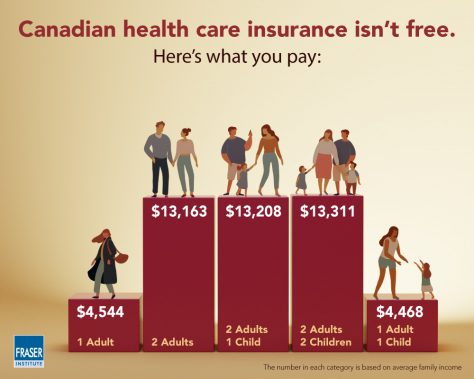
Price of healthcare per Canadian household (Source: Fraser Institute)

Price of healthcare per Canadian household (Source: Fraser Institute)

What about Canada?

I think it’s worth remembering how much government-run health care costs in countries that have adopted “Medicare for All” plans.

I found two interesting studies from Canada’s Angus Reid Institute describing single payer health care in Canada. I’m very interested in find out what things are like in countries that have true government-run health care. A typical Canadian family pays $13,000+ per year per household for healthcare, or about $585,000 over their working lives. What are they getting for all that money?

Here is the first Angus Reid article:

The study finds more than 2 million Canadians aged 55 and older face significant barriers when accessing the health care system in their province, such as being unable to find a family doctor or experiencing lengthy wait-times for surgery, diagnostic tests, or specialist visits.

Moreover, most Canadians in this age group have at least some difficulty getting the care they want or need in a timely manner.

The study focuses on the health care experiences of older Canadians, as well as their assessments of the quality of care they receive.

According to the article, 31% of respondents (aged 55 and older) rated access to the government’s healthcare system as “easy”. 48% had “moderate” problems with access, and 21% had “major” problems with access.

The second Angus Reid article explains:

This second part of the study finds one-in-six Canadians (17%) in the 55-plus age group – a figure that represents upwards of 1.8 million people – say that they or someone else in their household have taken prescription drugs in a way other than prescribed because of cost.

One-in-ten (10%) have decided to simply not fill a prescription because it was too expensive, and a similar number (9%) have decided not to renew one for the same reason. One-in-eight (12%) have taken steps to stretch their prescriptions, such as cutting pills or skipping doses.

Some 17 per cent of Canadians 55 and older have done at least one of these things, and that proportion rises among those who have greater difficulty accessing other aspects of the health care system.

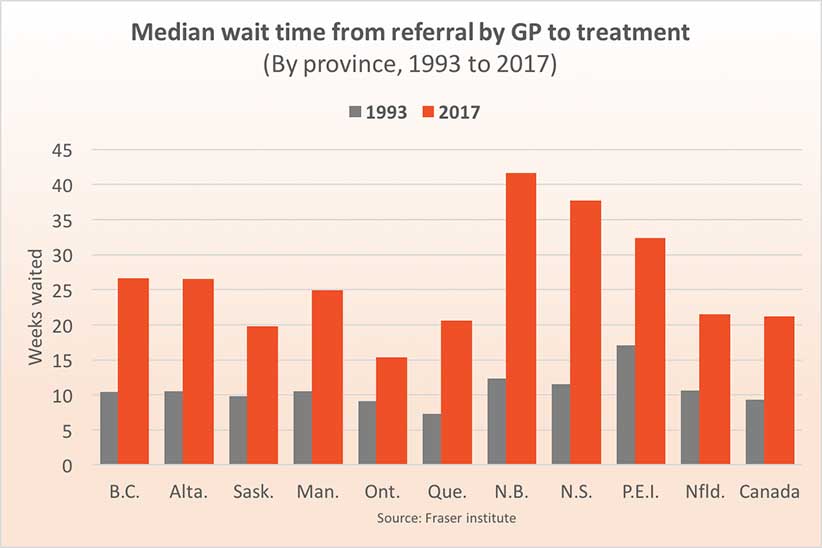
In a previous blog post, I reported on how Canadians have to wait in order to see their GP doctor. If that doctor refers them to a specialist, then they have to wait to see the specialist. And if that specialist schedules surgery, then they have to wait for their surgery appointment. The delays can easily go from weeks to months and even years. The MEDIAN delay from GP referral to treatment is 19.5 weeks.

Wait times in weeks (Source: Maclean's magazine)
Wait times in weeks (Source: Maclean’s magazine)

Also, the Canadian system does NOT cover prescription drugs.

Please share this article and yesterday’s because we have an election coming up, and votes need to know the facts.