Tag Archives: Christianity

Bible study: the importance of truth in religion

Bible study that hits the spot

Here’s an interesting passage of the Bible. What do you all think the practical value of this passage is?

1 In the second year of his reign, Nebuchadnezzar had dreams; his mind was troubled and he could not sleep.

2 So the king summoned the magicians, enchanters, sorcerers and astrologers to tell him what he had dreamed. When they came in and stood before the king,

3 he said to them, “I have had a dream that troubles me and I want to know what it means.”

4 Then the astrologers answered the king, “May the king live forever! Tell your servants the dream, and we will interpret it.”

5 The king replied to the astrologers, “This is what I have firmly decided: If you do not tell me what my dream was and interpret it, I will have you cut into pieces and your houses turned into piles of rubble.

6 But if you tell me the dream and explain it, you will receive from me gifts and rewards and great honor. So tell me the dream and interpret it for me.”

7 Once more they replied, “Let the king tell his servants the dream, and we will interpret it.”

8 Then the king answered, “I am certain that you are trying to gain time, because you realize that this is what I have firmly decided:

9 If you do not tell me the dream, there is only one penalty for you. You have conspired to tell me misleading and wicked things, hoping the situation will change. So then, tell me the dream, and I will know that you can interpret it for me.”

10 The astrologers answered the king, “There is no one on earth who can do what the king asks! No king, however great and mighty, has ever asked such a thing of any magician or enchanter or astrologer.

11 What the king asks is too difficult. No one can reveal it to the king except the gods, and they do not live among humans.”

12 This made the king so angry and furious that he ordered the execution of all the wise men of Babylon.

13 So the decree was issued to put the wise men to death, and men were sent to look for Daniel and his friends to put them to death.

14 When Arioch, the commander of the king’s guard, had gone out to put to death the wise men of Babylon, Daniel spoke to him with wisdom and tact.

15 He asked the king’s officer, “Why did the king issue such a harsh decree?” Arioch then explained the matter to Daniel.

16 At this, Daniel went in to the king and asked for time, so that he might interpret the dream for him.

17 Then Daniel returned to his house and explained the matter to his friends Hananiah, Mishael and Azariah.

18 He urged them to plead for mercy from the God of heaven concerning this mystery, so that he and his friends might not be executed with the rest of the wise men of Babylon.

19 During the night the mystery was revealed to Daniel in a vision. Then Daniel praised the God of heaven

20 and said:

“Praise be to the name of God for ever and ever;
wisdom and power are his.

21 He changes times and seasons;
he deposes kings and raises up others.
He gives wisdom to the wise
and knowledge to the discerning.

22 He reveals deep and hidden things;
he knows what lies in darkness,
and light dwells with him.

23 I thank and praise you, God of my ancestors:
You have given me wisdom and power,
you have made known to me what we asked of you,
you have made known to us the dream of the king.”

24Then Daniel went to Arioch, whom the king had appointed to execute the wise men of Babylon, and said to him, “Do not execute the wise men of Babylon. Take me to the king, and I will interpret his dream for him.”

25 Arioch took Daniel to the king at once and said, “I have found a man among the exiles from Judah who can tell the king what his dream means.”

26 The king asked Daniel (also called Belteshazzar), “Are you able to tell me what I saw in my dream and interpret it?”

27 Daniel replied, “No wise man, enchanter, magician or diviner can explain to the king the mystery he has asked about,

28 but there is a God in heaven who reveals mysteries. He has shown King Nebuchadnezzar what will happen in days to come. Your dream and the visions that passed through your mind as you were lying in bed are these:

29 “As Your Majesty was lying there, your mind turned to things to come, and the revealer of mysteries showed you what is going to happen.

30 As for me, this mystery has been revealed to me, not because I have greater wisdom than anyone else alive, but so that Your Majesty may know the interpretation and that you may understand what went through your mind.

This passage is interesting to me because it shows the kind of attitude that God answers. The King in this passage was tired of hearing man-made stories from his servants – stories that were undoubtedly influenced by the servants desire to survive the King’s wrath. The servants would only have told the King things that were vague and happy, so that they could never be proved wrong or found to be judgmental or offensive. But the King was tired of that. He wanted someone with authority to tell him the truth about the way the world was.

In the rest of the chapter, Daniel interprets the dream, and concludes by saying this: “The great God has shown the king what will take place in the future. The dream is true and its interpretation is trustworthy.”. The King replies: “Surely your God is the God of gods and the Lord of kings and a revealer of mysteries, for you were able to reveal this mystery.”

I think it is is going to be difficult for Christians living today to be able to tell people their dreams like that. But what we can do is talk about God’s miracles as revealed by science and history. We can study astrophysics, biochemistry and history and we can explain what God did in creating and fine-tuning the universe for life, in sequencing amino acids into functioning proteins, in creating brand new body plans in the Cambrian explosion, in raising Jesus from the dead as a matter of historical record, and so on. We have to show how great God is to people who do not even think he exists, and without assuming that they believe in the Bible.

There are still people out there like the King who are looking for someone who can speak to them with authority. All it takes from us is a little studying, and we can be like Daniel, too. But we have to know what God has done from science and history, and speak with authority about how we can know that God has acted supernaturally. Authority to speak comes from having knowledge about what we are talking about, and knowledge comes from studying and debating with people we disagree with. Nebuchadnezzar  was not a believer in the God of Israel, but he was still interested in truth. That won’t always be the case, but it is the case for some people.
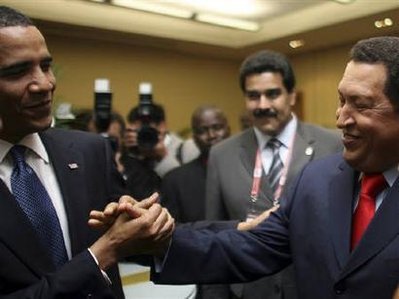

Do young Americans know how well socialism is working in Venezuela?

Two socialists shake hands: Barack Obama and Hugo Chavez

I’m very interested in how economic policy in different times and places affects the ability of Christians to carry out their Christian life plans. What economic policies should Christians support in order to be able to carry out their lives? Do Christians need to eat? Do they need to be safe from criminals? Do they need to be able to work or run a business without violating their consciences? Can a Christian be as charitable when he cannot even feed himself or his family?

When I talk to young evangelicals, they seem to be pretty in lockstep with the left on policies like raising the minimum wage, having government take over health care, environmental regulations on private sector energy companies to stop global warming, etc.

So, it’s worth it to look at how things work in places where socialism is actually being tried.

Here is an article from March 2013 from the radically leftist Slate. The headline is “Hugo Chavez’s economic miracle: The Venezuelan leader was often marginalized as a radical. But his brand of socialism achieved real economic gains”. The author is “a senior writer for the International Business Times”.

He writes:

Chavez became the bugaboo of American politics because his full-throated advocacy of socialism and redistributionism at once represented a fundamental critique of neoliberal economics, and also delivered some indisputably positive results. Indeed, as shown by some of the most significant indicators, Chavez racked up an economic record that a legacy-obsessed American president could only dream of achieving.

What did Chavez do, precisely, that caused the Venezuelan economic to boom? Well, he nationalized private industry and redistributed wealth from job creators and entrepreneurs to the poor.

As The Week correctly put it, while “Chavez’s policies of redistribution and nationalization of oil assets endeared him to Venezuela’s working class” and produced many laudable results, the country’s “oil-centric economy has taken away resources from other areas that are badly in need of development.”

Well, what happened next?

Consider this long and detailed article from the left-leaning The Atlantic. I can only quote part of it, but you really need to read this to understand what happens when country attacks all the people who were creating wealth and jobs with regulations, taxes, price controls and property seizure.

It says:

In the last two years Venezuela has experienced the kind of implosion that hardly ever occurs in a middle-income country like it outside of war. Mortality rates are skyrocketing; one public service after another is collapsing; triple-digit inflation has left more than 70 percent of the population in poverty; an unmanageable crime wave keeps people locked indoors at night; shoppers have to stand in line for hours to buy food; babies die in large numbers for lack of simple, inexpensive medicines and equipment in hospitals, as do the elderly and those suffering from chronic illnesses.

But why? It’s not that the country lacked money. Sitting atop the world’s largest reserves of oil at the tail end of a frenzied oil boom, the government led first by Chavez and, since 2013, by Maduro, received over a trillion dollars in oil revenues over the last 17 years. It faced virtually no institutional constraints on how to spend that unprecedented bonanza. It’s true that oil prices have since fallen—a risk many people foresaw, and one that the government made no provision for—but that can hardly explain what’s happened: Venezuela’s garish implosion began well before the price of oil plummeted. Back in 2014, when oil was still trading north of $100 per barrel, Venezuelans were already facing acute shortages of basic things like bread or toiletries.

The real culprit is chavismo, the ruling philosophy named for Chavez and carried forward by Maduro, and its truly breathtaking propensity for mismanagement(the government plowed state money arbitrarily into foolish investments);institutional destruction (as Chavez and then Maduro became more authoritarian and crippled the country’s democratic institutions); nonsense policy-making (like price and currency controls); and plain thievery (as corruption has proliferated among unaccountable officials and their friends and families).

A case in point is the price controls, which have expanded to apply to more and more goods: food and vital medicines, yes, but also car batteries, essential medical services, deodorant, diapers, and, of course, toilet paper. The ostensible goal was to check inflation and keep goods affordable for the poor, but anyone with a basic grasp of economics could have foreseen the consequences: When prices are set below production costs, sellers can’t afford to keep the shelves stocked. Official prices are low, but it’s a mirage: The products have disappeared.

When a state is in the process of collapse, dimensions of decay feed back on each other in an intractable cycle. Populist giveaways, for example, have fed the country’s ruinous flirtation with hyperinflation; the International Monetary Fund now projects that prices will rise by 720 percent this year and 2,200 percent in 2017. The government virtually gives away gasoline for free, even after having raised the price earlier this year. As a result of this and similar policies, the state is chronically short of funds, forced to print ever more money to finance its spending. Consumers, flush with cash and chasing a dwindling supply of goods, are caught in an inflationary spiral.

The rest of the article has horrifying details about what socialism really means: businesses shut down, shortages of food and medicine, government waste, skyrocketing crime, failing education system, Zika epidemic, water rationing, blackouts, and so on.

There was even an article this weekend in the radically leftist New York Times about the horrifying conditions of hospitals in Venezuela:

By morning, three newborns were already dead.

The day had begun with the usual hazards: chronic shortages of antibiotics, intravenous solutions, even food. Then a blackout swept over the city, shutting down the respirators in the maternity ward.

Doctors kept ailing infants alive by pumping air into their lungs by hand for hours. By nightfall, four more newborns had died.

“The death of a baby is our daily bread,” said Dr. Osleidy Camejo, a surgeon in the nation’s capital, Caracas, referring to the toll from Venezuela’s collapsing hospitals.

The economic crisis in this country has exploded into a public health emergency, claiming the lives of untold numbers of Venezuelans. It is just part of a larger unraveling here that has become so widespread it has prompted President Nicolás Maduro to impose a state of emergency and has raised fears of a government collapse.

Hospital wards have become crucibles where the forces tearing apart Venezuela have converged. Gloves and soap have vanished from some hospitals. Cancer medicines are often found only on the black market. There is so little electricity that the government works only two days a week to save what energy is left.

At the University of the Andes Hospital in the mountain city of Mérida, there was not enough water to wash blood from the operating table. Doctors preparing for surgery cleaned their hands with bottles of seltzer water.

“It is like something from the 19th century,” said Dr. Christian Pino, a surgeon at the hospital.

The figures are devastating. The rate of death among babies under a month old increased more than a hundredfold in public hospitals run by the Health Ministry, to just over 2 percent in 2015 from 0.02 percent in 2012, according to a government report provided by lawmakers.

The rate of death among new mothers in those hospitals increased by almost five times in the same period, according to the report.

Here in the Caribbean port town of Barcelona, two premature infants died recently on the way to the main public clinic because the ambulance had no oxygen tanks. The hospital has no fully functioning X-ray or kidney dialysismachines because they broke down long ago. And because there are no open beds, some patients lie on the floor in pools of their own blood.

This is not happening because of capitalism and the greedy rich. It is happening because of hatred and persecution of entrepreneurs and job creating private businesses. But, if you read books on economic policy like “The Spirit Level”, which is written by socialists, countries like Venezuela that have lower income inequality have lower infant mortality, lower crime rates and better health care. Socialism works great in academia, not so well in a North Korean work camp.

It’s not just Venezuela. This article from Investors Business Daily covers how well socialism is going in countries like France, Brazil and Argentina. It never works.

Now, in most churches, pastors are more concerned with making people feel good so that the coins continue to fall into the offering plate. Therefore, they carefully stay clear of topics like economics, business and entrepreneurship. The question that we need to ask ourselves is this: how easy is it for you to live out a Christian life in a country where poverty, crime, and government suppression of free speech and religious liberty are rampant? Shouldn’t part of being a Christian mean voting for public policies that actually help poor people have opportunities, children in broken homes and victims of crime, instead of just embracing what sounds nice and makes us feel good?

In case I need to be clearer, I mean that Christians who embrace socialism are taking us down the road to serfdom because of their ignorance of economics. And it’s not just the Democrats. Christians who support Donald Trump are embracing import tariffs, opposing free trade, raising taxes, raising the minimum wage, government seizing private property, and so on. That’s socialism, too. And we won’t escape the consequences of our economic ignorance anymore than the well-meaning Venezuelan voters did when they elected their strong man to rescue them.

J. Warner Wallace: I am not a Christian because it works for me

12231469_1518516371799768_1908477683_n

Here’s a must-read post from Cold-Case Christianity author J. Warner Wallace.

Excerpt:

Life on this side of my decision hasn’t always been easy. It’s been nearly seventeen years since I first trusted Jesus as Lord and Savior. I still struggle to submit my prideful will to what God would call me to do. Christianity is not easy. It doesn’t always “work” for me. There are times when I think it would be easier to do it the old way; easier to cut a corner or take a short cut. There are many times when doing the right thing means doing the most difficult thing possible. There are also times when it seems like non-Christians have it easier, or seem to be “winning”. It’s in times like these that I have to remind myself that I’m not a Christian because it serves my own selfish purposes. I’m not a Christian because it “works” for me. I had a life prior to Christianity that seemed to be working just fine, and my life as a Christian hasn’t always been easy.

I’m a Christian because it is true. I’m a Christian because I want to live in a way that reflects the truth. I’m a Christian because my high regard for the truth leaves me no alternative.

I think this is important. There are people who I know who claim to be Christian, but they are clearly believing that God is a mystical force who arranges everything in their lives in order to make them happy. They are not Christians because it’s true, but because of things like comfort and community. But people ought to become Christians because they think it’s true. Truth doesn’t necessarily make you happy, though. Truth can impose intellectual obligations and moral obligations on you. Seeing God as he really is doesn’t help us to “win” at life, as the culture defines winning.

Winning in Christianity doesn’t mean making lots of money, or being famous, or winning human competitions, or being approved of by lots of people. Winning for a Christian might involve things like building relationships with people and leading them to know that God exists and who Jesus is. That has no cash value, and it’s not going to make you famous. Actually, it will probably cost you money and time, and make you unpopular with a lot of people.

The Bible doesn’t promise that people who become Christians will be happier. Actually, it promises that Christians will suffer for doing the right things. Their autonomy will suffer, as they sacrifice their own interests and happiness in order to make God happy, by serving his interests. Christianity isn’t something you add on to your before-God life in order to achieve your before-God goals. When you become a Christian, you get a new set of goals, based on God’s character and his design for you. And although you might be very successful in the world as part of serving God, there is no guarantee of that. Christianity is not life enhancement.