I pulled the MP3 audio from the lecture in case anyone wants just the audio.
Summary:
What does science tell us about God?
– the discoveries of Copernicus made humans less significant in the universe
– the discoveries of Darwin should that humans are an accident
– but this all pre-modern science
– what do the latest findings of science say about God?
Evidence #1: the origin of the universe
– the steady state model supports atheism, but was disproved by the latest discoveries
– the oscillating model supports atheism, but was disproved by the latest discoveries
– the big bang model supports theism, and it is supported by multiple recent discoveries
– the quantum gravity model supports atheism, but it pure theory and has never been tested or confirmed by experiment and observation
Evidence #2: the fine-tuning of physical constants for life
– there are over 100 examples of constants that must be selected within a narrow range in order for the universe to support the minimal requirements for life
– example: mass density
– example: strong nuclear force (what he studies)
– example: carbon formation
Evidence #3: the fine-tuning of our planet for habitability
– the type of galaxy and our location in it
– our solar system and our star
– our planet
– our moon
It’s a good lecture explaining basic arguments for a cosmic Creator and Designer. If you add the origin of life and the Cambrian explosion (Stephen C. Meyer’s arguments), then you will be solid on science apologetics. That’s everything a rank-and-file Christian needs.
A father in the home helps children to reconcile love and moral boundaries
Here’s an article by Paul Copan which points out how father presence/absence and father quality affects belief and disbelief in God.
Excerpt:
Seventh, the attempt to psychologize believers applies more readily to the hardened atheist.It is interesting that while atheists and skeptics often psychoanalyze the religious believer, they regularly fail to psychoanalyze their ownrejection of God. Why are believers subject to such scrutiny and not atheists? Remember another feature of Freud’s psychoanalysis — namely, an underlying resentment that desires to kill the father figure.
Why presume atheism is the rational, psychologically sound, and default position while theism is somehow psychologically deficient? New York University psychology professor Paul Vitz turns the tables on such thinking. He essentially says, “Let’s look into the lives of leading atheists and skeptics in the past. What do they have in common?” The result is interesting: virtually all of these leading figures lacked a positive fatherly role model — or had no father at all.11
Let’s look at some of them.
Voltaire(1694–1778): This biting critic of religion, though not an atheist, strongly rejected his father and rejected his birth name of François-Marie Arouet.
David Hume(1711–76): The father of this Scottish skeptic died when Hume was only 2 years old. Hume’s biographers mention no relatives or family friends who could have served as father figures.
Baron d’Holbach(1723–89): This French atheist became an orphan at age 13 and lived with his uncle.
Ludwig Feuerbach (1804–72): At age 13, his father left his family and took up living with another woman in a different town.
Karl Marx(1818–83): Marx’s father, a Jew, converted to being a Lutheran under pressure — not out of any religious conviction. Marx, therefore, did not respect his father.
Friedrich Nietzsche(1844–1900): He was 4 when he lost his father.
Sigmund Freud(1856–1939): His father, Jacob, was a great disappointment to him; his father was passive and weak. Freud also mentioned that his father was a sexual pervert and that his children suffered for it.
Bertrand Russell(1872–1970): His father died when he was 4.
Albert Camus(1913–60): His father died when he was 1 year old, and in his autobiographical novel The First Man, his father is the central figure preoccupation of his work.
Jean-Paul Sartre(1905–80): The famous existentialist’s father died before he was born.12
Madeleine Murray-O’Hair (1919–95): She hated her father and even tried to kill him with a butcher knife.
We could throw in a few more prominent contemporary atheists not mentioned by Vitz with similar childhood challenges:
Daniel Dennett (1942–): His father died when he was 5 years of age and had little influence on Dennett.13
Christopher Hitchens (1949–): His father (“the Commander”) was a good man, according to Hitchens, but he and Hitchens “didn’t hold much converse.” Once having “a respectful distance,” their relationship took on a “definite coolness” with an “occasional thaw.” Hitchens adds: “I am rather barren of paternal recollections.”14
Richard Dawkins (1941–): Though encouraged by his parents to study science, he mentions being molested as a child — no insignificant event, though Dawkins dismisses it as merely embarrassing.15
Moreover, Vitz’s study notes how many prominent theists in the past — such as Blaise Pascal, G.K. Chesterton, Karl Barth, and Dietrich Bonhoeffer — have had in common a loving, caring father in their lives.16
Not only is there that anecdotal evidence, but there is also statistical evidence.
Excerpt:
In 1994 the Swiss carried out an extra survey that the researchers for our masters in Europe (I write from England) were happy to record. The question was asked to determine whether a person’s religion carried through to the next generation, and if so, why, or if not, why not. The result is dynamite. There is one critical factor. It is overwhelming, and it is this: It is the religious practice of the father of the family that, above all, determines the future attendance at or absence from church of the children.
If both father and mother attend regularly, 33 percent of their children will end up as regular churchgoers, and 41 percent will end up attending irregularly. Only a quarter of their children will end up not practicing at all. If the father is irregular and mother regular, only 3 percent of the children will subsequently become regulars themselves, while a further 59 percent will become irregulars. Thirty-eight percent will be lost.
If the father is non-practicing and mother regular, only 2 percent of children will become regular worshippers, and 37 percent will attend irregularly. Over 60 percent of their children will be lost completely to the church.
Let us look at the figures the other way round. What happens if the father is regular but the mother irregular or non-practicing? Extraordinarily, the percentage of children becoming regular goesupfrom 33 percent to 38 percent with the irregular mother and to 44 percent with the non-practicing, as if loyalty to father’s commitment grows in proportion to mother’s laxity, indifference, or hostility.
[…]In short, if a father does not go to church, no matter how faithful his wife’s devotions, only one child in 50 will become a regular worshipper. If a father does go regularly, regardless of the practice of the mother, between two-thirds and three-quarters of their children will become churchgoers (regular and irregular). If a father goes but irregularly to church, regardless of his wife’s devotion, between a half and two-thirds of their offspring will find themselves coming to church regularly or occasionally.
A non-practicing mother with a regular father will see a minimum of two-thirds of her children ending up at church. In contrast, a non-practicing father with a regular mother will see two-thirds of his children never darken the church door. If his wife is similarly negligent that figure rises to 80 percent!
The results are shocking, but they should not be surprising. They are about as politically incorrect as it is possible to be; but they simply confirm what psychologists, criminologists, educationalists, and traditional Christians know. You cannot buck the biology of the created order. Father’s influence, from the determination of a child’s sex by the implantation of his seed to the funerary rites surrounding his passing, is out of all proportion to his allotted, and severely diminished role, in Western liberal society.
Basically, anyone who doesn’t have a benevolent, involved father is going to have an enormously difficult time believing that moral boundaries set by an authority are for the benefit of the person who is being bounded. The best way to make moral boundaries stick is to see that they apply to the person making the boundaries as well – and that these moral boundaries are rational, evidentially-grounded and not arbitrary. It is therefore very important to children to be shepherded by a man who studied moral issues (including evidence from outside the Bible) in order to know how to be persuasive to others. If you want your child to be religious and moral, you have to pick a man who is religious and moral. And it can’t just be a faith commitment that he makes, he can just lie about that. Women ought to check whether men are bound to what they believe by checking what they’ve read. A man usually acts consistently with what he believes, and beliefs only get formed when a man informs himself through things like reading.
A child’s relationship with God begins before he/she is even born. It begins with his/her mother’s ability to control herself and choose the right man for the job of being a father. Note that superficial qualities like “deep voice”, “broad shoulders”, “expensive shoes”, “likes dogs” and “makes me laugh” have no bearing on a man’s ability to commit and lead on moral/spiritual issues. Christians don’t really do a good job of showing the practical consequences of bad choices to women in the church. The ones I talk to impress on me how “unpredictable” men are, so that they are justified in choosing one that they like based on tingles, and hoping it will work out. We should be telling women that poor choices with men are wrong, and it leads to fatherlessness and abortion.
Here’s a wonderful post on decision making and the will of God posted on Neil’s blog. In his post, Neil explains the Biblical model for making good decisions.
Excerpt:
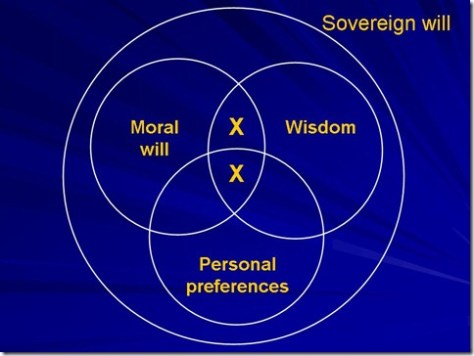
Really short version: Aside from direct and clear personal revelation from God, you don’t have access to his sovereign will when making decisions. Therefore you must look at other factors. If it isn’t moral, don’t do it. If it is moral but not wise, don’t do it. If it is moral and wise, then use your personal preferences.
Using this model you can end up with a wise and biblical decision, but you have avoided the traps of the “God told me to ____” routine. People who run around saying that God told them this and that convey a super-spirituality that can leave less mature believers wondering if they really have a relationship with God (i.e., “God doesn’t tell me every little thing to do, so maybe I don’t really know him.”).
He has a helpful picture posted as well:
This is actually a very important topic for me, because I like making plans and making good decisions. I like being the quarterback or squad leader of my own life. I like to pick objectives and then make plans to achieve them. (Nothing too exotic, just simple stuff like saving money or reading more books)
Actually, I really oppose the idea that God has a magical fairy tale will for each person that will make them happy and fulfilled. For me, life isn’t like that. I don’t expect God to lead me along like a child at a scavenger hunt. I expect to survey the battlefield where I am and then do something to make a difference. There are lots of things you can do that will please God. Should you focus on your career and sponsor apologetics conferences? Or should you use your spare time preparing Sunday school lessons? There are lots of good things you could do to please God. Your job is to pick the one that will be the most effective. It doesn’t matter if it makes you happy, it only matters if it’s effective and if you are good at it.
Who is Rifleman Dodd?
A while back, I was busily working my way through the U.S. Marine Corps Official Reading List, and I came across a book by C.S. Forester called Rifleman Dodd, or alternatively titled Death to the French. It’s a work of historical fiction that takes place during the Napoleonic wars. The story is about a British marksman named Dodd, who is cut off from his own lines during a withdrawal maneuver. He is subsequently left to fend for himself behind enemy lines. An ordinary man might be full of despair and forget about his mission entirely. But Dodd is no ordinary man. Not only does he find a way to survive by finding food to eat, water to drink and places to sleep, but he also tries to remember his orders and to think about what he can do to advance the cause of his General, the Duke of Wellington.
It’s about a green-coated British infantry rifleman in the Napoleonic Wars, an age when rifles were a novelty and most of the army was red-coated and carried muskets. Private Matthew Dodd gets separated from his regiment during a retreat and finds himself stranded behind enemy (French) lines in Portugal. With the occasional aid of some natives, but mostly on his own, he harasses the French with his rifle and tries to prevent them from building a bridge across the Tagus River. It’s a remarkable tale of survival and solitary achievement, of a rank-and-file soldier who lives by his wits and slowly learns to make plans without orders, and shows leadership qualities and a knowledge of warfare.
I think we’re in the same situation as Dodd.
There is no point in us looking for breadcrumb trails to happiness at this point. That’s not the point of Christianity. The point of Christianity is friendship with God, imitation of Christ, honoring moral obligations, self-sacrificial love for your neighbor (and even your enemies!), and dedication to the truth – whether anyone else likes you or not. It’s not supposed to make you happy, and it’s not necessarily going to be a normal life like everyone else has. Things may not work out the way you’d like them to.
We seem to be making such a big deal about compassion and forgiveness in the Christian life these days – such a big emphasis on our feelings. Almost like we have forgotten that we have obligations to our friend – and his objectives. A relationship doesn’t mean that one person completely disregards the character and goals of the other person and then is automatically granted forgiveness whenever they want it. That’s not a friendship – that’s using someone else for your own ends. Maybe it’s time to remember what this is all about.



 WINTERY KNIGHT