Tag Archives: Christianity

Pastor Matt: How apologetics saved my faith

Here’s a must-read post from Pastor Matt Rawlings whose reading list I wrote about before.

Excerpt:

I became a Christian at 24 after a cancer diagnosis.  I had been an atheist for 10 years but came to God in desperation.  I left Capitol Hill (and politics altogether) to learn about Christianity.  I attended what many believed was a conservative seminary but had slowly slipped into liberalism by the time I arrived in 1999.  I was sold on “higher criticism” (or a skeptical approach to the historicity and inerrency of Scripture) and joined the then growing “Emergent Church” movement.  Within a few years, I was where Rob Bell is now–a soft universalist with a condescending attitude toward conservatives.  Yet, I was also spiritually dead and was struggling with depression.  I was quickly headed back to the atheism I had thought I had left behind while praying for my life.

During this time of personal struggle, my wife and I were helping a small church in Charleston, West Virginia.  When an elder learned my wife had a degree in micro-biology and had helped overseen a science program at Cornell, he asked her to meet with the youth group and answer their questions about science and the faith.  In preparation, she picked up the book The Case for a Creator by Lee Strobel (Zondervan 2005).  She devoured the book and went on and on about wonderful it was and how I had to read it.  I resisted as the cover struck me as “fundamentalist nonsense.”  Yet, she persisted and it became clear that either I was going to read the book or spend a few nights on the couch!

I opened the book with a bad attitude.  After all, my seminary professors had told me that “apologetics is dead!” and that “Generation-X and -Y desired experience not ‘answers.’”  I was even more resistant when I saw the first few chapters take on evolution.  I was convinced Genesis 1-11 was all myth, Darwin had been proven correct and that only nutters questioned it.  But after reading Strobel’s interaction with Dr. Jonathan Wells and Dr. Stephen C. Meyer of the Discovery Institute, I realized I had no real counter argument to intelligent design.

Read the rest.

The Case for a Creator is one of my favorite apologetics books. I have read it once, but I’ve listened to the audio version TEN TIMES. This book more than any other is the perfect introduction to science apologetics for beginners. I really recommend the audio book as a companion to the print version.

When I read this post by Pastor Matt, I felt that his faith was not just castles built in the sky. A lot of pastors basically start by assuming (without any evidence) that the Bible is correct in everything it says, and then they start lecturing everyone else about what the Bible says without ever having done a moment of investigation into the evidence for or against what they are preaching about. They’ve never read anyone who disagrees with them, and they don’t know how to explain what they believe to anyone outside the church walls. I have to tell you that this is one of the the most uncomfortable feelings to have when you are not yet a Christian. You are in a building filled with people who don’t know whether what they believe is true. You are being lectured by a man who typically has no idea how to show others that what he is talking about is true, except for appealing to feelings. I don’t know about you, but that really makes me uncomfortable. I trust people more when I know they are good at something practical, like mechanical engineering, medicine, automobile mechanics, weight-lifting, nutrition or cooking. When you read outside the Bible, it’s basically treating Christianity like it’s a real area of knowledge. That makes me interested, because it means we are talking about something real, not just a personal preference or a subjective experience or a community custom.

Pastor Matt is different. He’s read tons of stuff outside the Bible, and he’s not presupposing anything when he preaches about God and Jesus. He’s got informed beliefs about this stuff. He’s authentic. And you can see the strength of his convictions by looking at what he’s read. He talks about his faith like we might talk about our professions. We have convictions about what we do that creates value for others because we know how to do it. When a pastor reads a lot on logic, philosophy, history and science, then he is able to know whether what he says he believes is really true or not out there in the real world. When I listen to my pastor and look at our church book store, I get very disappointed. It makes me wonder why I can’t go to a church like Pastor Matt’s church. Wouldn’t that be great? I would really fly out of bed on Sunday morning if I thought “what is he going to teach on this morning, that I can use at work on Monday morning?” I am always interested in hearing what someone else knows. I am one of those people who is always asking the dentist, the doctor, the mechanic, and the food preparers “how did you do that?” I even got the recipe for the cilantro-lime rice that Chipotle makes by asking the woman who was making my burrito bowl. How did you do it? I want to know how you know.

I have a good friend of mine right now who is going through a tough time with her church. She keeps telling me that Sunday school is very emotional, and clearly designed to comfort people and make them feel “gooey” (her word). This is a woman who is on fire academically and is making tons of money in a summer job in her field. She just got a new scholarship, too. She keeps thinking that Sunday school is supposed to be the time to learn about difficult things and practical things. It’s causing her to really get bored with church and even to look for a new church. I think a lot of young people are tired of being entertained in church, and they would like to get their minds on some real knowledge about God and what he’s done in history and in nature. I’ll bet that Pastor Matt doesn’t have any problems packing his church with young people. Young people can tell when someone really knows what they are talking about, the same way that a dentist knows about teeth, or that a tax preparer knows about tax laws.
Who were the Jesus Seminar? Should anyone have taken them seriously?

Was having a conversation Sunday evening with the woman I am mentoring and she brought up the Jesus Seminar – a small group of naturalistic, pluralistic academics. Apparently, someone’s child went to college, heard about them, and lost their faith because of their writings. I wanted to find a good article for her on this, and since Dr. William Lane Craig has debated most of the leading scholars in the Jesus seminar, (e.g. – John Dominic Crossan, Marcus Borg, Roy Hoover, Gerd Ludemann, Robert Price, John Shelby Spong, etc.), I chose an article by Dr. Craig. I also link to two debates that Dr. Craig did with Jesus Seminar people below.

First a short video (4 minutes):

If you can’t watch anything long, then watch that.

Here is the article, on the Reasonable Faith web site.

Intro:

In 1985 a prominent New Testament scholar named Robert Funk founded a think tank in Southern California which he called the Jesus Seminar. The ostensible purpose of the Seminar was to uncover the historical person Jesus of Nazareth using the best methods of scientific, biblical criticism. In Funk’s view the historical Jesus has been overlaid by Christian legend, myth, and metaphysics and thus scarcely resembled the Christ figure presented in the gospels and worshipped by the Church today. The goal of the Seminar is to strip away these layers and to recover the authentic Jesus who really lived and taught.

Excerpt:

The number one presupposition of the Seminar is antisupernaturalism or more simply, naturalism.Naturalism is the view that every event in the world has a natural cause. There are no events with supernatural causes. In other words, miracles cannot happen.

Now this presupposition constitutes an absolute watershed for the study of the gospels. If you presuppose naturalism, then things like the incarnation, the Virgin Birth, Jesus’ miracles, and his resurrection go out the window before you even sit down at the table to look at the evidence. As supernatural events, they cannot be historical. But if you are at least open to supernaturalism, then these events can’t be ruled out in advance. You have to be open to looking honestly at the evidence that they occurred.

[…][T]he second presupposition which I wanted to discuss, namely, sceptical critics presuppose that our most primary sources for the life of Jesus are not the Gospels, but rather writings outside the New Testament, specifically the socalled apocryphal gospels. These are gospels forged under the apostles’ names, like the Gospel of Thomas, the Gospel of Peter, the Gospel of Philip, and so forth. These extrabiblical writings are said to be the key to correctly reconstructing the historical Jesus.

In addition to that, there seems to be a third presupposition – radical religious pluralism.

John Dominic Crossan closed his opening speech in his debate with Dr. Craig with this:

When I look a Buddhist friend in the face, I cannot say with integrity, “Our story about Jesus’ virginal birth is true and factual. Your story that when the Buddha came out of his mother’s womb, he was walking, talking, teaching and preaching (which I must admit is even better than our story)—that’s a myth. We have the truth; you have a lie.” I don’t think that can be said any longer, for our insistence that our faith is a fact and that others’ faith is a lie is, I think, a cancer that eats at the heart of Christianity.

But of course, he thinks that all miracle claims are lies, because of his supernaturalism. What he is really trying to do here is redefine these claims so they are not truth claims at all, but personal preference claims.

But the main point is that the co-chair of the Jesus Seminar pre-supposes that nothing that Christianity claims that offends people in other religions can be true. Before he sits down to look at the evidence. I’m not saying that these guys can’t do history, I’m saying that the real debate with these guys should not be about history. The real debate should be about their presuppositions. We should work to defeat their pre-supposition naturalism with good scientific arguments like the origin of the universe, the fine-tuning, the origin of life, the Cambrian explosion, the habitability-discoverability argument, etc. And we should work to defeat their pre-supposition of pluralism by just asking them to defend it, and maybe point out that a person’s being offended by some claim about reality being true does not make that claim false. Logic requires that people who make claims that are made false by reality are wrong and no amount of crying and sobbing can change that.

The second article in the series that Dr. Craig mentioned in the article I linked above is a generic article on the evidence for the historical Jesus. If you have not read a case for the resurrection of Jesus, then read it, too. Or you can check out this lecture by Dr. Craig on the Jesus Seminar and the historical Jesus:

If you want to see a good debate between Dr. Craig and Marcus Borg, here it is:

Dr. Borg is one of the more respected Jesus Seminar people, and a really nice guy. But also, a really wrong guy.

The key thing to know about them is that they presuppose naturalism (miracles never happen) and radical pluralism (no exclusivist religion can be correct, because that would make people in the other religions feel bad). The presuppositions are key to understanding the “historical work” of the Jesus Seminar.


On wargames, history and heroes: “this story shall the good man teach his son”

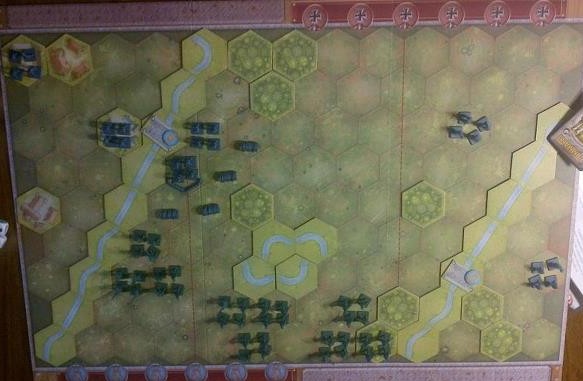
Memoir '44: Pegasus Bridge setup
Memoir ’44: Pegasus Bridge setup

Reposting this old post because Dina and I spent Friday night playing games again! And this is one of my favorite posts. Last night was Portal 2 and Orcs Must Die! 2.

Last night, I played through the Pegasus Bridge scenario from the Memoir ’44 wargame with Dina a few times. We actually played the online version of the game, using Steam. She was very gracious to play a wargame with me, which I don’t think is necessarily the first thing on most women’s lists of things to do on a Thursday night! I appreciated her agreeing to learn how to play and then playing with me several times. I think that Christians need to plan and execute more “together” activities like that – activities that involve interaction, co-operation, communication and engagement. We try to avoid doing things where we are both spectators. Playing wargames is not the only thing we do – we also do Bible study and cooking lessons (for me), for example.

Anyway, the point of this post is to express the deeper meaning behind playing wargames. I think that it is important to recognize and celebrate those who have demonstrated good character, whether it be now, or in the past. I think that it is important for us to search out the best role models ourselves, so that they will influence the way we act in our own lives. The second world war was a clear example of good versus evil. Anyone on the Allied side who demonstrated bravery and courage should be celebrated for safeguarding the security, liberty and prosperity that we enjoy today. In the case of Pegasus bridge, the hero is Major John Howard of the British paratroops.

Here is a quick re-cap of his exploits that day from the New York Times:

Maj. John Howard, the commander of glider-borne British infantrymen who seized the strategically vital Pegasus Bridge in the first battle of the D-Day invasion of Normandy, died Wednesday in a hospital in Surrey, England. He was 86 and had lived in Burford, near Oxford.

Under cover of night on June 6, 1944, six gliders carrying 181 officers and men of the Second Oxfordshire and Buckinghamshire Light Infantry landed on the eastern flank of a 60-mile invasion front on the northern coast of France. The regiment had a heritage going back to the battles of Bunker Hill and New Orleans, to Waterloo and to World War I. Now its soldiers were in the vanguard of the invasion of Hitler’s Europe.

Major Howard’s D Company was ordered to seize two bridges, one over the Caen Canal and the other spanning the parallel Orne River. If the Germans held on to those bridges, panzer units could move across them in a counterattack isolating 10,000 British paratroopers jumping behind the British invasion beach known as Sword, where infantry forces would arrive at daybreak. And Major Howard’s men sought to strike swiftly to prevent the Germans from blowing up the bridges if they were overwhelmed; the British needed those bridges to resupply their airborne units.

British Halifax bombers towed the gliders over the English Channel, then cut them loose.

Major Howard’s lead glider landed at 12:16 A.M., only 50 yards from the Caen Canal bridge, but the glider’s nose collapsed on impact, knocking everybody aboard unconscious for a few seconds. The soldiers quickly emerged, and over the next five minutes the men directly under Major Howard killed the surprised German defenders.

The nearby Orne River bridge was captured by other troops in Major Howard’s unit, and soon the words ”Ham and Jam,” signifying mission accomplished, were radioed to the airborne.

Two British soldiers were killed and 14 wounded in the operation.

Over the next 12 hours, British paratroopers and commandos reinforced Major Howard’s men, and British forces were able to move toward the city of Caen, their flank having been protected by the capture of the bridges.

On July 16, Major Howard received the Distinguished Service Order, Britain’s second-highest award for valor. On the 10th anniversary of D-Day, he received the Croix de Guerre Avec Palme from the French Government, which had renamed the Caen Canal span Pegasus Bridge, for the flying horse symbolizing the British airborne. The road crossing the bridge was later renamed Esplanade Major John Howard.

Why is this important? Well, it’s important to think on the things that are excellent. There are so many things in the culture that are not excellent that we are confronted with every day. We have to make it our business to do things together where goodness is celebrated. Especially when manly virtues like courage are celebrated. We don’t do that much anymore. And I think there’s a connection between wargames and Christian apologetics that we need to deliberately encourage.

Here’s an excellent passage from Shakespeare’s “Henry V” that makes the point:

This day is called the feast of Crispian:
He that outlives this day and comes safe home,
Will stand a tip-toe when this day is named,
And rouse him at the name of Crispian.
He that shall live this day, and see old age,
Will yearly on the vigil feast his neighbours,
And say, ‘To-morrow is Saint Crispian:’
Then will he strip his sleeve and show his scars,
And say, ‘These wounds I had on Crispin’s day.’
Old men forget: yet all shall be forgot,
But he’ll remember with advantages
What feats he did that day. Then shall our names,
Familiar in his mouth as household words,
Harry the King, Bedford and Exeter,
Warwick and Talbot, Salisbury and Gloucester,
Be in their flowing cups freshly remembered.
This story shall the good man teach his son;
And Crispin Crispian shall ne’er go by,
From this day to the ending of the world,
But we in it shall be rememberèd;
We few, we happy few, we band of brothers;
For he to-day that sheds his blood with me
Shall be my brother; be he ne’er so vile
This day shall gentle his condition:
And gentlemen in England, now a-bed
Shall think themselves accursed they were not here,
And hold their manhoods cheap whiles any speaks
That fought with us upon Saint Crispin’s day. (4.3.43)

This is from the famous speech in which King Henry charges his men to fight well before the famous Battle of Agincourt.

You can read more about the history of the British Airborne division and Pegasus bridge. The famous historian of the second world war Stephen E. Ambrose also wrote a history of the Pegasus bridge battle, called “Pegasus Bridge: June 6, 1944“. You won’t find many military historians better than Stephen E. Ambrose!

You might be surprised how many men are interested in military history and wargames, precisely because men instinctively look up to men like John Howard who embody qualities like bravery and courage. We have a dearth of moral character in this society. And we don’t do much to teach young men about manly virtues, even in the church. I think that it is important for us to think of creative ways for us to present good character to our young men. Young women should also learn about good character, because they must separate out the good men from the bad when they are courting.

Thanks to Dina for helping me to edit this post!