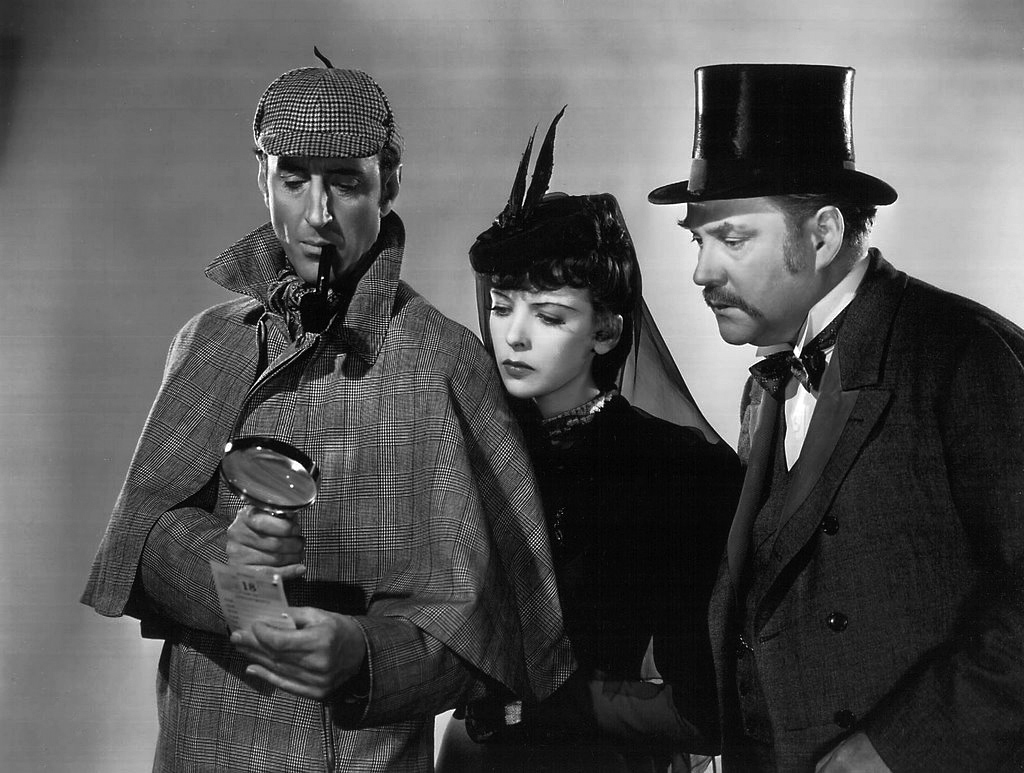
Sherlock Holmes and John Watson are going to take a look at the data
The criterion of embarrassment is just one of the historical criteria used to select the parts of a piece of ancient literature that are likely to be historical. Other things in the source may have happened, but we can’t know them as history. If significant parts of a text are historical, it is possible to accept it as historical until there are specific reasons to say that some part of it is NOT historical.
Here is William Lane Craig’s list of criteria for a saying or event to be historical:
Historical congruence: S fits in with known historical facts concerning the context in which S is said to have occurred.
Independent, early attestation: S appears in multiple sources which are near to the time at which S is alleged to have occurred and which depend neither upon each other nor a common source.
Embarrassment: S is awkward or counter-productive for the persons who serve as the source of information for S.
Dissimilarity: S is unlike antecedent Jewish thought-forms and/or unlike subsequent Christian thought-forms.
Semitisms: traces in the narrative of Aramaic or Hebrew linguistic forms.
Coherence: S is consistent with already established facts about Jesus.
The criteria is the same for liberal historians and conservative historians, although some historians weight one criteria more than others when trying to evaluate the historicity of different New Testament parts.
What’s amazing is that even liberal historians will give you facts that are embarrassing to the authors as “historical”.
Anyway, here are 8 examples of parts of the New Testament that exhibit the criterion of embarrassment, thanks to theologian C. Michael Patton.
Jesus’ Baptism
Jesus’ Family Did Not Believe
John the Baptist’s Doubt
The Disciples Doubted After the Resurrection
Jesus Does not Know the Time of His Coming
Women are the First to Witness the Resurrection
Jesus Cursed a Fig Tree
Death and Resurrection of Christ
I think 6 and 8 are the ones I want you to take away with you when you finish this post.
Here they are:
Women are the First to Witness the Resurrection
This is one that is often brought up. Craig Keener puts it well enough: “The witness of women at the tomb is very likely historical, precisely because it was so offensive to the larger culture — not the sort of testimony one would invent. Not all testimony was regarded as being of equal merit; the trustworthiness of witnesses was considered essential. Yet most of Jesus’ Jewish contemporaries held much less esteem for the testimony of women than for that of men; this suspicion reflects a broader Mediterranean limited trust of women’s speech and testimony also enshrined in Roman law.” (Keener, The Historical Jesus, 331)
And:
Death and Resurrection of Christ
This easily escapes our notice since the basic story of Christ is so well known. However, both the death and resurrection of Christ are, from the standpoint of the culture of the day, embarrassing and damaging. Concerning the death of Christ on a cross, Paul sees this problem: “But we preach Christ crucified: a stumbling block to Jews and foolishness to Gentiles” (1 Cor. 1:23). The word used for “stumbling block” is skandalon. Louw-Nida defines this as “that which causes offense and thus arouses opposition.” Why? Because the Jews would never have thought their Messiah would have been hung on a tree. “Cursed is one who hangs on a tree” (Gal. 3:13; Deut 21:23). The Greeks thought of the resurrection as foolishness as they were dualist, essentially believing that the material world was evil and the spiritual world good. They would have scoffed at the idea that Christ returned to physical form. This is why later Greeks attempted to adapt the Christ story, doing away with the physical resurrection. Marcion is the most famous promoter of this view (see Docitism).
Now, when you are talking about the New Testament to your non-believing friends, you definitely want to draw attention to passages that are embarrassing to the authors. It will help you to be more convincing when you explain the New Testament like a historian.
By the way, you can read an entire post I did on all the criteria that historians use to evaluate ancient historical documents.
This video has 3 parts, as well as questions and answers in individual clips.
For those who cannot watch the video, you can read this essay by Dr. Craig which covers exactly the same ground as the video. The essay is for Christians already familiar with basic apologetics.
Part 1 of 3:
Part 2 of 3:
Part 2 of 3:
Here’s a quick couple of quotes from the essay for those who cannot watch:
If there is no God, then any ground for regarding the herd morality evolved by homo sapiens as objectively true seems to have been removed. After all, what is so special about human beings? They are just accidental by-products of nature which have evolved relatively recently on an infinitesimal speck of dust lost somewhere in a hostile and mindless universe and which are doomed to perish individually and collectively in a relatively short time. Some action, say, incest, may not be biologically or socially advantageous and so in the course of human evolution has become taboo; but there is on the atheistic view nothing really wrong about committing incest. If, as Kurtz states, “The moral principles that govern our behavior are rooted in habit and custom, feeling and fashion,”5 then the non-conformist who chooses to flout the herd morality is doing nothing more serious than acting unfashionably.
The objective worthlessness of human beings on a naturalistic world view is underscored by two implications of that world view: materialism and determinism. Naturalists are typically materialists or physicalists, who regard man as a purely animal organism. But if man has no immaterial aspect to his being (call it soul or mind or what have you), then he is not qualitatively different from other animal species. For him to regard human morality as objective is to fall into the trap of specie-ism. On a materialistic anthropology there is no reason to think that human beings are objectively more valuable than rats. Secondly, if there is no mind distinct from the brain, then everything we think and do is determined by the input of our five senses and our genetic make-up. There is no personal agent who freely decides to do something. But without freedom, none of our choices is morally significant. They are like the jerks of a puppet’s limbs, controlled by the strings of sensory input and physical constitution. And what moral value does a puppet or its movements have?
[…]Moreover, if atheism is true, there is no moral accountability for one’s actions. Even if there were objective moral values and duties under naturalism, they are irrelevant because there is no moral accountability. If life ends at the grave, it makes no difference whether one lives as a Stalin or as a saint. As the Russian writer Fyodor Dostoyevsky rightly said: “If there is no immortality, then all things are permitted.”
If you want a much shorter, slicker version of this argument to share, Reasonable Faith has produced this nice 5-minute video that you can tweet or share on your Facebook page or whatever:
The moral argument is the easiest argument in the world to discuss with non-Christians, as everyone has to have an answer to questions like “what makes humans valuable?” and “why should I do the right thing when it goes against my self-interest?” and “will evildoers who escape justice in this life be punished when they die?” and “do humans have free will to make moral choices?” These are interesting questions, and people can just give their opinion and then think about it as they discuss it.
You can read a debate transcript where Dr. Craig puts his ideas to the test, against Dr. Richard Taylor. I found this debate very helpful for answering the question that everyone should be able to answer: “why should I be moral?”
Which passage of the Bible is the favorite of Christians who like to defend the Christian worldview? I don’t mean which one is most inspirational… I mean “which one is the most useful for winning arguments?” Well, when it comes to the historical Jesus, the most important passage has to be 1 Corinthians 15:3-7.
The tradition in 1 Corinthians 15 is an early creed that was received from the eyewitnesses Peter and John when Paul visited them several times in Jerusalem, as documented in Galatians 1 and 2, where Paul meets the eyewitnesses. And of course, Paul records his own eyewitness experience, documented in 1 Cor 15:8.
So, is this passage accepted as historically reliable by all ancient historians? Or only by the Bible-believing ones?
The evidence that Paul is not writing in his own hand in I Cor. 15.3-5 is so powerful that all New Testament scholars recognize that Paul is here passing on a prior tradition. In addition to the fact that Paul explicitly says as much, the passage is replete with non-Pauline characteristics, including, in order of appearance: (i) the phrase “for our sins” using the genitive case and plural noun is unusual for Paul; (ii) the phrase “according to the Scriptures” is unparalleled in Paul, who introduces Scriptural citations by “as it is written”; (iii) the perfect passive verb “has been raised” appears only in this chapter and in a pre-Pauline confessional formula in II Tim. 2.8; (iv) the phrase “on the third day” with its ordinal number following the noun in Greek is non-Pauline; (v) the word “appeared” is found only here and in the confessional formula in I Tim. 3.16; and (vi) “the Twelve” is not Paul’s nomenclature, for he always speaks of the twelve disciples as “the apostles.”
Now the visit during which Paul may have received this tradition is the visit you mention three years after his conversion on the road to Damascus (Gal. 1.18). This puts the tradition back to within the first five years after Jesus’ death in AD 30. So there’s not even an apparent inconsistency with Paul’s appropriating the language of the formula to encapsulate the Gospel he was already preaching during those first three years in Damascus.
Ancient historian Gary Habermas loves to read non-Christian scholars… and then he writes about what THEY think about Jesus in peer-reviewed articles, published in academic journals. Let’s look at this one: Dialog: A Journal of Theology, Vol. 45; No. 3 (Fall, 2006), pp. 288-297; published by Blackwell Publishing, UK.
He writes:
(1) Contemporary critical scholars agree that the apostle Paul is the primary witness to the early resurrection experiences. A former opponent (1 Cor. 15:9; Gal. 1:13-14; Phil. 3:4-7), Paul states that the risen Jesus appeared personally to him (1 Cor. 9:1; 15:8; Gal. 1:16). The scholarly consensus here is attested by atheist Michael Martin, who avers: “However, we have only one contemporary eyewitness account of a postresurrection appearance of Jesus, namely Paul’s.”[3]
(2) In addition to Paul’s own experience, few conclusions are more widely recognized than that, in 1 Corinthians 15:3ff., Paul records an ancient oral tradition(s). This pre-Pauline report summarizes the early Gospel content, that Christ died for human sin, was buried, rose from the dead, and then appeared to many witnesses, both individuals and groups.
Paul is clear that this material was not his own but that he had passed on to others what he had received earlier, as the center of his message (15:3). There are many textual indications that the material pre-dates Paul. Most directly, the apostle employs paredoka and parelabon, the equivalent Greek terms for delivering and receiving rabbinic tradition (cf. 1 Cor. 11:23). Indirect indications of a traditional text(s) include the sentence structure and verbal parallelism, diction, and the triple sequence of kai hoti Further, several non-Pauline words, the proper names of Cephas (cf. Lk. 24:34) and James, and the possibility of an Aramaic original are all significant. Fuller attests to the unanimity of scholarship here: “It is almost universally agreed today that Paul is here citing tradition.”[4] Critical scholars agree that Paul received the material well before this book was written.[5]
This is important:
The most popular view is that Paul received this material during his trip to Jerusalem just three years after his conversion, to visit Peter and James, the brother of Jesus (Gal. 1:18-19), both of whose names appear in the appearance list (1 Cor. 15:5; 7). An important hint here is Paul’s use of the verb historesai (1:18), a term that indicates the investigation of a topic.[6] The immediate context both before and after reveals this subject matter: Paul was inquiring concerning the nature of the Gospel proclamation (Gal. 1:11-2:10), of which Jesus’ resurrection was the center (1 Cor. 15:3-4, 14, 17; Gal. 1:11, 16).
He’s an eyewitness (verse 8), and he met with the other eyewitnesses, James and Peter. 1 Corinthians is early. Galatians is early. The creed is extremely early – right after the events occurred. There was no time for legends to develop.
And atheistic / critical historians agree, the creed is reliable:
Critical scholars generally agree that this pre-Pauline creed(s) may be the earliest in the New Testament. Ulrich Wilckens asserts that it “indubitably goes back to the oldest phase of all in the history of primitive Christianity.”[7] Joachim Jeremias agrees that it is, “the earliest tradition of all.”[8] Perhaps a bit too optimistically, Walter Kasper even thinks that it was possibly even “in use by the end of 30 AD . . . .”[9]
Indicating the wide approval on this subject, even more skeptical scholars frequently agree. Gerd Ludemann maintains that “the elements in the tradition are to be dated to the first two years after the crucifixion of Jesus. . . . not later than three years. . . . the formation of the appearance traditions mentioned in I Cor.15.3-8 falls into the time between 30 and 33 CE. . . .”[10] Similarly, Michael Goulder thinks that it “goes back at least to what Paul was taught when he was converted, a couple of years after the crucifixion.”[11] Thomas Sheehan agrees that this tradition “probably goes back to at least 32-34 C.E., that is, to within two to four years of the crucifixion.”[12] Others clearly consent.[13]
Overall, my recent overview of critical sources mentioned above indicates that those who provide a date generally opt for Paul’s reception of this report relatively soon after Jesus’ death, by the early to mid-30s A.D.[14] This provides an additional source that appears just a half step removed from eyewitness testimony.
(3) Paul was so careful to assure the content of his Gospel message, that he made a second trip to Jerusalem (Gal. 2:1-10) specifically to be absolutely sure that he had not been mistaken (2:2). The first time he met with Peter and James (Gal. 1:18-20). On this occasion, the same two men were there, plus the apostle John (2:9). Paul was clearly doing his research by seeking out the chief apostles. As Martin Hengel notes, “Evidently the tradition of I Cor. 15.3 had been subjected to many tests” by Paul.[15]
These four apostles were the chief authorities in the early church, and each is represented in the list of those who had seen the resurrected Jesus (1 Cor. 15:5-7). So their confirmation of Paul’s Gospel preaching (Gal. 2:9), especially given the apostolic concern to insure doctrinal truth in the early church, is certainly significant. On Paul’s word, we are again just a short distance from a firsthand report.
(4) Not only do we have Paul’s account that the other major apostles confirmed his Gospel message, but he provides the reverse testimony, too. After listing Jesus’ resurrection appearances, Paul tells us he also knew what the other apostles were preaching regarding Jesus’ appearances, and it was the same as his own teaching on this subject (1 Cor. 15:11). As one, they proclaimed that Jesus was raised from the dead (15:12, 15). So Paul narrates both the more indirect confirmation of his Gospel message by the apostolic leaders, plus his firsthand, direct approval of their resurrection message.
Now, some of the people he lists are really biased against the supernatural, and they really hate the idea that the claims of Christianity exclude other religions. And yet they don’t deny the historical reliability of 1 Corinthians 15, or that it is based on eyewitness testimony.
That’s why when you watch debates about the historical Jesus, you see skeptical historians like Bart Ehrman, Gerd Ludemann, James Crossley, Michael Goulder, etc. accepting that the disciples thought they saw Jesus after his death. They’re not just being nice to Dr. Craig when they give him that. They are forced to accept it, because it passes the historical tests. Every Christian ought to be aware of which passages of the New Testament are seen by the broad spectrum of ancient historians as “historical”, regardless of their various biases. You can believe everything in the Bible. But when you debate non-Christians, you have to use the historical core of Christianity which successfully passes historical analysis.



 WINTERY KNIGHT