Tag Archives: Children

Philosopher Doug Groothuis explains the logic of the pro-life position

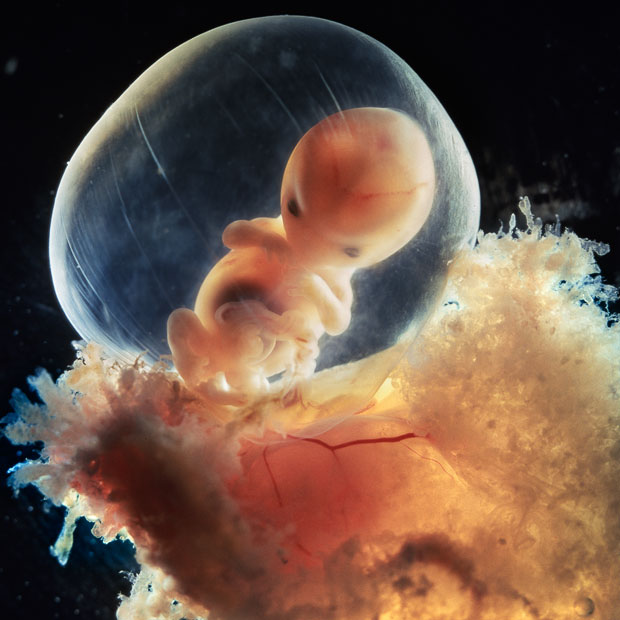
I'm Scheming Unborn Baby, and I approve this study
I’m Scheming Unborn Baby, and I approve this message

At Christian Post, an article by Douglas Groothuis. (H/T Mary)

Here’s the most useful bit:

When we separate personhood from humanity, we make personhood an achievement based on the possession of certain qualities. But what are these person-constituting qualities? Some say a basic level of consciousness; others assert viability outside the womb; still others say a sense of self-interest (which probably does not obtain until after birth). All of these criteria would take away humanity from those in comas or other physically compromised situations.4 Humans can lose levels of consciousness through injuries, and even infants are not viable without intense and sustained human support. Moreover, who are we to say just what qualities make for membership in the moral community of persons?5 The stakes are very high in this question. If we are wrong in our identification of what qualities are sufficient for personhood and we allow a person to be killed, we have allowed the wrongful killing of nothing less than a person. Therefore, I argue that personhood should be viewed as a substance or essence that is given at conception. The fetus is not a lifeless mechanism that only becomes what it is after several parts are put together—as is the case with a watch or an automobile. Rather, the fetus is a living human organism, whose future unfolds from within itself according to internal principles. For example, the fertilized ovum contains a complete genetic code that is distinct from that of the mother or father. But this is not a mere inert blueprint (which is separable from the building it describes); this is a living blueprint that becomes what its human nature demands.

Yet even if one is not sure when personhood becomes a reality, one should err on the side of being conservative simply because so much is at stake. That is, if one aborts a fetus who is already a person, one commits a deep moral wrong by wrongfully killing an innocent human life. Just as we do not shoot target practice when we are told there may be children playing behind the targets, we should not abortion fetuses if they may be persons with the right not to be killed. As I have argued, it cannot be disputed that abortion kills a living, human being.

Many argue that outside considerations experienced by the mother should overrule the moral value of the human embryo. If a woman does not want a pregnancy, she may abort. But these quality of life considerations always involve issues of lesser moral weight than that of the conservation and protection of a unique human life (which considers the sanctity or innate and intrinsic value of a human life).6 An unwanted pregnancy is difficult, but the answer is not to kill a human being in order to end that pregnancy.

I think that the real question in the abortion debate right now is whether a living organism with a human nature and a human genetic code that is distinct from its mother and father deserves the right to life, or whether it needs to develop some other capability in order to be worthy of protection from violence.

Consider something from philosopher Francis J. Beckwith.

Excerpt:

Some argue that personhood does not arrive until brain waves are detected (40 to 43 days).11Others, such as Mary Anne Warren,12 define a person as a being who can engage in cognitive acts such as sophisticated communication, consciousness, solving complex problems, self-motivated activity and having a self-concept. This would put the arrival of personhood at some time after birth. Still others, such as L. W. Sumner, 13 hold a more moderate position and argue that human personhood does not arrive until the fetus is sentient, the ability to feel and sense as a conscious being. This, according to Sumner, occurs possibly as early as the middle weeks of the second trimester of pregnancy and definitely by the end of that trimester.

Although these criteria differ from each other in important ways, they all have one thing in common: each maintains that if and only if an entity functions in a certain way are we warranted in calling that entity a person. Defenders of these criteria argue that once a human being, whether born or unborn, acquires a certain function or functions–whether it is brain waves, rationality, sentience, etc.– it is then and only then that a person actually exists. Those who defend these personhood criteria typically make a distinction between “being a human” and “being a person.” They argue that although fetuses are members of the species homo sapiens, and in that sense are human, they are not truly persons until they fulfill a particular set of personhood criteria.

Although functional definitions of personhood may tell us some conditions that are sufficient to say that a being is a person, they are not adequate in revealing to us all the conditions that are sufficient for a particular being to be called a person. For example, when a human being is asleep, unconscious, and temporarily comatose, she is not functioning as a person as defined by some personhood criteria. Nevertheless, most people would reject the notion that a human being is not a person while in any of these states. In other words, while personhood criteria, such as the ones presented by Warren can tell us that a being is a person, these criteria are not adequate to declare a being a non-person: The exercise of rational thought tells us that a being is a person; when that person is sleeping, and thus is not exercising rational thought, that lack of exercise of the thought function does not make her a non-person at that time. Consequently, it seems more consistent with our moral intuitions to say that personhood is not something that arises when certain functions are in place, but rather is something that grounds these functions, whether or not they are ever actualized in the life of a human being. Thus, defining personhood strictly in terms of function is inadequate.

If you are pro-life because of your feelings, or because someone told you to be, you ought to know that being pro-life is quite rational and supported by medical evidence. People who are pro-abortion are pro-abortion because they want recreational sex without the complications of having to care for the consequences (babies!) of their own actions. Even if they do not engage in the sex and the abortions themselves, they advocate for abortion rights, and they are guilty of encouraging a culture where 57 million unborn children have died since 1973. We’re long past Stalin numbers with this thing now.

We ought to care about not hurting other people. If grown-up’ selfish pursuit of happy feelings conflicts with another person’s right to life, then maybe we need to take a step back from being happy and start trying to be good instead.

Implications of the Supreme Court’s “Obergefell v. Hodges” decision

Gay activist vandalizes pro-marriage sign

I am linking to an article posted at the Stream about an important new book by marriage defender Ryan T. Anderson, entitled “Truth Overruled”. I have already bought myself a paperback copy of it.

Anyway, here’s the excerpt:

Anderson lays out soberly all the radical, counter-intuitive and just-plain-crazy implications of the Supreme Court decision in June, Obergefell v. Hodges, that overturned all state laws predicated on the natural, timeless structure of marriage as one man and one woman, hopefully till death:

  • Marriage is not about protecting children and helping to form future free citizens. It exists to cater to the fleeting emotional needs of adults.
  • The state recognizes marriages in order to validate the “dignity” of citizens — that is, to boost their self-esteem.
  • Men and women are exactly the same, and therefore completely interchangeable as parents.
  • Children do not need or deserve continuity of care from their biological parents. Any adult present will do.
  • The U.S. Constitution has no permanent, substantive meaning. It is instead a means by which social and legal elites can override democratic majorities whenever they feel that the time is ripe to impose new philosophical premises on the populace.
  • The free exercise of religion is no more extensive than simple free speech, and can be restricted when a religious group’s views diverge from the Court’s majority view of what the Constitution means at the moment.
  • The connection between sexual activity and human reproduction is simply accidental, a quirk of biology that has no implications for morality, law or society.
  • Those who deny any of these points are morally equivalent to white racists, and will be treated by the government with no greater deference.

Anderson is not alone in recognizing the sheer radicalism of Obergefell v. Hodges; indeed, four justices of the Court, including its Chief Justice, John Roberts, issued a stinging dissent that raises most of the objections which Anderson coolly unpacks in the course of his book. Advocates of same-sex marriage were quick to brush such arguments aside, and cast their opponents as isolated, irrational extremists, motivated only by fideistic reliance on ancient religious texts. Anderson makes it clear that this tactic is fundamentally dishonest, expanding on the dissenters’ points and fleshing each of them out with reference to history, biology, social science — and yes, even religion.

Anderson rightly avoids the temptation to simply play whack-a-mole with every specious argument offered by those who claim to advocate “marriage equality.” While he answers such objections, he also does the reader the service of clarifying and simplifying the terms of the debate, showing how it is finally, starkly, the face-off between two irreconcilable views of marriage:

  1. A “comprehensive — permanent and exclusive — union of sexually complementary spouses who engage in a comprehensive act that is inherently ordered toward a comprehensive good: the procreation and rearing of new human life.”
    and
  2. An “intense emotional union — a romantic, care-giving union of consenting adults.”

As Anderson demonstrates, the first view is the one that has existed in every human society of which we have any record, even those that tolerated polygamy and extra-marital homosexual relationships. The second, impoverished view is the program of the Sexual Revolution, whose gradual implementation (beginning with no-fault, unilateral divorce) has seen the virtual collapse of marriage, the enormous suffering of children, the disappearance of two-parent families in large swathes of society — in other words, domestic chaos.

Anderson cites solid, peer-reviewed research to show the grave harm this social change has done to the most vulnerable people in America: the children of the poor. Our prisons are disproportionately full of boys who grew up without fathers, and our welfare rolls of young girls who were sexually exploited and made pregnant as young teenagers, in part because they had no father to protect them. They in turn are likely to raise children without their biological fathers. This cycle of dysfunction can all be traced to the loosening of the marriage bond, which is only further weakened when the law itself — and even the U.S. Constitution — is invoked by our nation’s highest authorities to affirm that sex has no permanent unitive meaning, and that children’s interests must play second fiddle to the emotional needs of adults.

You might think that same-sex “marriage” could improve the well-being of children, but Anderson cites statistics showing a clear correlation between its legal adoption in particular polities, and declines in the marriage and even the birth rate.

No man is an island, and no woman neither. But least of all are children, those fragile and needy creatures who depend on us for their present, who will populate our future. The acceptance of same-sex marriage, as Anderson doggedly demonstrates, is only the latest stage in our culture’s narcissistic rejection of responsibility toward the vulnerable.

Federal enforcement of a new, invented Constitutional “right” poses a threat to religious liberty and freedom of association. Anderson lays out the well-known (and some of the lesser-known) cases of same-sex marriage advocates using the state’s coercive power to harm innocent citizens who were acting on their conscience, who declined to assist with same-sex marriages. He correctly notes the grave danger posed to churches, citing the now-infamous exchange between Obama’s solicitor general and Justice Samuel Alito, in which the former admitted that churches who decline to perform same-sex marriages may well face the same legal and tax penalties applied in the past to segregationist sects.

This little excerpt is a very good summary of the issues, and how marriage fits into the overall fight to defend the rights of children to their moms and dads, and a stable childhood where both parents sacrifice themselves for the good of their children. We need to get that culture back. If you are pro-same-sex marriage, then you are part of the problem. It doesn’t matter what you do in your personal life. If you are voting for this, you are harming society, and harming children, all for the self-esteem of self-centered grown ups. I urge all my readers to get informed about marriage and to be persuasive when talking about marriage to their neighbors.

Related posts

New study: adopted kids struggle, even with well-educated, wealthy parents

I’ll explain why I am posting this below, but for now, let’s take a look at the study, which is discussed at Family Studies. (H/T Brad Wilcox tweet)

Excerpt:

To expand what we know about adopted students, for this Institute for Family Studies research brief, I carried out a fresh analysis of data from a large longitudinal study of 19,000 kindergarten students that was conducted by the National Center for Education Statistics beginning in 1998.

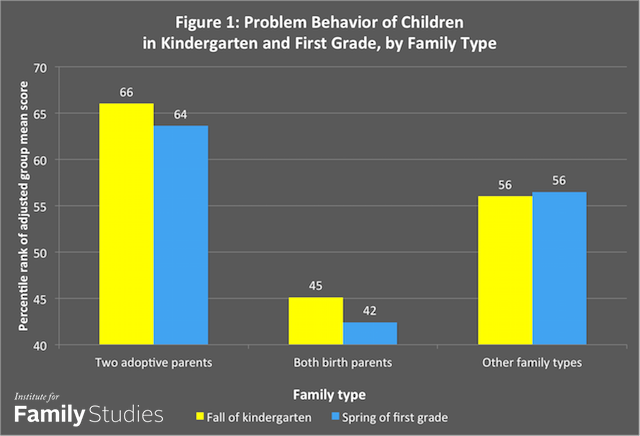
[…]Kindergarten and first-grade teachers were asked to rate the classroom behavior of children in the ECLS-K sample—how well they got along with other children in a group situation. In both the fall of kindergarten and the spring of first grade, adopted children were more likely than biological ones to be reported to get angry easily and often argue or fight with other students.

Here’s the first chart:

Adopted kids struggle in school
Adopted kids more likely to engage in problem behaviors

And more results:

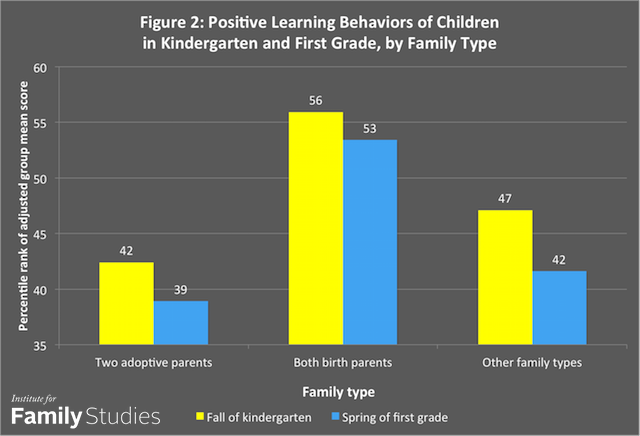
Children in the ECLS-K were also rated by their teachers on how well they paid attention in class, whether they seemed eager to learn new things, and whether they persisted at challenging learning tasks. Scores on these measures have proven to be predictive of later academic performance and career success beyond elementary school.5 Adopted children were rated less highly with respect to such positive approaches to learning than were children being raised by both birth parents.

Here’s the second chart:

Adopted kids struggle to pay attention in class

And even more results:

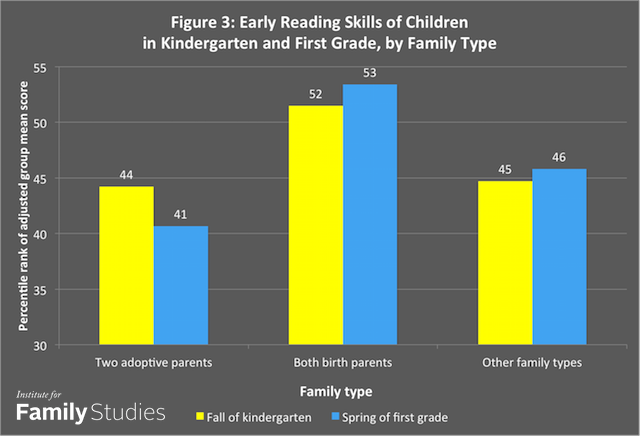
As the participating children began kindergarten, the ECLS-K assessed their pre-reading skills, such as recognizing letters by name, associating sounds with letters, identifying simple words by sight.

Here’s the third chart:

Adopted kids struggle with reading skills

And now math results:

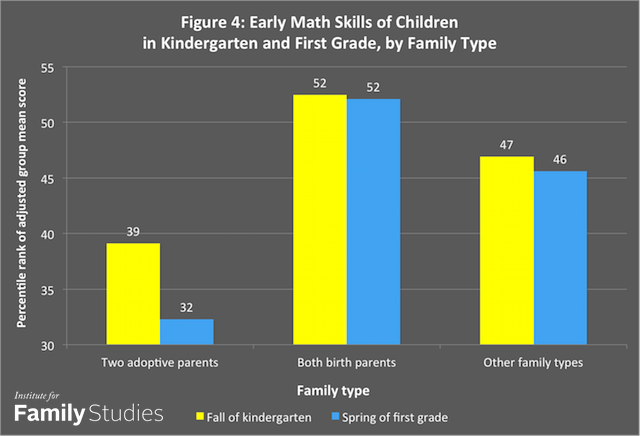
In the fall of their kindergarten year, the ECLS-K assessed children’s pre-arithmetic skills like counting by rote, recognizing written numerals, and understanding greater, lesser, and equal relationships.

Here’s the fourth chart:

Adopted kids struggle with math skills

The article concludes:

Attachment theory holds that a warm, intimate, and continuous relationship with at least one adult, usually the mother, is essential for the mental health of infants and young children. Children who do not develop a stable and secure bond during early childhood, or have the bond disrupted, are subject to both short-term distress reactions and longer-term abnormalities in their feelings and behavior toward other people. Not having a stable maternal bond is apt to produce long-lasting deficits in the child’s social development, deficiencies that are not easily remedied by a new home environment, no matter how favorable.

Some adopted children experienced neglect, abuse, or other stressful events prior to their adoption. According to traumatic stress theory, the likelihood of long-term emotional scars depends on the intensity and duration of the stress. Severe or prolonged early stress can have long-lasting effects on a child’s development, effects that a supportive adoptive family may only partly ameliorate.

So what do I want to say about this? I want to warn young women, especially young Christian women, that children work best when grown-ups plan their lives in such a way that they can provide for what the children need, at the time they need it. And if you miss the window of opportunity to have your own kids and raise them yourself, then you can’t just fix it at the last minute with ad hoc alternatives.

But for some reason, I get a lot of kickback from young women when I tell them what studies say about things like marriage, premarital sex, cohabitation, infertility, day care, and on and on and on. The Christian women in particular dismiss all the facts with stuff like:

God is leading me to choose fun and thrills now. That’s what my feelings say (and all my friends and family tell me that my feelings are God speaking to me). Tingles and peer-approval rationalize my choice to delay marriage and child-bearing. Who cares about stuff evidence? I don’t like to hear about constraints and deadlines. So I’ll just keep up this plan to run up debts, go on missionary trips, and have fun traveling till I’m 90 years old. God always calls people to do what feels good. I’m going on an adventure! And it will be easy to find a good husband and raise happy and effective kids later – whenever I feel like it. Er, I mean when God leads me to feel like it. Yeah.

So even though all of these studies show the need for timings, pre-conditions, best practices, and so on, that can all be dismissed because the feelings are God speaking to her, and God can somehow magically make all the data not apply to her. One of my married friends once wrote to a young, single fun-seeking feminist telling her about the risks of delaying marriage and child-bearing for too long, and the fun-seeker came back to me dismissing the whole letter because “I don’t like the feeling that I am being constrained”. So, the advice of old Christian women (Titus 2:4) can be dismissed because the young adventurous feminist didn’t like the feeling of being confronted by reality by someone who had more wisdom and experience than she did.

What young children need is their mom, and a Dad who can provide for her to stay home during the crucial first 5 years of their lives. That is more important than pursuing fun and thrills, then grabbing for children as if they were handbags at the last second after natural child-bearing becomes impossible. The right thing to do is to use your 20s preparing financially and otherwise to have kids when you are young, and to be financially set up to stay home with them during the critical years. Choosing a man who can provide, and who understands the best practices for having and raising children is vital, if you want your children to be effective and influential for Christ and his kingdom.

I do think that if a couple is intentionally adopting because they want the challenge and want to help a child who really needs it, then it’s praiseworthy to do that. I just don’t want someone who isn’t ready for the challenge thinking that adoption is the same, so they can delay marriage and children.I know that I am lazy, and I always want to do things the easy way. E.g. – I buy new cars, not used cars. I will buy hand-fed birds, not rescue birds. I would buy a new house, not a fixer-upper. I’m just not cut out for doing things that are hard. I have no ability to struggle through when there is resistance. When I face rejection or resistance to trying to grow or lead someone, I just give up. I think what I was saying to young women was – don’t delay marriage and child-bearing, you’ll get better results with less work.

Related posts