
Tag Archives: Child Development

New study: three or more hours of TV per day harms children’s development

From the UK Daily Mail.

Excerpt:

Toddlers who watch three hours of TV a day may end up educationally stunted, physically weak and prone to bullying, a study has revealed.

Researchers have found that after two hours of viewing, every extra hour of TV has the potential to harm a child’s development, both physically and socially.

This includes poorer vocabulary, maths skills and attention in class, victimisation by classmates and poor physical prowess at nursery.

The study looked at 1,997 boys and girls aged 29 months whose parents reported their television viewing behaviour as part of the Quebec Longitudinal Study of Child Development.

The researchers found that if a child watched up to two hours and 52 minutes of TV, they were unlikely to suffer any negative effects.

[…]The study was published in the journal Paediatric Research.

I actually made the decision to give up TV about 8 years back and stick with my computer and a high speed connection instead. One of my reasons was to avoid handing money to the people who create TV programs, because those people do not agree with my values in the vast majority of cases. Why would I give them money to present their worldview to me, when I cannot get a hearing from them?

Life Site News explains the problem.

Excerpt:

Ipsos MediaCT, a global market research company, have just released a study…

According to the report, 18 percent of Americans between the ages of 13 and 64 said that television has directly contributed to their increasing support for same-sex “marriage.”

That’s nearly double the number (10 percent) who reported television had increased their opposition to marriage redefinition.

“Based on this data, I think we can conclude that TV has, at least in part, moved the needle of public opinion to see same-sex marriage in a positive way,” Ben Spergel, Senior Vice President and Head of TV Insights at Ipsos MediaCT said in a statement.

“With everything from higher profile portrayals of gay characters, to celebrity support of gay marriage, to last year’s groundbreaking endorsement by President Obama, we are seeing a shift in our culture that is being influenced by popular culture,” he said.

Last month, liberal writer Andrew O’Hehir wrote an article for Salon crediting the American movement toward homosexual acceptance to television shows like “Will and Grace,””Roseanne,” “The Real World,” “Ellen DeGeneres,” “Buffy the Vampire Slayer,” “Modern Family,” and “Glee.”

“From ‘Soap’ to Ellen DeGeneres to Richard Hatch on ‘Survivor’ to the macho male couple who won season 4 of ‘The Amazing Race,’” O’Hehir wrote, “televisual images of sexual diversity have gradually moved away from victimology and ‘gay best friend’ stereotypes toward a ‘normalizing vision’of LGBT culture.”

“While the startling public shift on gay marriage – something few people of my generation, straight or gay, thought they’d ever see — is not solely the product of TV, it represents the ultimate fulfillment of TV’s vision of sexual equality,” O’Hehir added.

Support for same-sex “marriage” is on the rise in the United States. Recent polls show more than half of Americans support redefining marriage to include homosexual couples, and several states now allow gay nuptials in defiance of federal law.

So that’s one reason. Why would I voluntarily give money to people who are working against what I believe?

Secondly, I particularly don’t like the “passive” feel of television. If I liked mysteries, I would rather solve one than watch one being solved. If I liked sports, I’d rather play sports or play a video game with a friend of sports, than watch millionaires play sports. If I liked military history, I’d rather play a military simulation than watch a documentary. I think that I learn a lot more by doing than by seeing.
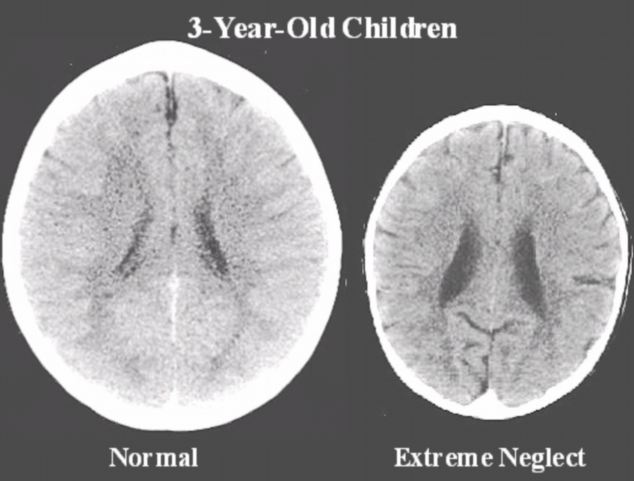
Study: brain of child neglected by mother is smaller and underdeveloped

Dina sent me this article from the UK Daily Mail.

Here is the scan:

Brain scans of 3-year old children: normal vs neglected

Excerpt:

Both of these images are brain scans of a two three-year-old children, but the brain on the left is considerably larger, has fewer spots and less dark areas, compared to the one on the right.

According to neurologists this sizeable difference has one primary cause – the way each child was treated by their mothers.

The child with the larger and more fully developed brain was looked after by its mother – she was constantly responsive to her baby, reported The Sunday Telegraph.

But the child with the shrunken brain was the victim of severe neglect and abuse.

According to research reported by the newspaper, the brain on the right worryingly lacks some of the most fundamental areas present in the image on the left.

The consequences of these deficits are pronounced – the child on the left with the larger brain will be more intelligent and more likely to develop the social ability to empathise with others.

But in contrast, the child with the shrunken brain will be more likely to become addicted to drugs and involved in violent crimes, much more likely to be unemployed and to be dependent on state benefits.

The child is also more likely to develop mental and other serious health problems.

Professor Allan Schore, of UCLA, told The Sunday Telegraph that if a baby is not treated properly in the first two years of life, it can have a fundamental impact on development.

He pointed out that the genes for several aspects of brain function, including intelligence, cannot function.

[…]The study correlates with research released earlier this year that found that children who are given love and affection from their mothers early in life are smarter with a better ability to learn.

The study by child psychiatrists and neuroscientists at Washington University School of Medicine in St. Louis, found school-aged children whose mothers nurtured them early in life have brains with a larger hippocampus, a key structure important to learning, memory and response to stress.

The research was the first to show that changes in this critical region of children’s brain anatomy are linked to a mother’s nurturing, Neurosciencenews.com reports.

The research is published online in the Proceedings of the National Academy of Sciences Early Edition.

Lead author Joan L. Luby, MD, professor of child psychiatry, said the study reinforces how important nurturing parents are to a child’s development.

I have a very good feminist non-Christian friend who sometimes comments here. I once asked her about marriage and she said that her skills would be wasting on raising children. I explained to her my view that a mother needs to stay at home with the children, and that is more important work. I expect my future wife to read all kinds of books on child care and to give the child attention, nutrition, exercise and play so that the child will grow up to be an effective Christian. Maybe I need to be clear. I am not going to spend hundreds of thousands per child with just any woman. I need a woman who can produce influential and effective Christians who will engage in the public square. And we do not entrust that job to just anyone – we want a Michele Bachmann or a Jennifer Roback Morse. Professional women who are willing to be stay-at-home moms when it’s necessary to do that.

I expect the woman I marry (if I marry) to have a college degree, and preferably a graduate degree, and a couple of years of employment. Then she has to stay home and invest in those children through the first five years at least. After that she can stay home or work as much as she thinks is beneficial to the family goals of impacting the university, the church and the public square – as well as continuing to raise those children. It’s not a waste of her talent to make the next William Lane Craig, the next Marsha Blackburn, the next Doug Axe, or the next Edith Jones.

New study: breastfeeding is slightly better for children’s intelligence

From the Wall Street Journal.

Excerpt:

Breast-feeding longer can make children smarter. That’s the conclusion of a study published Monday in JAMA Pediatrics, a journal of the American Medical Association.

[…]The latest study examined and rated each child’s environment based on factors such as how many books are available, and gave each mother an IQ test. They also asked detailed questions about factors that might influence IQ, such as child care, income and parental education. They then subtracted those factors using a statistical model. Dr. Belfort said she hopes that “what we have left is the true connection” with nursing and IQ.

[…]Researchers at Boston Children’s hospital followed 1,312 babies and mothers from 1999 to 2010. They found out how many of those children were still consuming their mothers’ milk at their first birthday, and then tested the children’s intelligence at ages 3 and 7.

[…]Children who were still nursing after a year had higher receptive language scores at age 3, which means they understood what was being said to them better than their formula-fed peers. At age 7, the breast-fed children scored higher on verbal and nonverbal intelligence tests.

In 3 year olds, every month of breast-feeding raised cognition scores by an average of .21 point. Each month of breast-feeding was associated with a .35 more verbal IQ point and a .29 more nonverbal point in the 7 year olds. A full year of nursing would boost a child’s IQ by about 4 points over a child who didn’t nurse, said Dr. Belfort, a significant bump considering that IQs average around 100. That is for children getting some breast milk in their diets; those consuming only breast milk before starting to eat solid foods around six months of age saw even greater advantages.

[…]The possible link between breast milk and brain development is only starting to be teased out. Some theories suggest that it isn’t the content of the milk but the bond between mother and child developed while nursing that accounts for some of the boost. Other ideas hinge on nutrients found in breast milk such as DHA and ARA, which are fatty acids linked to brain development. Some formula companies put DHA and ARA in their offerings.

[…]One difficulty in studying breast milk is that every feeding can vary based on the mother and what she has eaten. So the Boston researchers also examined a component in mothers’ diets that might be responsible for children’s brain development: fish, which contains DHA.

The authors found that more than two or more servings of fish per week seemed to confer IQ benefits, but that boost in children’s cognition wasn’t statistically significant.

Gee, we haven’t had any controversy on this blog since… yesterday! I wonder what everyone thinks of this study. Does it ring true to you?