Tag Archives: Career

Pre-marriage counseling is good, and pre-engagement counseling is even better


Painting: "Courtship", by Edmund Blair Leighton (1888)
Painting: “Courtship”, by Edmund Blair Leighton (1888)

OK, I was chatting with my friend McKenzie who recently got married to an amazing Christian man. She and I are both big believers in asking questions during the courtship. She sent me this article from Verily magazine that has a nice story, and lots of questions.

The article starts like this:

When you know, you know. And with Zach, I knew. Just eleven months into dating, I knew this was the man I wanted to marry. Zach felt the same about me. But instead of putting a ring on it then and there, we decided to seek out a pastor for pre-engagement counseling. You read it right, pre-engagement.

It might sound intense or premature at first, but I am here to tell you that it has been an awesome experience. Sure, the deal isn’t sealed until you say “I do,” but engagement is a huge decision, too. I don’t want to get engaged and then deal with our baggage. When Zach proposes marriage to me, I want my “Yes!” to be with eyes wide open, and pre-engagement counseling has really helped us move in that direction.

What has been so great about pre-marriage preparation? It’s a structured way for us to explore the most important ideas that will be the foundation of our marriage. We have a session once every two weeks for about an hour and a half, during which we’re working through the book Preparing for Marriage by Dennis Rainey with our pastor through homework assignments and discussing together. Of course, pre-marriage counseling can take many forms, but no matter where you might go to get pre-marriage counseling, there are certain things I think any couple should consider before truly committing. Whether you work through them pre-marriage or pre-engagement, like us, is up to you.

She has 4 sections and here they are:

  1. PERSONAL HISTORY
  2. FAMILY
  3. EXPECTATIONS
  4. MONEY MATTERS

The whole essay is very practical, but let me just quote the one that stood out to me:

Few people enjoy talking about money, and Zach certainly did not look forward to this conversation. But money, how we think about it and what we do with it, plays a big part in marital happiness. In our pre-engagement sessions we were posed with great questions when talking about finances. Here are a few of the important questions to cover in a conversation about money:

  • Who will be the primary financial provider in the family?
  • How will you decide on major purchases?
  • Who will pay the bills, balance the checkbook, and keep track of expenses?
  • What is your philosophy of giving (charitable donations to your church or other organizations), and how will you make decisions about giving?
  • What is your conviction about debt and the use of credit cards?

These were just a handful of the financial questions we were asked to think about. We also discussed how we want to handle our finances as a couple and individually (joint or separate bank accounts). It’s a lot to think about, but the goal was to get on the same page.

What I am seeing a lot of these days – I am literally seeing this everywhere – is when older women prefer to date and marry younger men who do not have jobs and who either never did some sort of post-high-school job training or are still students into their mid-20s. And I know why they do that. Younger men who are not serious about providing are very, very easy for older women to manipulate. She can throw out pretty much any crazy plan she wants – and maybe say “God told me” – and he will have no authority from his own life experiences to second guess her. Because he is not responsible or disciplined himself. Young women not only struggle enormously with respecting men, they also prefer men who they do not have to respect, so they can run the relationship based on their own feelings and intuitions.

I have also encountered a very strange attitude among young women where they think that hard work in an area that doesn’t pay is as “promising” as hard work in an area that does. Actually, this isn’t true. Some people work very hard at things that don’t pay, and some people just choose things that do pay and don’t work as hard at them. What matters is not how hard you work, it’s what is in demand. An engineer working a 40 hour week is probably going to make a lot more than a graduate student working 80 hour weeks. Or an assistant professor working 80 hour weeks. The important thing is not to just be busy and organized. It’s much safer to choose a field where you can earn a good salary without killing yourself. Work stress is a stress on the marriage, especially if both spouses have to work because the male provider isn’t making enough.

There is no substitute for earning and saving money. You can’t run a marriage without money – somebody has to pay the bills. Pre-engagement counseling is useful to find out whether one or both people has a proven record of being able to earn, save, and invest. If both people have never earned, saved, or invested, that’s a pretty bad sign. Especially the way things are going with the economy and the national debt. Marriage poses serious financial challenges, and they cannot be wished away. If your plan for prosperity is to discern God’s mysterious will through your feelings and intuitions, then you should make a new plan.

How to go to college without going into debt for the rest of your life

Choosing the right major
Choosing the right major: study one of these, or learn a trade that pays well

First, watch this this 5-minute video that explains why college is so expensive:

This video clearly makes two points:

  1. College costs more because of government subsidies
  2. Only STEM degrees are worth taking out loans for, because there is a demand for STEM-degree holders

Now, in a previous post, I explained more about what’s in the video, and linked to appropriate sources (the New York Times) for support.

But this time, I want to get some advice from a friend of mine, the famous Lindsay. She has a BS and MS in biology, was admitted to a PhD program in biology, but then decided to become a stay-at-home wife, and the best homeschooling mom in the whole world.

She writes:

It is possible to go to college and get a degree that will prepare you for a job and to do it without drowning yourself in debt. I did it. I graduated with a Master’s degree in Biology, with a 4.0 GPA throughout, with no debt, and got a job right out of college. But I’m the exception. You can’t just do what everyone else is doing and expect things to work out well for you. You have to be smart and informed or you’re likely to end up an unhappy statistic, paying down enormous debt on a degree you never use.

She has 5 pieces of advice for you young people.

Here’s my favorite:

5) Remember that the proper amount of student loans is zero and any non-zero amount must be justified by careful study and number-crunching to make sure it is worth it. Your future is at stake. In my experience, the only time student loans are an acceptable investment is when you’re going into a high paying field (think doctor, lawyer, or engineer), have very high graduation and employment potential (good grades and some work experience), and your realistic (not idealistic) future income will be sufficient to pay for your total student loans in less than 10 years while also allowing you to cover all your living expenses. You have to crunch the numbers and make sure the investment, including the interest you will pay, is worth it in better job prospects and pay than you could achieve without the degree. You can’t rely on the system to check this for you. They are all too happy to mortgage your future for a degree you can’t afford and that won’t get you a job.

Straight talk from the Lindsay.

I guess I should say something about me. It’s hard for me to remember the numbers exactly, but I think I finished my Bachelor of Computer Science with $9,000 in the black, and then graduated with a Masters of Computer Science with $16,000 in the black. As Lindsay advises in her point #4, I worked in the summers and took two semesters off (in my BS) to work full time. I went to a very ordinary school in my home town for both degrees, and chose all programming courses as much as I could. I stayed away from anything theoretical, and even niche courses. (At least until graduate school – then I went crazy and audited 5 theoretical courses in addition to my programming courses and thesis). I do recommend working in some work related to your degree, at least in the summer, even if you don’t get paid. However, if you can’t find paid work in the summer related to your degree, that’s a pretty good sign that you’re not in a program that is going to pay for itself.

I mentor a lot of young Christian men and women about their educations and careers. Of all the other young Christians I mentor, everyone is in a STEM program, except for these two girls in California who just started working on. One got a job on Monday night, and the other one (who is shy) is investigating getting a promotion at her current job, as well as adjusting the courses she is taking now. Parents really need to be on top of the education and career situation of their children. And older Christians like me, well we need to be taking an interest in young Christians… making sure they study apologetics, apply themselves in school, study for jobs that pay – either in vocational training or in a STEM college program. Something where they  can find a job that pays. This is especially important for men, because they are tasked with the role of primary provider.

By the way, college is not for everyone. Previously, I blogged about the specialty welder who has struck it rich. There are many advantages to being in a field like that where you get to work as much or as little as you want, instead of working 40 hours a week regardless of money requirements. If you don’t like welding, here’s a list of blue-collar jobs that pay well.

New study: adopted kids struggle, even with well-educated, wealthy parents

I’ll explain why I am posting this below, but for now, let’s take a look at the study, which is discussed at Family Studies. (H/T Brad Wilcox tweet)

Excerpt:

To expand what we know about adopted students, for this Institute for Family Studies research brief, I carried out a fresh analysis of data from a large longitudinal study of 19,000 kindergarten students that was conducted by the National Center for Education Statistics beginning in 1998.

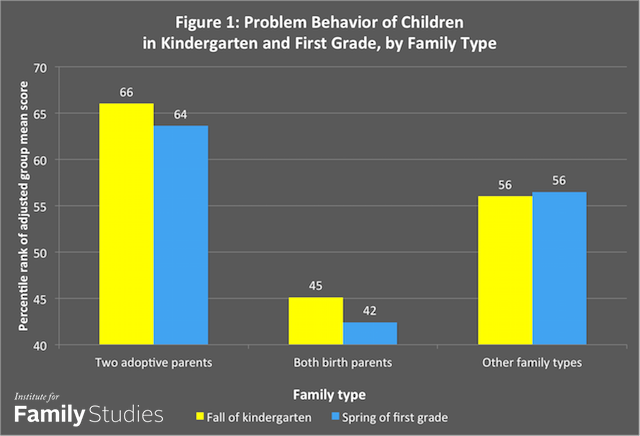
[…]Kindergarten and first-grade teachers were asked to rate the classroom behavior of children in the ECLS-K sample—how well they got along with other children in a group situation. In both the fall of kindergarten and the spring of first grade, adopted children were more likely than biological ones to be reported to get angry easily and often argue or fight with other students.

Here’s the first chart:

Adopted kids struggle in school
Adopted kids more likely to engage in problem behaviors

And more results:

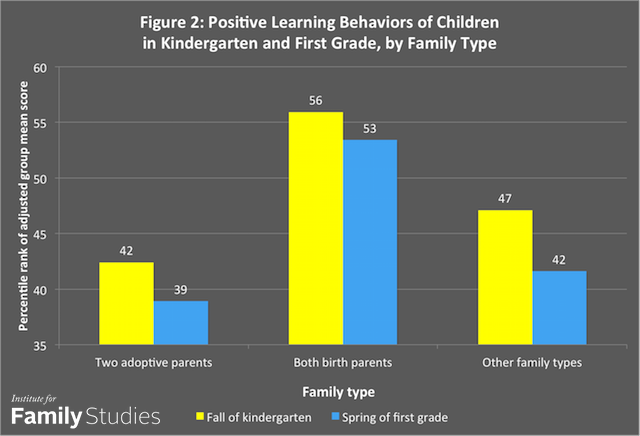
Children in the ECLS-K were also rated by their teachers on how well they paid attention in class, whether they seemed eager to learn new things, and whether they persisted at challenging learning tasks. Scores on these measures have proven to be predictive of later academic performance and career success beyond elementary school.5 Adopted children were rated less highly with respect to such positive approaches to learning than were children being raised by both birth parents.

Here’s the second chart:

Adopted kids struggle to pay attention in class

And even more results:

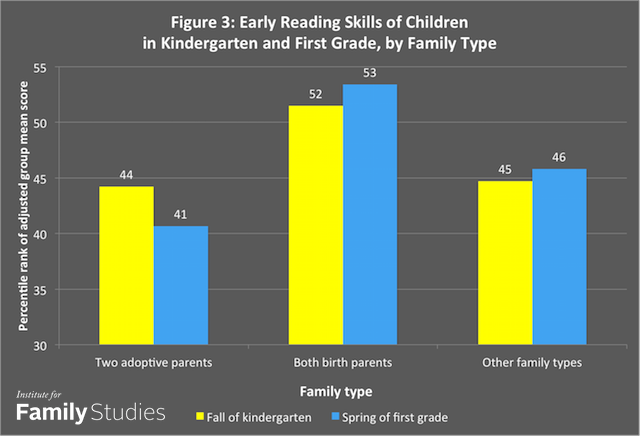
As the participating children began kindergarten, the ECLS-K assessed their pre-reading skills, such as recognizing letters by name, associating sounds with letters, identifying simple words by sight.

Here’s the third chart:

Adopted kids struggle with reading skills

And now math results:

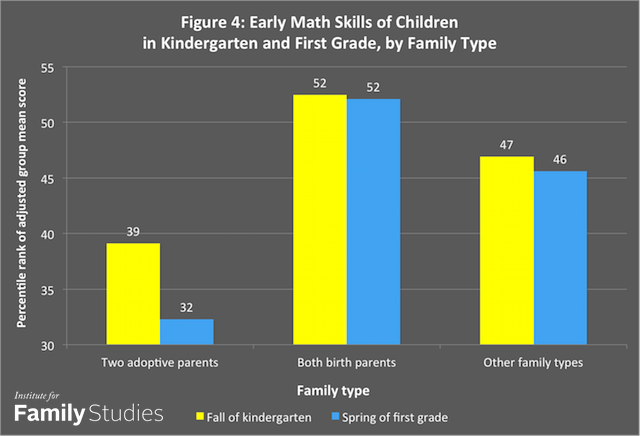
In the fall of their kindergarten year, the ECLS-K assessed children’s pre-arithmetic skills like counting by rote, recognizing written numerals, and understanding greater, lesser, and equal relationships.

Here’s the fourth chart:

Adopted kids struggle with math skills

The article concludes:

Attachment theory holds that a warm, intimate, and continuous relationship with at least one adult, usually the mother, is essential for the mental health of infants and young children. Children who do not develop a stable and secure bond during early childhood, or have the bond disrupted, are subject to both short-term distress reactions and longer-term abnormalities in their feelings and behavior toward other people. Not having a stable maternal bond is apt to produce long-lasting deficits in the child’s social development, deficiencies that are not easily remedied by a new home environment, no matter how favorable.

Some adopted children experienced neglect, abuse, or other stressful events prior to their adoption. According to traumatic stress theory, the likelihood of long-term emotional scars depends on the intensity and duration of the stress. Severe or prolonged early stress can have long-lasting effects on a child’s development, effects that a supportive adoptive family may only partly ameliorate.

So what do I want to say about this? I want to warn young women, especially young Christian women, that children work best when grown-ups plan their lives in such a way that they can provide for what the children need, at the time they need it. And if you miss the window of opportunity to have your own kids and raise them yourself, then you can’t just fix it at the last minute with ad hoc alternatives.

But for some reason, I get a lot of kickback from young women when I tell them what studies say about things like marriage, premarital sex, cohabitation, infertility, day care, and on and on and on. The Christian women in particular dismiss all the facts with stuff like:

God is leading me to choose fun and thrills now. That’s what my feelings say (and all my friends and family tell me that my feelings are God speaking to me). Tingles and peer-approval rationalize my choice to delay marriage and child-bearing. Who cares about stuff evidence? I don’t like to hear about constraints and deadlines. So I’ll just keep up this plan to run up debts, go on missionary trips, and have fun traveling till I’m 90 years old. God always calls people to do what feels good. I’m going on an adventure! And it will be easy to find a good husband and raise happy and effective kids later – whenever I feel like it. Er, I mean when God leads me to feel like it. Yeah.

So even though all of these studies show the need for timings, pre-conditions, best practices, and so on, that can all be dismissed because the feelings are God speaking to her, and God can somehow magically make all the data not apply to her. One of my married friends once wrote to a young, single fun-seeking feminist telling her about the risks of delaying marriage and child-bearing for too long, and the fun-seeker came back to me dismissing the whole letter because “I don’t like the feeling that I am being constrained”. So, the advice of old Christian women (Titus 2:4) can be dismissed because the young adventurous feminist didn’t like the feeling of being confronted by reality by someone who had more wisdom and experience than she did.

What young children need is their mom, and a Dad who can provide for her to stay home during the crucial first 5 years of their lives. That is more important than pursuing fun and thrills, then grabbing for children as if they were handbags at the last second after natural child-bearing becomes impossible. The right thing to do is to use your 20s preparing financially and otherwise to have kids when you are young, and to be financially set up to stay home with them during the critical years. Choosing a man who can provide, and who understands the best practices for having and raising children is vital, if you want your children to be effective and influential for Christ and his kingdom.

I do think that if a couple is intentionally adopting because they want the challenge and want to help a child who really needs it, then it’s praiseworthy to do that. I just don’t want someone who isn’t ready for the challenge thinking that adoption is the same, so they can delay marriage and children.I know that I am lazy, and I always want to do things the easy way. E.g. – I buy new cars, not used cars. I will buy hand-fed birds, not rescue birds. I would buy a new house, not a fixer-upper. I’m just not cut out for doing things that are hard. I have no ability to struggle through when there is resistance. When I face rejection or resistance to trying to grow or lead someone, I just give up. I think what I was saying to young women was – don’t delay marriage and child-bearing, you’ll get better results with less work.

Related posts