Tag Archives: Card Check

Do right-to-work or forced union states create more high-paying jobs?

Neil Simpson writes about a CNBC report entitled “America’s Top States for Business 2011“. At the top of the list: right-to-work states where workers are not forced to join unions that collect union dues to support Democrat policies like amnesty for illegal immigrants, taxpayer-funded abortion and legalizing same-sex marriage.

Here are the criteria used to rank states in the CNBC survey:

  • Cost of Doing Business
  • Workforce
  • Quality of Life
  • Economy
  • Transportation & Infrastructure
  • Technology & Innovation
  • Education
  • Business Friendliness
  • Access to Capital
  • Cost of Living

Red State writes:

When it comes to America’s Top States for Business 2011, when it comes to a quality workforce, 18 out of the top 20 states are Right-to-Work states. Moreover, all 22 Right-to-Work states are in the top 25 states for having the best workforces.

CNBC defines its criteria as this:

Many states point with great pride to the quality and availability of their workers, as well as government-sponsored programs to train them. We rated states based on the education level of their workforce, as well as the numbers of available workers. We also considered union membership. While organized labor contends that a union workforce is a quality workforce, that argument, more often than not, doesn’t resonate with business. We also looked at the relative success of each state’s worker training programs in placing their participants in jobs.

Since nine out of 10 of the states cited for having the best education are not right to work states, it appears that those who receive their educations in forced-union states get smart, pack up and leave, leaving the not-so-smart union extremists to invent myths about their own superiority while they pay their forced union dues.

And here’s a map of right to work states:

Right to Work State Map

Notice that they are mostly Republican states, because are the states that are run by economists and people with business experience – people who know how to create jobs, as opposed to giving speeches that demonize and threaten the people who create jobs.

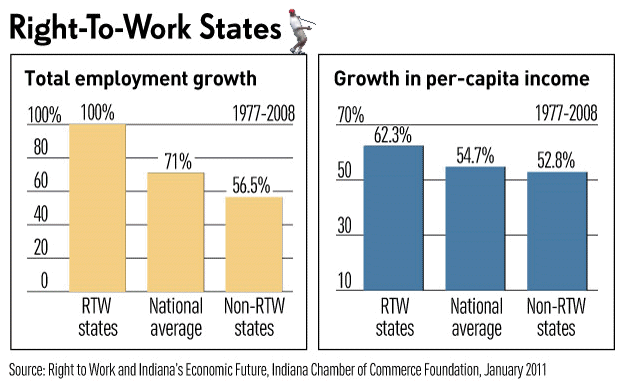
Doug Ross posted these charts a while back that show that employees also do better in right to work states. There are more jobs being created, and the income growth is higher than the forced union states.

Employment growth:

Right To Work States: Employment Growth

Income growth:

Right To Work States: Income Growth

The only losers are the unions. In right to work states, businesses and workers WIN.

What is a “right-to-work” law, and why do Democrats oppose them?

From the Heritage Foundation.

Excerpt:

It’s hard to imagine Uncle Sam telling Walt Disney where to make movies or McDonald’s how many hamburgers to make, but if you take a look at the case of the National Labor Relations Board (NLRB) versus Boeing, you’ll see that the federal government is trying to do just that: dictate where and how private industry may do business. And it’s doing so to bolster one of President Barack Obama’s favorite special interests—labor unions.

To catch you up on the story, Boeing Corporation decided to build a new assembly plant in Charleston, South Carolina, in order to produce the 787 Dreamliner. The NLRB (which is responsible investigating unfair labor practices) got wind of the decision and last month filed a complaint against Boeing, alleging that the company decided to build the plant in South Carolina out of retaliation for union strikes at its Washington state facilities. Nevermind that Boeing actually added 2,000 jobs in Washington on this particular project.

South Carolina is a right-to-work state, meaning that Boeing can hire non-union workers. For fans of big labor (like President Obama and his allies), right-to-work states are a threat to unions’ dominance. (It’s worth noting that the NLRB today is composed of four members, three of whom are Obama appointees.)

The NLRB’s intentions, then, could be easily inferred. It is doing all it can to help unions at the expense of right-to-work states, corporations and at the end of the day, American workers. But in this case, we have even more than inference.

This is important. The way to destroy the Democrats as a political party is to go after their funding.And a lot of their funding is taken from union workers, many of whom are social conservatives who don’t agree with Democrat priorities like taxpayer-funding of abortions and legalizing same-sex marriage.

Here’s a good explanation of the difference that right-to-work laws make to individual union members.

Excerpt:

As Oregon teachers and lawmakers continue brainstorming various education reforms, getting rid of mandatory union dues should be at the top of the list.

That’s nothing against the Oregon Education Association. As far as I can tell, OEA has well-meaning, knowledgeable people working for it. And unlike in Washington, where the state-level teachers union was recently riddled with lawsuits over how it spends members’ dues, Oregon teachers who have had unacceptable run-ins with their state-level union either don’t exist or are hard to find.

But no matter how decent a job a union does, a teacher should never be forced to give it money as a condition of his or her employment, especially when unions are known to engage in all sorts of politicking. Just imagine if your employer took a portion of your paycheck each month and spent it furthering causes and issues and candidates with which you disagreed.

As Susan Stacy, a special education teacher in Seaside, said, “I don’t agree with a lot of the policies or pursuits of the NEA or the OEA. And when they support organizations or causes I flat out disagree with, I don’t think I should be forced to support them. Even when it comes to organizations I think are good, it should be my choice to support them.”

Stacy has been teaching in Oregon for 12 years. Before that, she taught for five years in Utah, a state without compulsory unionism. When she was hired here, she was surprised when she received her first paycheck to find a deduction for union dues. She asked her district what it was all about since she wasn’t planning to be a member and then was informed that in Oregon she had to pay dues.

“I was incensed,” she said.

[…]Taxpayers should be against compulsory union dues, too. After all, taxpayers employ teachers, not unions. It’s crazy that the state allows a union to take hundreds of dollars from 47,000-plus educators each year to help further its agenda. While the majority of the union’s work involves collective bargaining, the union regularly opposes charter schools and partakes in legislative battles to eliminate them. It routinely backs Democrats, endorsing just eight Republicans from among 90 state races in 2008.

There is a move to pass a right-to-work law on right now in New Hampshire. This would allow workers to work without being forced to join a union, and to pay union dues.

Business leaders blame Obama for high unemployment rate

Story from Reuters about a recent jobs summit. (H/T American Spectator via ECM)

Excerpt:

At a recent symposium, Intel boss Paul Otellini, a contributor to both parties, expressed concern about the “amount of variability in the system” created by the state of policy flux in healthcare, energy and tax policy. “It is very difficult to make a hiring decision,” he said. General Electric chief executive Jeffery Immelt, a strong supporter of Obama’s cap-and-trade proposal, added he would just like to “know what the rules are.”

All in all, a disturbing replay of the 1930s when FDR’s big changes left business reeling with uncertainty and confusion. The “devil you don’t know” and all that.

Small business is certainly with Big Business on this, particularly regarding the mercurial nature of healthcare reform. The substance of ObamaCare continues to morph daily — from the state of the public option to employer mandates to financing expanded coverage – as Senate leader Harry Reid scrounges for votes. On energy, the president will make big promises at Copenhagen even though cap-and-trade looks stillborn in the Senate.

As for financial reform, Senate banking committee chair Chris Dodd has proposed sweeping changes, while the Tim Geithner-Barney Frank version in the House seems beamed in from a universe where the credit crisis never happened. Compromise could prove elusive. Even Obama’s tax reform panel has delayed releasing its findings.

The thing you have to understand about business is that finding and hiring an employee is an expensive process. If this employee has to be laid off later because of government increasing tax rates or regulations, then that layoff poisons the atmosphere in the entire company. If you want businesses to feel comfortable about hiring, you need to convince them that you aren’t going to raise their taxes or expenses, unionize their work force, fine them for hurting the environment, or pass laws that encourage their employees to sue them for being offended, etc.

Legislative initiatives like card-check, health care mandates, cap-and-trade, ENDA, increased government spending, tariffs, “pay equity” laws, restrictions on executive salaries, capital gains tax hikes, etc., make businesses very risk-averse about hiring decisions. If Obama wants to attack businesses, these businesses may just leave the USA and set up shop elsewhere. But more likely they will just stay here and avoid hiring any new employees until the 2012 election.