
Tag Archives: Canada

Canadians brace themselves for a federal election

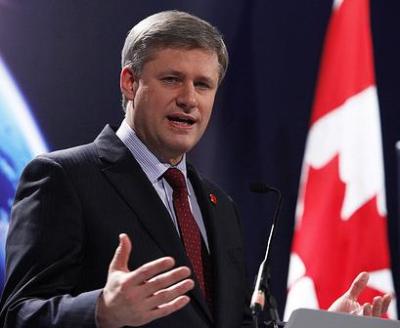
Prime Minister Stephen Harper

This just in! The Conservatives are going to take a shot at winning a majority.

Excerpt:

Canadians may face their fourth federal election in seven years as early as May, after opposition parties said they wouldn’t back Conservative Prime Minister Stephen Harper’s fiscal plan.

Leaders of all three opposition parties said that C$7.6 billion ($7.7 billion) in new measures announced yesterday by Finance Minister Jim Flaherty weren’t enough to warrant their support. Harper will face a Liberal motion of non-confidence on March 25.

Opposition lawmakers are seeking to benefit from what they say have been ethics violations by Harper’s administration, including accusations by Liberal Leader Michael Ignatieff that former Harper aide Bruce Carson was peddling influence with companies seeking state contracts, as well as charges that ministers have misled Parliament. Harper has said he doesn’t want an election that could undermine the country’s recovery.

“The opposition parties are going to talk about contempt of Parliament and ethics” to weaken the government’s position, said Robert Drummond, a political scientist at York University in Toronto. The Conservatives “are going to want to talk about their economic record.”

I don’t know why the opposition parties would focus on ethics – according to the latest poll, the Conservatives have them beat solidly on ethics.

Excerpt:

In the poll, Canadians were given two choices for what they think is the most important issue in the election.

Sixty-three per cent said that “electing a party and leader that will provide honest, open and trustworthy government” is more important.

By comparison, 37% believe that “electing a party and leader that will make sure that our economic recovery continues” is more important.

Those findings, on their surface, should be good news for the Liberals. But in an ironic twist, the very issue the Liberals are trumpeting could backfire on them in a campaign.

Here’s why:

• 28% of Canadians believe the Conservatives, if re-elected, would do the best job of “providing honest, open and trustworthy government.”

• 22% believe the NDP would do the best job of this.

• Just 15% say the Liberals would be best at providing honest, open and trustworthy government.

And more:

When it comes to the party that can do the best job at “making sure our economic recovery continues,” 37% chose the Tories, while significantly fewer believe the Liberals (20%), NDP (14%) or Bloc (6%) are best positioned to do this.

Nearly one-quarter (23%) don’t believe any of these parties would do the best job at this.

Thinking about which party would “keep taxes under control,” 36% believe the Conservatives are best able to do this, while fewer believe the Liberals (17%), NDP (16%) or Bloc (6%) are best positioned to do this. Twenty-five per cent think that some other party would do a better job with this.

One in three (33%) believe the Conservatives would do the best job at “spending taxpayers money wisely,” while others believe the NDP (18%), Liberals (16%) or Bloc (6%) would do the best job of this. Another 27% don’t believe any of these parties would do the best job at spending taxpayers money wisely.

The Conservatives currently have 143 seats, with 155 needed for a majority. The latest poll puts them just shy of a majority.

UPDATE: An even later poll puts Harper at 43% support.

Related posts

Objective truth in the abortion debate – a pro-life training video

This is a training video from CCBR, a Canadian pro-life group I really like.

That guy in the video is the one who is always getting into trouble at university debates and lectures.

Here is his biography:

Jojo has taught pro-life apologetics for both Christian and secular audiences. He has represented the pro-life side in abortion debates held at universities, trained pro-lifers at conferences and given pro-life talks at different religious venues. Jojo has also spoken to the Parliamentary Pro-life Caucus, a group made up of pro-life Members of Parliament, in 2006.

In 2006, Jojo debated Tracy Davidson, the executive director of Planned Parenthood Ottawa, and Jeannette Doucet of Canadians for Choice in Ottawa. Abortion advocates were so frustrated with the debate that they tried to ban the pro-life club which organized it.

In 2009, abortion advocates at St. Mary’s University in Halifax shouted Jojo down for 45 minutes in an attempt to stop his presentation. Because of the publicity the protests received, more people attended Jojo’s subsequent talks in the area.

Jojo also shares the Christian case for the pro-life view at a variety of different church denominations across the country. He has spoken as the main Sunday morning speaker as well as at various church venues during the week.

One Christian friend, after hearing Jojo’s pro-life presentation, said, “I can’t believe they do this [abortion] in Canada” and now supports his work.

After graduating, Jojo worked for the National Campus Life Network, the only national pro-life student organization, where he organized two national pro-life conferences.

Jojo earned a Bachelor of Journalism and a Masters in Political Science from Carleton University in Ottawa. He is a co-founder of, and works full-time with, the Canadian Centre for Bio-Ethical Reform.

Ugh! He went to that awful fascist Carleton University! No wonder they turned him into a pro-life debater!

You may also like this longer talk on pro-life apologetics by Scott Klusendorf delivered at an Alliance Defense Fund conference.

Stephen Harper’s Conservative Party cuts federal spending by 6.2%

Prime Minister Stephen Harper

More news from up north. (H/T Ben)

Excerpt:

Federal government expenditures are set to fall next fiscal year by $16.5-billion, or 6.2%, with big cuts to regional development and environment programs, according to documents tabled Tuesday.

That would leave total expenditures for the 2011-12 year at $250-billion, with the bulk taken up by transfer payments to individuals and governments, and operating costs. Just over $30-billion of that expense is attributed to refinancing Canada’s debt.

The figures, contained in spending estimates provided by the Treasury Board, sees budget increases for departments entrusted with security and law enforcement – such as a 21% boost to jails — but cuts of roughly 20% to Environment Canada, Natural Resources Canada and Agriculture and Agri-Food Canada.

Government is supposed to be concerned with security and law enforcement, not with environmentalist wastefulness.

Here’s Paul Ryan. He would like to cut our budget by 6.2% – and maybe even more.

If Canada is cutting their government waste, then why can’t we?

There are a lot of programs that we could be cutting.

Excerpt:

The federal government could save billions in taxpayer dollars annually by consolidating duplicative government programs, according to a new report.

The newly-released report from the Government Accountability Office “makes us all look like jackasses,” Sen. Tom Coburn (R-Okla.) told reporters Monday night.

The conservative senator said the report — which identifies redundancies in more than 546 individual programs — reveals why the United States is $14 trillion in debt.

“Anybody who says we don’t look like fools up here hasn’t read the report,” he said.

[…]The GAO reviewed 34 areas (among them agriculture, defense and social services) where agencies, offices or initiatives have similar or overlapping objectives. The report also looked at 47 additional cost-saving opportunities related to more general government efficiency. For instance, the report said, “Improved corrosion prevention and control practices could help [the Defense Department] avoid billions in unnecessary costs over time.”

Addressing duplicative efforts on even a single issue could save billions, the report found. For instance, the GAO says the government could save up to $5.7 billion annually by addressing potentially duplicative policies designed to boost domestic ethanol production. Additionally, the Defense Department could save $460 million annually by making broader changes to the governance of its military health care system.

The report finds that there are 15 agencies involved in food safety, 80 programs involved in economic development and more than 100 involved in surface transportation. There are 10 agencies and 82 programs involved in teacher quality, and more than 20 agencies and about 56 programs involved in financial literacy efforts. There are about 2,300 investments across the Defense Department to modernize its business operations.

House Majority Leader Eric Cantor (R-Va.) said today that in order to foster long term economic growth, “we’re going to deal with the pressing issues of regulatory waste in our agencies, as well as long term issues facing our country with entitlement programs.”

This is why we have to stop giving private sector money to government. They don’t earn any money by making things or helping people – they don’t sell anything useful. They just steal money from the productive workers and businesses and then they waste it and run up trillion dollar deficits. This kind of corruption, fraud and waste would not survive in small businesses, and probably not even in big businesses. Business have to be efficient or they go bankrupt. They have to perform or their competitors will have them for lunch. The consumer is king in the private sector.

Related posts