
Tag Archives: Canada

Evaluating common criticisms of American health care

Here is a must-read article from my friend Matt Palumbo at the American Thinker. It’s extremely high quality. (I removed the links in my excerpt – but he linked all the sources in his post)

Excerpt:

The oft-cited “46 million uninsured” is breathtakingly easy to break down to size.  Keep in mind that there is overlap in the following statistics, as many people listed in them belong to multiple categories.  Around 10 million of the uninsured aren’t even citizens.  Another 8 million are aged 18-24, which is the group least prone to medical problems.  The average salary of a person in this age group is $31,790, so affording health care would not be a problem.  Seventeen million of the uninsured make over $50,000 a year, and within that group, 8 million make over $75,000.  These people are usually referred to as the “voluntarily uninsured.”  Another large group of these 46 million are uninsured in name only, as they are eligible for government programs that they haven’t signed up for.  Estimates on how large this group is vary, the range being from 5.4 million as estimated by the Kaiser Family Foundation to as large as one third of all the uninsured, as estimated by BlueCross BlueShield.  The number of people without care because they cannot afford it is around 6 million — still a large number, but a fraction of 46 million, and no reason to restructure the entire health care system.

Then comes the issue of lifespan.  Of all attempts to discredit the American system, lifespan has been the worst.  Although lifespan gives a good indicator of a nation’s health at a glance, it does have its problems under analysis.  We get a strange paradox when examining two statistics: life expectancy and cancer survival rates.  Estimates vary on how we rank exactly; the World Fact Book showing that we rank as poorly as 50th worldwide.  Even the best estimates in our favor place us far behind most developed nations.  Despite this, the United States excels at cancer survival.  Of the 16 most common cancers, the United States has the highest survival rate for 13 of them.  Overall, the five-year cancer survival rate for men in the States is 66.3%, and 47.3% in Europe.  Women have an advantage too, with a survival rate of 62.9% in the States, and 55.8% in Europe.  So that said, how is it that our system takes better care of us, and doesn’t grant added lifespan to boot?  Quite simply, the lifespan measurement commonly cited doesn’t factor in many variables which shorten lifespan, many of which medical care cannot prevent.  Among these factors are murders, suicides, obesity, and accidents.

He looks at the uninsured number, the infant mortality rate, and other interesting things in the article, showing how the statistics that impugn the US health care system have been misused. There are some good articles linked, like this post from Commentary magazine by Scott Atlas, entitled “The Worst Study Ever?”. Atlas is the same guy who listed out how the US health care system compares to others, which I blogged about before.

You can check out Matt’s blog “The Conscience of a Young Conservative“. Not sure how scalable that blog name is. Because of the “young” part, not because of the conscience or conservative part.
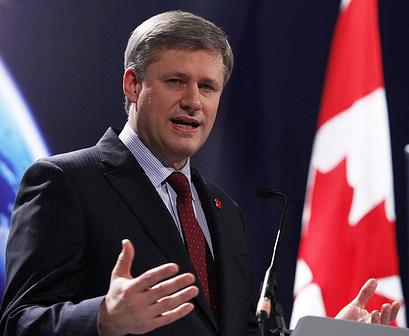
Canada’s economic boom: low tariffs, low corporate tax and more oil drilling

Prime Minister Stephen Harper

From Canoe.

Excerpt:

Finance Minister Jim Flaherty announced Sunday the government will scrap 70 tariff items to save Canadian businesses about $32 million a year.

“This builds on our government’s commitment in Budget 2010 to make Canada a tariff-free zone for industrial manufacturers,” Flaherty said in a statement. “By lowering costs for these businesses, we are enhancing their ability to compete in domestic and foreign markets and helping them invest and create jobs here at home.”

Various sectors — including food processing, apparel, electrical equipment and furniture — will benefit from the move.

The Conservatives had previously eliminated the duty on imported machinery and equipment in an attempt to make Canada a tariff-free zone for industrial manufacturers by 2015.

The Tories say that since 2009 they have eliminated more than 1,800 tariff items and have provided more than $435 million in annual tariff relief to Canadian businesses.

According to the leftist CTV news, Canada also has lower corporate taxes.

Excerpt:

The study released Wednesday by KPMG International found Canada’s corporate tax rate has dropped by more than 16 per cent over the last 11 years.

Canadian companies are actually paying less than their American counterparts.

On average, Canadian companies pay 28 per cent of their income in federal and provincial tax, well below the 40 per cent paid by American companies.

But Canada’s corporate tax rate is higher than Europe’s 20 per cent and the OECD average of 26 per cent.

Canadian corporate taxes fell three per cent in 2011, from 31 per cent in 2010.

“Canada’s corporate tax rate falls around the middle of the pack among the OECD countries,” said Elio Luongo, KPMG’s Canadian Managing Partner for Tax.

“But Canada’s general corporate tax rate is anticipated to continue to fall in 2012, when the federal tax rate will be 15 per cent, versus 16.5 per cent in 2011.”

I’ve written before about how Democrats oppose the job creation that would occur if the United States developed energy in Alaska, the Gulf of Mexico and the Ohio shale. Additionally, Obama has also opposed building the Keystone XL pipeline, which would have created 20,000 jobs paid for by a Canadian company. But Canada has no problems with developing their own energy resources, because their government operates independently of the environmentalist left.

Excerpt:

As world leaders gather in South Africa to discuss climate change this week and next, Canada’s environment minister says he plans to defend Alberta’s oilsands and is willing to argue they are an “ethical” and reliable energy source.

Heading into the 17th Conference of the Parties meeting, Environment Minister Peter Kent says he will not sign on to any deals that mandate some countries reduce greenhouse gas emissions while others don’t — as his government argues was the case under the Kyoto Protocol. He is also unequivocal in his defence of northern Alberta’s bitumen production, a position he expects will be supported by Alberta Environment Minister Diana McQueen when she joins him at the end of the week.

“We still need to — and the industry needs to and our provincial partners need to — be aggressive in ensuring international friends and neighbours and customers recognize Alberta’s heavy oil is no different from heavy oil produced in any number of other countries which don’t receive nearly the negative attention or criticism,” he says. “It is a legitimate resource.”

Kent has made headlines in the last year by arguing that Alberta’s oil is “ethical.”

“We talk about this on quite a regular basis,” Kent says. “I think it’s important we correct where we find … misunderstanding, misinformation or deliberate ignorance to demonize, to criticize and to attempt … to create a boycott.”

In January, on his second day as environment minister, Kent referred to Alberta’s oilsands product as “ethical oil” during an interview with a newspaper reporter.

Reports immediately linked Kent’s comments to the title of conservative activist Ezra Levant’s recent book, Ethical Oil: The Case for Canada’s Oil Sands.

The book essentially compares Canada’s human rights record to those of other oil-producing countries, and argues Canada’s “ethical oil” is preferable to “conflict oil” produced in countries with poor human rights records, such as Sudan, Venezuela, Saudi Arabia or Iran. The argument removes environmental issues, such as greenhouse gas emissions, from the equation, though Levant notes Alberta’s data on environmental issues is more transparent than information shared by other countries.

So in total I’ve presented three reasons why the Canadian economy is booming, while the American economy is stuck in neutral. Obama opposes free trade, lower corporate taxes and domestic energy production. When you elect a socialist lawyer, you get a Greece/Spain economy. When you elect a capitalist economist, you get Canada’s booming economy, and consequently, a lower unemployment rate. Recall that our recession began exactly when we elected Nancy Pelosi to the House leadership and Harry Reid to the Senate leadership in 2007. Democrats wreck economies. There is no reason why America cannot be more prosperous than Canada, but we have to not elect an abject buffoons as our leaders.

Should people of faith have a right to disagree with homosexuality?

From Ari, a post pleading for people of faith to defend their right to civil disagreement with others on moral questions.

Excerpt:

In Canada, citizens have been much more successful in getting the government to correct the thoughts of political heretics.  Moslem extremists and gay activists seem to be particularly keen in the use of the Canadian Human Rights Tribunals to cleanse Canada from impious speech, thought and action.

Ezra Levant, for instance, is one of my main inspirations for Bias Incident: The World’s Most Politically Incorrect Novel.  He was hauled before the tribunal for, among other things, republishing the now infamous Danish mohommad cartoons.  Pastor Stephen Boisson was fined and forbidden from preaching about the topic of homosexuality by the commission because his views on the subject offended gay activists. (Is my mind playing tricks on me, or am I beginning to notice a pattern here?)

Although homosexual conduct is forbidden by my faith, just as it is forbidden for Christians, I have never heard a rabbi mention the topic in all my years as a congregant.  I’m glad of this, because the unequivocal nature of the authentic Jewish teaching about this subject would make for a boring sermon.  Better to hear from the pulpit words of inspiration or discussion of issues that are made more interesting by there being some sort of gray area.

There are people who are offended by my opinion.  They are offended by my right and the right of my religious teachers to express that opinion, even if they almost always decline that right.  They are offended even though homosexual conduct is one of many, many acts that are forbidden by my religion and even though homosexual conduct occupies no special place among the things forbidden by my beloved faith.

I have little doubt that the persecution of Stephen Boisson has had a chilling effect on the speech of Canadian clergy.  This has to change.  Religious people must act if they are not to lose their rights one piece at a time.  They must defy the “enlightened” and “tolerant” forces that would oppose them.

The defiance doesn’t have to be hateful.  It doesn’t have to be over-the-top.  The simple, defiant declaration to conclude every sermon in the manner of Cato the Elder will suffice.  “Furthermore, I feel it my duty to call your attention to Leviticus 18:22 and Leviticus 20:13,” should be all that is necessary to stand up for free speech and to defy the bullies who would use the government to correct the thinking of its citizenry.

If enough clergy were to do so, it would be all the harder for Canada to trample on the rights of its citizens.

My secular case against same-sex marriage is here, which shows that you don’t need to be religious in order to oppose same-sex marriage.