Indiana is poised to become the first right-to-work state in more than a decade after the Republican-controlled House passed legislation on Wednesday banning unions from collecting mandatory fees from workers.
It is yet another blow to organized labor in the heavily unionized Midwest, which is home to many of the country’s manufacturing jobs. Wisconsin last year stripped unions of collective bargaining rights.
The vote came after weeks of protest by minority Democrats who tried various tactics to stop the bill. They refused to show up to debate despite the threat of fines that totaled $1,000 per day and introduced dozens of amendments aimed at delaying a vote. But conceding their tactics could not last forever because they were outnumbered, they finally agreed to allow the vote to take place.
The House voted 54-44 Wednesday to make Indiana the nation’s 23rd right-to-work state. The measure is expected to face little opposition in Indiana’s Republican-controlled Senate and could reach Republican Gov. Mitch Daniels’ desk shortly before the Feb. 5 Super Bowl in Indianapolis.
“This announces especially in the Rust Belt, that we are open for business here,” Republican House Speaker Brian Bosma said of the right-to-work proposal that would ban unions from collecting mandatory representation fees from workers.
Republicans recently attempted similar anti-union measures in other Rust-Belt states like Wisconsin and Ohio where they have faced massive backlash. Ohio voters overturned Gov. John Kasich’s labor measures last November and union activists delivered roughly 1 million petitions last week in an effort to recall Wisconsin Gov. Scott Walker.
Indiana would mark the first win in 10 years for national right-to-work advocates who have pushed unsuccessfully for the measure in other states following a Republican sweep of statehouses in 2010. But few right-work states boast Indiana’s union clout, borne of a long manufacturing legacy.
Every time one state enacts a right-to-work law, it puts competitive pressure on other states. The reason why is because businesses are attracted to right-to-work states, and they will prefer to expand there, rather than in union-friendly states. In fact, some companies will just up and move to right-to-work states, leaving the union-friendly states with no employers at all.
There are only 140,000 jobs in the whole renewable-energy sector, but in a new ad, Obama is taking credit for a “clean energy industry” that has “2.7 million jobs.” Obama inflated the number of “clean-energy” jobs by adding people who have nothing to do with clean-energy, like “trash collectors” and bureaucrats. By inflating the total, Obama was able to paper over his complete failure to live up to his utterly unrealisticcampaign promise “to create 5 million new green jobs.” Most of America’s existing green jobs predate the Obama Administration, which did not create them: “from 2003-2010, the rate of growth for clean jobs was 3.4 percent.”
Indeed, the Obama Administration used federal green-jobs money to outsource American jobs to countries like China: “Despite all the talk of green jobs, the overwhelming majority of stimulus money spent on wind power has gone to foreign companies, according to a new report by the Investigative Reporting Workshop” at American University. “79 percent” of all green-jobs funding “went to companies based overseas,” with the largest payment going to a bankrupt Australian company. “Most of the jobs are going overseas,” said Russ Choma at the Investigative Reporting Workshop.
Meanwhile, America actually lost jobs in wind-manufacturing: “Even with the infusion of so much stimulus money, a recent report by American Wind Energy Association showed a drop in U.S. wind manufacturing jobs last year.” (CBS News recently reported that there are 11 more companies, in addition to Solyndra, that are embroiled in financial trouble after receiving billions of dollars in taxpayer money; five have already filed for bankruptcy).
Obama’s mythical green-jobs are like other imaginary jobs he claimed to have created with the $800 billion stimulus package. The Obama Administration took credit for jobs created in 440 non-existent Congressional districts, such as Arizona’s 15th and 86th districts (Arizona only had 8 Congressional districts, as ABC News noted with amusement). The Washington Examiner noted that at least “75,000 jobs” Obama has claimed credit for are “clearly imaginary” or “highly doubtful.” Readers can view its interactive map of “Inflated Jobs by State.”
He’s going to have trouble defending this in a debate, as long as we pick someone who will go after him.
It’s important not to overstate the perils Romney faces. He is still by far the best-funded candidate in the race. He has a state-by-state infrastructure that is the envy of his rivals. Even if he were to lose Saturday’s South Carolina primary, he would likely remain the overall favorite to clinch the nomination.
But the procession of errors has been striking nonetheless — and it has raised concerns among many in the GOP about his vulnerabilities in a general election contest with President Obama.
Most of Romney’s awkwardness has revolved around questions about his wealth. During a heated exchange during a debate last month, he ill-advisedly offered to bet Perry $10,000 that his own account of what he had written in one of his books was correct. Perry declined, saying he was “not in the betting business,” but the episode heightened perceptions that Romney is out of touch with most Americans.
The same pattern keeps cropping up. Earlier this week, he was asked about the effective tax rate he pays on his income, and managed to injure himself twice in the space of a few sentences. First, he acknowledged that his tax rate was “probably closer to the 15 percent rate than anything.” He then added: “I get speaker’s fees from time to time, but not very much.”
The first claim was almost certainly true. Romney’s income is believed to come chiefly from long-term investments rather than earned income, and that would indeed make him liable for capital gains tax levied at a 15 percent rate. But it still places the multimillionaire in a more lightly taxed band than many voters — something which Newt Gingrich tried to take advantage of with his mocking proposal to introduce a “Mitt Romney 15 percent flat tax.”
Perhaps even worse was Romney’s “not very much” comment. His latest financial disclosure form, which covered the period from February 2010 to February 2011, revealed that he earned $374,327 for speeches. The sum is approximately seven times the median household income in the United States.
Those remarks had been preceded by a televised debate at which he gave a muddled response about whether he would release his tax returns.
Romney flubbed the tax-return question for a second time at a debate last Thursday, eliciting boos from the crowd when he said he would “maybe” follow the example of his late father, former Michigan Gov. George Romney, who released 12 years of tax returns when running for the presidency in 1968.
Romney’s mangled syntax on these occasions seems symptomatic of a wider personal unease in discussing his finances. GOP consultants say he needs to get over that discomfort if he is to prove an effective candidate.
Like many Americans, Mitt Romney has an individual retirement account. Unlike most Americans, Mr. Romney has between $20.7 million and $101.6 million in it, a big chunk of his fortune.
Experts on estate planning said it is highly unusual to accumulate such a considerable sum in an IRA, an investment vehicle restricted by annual contribution limits. It appears that Mr. Romney’s grew so large mostly because it holds investments in Bain Capital, the private-equity firm he helped start.
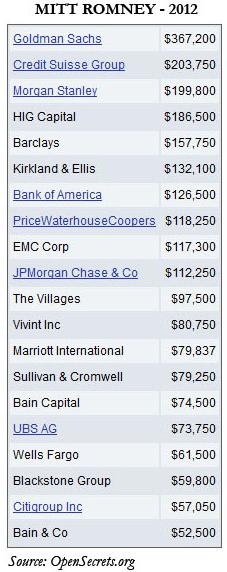
[…]Mr. Romney is one of the richest presidential candidates in decades, and his GOP opponents increasingly are trying to turn wealth into a liability. President Barack Obama is expected to do the same if the former Massachusetts governor wraps up the nomination. Mr. Romney’s tax liability has emerged as a debating point in the GOP nominating contest, a proxy for a bigger argument over who should shoulder the nation’s tax burden.
In recent days, Mr. Romney’s rivals have pressed him to release his tax returns. They have attacked him for his role at Bain Capital, the source of his wealth. When Mr. Romney revealed Tuesday that his effective federal income-tax rate had been about 15% in recent years, both the White House and GOP candidates used the number as a cudgel.
[…]Michael Whitty, a lawyer at Vedder Price in Chicago who advises private-equity executives, said it is impossible to determine from Mr. Romney’s public disclosures how the IRA grew so large. Based on its listed holdings, which include many Bain Capital vehicles, Mr. Whitty theorizes Mr. Romney may have invested in Bain funds through a 401(k)-type plan, or directed some of his Bain holdings into such a plan, which he then rolled into an IRA.
How is he going to explain that? This might be one of the reasons why Romney is not releasing his tax returns. He needs to be pounded on this by Gingrich and Santorum until he drops out – we can’t afford to choose a nominee who has no hope of beating Barack Obama.


 WINTERY KNIGHT