Tag Archives: Borrowing

Bank run in socialist Europe begins

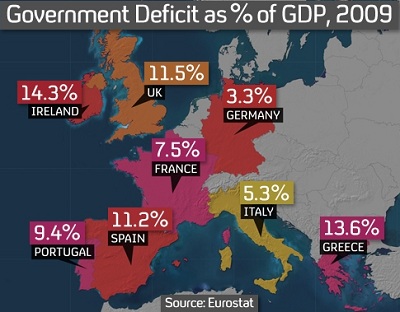
Europe: Annual Budget Deficit as % of GDP

From CNBC.

Excerpt:

Money-market funds in the United States have quite dramatically slammed shut their lending windows to European banks. According to the Economist, Fitch estimates U.S. money market funds have withdrawn 42 percent of their money from European banks in general.

And for France that number is even higher — 69 percent. European money-market funds are also getting in on the act.

Bond issuance by banks has seized up because buyers have gone on strike.

From the Economist’s Free Exchange Blog:

In the third quarter bonds issues by European banks only reached 15 percent of the amount they raised over the same period in the past two years, reckon analysts at Citi Group. It is unlikely that European banks have sold many more bonds since.

Corporate depositors are also pulling their cash.

Free Exchange:

“We are starting to witness signs that corporates are withdrawing deposits from banks in Spain, Italy, France and Belgium,” an analyst at Citi Group wrote in a recent report. “This is a worrying development.”

And there are troubling signs that banks are even running out of collateral to back their borrowings from the European Central Bank .

So far the liquidity of the European Central Bank (ECB) has kept the system alive. Only one large European bank, Dexia, has collapsed because of a funding shortage. Yet what happens if banks run out of collateral to borrow against?

And from the leftist New York Times.

Excerpt:

The flight from European sovereign debt and banks has spanned the globe. European institutions like the Royal Bank of Scotland and pension funds in the Netherlands have been heavy sellers in recent days. And earlier this month, Kokusai Asset Management in Japan unloaded nearly $1 billion in Italian debt.

At the same time, American institutions are pulling back on loans to even the sturdiest banks in Europe. When a $300 million certificate of deposit held by Vanguard’s $114 billion Prime Money Market Fund from Rabobank in the Netherlands came due on Nov. 9, Vanguard decided to let the loan expire and move the money out of Europe. Rabobank enjoys a AAA-credit rating and is considered one of the strongest banks in the world.

American money market funds, long a key supplier of dollars to European banks through short-term loans, have also become nervous. Fund managers have cut their holdings of notes issued by euro zone banks by $261 billion from around its peak in May, a 54 percent drop, according to JPMorgan Chase research.

This is really disturbing. I wonder if any of my economics-minded commenters can explain to me what happens when there is a run on banks. I am guessing that there will be some rioting over benefits as austerity measures are imposed, and interest rates will go up.

Those who complain about corporate greed may be greedy themselves

From the moderately leftist National Post.

Excerpt:

But what about that 99%? What responsibility do they bear for the situation the world finds itself in? The answer is: plenty. Greed doesn’t just live on Wall Street: it finds a home on Main Street too. And when people think it’s perfectly OK to take out mortgages they can’t afford, or rack up credit card debt to buy flat screen TVs, clothes and appliances, or draw on their home’s equity to finance cars and vacations, well, as they say, you reap what you sow.

[…]But you only have to crack open the business pages, or watch a reality TV show like Gail Vaz-Oxlade’s “Princesses” (about heavily indebted young women) to start questioning the moral purity of the 99%. Many of these people are the authors of their own misery: they consider credit to be cheap, if not free, money. The result is that even here in Canada, the ratio of household debt to personal income has hit a whopping 150%, up 78% in real terms in the past twenty years.

I have no pity for those heavily indebted people, in part because I was once one of them. My love affair with credit started in university. While the limit on that first card was low – $1500 – it allowed a student with a part-time job to buy things she couldn’t otherwise afford (and mostly didn’t need). After getting married, I kept spending, even cashing in my meagre RRSP to help finance the wedding. Post-divorce, I racked up consumer debt, over $15,000 at its peak, at which point I took a harsh look at myself and said: enough. At the time, I was selling my condo: I took the proceeds, paid off the debt, invested the balance, and vowed to both save and pay monthly bills in full, promises I have kept ever since.

Luckily, I got religion well before the meltdown of 2008. But many people didn’t. And this makes them responsible not only for their own problems, but those of their neighbours.

Sure, it’s easy to blame the Wall Street CEOs for bundling rotten mortgages and contriving arcane debt instruments that weren’t worth the paper they were written on. But someone took out those mortgages. Millions of people, actually, who bought more house than they could afford. Did someone hold a gun to their head? No. They were just as greedy as the 1%, only on a smaller scale.

Governments are also just as guilty. In the U.S., Fannie Mae and Freddie Mac granted mortgages to people deemed disadvantaged – minorities, the poor – in the hopes of increasing home ownership. This spurred the private sector to compete and fuelled the infamous subprime mortgage market.

The Canadians have special tax-free savings accounts that encourage them to save money instead of spending it. That’s something that we should do – provide people with tax-free savings accounts. Give people the incentive to save their money instead of spending it.

Andrew Klavan compares the Ryan budget to the Obama budget

Andrew Klavan on the culture. (H/T Club For Growth)

Douglas Groothuis also tweeted this Fox News article by Paul Ryan, in which Ryan talks about the current economic crisis and his plan to address the issues.

Excerpt:

There are three main reasons why the president’s policies have made this recovery weaker than usual:

1. Regulatory uncertainty: After the stimulus passed, the president turned his attention immediately to costly overhauls of the nation’s financial and health-care sectors. These overhauls needlessly transferred more control over America’s economy to government bureaucrats in Washington, without fixing the problems they were intended to address. The transfer of so much power to the arbitrary dictates of federal regulators has made it hard for businesses to plan for the future with confidence, and things will remain this way until these laws are replaced with real reforms.

2. Tax uncertainty: The president’s ad hoc tax policies, with a mix of tax hikes on job creators and temporary rebates for others being the hallmarks of his approach, have left businesses in the lurch. Moreover, the president’s new health care law imposes a crushing $800 billion tax hike, and he continues to threaten businesses and families with higher rates in the future, even as he dithers on his vague promise to address America’s uncompetitive corporate tax rate, which is the highest in the developed world.

3. Debt uncertainty: The president has not put forward a plan that saves Medicare from bankruptcy, even though nonpartisan experts tell us that this could happen in 9-13 short years unless we act. Each year that we fail to put our critical government health and retirement programs on a path to long-term solvency, we are making trillions of dollars of unfunded promises to future retirees. We are already borrowing 40 cents of every dollar we spend, and Washington’s inability to solve its spending problems is leading rating agencies such as Standard & Poors to downgrade our credit outlook. Government under this administration is failing at its number-one economic job, which is to create a stable, predictable environment for job creators.

Also: One seniors group is already supporting the Ryan plan.