14: The logical coherence of the doctrine of the Trinity
15: The logical coherence of the doctrine of the Incarnation
16: The logical coherence of the doctrine of the Atonement
17: The logical coherence of the doctrine of the Hell
18: Responding to objections to God’s knowledge of the future
I have this book, and I highly recommend this book and “Passionate Conviction: Contemporary Discourses on Christian Apologetics”, along with Lee Strobel’s “Case for…” books, as the basic building blocks of an amateur apologists’s arsenal.
You may also be interested in a new book offering a detailed response to the New Atheists, called “God Is Great, God Is Good: Why Believing in God Is Reasonable & Responsible”.
Bart Ehrman is the US author of the bestselling book “Misquoting Jesus” (In the UK “Whose word is it?”). He calls into question the authority of the New Testament as scribal changes over time have changed the documents.
So can we trust the scripture? Bible scholar Peter Williams believes in the reliability of the New Testament and that Bart’s prognosis is far too pessimistic.
This post is a re-post from 2011. I have been listening to this lecture by Peter J. Williams on “Misquoting Jesus” this week, and it reminded me to re-post this debate.
Summary of the Williams-Ehrman debate:
Note: this summary is snarky. It’s very very very snarky, and it should really be viewed as childish, immature, crude, snarky, mendacious humor, rather than an accurate summary. I just cannot stand Bart Ehrman, which his sensational Dan Brown style of expressing himself. He just makes me so mad! I hope you can all forgive me for being snarky.
Ehrman:
I had a mystical experience in childhood and became an evangelical Christian
I went to Moody Bible Institute, and they told me that the Bible was inerrant
For a while, I was committed to the view that there are no mistakes in the Bible
At Princeton, I was taught and graded by professors who did not accept inerrancy
By a strange coincidence, I began to see that the Bible did have errors after all!
We don’t have the original documents written by the original authors, we only have thousands of copies
if the words of the Bible are not completely inerrant, then none of it is historical
if all of the words in the copies of the Bible are not identical, then none of it is historical
Williams:
I would say the New and Old testaments are the Word of God
We don’t need to have the original Greek writings in order to believe in the authority of the Bible
I believe in inerrancy, but doesn’t mean there are no problems
the doctrine of inerrancy has always referred to the original Greek copies, not the translations
Moderator:
what are the main points of Misquoting Jesus?
Ehrman:
we don’t have the originals of any of the books of the New Testament
we have copies that are much later, sometimes even centuries later!!1!
the copies we have all differ from one another – they were changed by scribes!!1!
we have 5000 manuscripts in the original Greek language
there are hundreds of thousands of differences!!1!
most of the differences don’t matter
some differences are significant for meaning or doctrine
errors are propagated because the next scribe inherits the mistake of their source copy
a large gap between the time of writing and the first extant copy means more errors have crept in
Williams:
the reason we have so many variants is because the number of manuscripts is large
Angry Jesus or compassionate Jesus in Mark
Ehrman:
most manuscripts say that Jesus was compassionate when healing a leper, but one says he was angry
it makes a huge huge huge really really big difference if Jesus is compassionate or angry
the whole Bible needs to be thrown out because of this one word between different in one manuscript
Williams:
this variant is important for understanding the passage, but it has no great meaning
the change is probably just an accident – the two words are very similar visually in Greek
it’s just an accident – it emerged in one manuscript, and it impacted a few more
the tiny number of manuscripts that have the error are geographically isolated
I’m pretty sure that WK prefers the angry Jesus anyway – so who cares?
Ehrman:
no! someone changed it deliberately! it’s a conspiracy! you should buy my book! it’s a *big deal*!!!!!1!!1!one!!eleventy-one!
The woman caught in adultery in John
Ehrman:
it is isn’t in any of the earliest manuscripts
this is an apocryphical story that some scribe deliberately inserted into the text
most people don’t even know about this! it’s a cover-up! you need to buy my scandalous book!
Williams:
that’s right, it’s a late addition by some overzealous scribe
and it’s clearly marked as such in every modern Bible translation
the only people who don’t know about this are people who don’t read footnotes in their Bible
and in any case, this isn’t a loss of the original words of the New Testament – it’s an addition
Grace of God or apart from God in Hebrews
Ehrman:
well this is just a one word difference, but it makes a huge huge really really big difference!
the words are very similar, so it’s could be an accident I guess
but it wasn’t! this was a deliberate change! it’s a conspiracy! it’s a cover-up! scandal!
buy my book! It’s almost as good as Dan Brown!
Moderator:
hmmmn…. I kind of like “apart from God” – why is this such a big scandal again?
Ehrman:
you don’t care? how can you not care? it has to be inerrant! or the whole thing is false!
Moody Bible Institute says!
Williams:
yeah Bart is always saying that every change is deliberate but it’s just an accident
the words are very similar, just a few letters are different, this is clearly an accident
I have no problem with apart from God, or by the Grace of God
please move on and stop screaming and running around and knocking things over
Moderator:
but what if pastors try to use this passage in a sermon?
Williams:
well, one word doesn’t make a big different, the meaning that appears is fine for preaching
it’s only a problem for people who treat the Bible as a magic book with magical incantations
they get mad because if one word is out of place then the whole thing doesn’t work for their spell
then they try to cast happiness spells but the spells don’t work and they experience suffering
the suffering surprises them since they think that fundamentalism should guarantee them happiness
then they become apostates and get on TV where they look wide-eyed and talk crazy
Ehrman:
hey! are you talking about me? a lot of people buy my books! i am a big success!
it is very important that people don’t feel bad about their sinning you know!
Is Misquoting Jesus an attack?
Williams:
it’s rhetorically imbalanced and misleading
it tries to highlight change and instability and ignore the majority of the text that is stable
he makes a big deal out of 5 or so verses that are different from the mainstream text
he says that scribes deliberately changed the scriptures, but he doesn’t prove that
it’s just as likely that the differences are just scribal errors made by accident
Ehrman:
well, maybe the variants aren’t a big deal, but what about one angel vs. two angels?
that’s a significant issue! significant enough for me to become an apostate – a rich apostate
if one word is different because of an accident, then the whole Bible cannot be trusted
it has to be completely inerrant, so a one word difference means the whole thing is unreliable
we don’t even know if Jesus was even named Jesus, because of one angel vs two angels!!!1!
buy my book! you don’t have to read it, just put it on your shelf, then you’ll feel better about not having a relationships with God – because who’s to say what God really wants from you? Not the Bible!
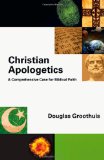
Looking for a good textbook on apologetics that covers everything you need to know? Check out Dr. Groothuis’ book. It’s now under $22 on Amazon.
Here are the chapters:
Part I: Apologetic Preliminaries
1 Introduction: Hope, Despair and Knowing Reality
2 The Biblical Basis for Apologetics
3 Apologetic Method: Evaluating Worldviews
4 The Christian Worldview
5 Distortions of the Christian Worldview–or the God I Don’t Believe In
6 Truth Defined and Defended
7 Why Truth Matters Most: Searching for Truth in Postmodern Times
8 Faith, Risk and Rationality: The Prudential Incentives to Christian Faith
Part II: The Case for Christian Theism
9 In Defense of Theistic Arguments
10 The Ontological Argument
11 Cosmological Arguments: A Cause for the Cosmos
12 The Design Argument: Cosmic Fine-Tuning
13 Origins, Design and Darwinism
14 Evidence for Intelligent Design
15 The Moral Argument for God
16 The Argument from Religious Experience
17 The Uniqueness of Humanity: Consciousness and Cognition
18 Deposed Royalty: Pascal’s Anthropological Argument
19 Jesus of Nazareth: How Historians Can Know Him and Why It Matters by Craig L. Bloomberg
20 The Claims, Credentials and Achievements of Jesus Christ
21 Defending the Incarnation
22 The Resurrection of Jesus
Part III: Objections to Christian Theism
23 Religious Pluralism: Many Religions, One Truth
24 Apologetics and the Challenge of Islam
25 The Problem of Evil: Dead Ends and the Christian Answer
26 Conclusion: Take It to the Streets
Appendix 1 Hell on Trial
Appendix 2 Apologetic Issues in the Old Testament by Richard S. Hess
Contemporary Christians interested in apologetics can now turn to another text that is bound to become one of the most-used textbooks in apologetics. Douglas Groothuis’ Christian Apologetics: A Comprehensive Case for the Biblical Faith (InterVarsity, 2011) may have more breadth both in content and wisdom than any apologetics text to date. The subtitle is justified as the book, over 700 pages and 26 chapters long (not including two appendixes), presents the need for apologetics and explores the main philosophical arguments for the existence of God. Unlike other apologetics texts, Groothuis includes chapters examining truth in postmodern society, religious pluralism, and a tactful approach to dealing with Islam. Furthermore, biblical scholars (and Denver Seminary colleagues) Richard Hess and Craig Blomberg build on an already strong text by writing chapters on apologetics in the Old Testament (Appendix 2) and a historical approach to the person of Christ and the gospels, respectively.
Here’s a snip from the review:
The chapter on cosmological arguments is superb and only further qualifies Groothuis as a proficient thinker. This chapter without question is the chapter I learned the most from. Groothuis engages very difficult scientific and philosophical concepts and communicates them in a way that even the beginner will be able to grasp. Though there are many different versions of the cosmological argument, the chapter hones in on the kalam cosmological argument as put forth by William Lane Craig. The kalam argument is superior to other cosmological arguments in that it supposedly secures the theistic doctrine of ex nihilo if the arguments proves successful (note: a minor quibble of this chapter is that Groothuis purports that the Thomistic cosmological argument does not endorse ex nihilo. I believe this to be false). This specific chapter was sensational – however I was left disappointed that no time was given to addressing the cosmological argument posited by Aquinas. In some respects, the Thomistic cosmological argument is the simplest form for people new to apologetics. The Thomistic version does not get into the technical issues of the metaphysics of time and Big Bang cosmology that the kalam version uses, nor does it require knowledge of the principle of sufficient reason that the Leibnizian version necessitates. While the kalam and Leibnizian versions are logical and sound arguments, they may confusing to people new to apologetics. Because of this, beginners ought to take the time to read this chapter slowly and more than once because of the finer technical details.
Chapters 12-14 are devoted to the design argument and issues relating to it. Groothuis opposes macroevolution and thus goes to great extent to battle Darwinism. Those interested in the philosophy of science will be drawn to these chapters. The chapter focused on intelligent design relies heavily on the work of William Dembski and Michael Behe. These chapters serve as a valuable introduction for those new to discussion between Christian and naturalistic sciences.
Chapter 15 is perhaps the most successful chapter of the entire book as it deals with the moral argument. It is my belief that the moral argument is the most successful argument for the existence of God as it appeals to everyone, Christian, atheist, and non-Christian religious persons. Ethical theory may perhaps be the most widely debated philosophical topic throughout history and thus Groothuis could have taken many approaches when discussing the moral argument. The way he structured his chapter, however, is nearly flawless. Building off his chapter examining truth in the postmodern culture (chapter 7), Groothuis correlates the denial of objective truth to the ridding of objective moral value. He unmercifully attacks moral relativism and brilliantly shows its dangers. He states that cultural relativism reduces to individual relativism, which, in turn, ultimately rests on nihilism. The setup of this reductio ad absurdum points the reader to a moral system that does not reduce to nihilism. Thus, a worldview that embraces objective moral truths must be embraced. Groothuis makes the claim that the source of objective moral truths is found in the absolute Being – God. Groothuis puts for the notion that God is the source of all perfect moral code because he himself is incapable of an evil act as it would be a contradiction of God’s Being.
I think that the big advantage you get from Doug Groothuis is his worldview. He has the most fully-integrated worldview of any Christian scholar I know.
I bought one copy of Dr. Groothuis’ book, but I gave it away. So I got myself another one. It’s a must have. My favorite four apologetics books are this one, “Philosophical Foundations for a Christian Worldview” by William Lane Craig and J.P. Moreland, Michael Licona’s “The Resurrection of Jesus” and Stephen C. Meyer’s “Signature in the Cell”. I think that if you add Wayne Grudem’s “Politics According to the Bible” to that list, then that’s a very practical set of tools.

 WINTERY KNIGHT