
Tag Archives: Birds

Wisconsin Health Board declares that wind power is a public health risk

From the Green Bay Gazette.

Excerpt:

Brown County health officials have declared wind turbines a public health risk, but they haven’t determined how to put their declaration into action.

The county’s Health Board this month declared the Shirley Wind Farm operated by Duke Energy Renewables poses a health risk to its neighbors in the town of Glenmore. Three families have moved out of their homes rather than endure physical illness they blame on the low-frequency noise the wind turbines generate, according to Audrey Murphy, president of the board that oversees the Brown County Health Department.

[…]Whatever happens, residents “are grateful to the Board of Health for reviewing the research and listening to the people of Brown County,” said Susan Ashley, who also lives in the Shirley area and who has helped rally opposition to the wind farm through the years.

Twenty families in the town have documented health issues since the wind farm started operated in 2010, Ashley said.

Duke Energy Renewables was not invited to the health board’s discussion and would have cited tests that determined sound levels from the wind generators were low and could not be linked to adverse health impacts, company spokeswoman Tammie McGee said. The company has not received any formal word about the board’s declaration, McGee said.

Dr. Jay Tibbetts, vice president of the Brown County health board and its medical adviser, said he knows of no science that proves there isn’t a link between health problems and the low-frequency noise the giant fans produce.

“There’s been nothing that’s debunked anything,” he said. “As far as what’s happening to these people, it doesn’t make a difference whether you’re in Shirley or Denmark, or Ontario, Canada. Forty people have moved out of their homes, and it’s not just for jollies. In Shirley, three people have moved out of their homes. I know all three. They’re not nuts. They’re severely suffering.”

People might not be able to hear the sounds the Shirley turbines produce, but Tibbetts said he knows of a teenager living in the area who can tell when the turbines are off or on without being able to see them. Area residents or former residents report headaches, nausea and other symptoms they say are brought on by the turbines, and those symptoms clear up when the residents move elsewhere for a time, Tibbetts said.

Previously, I blogged about how wind power is a threat to birds – even rare, protected birds.

Excerpt:

Wind energy facilities have killed at least 67 golden and bald eagles in the last five years, but the figure could be much higher, according to a new scientific study by government biologists.

The research represents one of the first tallies of eagle deaths attributed to the nation’s growing wind energy industry, which has been a pillar of President Obama’s plans to reduce the pollution blamed for global warming. Wind power releases no air pollution.

But at a minimum, the scientists wrote, wind farms in 10 states have killed at least 85 eagles since 1997, with most deaths occurring between 2008 and 2012, as the industry was greatly expanding. Most deaths — 79 — were golden eagles that struck wind turbines. One of the eagles counted in the study was electrocuted by a power line.

The vice president of the American Bird Conservancy, Mike Parr, said the tally was “an alarming and concerning finding.”

And this is not only something that Democrats know about – they are actually protecting these bird killers.

Look at this article from ultra-liberal PBS:

The Obama administration said Friday it will allow some companies to kill or injure bald and golden eagles for up to 30 years without penalty, an effort to spur development and investment in green energy while balancing its environmental consequences.

The change, requested by the wind energy industry, will provide legal protection for the lifespan of wind farms and other projects for which companies obtain a permit and make efforts to avoid killing the birds. An investigation by The Associated Press earlier this year documented the illegal killing of eagles around wind farms, the Obama administration’s reluctance to prosecute such cases and its willingness to help keep the scope of the eagle deaths secret. The White House has championed wind power, a pollution-free energy intended to ease global warming, as a cornerstone of President Barack Obama’s energy plan.

In other areas, too, such as the government’s support for corn-based ethanol to reduce U.S. dependence on gasoline, the White House has allowed the green industry to do not-so-green things. Another AP investigation recently showed that ethanol has proven far more damaging to the environment than politicians promised and much worse than the government admits today.

Under the change announced Friday, companies would have to commit to take additional measures if they kill or injure more eagles than they have estimated they would, or if new information suggests that eagle populations are being affected. The permits would be reviewed every five years, and companies would have to submit reports of how many eagles they kill. Now such reporting is voluntarily, and the Interior Department refuses to release the information.

Just because something is called green, it doesn’t make it good for nature.
New $2.2 billion solar plant kills one bird every two minutes

From the leftist Washington Post: (H/T Barbara)

Workers at a state-of-the-art solar plant in the Mojave Desert have a name for birds that fly through the plant’s concentrated sun rays — “streamers,” for the smoke plume that comes from birds that ignite in midair.

Federal wildlife investigators who visited the BrightSource Energy plant last year and watched as birds burned and fell, reporting an average of one “streamer” every two minutes, are urging California officials to halt the operator’s application to build a still-bigger version.

The investigators want the halt until the full extent of the deaths can be assessed. Estimates per year now range from a low of about a thousand by BrightSource to 28,000 by an expert for the Center for Biological Diversity environmental group.

[…]Federal wildlife officials said Ivanpah might act as a “mega-trap” for wildlife, with the bright light of the plant attracting insects, which in turn attract insect-eating birds that fly to their death in the intensely focused light rays.

Federal and state biologists call the number of deaths significant, based on sightings of birds getting singed and falling, and on retrieval of carcasses with feathers charred too severely for flight.

The Associated Press had this to say this about wind power:

The Obama administration said Friday it will allow some companies to kill or injure bald and golden eagles for up to 30 years without penalty, an effort to spur development and investment in green energy while balancing its environmental consequences.

The change, requested by the wind energy industry, will provide legal protection for the lifespan of wind farms and other projects for which companies obtain a permit and make efforts to avoid killing the birds. An investigation by The Associated Press earlier this year documented the illegal killing of eagles around wind farms, the Obama administration’s reluctance to prosecute such cases and its willingness to help keep the scope of the eagle deaths secret. The White House has championed wind power, a pollution-free energy intended to ease global warming, as a cornerstone of President Barack Obama’s energy plan.

If it were up to me, I would just stick with clean natural gas and fracking, and build the Keystone XL pipeline. That would create a lot of jobs, and without wasting taxpayer money to reward Obama’s rich campaign donors who often own these green energy companies. But then I guess the White House would reply “but then who will kill all the endangered bird species unless we pay people to do it?”.

The best explanation for the design of bird wings is intelligent design

A great post from Evolution News about my favorite animals in the whole world – BIRDS!

Excerpt:

How hard can it be to make a flexible wing flap for an airplane? Almost all aircraft today use rigid wings with rigid landing flaps. They work, but they waste fuel. German engineers embarked on a mission to reduce kerosene consumption by 6%: “integrating flexible landing devices into aircraft wings is one step towards that target,” a news item from Fraunhofer says. They’ve named the project SARISTU, for Smart Intelligent Aircraft Structures.

Birds are way ahead of them:

While birds are able to position their feathers to suit the airflow, aircraft wing components have so far only been rigid. As the name suggests, landing flaps at the trailing edge of the wing are extended for landing. This flap, too, is rigid, its movement being limited to rotation around an axis. This is set to change in the SARISTU project. “Landing flaps should one day be able to adjust to the air flow and so enhance the aerodynamics of the aircraft,” explains Martin Schüller, researcher at the Fraunhofer Institute for Electronic Nano Systems ENAS in Chemnitz. (Emphasis added.)

What are some of the challenges in building a flexible wing?

  1. Knowing where to flex: The flap can’t be flexible all over, or it would be hard to control. The designers made “five hard and three soft zones, enclosed within a silicon skin cover extending over the top.”
  2. Finding stretchy skin: When the soft zone moves, the skin of the aircraft has to stretch with it. “The mechanism that allows the landing flap to change shape can only function if the skin of the landing flap can be stretched as it moves, a problem tackled by researchers from the Fraunhofer Institute for Manufacturing Technology and Advanced MaterialsIFAM in Bremen.”
  3. Covering the air gap: “Any gap between the flap and the fixed aircraft wingwould cancel out any positive effect,” the article notes. “This led us to develop an elastic connecting element, and this work already covers everything from the chemical makeup to the process technology andmanufacture of the component,” an engineer says.
  4. Designing the material to tolerances: “The mechanism sits underneath the soft zones, the areas that are most distended. While the novel design is noteworthy, it is the material itself that stands out, since the flexible parts are made of elastomeric foam that retain their elasticity even attemperatures ranging from minus 55 to 80 degrees Celsius.”

No feathers, but it’s a start. The team showed off their prototype at the ILA Berlin Air Show in May. Apparently it was not quite ready for takeoff:

When the prototype takes off for the first time it will benefit from a development known as SARISTU, a deformable wing which is currently the subject of intensive research by Fraunhofer Gesellschaft. In future the landing flaps will be designed to adapt in flight to the air flow conditions, thereby always ensuring the best possible aerodynamics.

We celebrate this advance, but you know where we’re going. Birds had it all figured out long ago: the right shape, the right material, the control of airflow, and much more. As Dr. Timothy Standish says in the film Flight: The Genius of Birds, “Feathers do a number of jobs remarkably well.” They are individually controllable, they flex, they insulate, they save on weight, and they can handle the temperature requirements of avian flight. That’s just a partial list achievements in powered flight that surpass anything man has yet designed.

If you want to get hold of that DVD on “Flight” that they mentioned, it’s right here on Amazon.com. I highly recommend it.

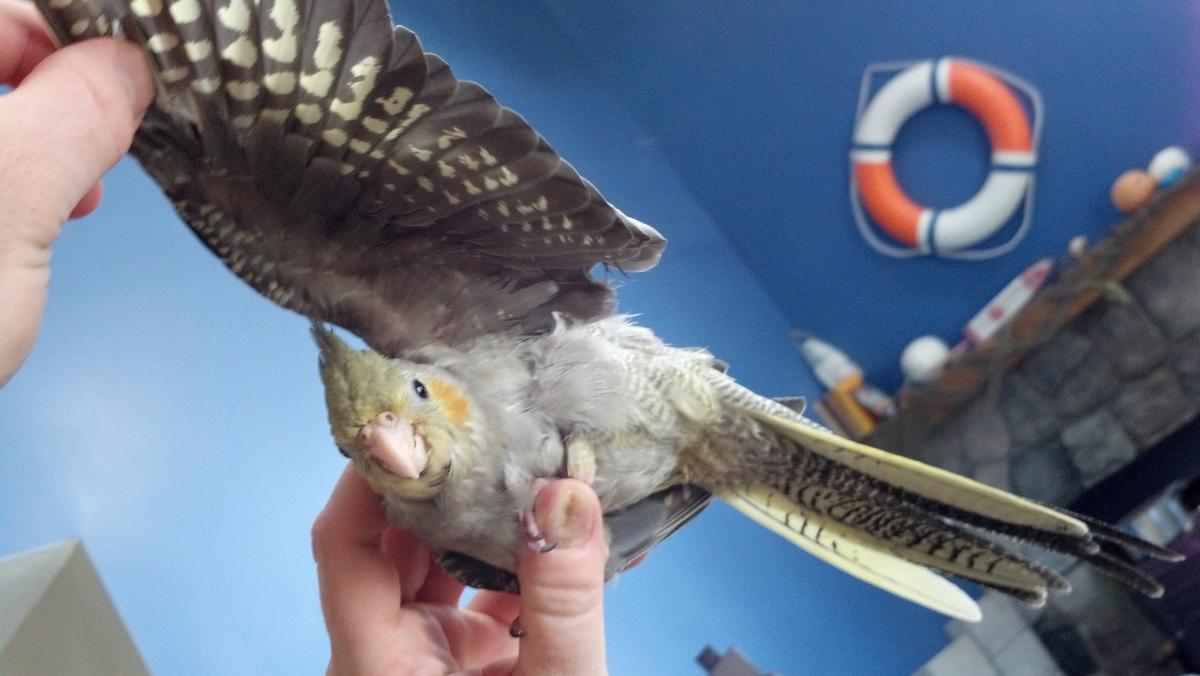
I also highly recommend owning birds – because if you work really hard at caring for one for a long time, they might grow to trust you. There is nothing quite like a tiny little bird trusting you enough to let you gently pull open his or her wing for a closer look at how it works:

Cockatiel lets a trusted friend see her wing
Awww! Cockatiel lets a trusted friend see under her wing

There’s more to birds than just well-designed wings. There’s a well-designed heart in there, too! That might even be more amazing than the design of the wing. It is to me.

Note: although this post does not provide a rigorous case for intelligent design, that can be found by looking at the work of Stephen C. Meyer on the origin of life and on the Cambrian explosion. The books that demonstrate the superiority of the intelligent design hypothesis are “Signature in the Cell” and “Darwin’s Doubt“. If you’d like to see a good popular-level presentation of intelligent design related to the origin of life, click here for a lecture.