
Tag Archives: Biomimetics

Biomimetics again: scientists reverse engineer the design of snake scales

Apologetics and the progress of science

Today, I have an example of biomimetics.

But first, here’s what that is:

Biomimetic refers to human-made processes, substances, devices, or systems that imitate nature. The art and science of designing and building biomimetic apparatus is called biomimetics, and is of special interest to researchers in nanotechnology, robotics, artificial intelligence (AI), the medical industry, and the military.

This is from Science Daily. (H/T Fuz Rana)

It says:

A snake moves without legs by the scales on its belly gripping the ground. It generates friction at the points needed to move forwards only and prevents its scales from being worn off by too much friction. Researchers of KIT have found a way to transfer this feature to components of movable systems. In this way, durability of hip prostheses, computer hard disks or smartphones might be enhanced.

“Friction and wear are two of the biggest challenges in systems of several individual components,” Christian Greiner of the Institute for Applied Materials says. A solution is found in nature: Snakes, such as the ball python, or lizards, such as the sandfish skink, use friction to move forwards, but can reduce it to a minimum thanks to their scales. Together with Michael Schäfer, Greiner developed a process to transfer the scale structure of reptiles to components of electromechanical systems: With a fiber laser, they milled scales into a steel bolt of 8 mm in diameter.

With the help of two different structures, the materials researchers tested whether the distance of the scales influences friction behavior. In the first structure, the scales overlap and are located very closely to each other, such as the scales on the belly of a ball python. The second structure consists of scales arranged in vertical rows at a larger distance, such as the skin of a sandfish skink. “The distance between the rows in our experiment was the smallest possible distance we could produce with the laser. The structure, hence, does not entirely correspond to that of the sandfish skink,” Greiner says. In the future, however, the researchers plan to produce structures that are closer to the original in nature.

[…]To find out whether scales reduce friction, Greiner and Schäfer fixed the structured surface of the bolts to a rotating plate. The experiments were carried out without and with a lubricant (1 ml of mineral oil). For the experiments with oil as lubricant, the scientists used steel disks. Under dry sliding conditions, sapphire disks were applied. The disk diameter was 50 mm.

Experiments under lubricated conditions revealed that both narrow and wide arrangements of the scales increase friction compared to the unstructured bolt: By the wide scales, friction is increased by a factor of 1.6. The narrow scales increase friction by a factor of 3. In the non-lubricated state, the wide scale structure reduced friction by more than 40 percent, while friction was reduced by 22 percent in case of a narrow scale structure.

The finding that the narrow scale structure increases friction under both lubricated and non-lubricated conditions had not been expected by the researchers: “We assumed that the narrow structure is more effective, as it is closer to nature,” Greiner says.

See the related posts for more examples of humans learning from the engineering designs in nature.

Related posts
Define biomimetics and give two examples from peer-reviewed science journals?

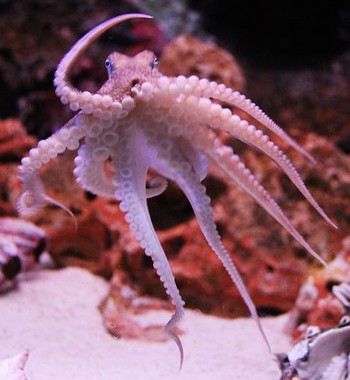
I'm baby octopus, and I approve this message
I’m baby octopus, and I approve this message

Today, I have two examples of biomimetics.

But first, here’s what that is:

Biomimetic refers to human-made processes, substances, devices, or systems that imitate nature. The art and science of designing and building biomimetic apparatus is called biomimetics, and is of special interest to researchers in nanotechnology, robotics, artificial intelligence (AI), the medical industry, and the military.

Here’s the first example from Science Daily.

A robotic arm that can bend, stretch and squeeze through cluttered environments has been created by a group of researchers from Italy.

Inspired by the eight arms of the octopus, the device has been specifically designed for surgical operations to enable surgeons to easily access remote, confined regions of the body and, once there, manipulate soft organs without damaging them.

It is believed the device could reduce the number of instruments, and thus entry incisions, necessary in surgical operations, with part of the arm being used to manipulate organs whilst another part of the arm operates.

The device, which has been presented 14 May, in IOP Publishing’s journal Bioinspiration and Biomimetics, holds a key advantage over traditional surgical tools due to its ability to quickly transform from a bending, flexible instrument into a stiff and rigid instrument.

It has been inspired by the eight highly flexible arms of the octopus which have no rigid skeletal support and can thus easily adapt to the surrounding environment by twisting, changing their length or bending in any direction at any point along the arm.

The octopus can, however, vary the stiffness of its arms, temporarily transforming the flexible limbs into stiffened segments to allow the octopus to move and interact with objects.

[…]The ability of the robotic arm to manipulate organs while surgical tasks are performed was successfully demonstrated in simulated scenarios where organs were represented by water-filled balloons.

‘Traditional surgical tasks often require the use of multiple specialized instruments such as graspers, retractors, vision systems and dissectors, to carry out a single procedure,’ Dr Ranzani continued.

‘We believe our device is the first step to creating an instrument that is able to perform all of these tasks, as well as reach remote areas of the body and safely support organs around the target site.’

Fascinating, and useful. If we are reverse engineering these designs, should we assume that they were designed in the first place? Especially when there is zero evidence for macroevolution either in the lab or in the fossil record.

The shorebird's beak is more interesting than you might think
The shorebird’s beak is more interesting than you might think

My second example of biomimetics is also from Science Daily.

Excerpt:

A UT Arlington engineering professor and his doctoral student have designed a device based on a shorebird’s beak that can accumulate water collected from fog and dew.

The device could provide water in drought-stricken areas of the world or deserts around the globe.

Xin Heng… a doctoral student in Mechanical and Aerospace Engineering, and Cheng Luo, MAE professor, have made a device that can use fog and dew to collect water.

Cheng Luo, professor in the Mechanical & Aerospace Engineering Department, and Xin Heng, PhD candidate in the same College of Engineering department, published “Bioinspired Plate-Based Fog Collectors” in the Aug. 25 edition of ACS’ (American Chemical Society) Applied Materials & Interfaces journal.

The idea began when Heng saw an article that explained the physical mechanism shorebirds use to collect their food — driving food sources into their throats by opening and closing their beaks. Luo said that inspired the team to try to replicate the natural beak in the lab.

“We wanted to see if we could do that first,” Luo said. “When we made the artificial beaks, we saw that multiple water drops were transported by narrow, beak-like glass plates. That made us think of whether we could harvest the water from fog and dew.”

Their experiments were successful. They found out they could harvest about four tablespoons of water in a couple of hours from glass plates that were about 26 centimeters long by 10 centimeters wide.

Now, if we are lifting designs out of nature, then shouldn’t we give honor to God for putting the designs in there in the first place? I really think it’s important to give God credit where due for his clever designs, even if you’re not a big fan of the shorebird. I also think it’s interesting that it’s engineers who made this application of something in nature, not biologists.  Also, I feel I have to mention that the birdy is also cute, which is not insignificant, if you like birds as much as I do. I blog about birds a lot on this blog. And dragonflies too! Because wings are awesome!

New study: how the hummingbird performs stunning feats of aerobatics

Hummingbird in flight

New study reported by Science Daily.

Excerpt:

The sight of a tiny hummingbird hovering in front of a flower and then darting to another with lightning speed amazes and delights. But it also leaves watchers with a persistent question: How do they do it?

Now, the most detailed, three-dimensional aerodynamic simulation of hummingbird flight conducted to date has definitively demonstrated that the hummingbird achieves its nimble aerobatic abilities through a unique set of aerodynamic forces that are more closely aligned to those found in flying insects than to other birds.

The new supercomputer simulation was produced by a pair of mechanical engineers at Vanderbilt University who teamed up with a biologist at the University of North Carolina at Chapel Hill. It is described in the article “Three-dimensional flow and lift characteristics of a hovering ruby-throated hummingbird” published this fall in the Journal of the Royal Society Interface.

For some time researchers have been aware of the similarities between hummingbird and insect flight, but some experts have supported an alternate model which proposed that hummingbird’s wings have aerodynamic properties similar to helicopter blades. However, the new realistic simulation demonstrates that the tiny birds make use of unsteady airflow mechanisms, generating invisible vortices of air that produce the lift they need to hover and flit from flower to flower.

You might think that if the hummingbird simply beats its wings fast enough and hard enough it can push enough air downward to keep its small body afloat. But, according to the simulation, lift production is much trickier than that.

For example, as the bird pulls its wings forward and down, tiny vortices form over the leading and trailing edges and then merge into a single large vortex, forming a low-pressure area that provides lift. In addition, the tiny birds further enhance the amount of lift they produce by pitching up their wings (rotate them along the long axis) as they flap.

Hummingbirds perform another neat aerodynamic trick — one that sets them apart from their larger feathered relatives. They not only generate positive lift on the downstroke, but they also generate lift on the upstroke by inverting their wings. As the leading edge begins moving backwards, the wing beneath it rotates around so the top of the wing becomes the bottom and bottom becomes the top. This allows the wing to form a leading edge vortex as it moves backward generating positive lift.

According to the simulation, the downstroke produces most of the thrust but that is only because the hummingbird puts more energy into it. The upstroke produces only 30 percent as much lift but it takes only 30 percent as much energy, making the upstroke equally as aerodynamically efficient as the more powerful downstroke.

Large birds, by contrast, generate almost all of their lift on the downstroke. They pull in their wings toward their bodies to reduce the amount of negative lift they produce while flapping upward.

Awesome design in nature!

So the question I have from reading the article is this. Do birds and flying insects have a recent common ancestor? I don’t have too many friends who can answer this for me, but I asked one of them and they both said there is no recent common ancestor for hummingbirds and flying insects. So this looks like another example of convergence – common design in two animals that don’t share a recent common ancestor.