
Tag Archives: Biological Information

What made the most famous atheist philosopher abandon atheism?

I first heard about Anthony Flew while reading a book-debate between Christian philosopher J.P. Moreland and atheist philosopher Kai Nielsen. Flew was one of the respondents, and he impressed me with his honest weighing of the evidence. Things got even more interesting when Flew debated William Lane Craig in front of over 4000 students at the University of Wisconsin at Madison. Here’s the audio and video. You can also buy the book!

During the Q&A, an angry atheist asked Dr. Flew why he had not appealed to the speculative oscillating model of the universe in order to escape the force of the kalam argument and the Big Bang. And that’s when Flew said a very strange thing. He said to the questioner that he could not appeal to the oscillating model of the universe because the big bang was the current best theory and the oscillating model was a speculation.

And that’s when I first knew that Flew would abandon atheism. You see, he was not interested in appealing to idle speculations against the evidence in order to justify his atheism. He was willing to go where the evidence led. He was not willing to play games with speculative theories like the oscillating model, the multiverse theory, unobservable aliens seeding life, etc. in order to weasel out of the demands of the moral law.

You can read all about his conversion to theism at Thinking Matters. (H/T MandM)

Excerpt:

Two of the most striking things about Antony Flew are his honesty and humility. He is prepared to admit where he has been wrong on a number of philosophical issues, not just on the existence of God. There is a humility and an openness to follow the evidence where it leads that is often lacking in the so-called “new atheists.” He is keenly aware of how easy it is to let preconceived ideas shape the way we view evidence instead of letting the evidence shape our ideas. Therein, he says, “lies the peculiar danger… of dogmatic atheism.”

So, just what evidence has brought about this remarkable turn-around in Flew’s convictions? In his view, modern science spotlights three dimensions of the natural world that point to God. The first of these is the existence of the laws of nature. After spelling out their precision, symmetry, and regularity, he asks how did nature come packaged like this? The point is not just that these laws exist but that they are mathematical. That is, they are not found through direct observation, but are discovered through experiment and mathematical theory. The laws are “written in a cosmic code that scientists must crack.”

[…]The second area of recent scientific study that leads Flew to the God conclusion is the investigation of DNA and the life of the cell. For Flew the key philosophical question here is: how can a universe of mindless matter produce self-replicating life?

[…[The third area of evidence that leads Antony Flew to God is the consensus among scientists about the big-bang theory.

And there are some gems in the article, such as Flew’s comments about atheists who embrace the unobservable multiverse as an alternative to the fine-tuning argument. If you would like to learn more about arguments that work, and responses to atheistic arguments that work, check out my index of Christian arguments and counter arguments, or the debate page for some academic debates.

What Christians should take away from this

Feminized-postmodern-relativist-universalist Christians need to understand what actually works to change people’s minds: arguments and evidence. Converting a person to Christianity can only be done by establishing the truth of Christianity. Any appeal to emotions and felt needs, parental authority, tradition and convention, or threats of eternal damnation do not result in authentic faith.

There are three reasons Christian use such subjective methods instead of the objective methods that worked on Flew. First, most Christians don’t know these arguments. Also, they don’t want to do any studying to learn these arguments. Finally, they are afraid of getting into public debates because they don’t want to be different from others and diminish their own comfort and happiness.

How about we try something different? Something that actually works?

This is all particularly distressing now that a new survey has come out indicating that America could be 25% atheist in 20 years.

Share

Is opposition to evolution based on ignorance of the scientific data?

Consider this article by Jonathan Wells.

First, let’s re-cap the challenge to evolution from the phenomenon of the Cambrian explosion.

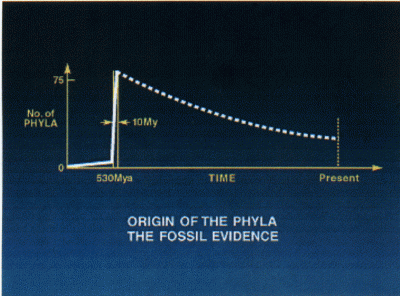
The newly released film “Darwin’s Dilemma” argues that the geologically abrupt appearance of the major groups of animals (the “phyla”) in the Cambrian Explosion posed a serious problem for Charles Darwin’s theory of evolution (as he himself knew), and that subsequent fossil discoveries—far from solving the problem—have made it worse.

Basically, all the major body plans we have today appear in the fossil record in a 2-3 million period about 543 million years ago. There are no precursors in the fossil record showing the gradual evolution of these major body plans.

The Cambrian Explosion: 0 to 60 in a few million years

Darwin expected to discover lots and lots of fossils leading up to the Cambrian explosion period that would show how all these phyla came into existence slowly over time. Unfortunately for the naturalistic evolutionists, the discoveries we’ve been making haven’t shown any hint of precursor fossils leading up the Cambrian explosion.

Since 1859, however, many Precambrian fossils have been found, including microfossils of single-celled bacteria in rocks more than three billion years old. In addition, multicellular Precambrian fossils have been found in the Ediacara Hills of Australia, though there is continuing debate over whether any—or how many—of the Ediacaran fossils were animals, or what relationship—if any—they had to the Cambrian phyla. In 1998, Cambridge University paleobiologist Simon Conway Morris (who is featured in the film “Darwin’s Dilemma”) wrote, “Apart from the few Ediacaran survivors… there seems to be a sharp demarcation between the strange world of Ediacaran life and the relatively familiar Cambrian fossils” (Crucible of Creation, 30).

But wait! Maybe we can’t find the precusor fossils required by Darwinism because they are too small or too soft to have survived for so long?

Since 1859, however, many Precambrian fossils have been found, including microfossils of single-celled bacteria in rocks more than three billion years old. In addition, multicellular Precambrian fossils have been found in the Ediacara Hills of Australia… In 1998, Cambridge University paleobiologist Simon Conway Morris… wrote, “Apart from the few Ediacaran survivors… there seems to be a sharp demarcation between the strange world of Ediacaran life and the relatively familiar Cambrian fossils” (Crucible of Creation, 30).

So there is now no shortage of Precambrian fossils. Not only do we have fossils of bacteria, but we also have many fossils of soft-bodied Multicellular organisms. “In the Ediacaran organisms there is no evidence for any skeletal hard parts,” wrote Conway Morris in 1998. “Ediacaran fossils look as if they were effectively soft-bodied” (Crucible of Creation, 28). The same is true of many of the organisms fossilized in the Cambrian explosion.

But wait! Scientists have discovered lots of exceptionally preserved microbes just before the Cambrian explosion. Don’t microbes count as precursors to the Cambrian explosion phyla?

Richard Callow and Martin Brasier reported in the January 2009 issue of the Journal of the Geological Society, London “a variety of exceptionally preserved microbes” from late Precambrian rocks in England that address “the paradox known as ‘“Darwin’s dilemma’.”

[…]Callow and Brasier didn’t solve Darwin’s dilemma. Instead, they put one more nail in the coffin of Darwin’s attempt to salvage his theory from it. The truth is that “exceptionally preserved microbes” from the late Precambrian actually deepen Darwin’s dilemma, because they suggest that if there had been ancestors to the Cambrian phyla they would have been preserved.

I am willing to believe in evolution. But in order to get me to believe it, I insist on seeing a fossil record that shows the gradual emergence of phyla, one or two at a time, over hundreds of millions of years. That is what Darwinism predicts. We now have a solid record of what came before the Cambrian explosion. So where are the precursors? Where is the record of gradual emergence? Where is my evidence?

More on the Cambrian explosion

The origin of life and biological information

Videos on intelligent design

How do we know that some parts of DNA really are non-functional?

ECM sent me this post from Uncommon Descent about DNA and software design.

Perhaps I should begin by explaining explaining how software is made. The customer gives you a list of use case, which are descriptions of things that you expect the finished software to do. This list of expected system behaviors is called the “functional requirements”. There are also “non-functional requirements” that the user will not see, such as how easily the components of the system can be maintained or tested.

Now consider the post by William Dembski. He writes:

One of the main arguments to support evolution appeals to shared non-functional structures between organisms. Since design entails design for function, shared non-functional structures would suggest common ancestry in the absence of common design. But how can we tell whether something is truly non-functional?

Then he cites an e-mail sent to him by a software engineer, who explains how a lot of code is included to address exception handling and non-functional concerns.

As a programmer, sometimes I spend a lot of time designing error-detection and/or error-correction algorithms (especially for dealing with user input). Some of these functions may never, ever be used in a real-life situation. There are also various subroutines and functions that provide either exotic or minor capabilities that, likewise, maybe be used very seldom if at all. But they are there for a reason. Good programming practice requires considerable extra design and implementation of features that may only rarely, if ever, be used.

If someone were to cut out and eliminate these sections of code, repairing what’s left so that the program still functions, the program may work perfectly well for just about all situations. But there are some situations that, without the snipped code, would create havoc if the program tried to call on a function that was no longer there or that was replaced by some different function that tried to take its place. (Ask yourself what percent of the functionality of your spreadsheet or word processor program you use, and then ask if you would even notice if some of the lesser-known functionality were removed.)

I think biological life is like that. It seems to me that if some DNA code can be successfully removed with no apparent effects, one possibility is that the removed portion is rarely used, or the impact of it not being there has effects that are masked or otherwise hidden.

Perhaps redundancy is what was removed, meaning the organism will now not be quite as robust in all situations as before. I can give a kidney to someone else and suffer no ill effect whatsoever… until my remaining kidney fails and cannot be helped by the redundant one that I gave up (which situation may never, ever really occur due to my general good health).

P.S. Being able to snip something with no apparent ill effect may in fact provide support for ID by showing that the system was so well engineered that it could automatically adjust to a certain degree, and in most cases completely (apparently). It would be interesting to see some ID research into some of the evo cases that are being used to support the various flavors of junk DNA, to see what REALLY happens long term with the new variety now missing something snipped.

Sometimes, I forget that most of the world is trying to assess where biological systems are designed without knowing what engineers know about how the process of engineering.

Consider the example of implementing caching in order to reduce the frequency of network and database calls. Making a call to a remote system over a network can be very slow if there is lot of traffic congestion. The same thing applies to reading from a database or the file system. Engineers have invented a solution to this problem called “caching”. This basically means keeping the data you use the most often, or the most recently, in memory. It helps you to avoid looking up the same data over and over.

Notice that caching doesn’t do anything for the functional requirements. Instead, engineers are writing a whole bunch of code to address a non-functional requirement: performance. That caching code still has to be designed, written and tested, but the user will never see it produce any external behavior. In fact, the user will not be aware of the caching module at all!