

Tag Archives: Bible

Dr. William Lane Craig interviewed on the Ben Shapiro Show Sunday Special

Dr. William Lane Craig on the Ben Shapiro Sunday special

The episode of the Ben Shapiro show that we’ve all been waiting for is here! They discuss arguments for God’s existence in the first 25 minutes. The spend the first 26 minutes on arguments for God,and  the next 16 minutes on Christian distinctives. They spend a bunch more time responding to common arguments for atheism, and finally Ben asks Dr. Craig how he became a Christian.

Summary:

William Lane Craig, philosopher, theologian, and best selling author of numerous books including “On Guard: Defending Your Faith With Reason And Precision,” joins Ben to discuss the hard sciences vs. philosophy, the cosmological and ontological arguments, Jesus, slavery, gay marriage, and much more.

Video:

The MP3 file is here.

Topics:

  • Why are we seeing such a decline in religious belief in America?
  • Why are mainline denominations in Christianity and Judaism emptying out?
  • What was the driver behind the move away from religion starting in the 1960s?
  • Why is their a gap in the university and in the broader culture between reason and religious belief?
  • What is the strongest argument for God’s existence?
  • What is the most compelling argument for God’s existence for this culture?
  • Respond to Richard Dawkins’ challenge that God needs a cause.
  • Why does the universe have to have a cause?
  • Does Darwinian evolution provide grounds for our awareness of objective moral values and duties?
  • What is the strongest objection to the cosmological argument?
  • What is the strongest objection to the moral argument?
  • What about the objection that the existence of the universe is just a “brute fact” and doesn’t need an explanation for it’s existence?
  • What about David Hume’s objection to the law of causality?
  • What about objections to the cause of the universe from apparently uncaused events in quantum mechanics?
  • What is the ontological argument, and why is it frequently dismissed?
  • How do we get from an unmoved mover to a moral God?
  • Which arguments show that God is a mind?
  • How do you show that God is present and active in time now?
  • How do you move from God as Creator, Designer and moral lawgiver to a God who has revealed himself to human beings?
  • Who does Jesus claim to be in the gospels, and what is the evidence that his claims were correct?
  • From the Jewish perspective, this narrative has some  problems. First, merely declaring yourself as the Messiah is not seen as a punishable offense.
  • Second, the real problem is that Jesus vision of himself as the Messiah is completely different than how Jews have understood the Messiah. The Messiah in Judaism has always been a political figure who is destined to restore the Kingdom of Israel, bringing more Jews back to Israel, etc.  Claiming to be God, though would be blasphemy and a punishable offense.
  • Why is resurrection proof of divinity? Wasn’t Lazarus also raised from the dead?
  • The gospels were written decades after the events they claim to describe. Should we still see them as reliable enough to infer that the resurrection really happened?
  • Couldn’t legends have been introduced in the gap between the events and the time that the events were recorded?
  • Is it enough for us to have a Creator God, or is there a reason for God to reveal himself to us?
  • Tell us about your experience debating atheist scholars on university campuses.
  • Has any an atheist ever caused you to doubt your arguments?
  • The problem of human evil is easy to respond to, but how do you respond to the problem of natural evil, i.e. – suffering from events in the natural world, such as birth defects or natural disasters.
  • Atheists like to bring up specific disagreements they have with the Bible, e.g. – same-sex marriage, abortion, slavery, genocide. How would you respond to those?
  • Regarding slavery in the Bible, isn’t it the case that people sometimes do things that are not prescribed by God, and the Bible merely records that?
  • How would you respond then to people who push for same-sex marriage by arguing that this is a case where God wanted same-sex marriage, but couldn’t press for it because the people were not capable at that time and in that culture?
  • When discussing specific issues of morality, do you try to argue from a natural law perspective or from the morality in the Bible?
  • How would you respond to someone like Jordan Peterson who approaches religion teachings pragmatically, focusing on behaviors rather than the rational grounding of those behaviors?
  • How do you speak to young people about God without them losing interest?
  • How did you become a Christian?
  • As the influence of Judeo-Christian religion recedes, what do you see filling the void, and how do you see that affecting Western civilization going forward?
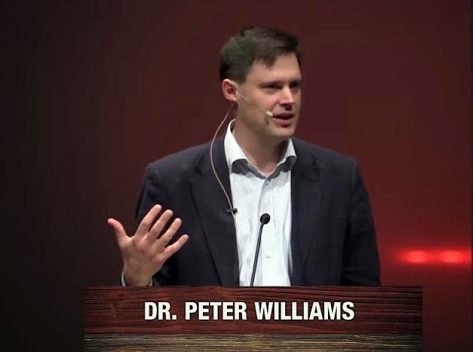

Peter J. Williams debates Bart Ehrman on his book “Misquoting Jesus”

Dr. Peter J. Williams, an expert on New Testament reliability

I have to re-post this debate between Bart Ehrman and Peter J. Williams, because Dr. Williams just followed me on Twitter. I noticed that he had re-tweeted one of the two senators I follow on Twitter, so I re-tweeted him. I like Tom Cotton and Josh Hawley, and he re-tweeted Senator Hawley talking about free speech.

Bart Ehrman posted the debate audio on YouTube:

Details:

Bart Ehrman is the US author of the bestselling book “Misquoting Jesus” (In the UK “Whose word is it?”).  He calls into question the authority of the New Testament as scribal changes over time have changed the documents.

So can we trust the scripture? Bible scholar Peter Williams believes in the reliability of the New Testament and that Bart’s prognosis is far too pessimistic.

This post is a re-post from 2011. I have been listening to this lecture by Peter J. Williams on “Misquoting Jesus” this week, and it reminded me to re-post this debate. (I checked to make sure the MP3 link is still good, and it is)

Summary of the Williams-Ehrman debate:

Note: this summary is snarky. If you want an accurate view of the debate, then listen to it. My summary is meant to be humorous.

Ehrman:

  • I had a mystical experience in childhood and became an evangelical Christian
  • I went to Moody Bible Institute, and they told me that the Bible was inerrant
  • For a while, I was committed to the view that there are no mistakes in the Bible
  • At Princeton, I was taught and graded by professors who did not accept inerrancy
  • By a strange coincidence, I began to see that the Bible did have errors after all!
  • We don’t have the original documents written by the original authors, we only have thousands of copies
  • if the words of the Bible are not completely inerrant, then none of it is historical
  • if all of the words in all the copies of the Bible are not identical, then none of it is historical

Williams:

  • I would say the New and Old testaments are the Word of God
  • We don’t need to have the original Greek writings in order to believe in the authority of the Bible
  • I believe in inerrancy, but doesn’t mean there are no problems
  • the doctrine of inerrancy has always referred to the original Greek copies, not the translations

Moderator:

  • what are the main points of Misquoting Jesus?

Ehrman:

  • we don’t have the originals of any of the books of the New Testament
  • we have copies that are much later, sometimes even centuries later!!1!
  • the copies we have all differ from one another – they were changed by scribes!!1!
  • we have 5000 manuscripts in the original Greek language
  • there are hundreds of thousands of differences!!1!
  • most of the differences don’t matter
  • some differences are significant for meaning or doctrine
  • errors are propagated because the next scribe inherits the mistake of their source copy
  • a large gap between the time of writing and the first extant copy means more errors have crept in

Williams:

  • the reason we have so many variants is because the number of manuscripts is large

Angry Jesus or compassionate Jesus in Mark

Ehrman:

  • most manuscripts say that Jesus was compassionate when healing a leper, but one says he was angry
  • it makes a huge huge huge really really big difference if Jesus is compassionate or angry
  • the whole Bible needs to be thrown out because of this one word between different in one manuscript

Williams:

  • this variant is important for understanding the passage, but it has no great meaning
  • the change is probably just an accident – the two words are very similar visually in Greek
  • it’s just an accident – it emerged in one manuscript, and it impacted a few more
  • the tiny number of manuscripts that have the error are geographically isolated
  • I’m pretty sure that WK prefers the angry Jesus anyway – so who cares?

Ehrman:

  • no! someone changed it deliberately! it’s a conspiracy! you should buy my book! it’s a *big deal*!!!!!1!!1!one!!eleventy-one!

The woman caught in adultery in John

Ehrman:

  • it is isn’t in any of the earliest manuscripts
  • this is an apocryphical story that some scribe deliberately inserted into the text
  • most people don’t even know about this! it’s a cover-up! you need to buy my scandalous book!

Williams:

  • that’s right, it’s a late addition by some overzealous scribe
  • and it’s clearly marked as such in every modern Bible translation
  • the only people who don’t know about this are people who don’t read footnotes in their Bible
  • and in any case, this isn’t a loss of the original words of the New Testament – it’s an addition

Grace of God or apart from God in Hebrews

Ehrman:

  • well this is just a one word difference, but it makes a huge huge really really big difference!
  • the words are very similar, so it’s could be an accident I guess
  • but it wasn’t! this was a deliberate change! it’s a conspiracy! it’s a cover-up! scandal!
  • buy my book! It’s almost as good as Dan Brown!

Moderator:

  • hmmmn…. I kind of like “apart from God” – why is this such a big scandal again?

Ehrman:

  • you don’t care? how can you not care? it has to be inerrant! or the whole thing is false!
  • Moody Bible Institute says!

Williams:

  • yeah Bart is always saying that every change is deliberate but it’s just an accident
  • the words are very similar, just a few letters are different, this is clearly an accident
  • I have no problem with apart from God, or by the Grace of God
  • please move on and stop screaming and running around and knocking things over

Moderator:

  • but what if pastors try to use this passage in a sermon?

Williams:

  • well, one word doesn’t make a big different, the meaning that appears is fine for preaching
  • it’s only a problem for people who treat the Bible as a magic book with magical incantations
  • they get mad because if one word is out of place then the whole thing doesn’t work for their spell
  • then they try to cast happiness spells but the spells don’t work and they experience suffering
  • the suffering surprises them since they think that fundamentalism should guarantee them happiness
  • then they become apostates and get on TV where they look wide-eyed and talk crazy

Ehrman:

  • hey! are you talking about me? a lot of people buy my books! i am a big success!
  • it is very important that people don’t feel bad about their sinning you know!

Is Misquoting Jesus an attack?

Williams:

  • it’s rhetorically imbalanced and misleading
  • it tries to highlight change and instability and ignore the majority of the text that is stable
  • he makes a big deal out of 5 or so verses that are different from the mainstream text
  • he says that scribes deliberately changed the scriptures, but he doesn’t prove that
  • it’s just as likely that the differences are just scribal errors made by accident

Ehrman:

  • well, maybe the variants aren’t a big deal, but what about one angel vs. two angels?
  • that’s a significant issue! significant enough for me to become an apostate – a rich apostate
  • if one word is different because of an accident, then the whole Bible cannot be trusted
  • it has to be completely inerrant, so a one word difference means the whole thing is unreliable
  • we don’t even know if Jesus was even named Jesus, because of one angel vs two angels!!!1!
  • buy my book! you don’t have to read it, just put it on your shelf, then you’ll feel better about not having a relationships with God – because who’s to say what God really wants from you? Not the Bible!

Why are Christians allowed to eat shellfish but not allowed to have sex before marriage?

I have a key that will unlock a puzzling mystery

Here’s a wonderful article from Peter Saunders.

The challenge:

An argument frequently advanced by those attempting to defend homosexual practice is that Christians ‘cherry pick’ the commands in the Bible – that is, they chose to emphasise some commands while ignoring others.

The Old Testament may forbid homosexual acts (Leviticus 18:2; 20:13) but it also forbids eating seafood without fins and scales (Leviticus 11:9-12; Deuteronomy 14:9, 10).

So how can Christians then justify upholding laws on sexual morality whilst at the same time ignoring the food laws from the very same books of the Bible? Why may they eat shellfish but not be allowed to have sex outside marriage? Isn’t this inconsistent and hypocritical?

The solution is that God enters into “covenants” with his people, and the terms of those covenants change.

Especially dietary laws:

The answer to this question lies in an understanding of biblical covenants.

A covenant is a binding solemn agreement made between two parties. It generally leaves each with obligations. But it holds only between the parties involved.

There are a number of biblical covenants: Noahic, Abrahamic, Sinaitic (Old), Davidic and New.

Under the Noahic covenant, which God made with all living human beings (Genesis 9:8-17), people were able to eat anything:

‘Everything that lives and moves about will be food for you. Just as I gave you the green plants, I now give you everything’ (Genesis 9:3).

But under the Sinaitic (Old) Covenant, which God made with the nation of Israel, people were able to eat certain foods, but not others.

Jesus clearly created a new covenant with his followers, where the dietary laws are lifted:

Jesus said that he had come to fulfil the ‘Law and the Prophets’ (Matthew 5:17; Luke 24:44). He would establish this new covenant with new laws, with himself as high priest based on his own sacrificial death on the cross.

This new covenant would completely deal with sin (Hebrews 10:1-18) and protect all those who put their faith in him from God’s wrath and judgement…

[…]‘In the same way, after the supper (Jesus) took the cup, saying, “This cup is the new covenant in my blood, which is poured out for you”’ (Luke 22:20). ‘…we have been made holy through the sacrifice of the body of Jesus Christ once for all’ (Hebrews 10:10)

People would come under the protection of this new covenant, not by virtue of belonging to the nation of Israel, but through faith in Christ. In fact the function of the Old Testament Law (Sinaitic covenant) was to point to Christ as its fulfilment.

[…]So what then did Christ say about foods? He pronounced all foods clean for his followers to eat:

‘ “Don’t you see that nothing that enters a person from the outside can defile them?  For it doesn’t go into their heart but into their stomach, and then out of the body.” (In saying this, Jesus declared all foods clean.) He went on: “What comes out of a person is what defiles them.  For it is from within, out of a person’s heart, that evil thoughts come—sexual immorality, theft, murder,  adultery, greed, malice, deceit, lewdness, envy, slander, arrogance and folly.  All these evils come from inside and defile a person.” (Mark 7:18-23)

Jesus was making that point that under the new covenant God required purity of the heart. Internal thoughts and attitudes were as important as external actions.

Food is OK for Christians, but sexual immorality – which includes premarital sex and adultery – are NOT OK for Christians.

I think sometimes when you are talking to people whose motivation is just to get rid of any objective moral law entirely, they tend to ask questions without really wanting a good answer. This is especially true when it comes to the morality of sex. They ask the question not to get an answer, but to justify getting rid of the moral rules governing sexuality. The answers are there for people who are willing to respect God in their decision-making to find. The answers are not found only by people who have a reason to not want to find them.

In case you’re wondering, I am one of those Christian men who takes chastity seriously. Marriage is about having a close connection with your spouse. Sure, I could break the rules and have a lot of fun now. A lot of Christians have a hard time turning down fun. But when I look at Jesus, I don’t see a man who is pursuing fun and thrills. I see a man who sees a need and then sacrifices his own interests to rescue others from peril.