
Tag Archives: Bible

What is the Christian doctrine of the Trinity?

The Christian doctrine of the Trinity

I have a friend who is considering Christianity and he is stuck on the doctrine of the Trinity. Tom, this one’s for you.

Excerpt:

So, what exactly do we mean when we talk about the Trinity? Writing in the early third century, in hisAgainst Praxeas, Tertullian is credited with first employing the words “Trinity”, “person” and “substance” to convey the idea of the Father, Son and Spirit being “one in essence — but not one in person”. Indeed, Tertullian writes,

“Thus the connection of the Father in the Son, and of the Son in the Paraclete, produces three coherent Persons, who are yet distinct One from Another. These Three are, one essence, not one Person, as it is said, “I and my Father are One,” in respect of unity of substance not singularity of number.”

This concept was established as church orthodoxy at the famous Council of Nicaea in A.D. 325. The Nicene Creed speaks of Christ as “God of God, Light of Light, very God of very God, begotten not made, being of one substance with the Father.”

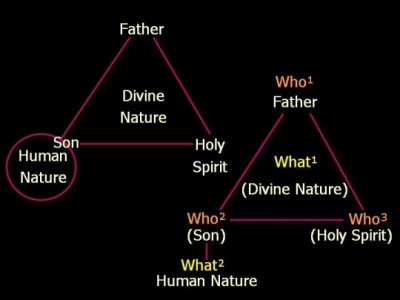
It is this definition that I am going to assume in the discussion that follows. Succinctly, then, the doctrine of the Trinity may be defined thusly: Within the one being or essence that is God, there exists three co-equal and co-divine distinct persons — namely the Father, Son and Holy Spirit — who share that essence fully and completely. This concept is not to be confused with polytheism, which maintains that there are multiple gods. While orthodox Christianity emphatically holds there to be only one God, we nonetheless understand God to be complex in his unity. The concept is also not to be confused with the ancient heresy of modalism, which maintains that God exists in three different modes. The Son has never been the Father and the Holy Spirit has never been the Son or the Father. Modalism is refuted by the picture given to us in all four gospels (Matthew 3:16-17; Mark 1:9-11; Luke 3:21-22; John 1:32-34) in which the Holy Spirit descends on Jesus in the form of a dove and a voice is heard from Heaven “This is my beloved Son. With him I am well pleased.” Similarly, it should be noted that the Father, Son and Spirit do not each make up merely a third of the Godhead. Rather, each of the three persons is God in the full and complete sense of the word.

Having shown that Scripture emphatically rejects the notion that the Father, Son and Spirit are synonymous persons, only five propositions remain to be demonstrated in order to provide Biblical substantiation for the concept of the Trinity. Those propositions are:

  1. There is only one eternal God.
  2. The Father is the eternal God.
  3. The Son is the eternal God.
  4. The Holy Spirit is the eternal God.
  5. Although the Father, Son and Holy Spirit are non-synonymous persons, the concept of the Trinity does not violate the law of non-contradiction.

Let’s take a look at each of these in turn.

He then takes a close look at what the Bible says about God with respect to those assertions. There can be no doubt that the Bible teaches that God is one divine substance, and three persons.

Have you turned away from God? Here’s what to do about it

A good foundational article from Kevin Alan Lewis. It explains what Christians believe about how people who turn away from God can be reconciled with God. The Bible calls turning away from God “sin”, and it also talks about how to fix the sin problem, and so be saved from God’s anger.

Summary:

While the means of biblical salvation includes many concepts such as justification, adoption and regeneration, the objective of biblical salvation is easy to understand: to enjoy a loving, mentoring relationship with our Creator, the one true God. As Adam walked with God, so should we. But how can one restore a broken relationship with God?

The requirements for restoring a broken friendship are easy to understand but difficult for most to do. To restore a lost friendship, the offended person must be willing to forgive by bearing the harm caused by the transgressor, electing not to hold it against him if certain conditions are met. The conditions for forgiveness are that the offending party must repent, confess his sin and want to restore the relationship with the offended party. Since the goal of forgiveness is the restoration of a genuine friendship, the offending party must begin with repentance. When the sinner genuinely repents, confesses and receives the offer of forgiveness, the estranged parties reconcile, walking together again in righteous harmony. If anyone has ever lost and genuinely restored a meaningful friendship, they know this is the only way to do it.

One purely hypothetical illustration may help. If I screamed at my wife, calling her unmentionable names, my wife would rightly be offended and our intimate fellowship would surely be broken. So how would I return to a genuine state of e-harmony with my wife? First, my wife must be willing to bear the harm I caused her and not hold it against me. But to restore the relationship in any meaningful sense, I need to realize that what I did was wrong, repent, and confess my sin to my wife — preferably with symbols of my repentance in hand, such as flowers and candy! When these conditions are fulfilled, my wife will forgive me.

So how does this relate to Jesus Christ as the only way? Simple. To restore the broken relationship with the one true God, the offended party, God, must be willing to bear the consequences of our sin. God accomplishes this by means of the Second Person of the Trinity assuming a full human nature, living a sinless life, and satisfying our penalty for sin on the cross. Sinners, the offenders, need to repent, confess and trust God’s offer of forgiveness. When we do, we are reconciled to God for the purpose of fellowship with him as his beloved children. This is biblical salvation.

Very often, people don’t reflect on how they treat God. Many of us are born in wealthy countries, and are relatively free of pain and suffering, with many years of leisure in which to puzzle about things. Yet many of us are content to go through life without giving any serious consideration big questions; does God exist? what is God like? what does God want from me? People know that the answers to those questions can mean the end of our autonomy, so we just don’t ask them – or we ask them and don’t answer them honestly.

God certainly provides enough evidence in nature and conscience to cause us to puzzle about his existence and character, but many of us don’t We want to do our own thing, and can’t be bothered to care about what anyone else thinks about it, including God. Maybe, especially God. This is not the way that we should be treating the person who created us and who has designed us to know him. This turning away from God is not good. There is a way for us to be reconciled with God, but we have to be reconciled with him in a way that is on his terms.

Four reasons why positing the resurrection best explains the historical data

From Ratio Christi at Ohio State University.

Introduction:

When it comes to the Christian faith, there is no doctrine more important than the resurrection of Jesus. Biblical faith is not simply centered in ethical and religious teachings. Instead, it is founded on the person and work of Jesus. From a soteriological perspective, if Jesus was not raised from the dead, we as His followers are still dead in our sins (1Cor.15:7).

He lists four pieces of “historical bedrock”. These are the facts that even really skeptical atheists like Bart Ehrman and James Crossley will give you in a debate.

  1. The post-mortem appearances
  2. Paul’s use of the Greek word “soma”, which means body
  3. Identification of Jesus as divine by the earliest Christian community
  4. The rapid growth of early Christianity even after its founder was dead

This is a very very minimal set. He did not even use the burial, much less the empty tomb, which is a harder sell.

Here’s a closer look at Reason #2 of 4:

2.The Bodily Resurrection of Jesus Explains Paul’s Use of the Word “Soma”

Whenever the New Testament mentions the word body, in the context of referring to an individual human being, the Greek word (soma, always refers to a literal, physical body). This is significant because Paul uses the word soma to describe the resurrection body of Jesus (1 Cor.15:42-44).Greek specialist Robert Gundry says “the consistent and exclusive use of soma for the physical body in anthropological contexts resists dematerialization of the resurrection, whether by idealism or by existentialism.” (1) Furthermore, N.T. Wright’s The Resurrection of the Son of God shows that the Greek word for resurrection which is “anastasis” was used by ancient Jews, pagans, and Christians as bodily in nature, with this being the case until much later(A.D. 200).

The only explanation that can be given to the emphatic insistence on the early proclamation of the bodily resurrection of Jesus, rather than translation or even a spiritual body is the fact that the apostles did in fact actually witness a material resurrection.

And one Bible passage from his Reason #3: 1 Corinthians 8:4-6.

4So then, about eating food sacrificed to idols: We know that an idol is nothing at all in the world and that there is no God but one.

5For even if there are so-called gods, whether in heaven or on earth (as indeed there are many “gods” and many “lords”),

6yet for us there is but one God, the Father, from whom all things came and for whom we live; and there is but one Lord, Jesus Christ, through whom all things came and through whom we live.

1 Corinthians is unanimously viewed by historians across the ideological spectrum – from evangelical to atheist – as a genuine epistle written by Paul, around 55 AD. I think this passage argues strongly that the earliest Christians thought of Jesus as other than an ordinary man. And the Ratio Christi post has many more passages to support Reason #3 as well.

Read the whole thing. If you want to see a great debate on the historicity of the resurrection of Jesus, you should watch William Lane Craig debate James Crossley.