Tag Archives: Bible

Professor explains how his study of the historical Jesus made him leave atheism

Sherlock Holmes and John Watson
Sherlock Holmes and John Watson: let’s investigate Jesus!

Dr. Michael F. Bird has a great article in Christianity Today. I’ve featured his debates with atheist historian James Crossley on this blog before, and I have the book they co-wrote.

In the article, Dr. Bird writes:

I grew up in a secular home in suburban Australia, where religion was categorically rejected—it was seen as a crutch, and people of faith were derided as morally deviant hypocrites. Rates for church attendance in Australia are some of the lowest in the Western world, and the country’s political leaders feel no need to feign religious devotion. In fact, they think it’s better to avoid religion altogether.

As a teenager, I wrote poetry mocking belief in God. My mother threw enough profanity at religious door knockers to make even a sailor blush.

Many years later, however, I read the New Testament for myself. The Jesus I encountered was far different from the deluded radical, even mythical character described to me. This Jesus—the Jesus of history—was real. He touched upon things that cut close to my heart, especially as I pondered the meaning of human existence. I was struck by the early church’s testimony to Jesus: In Christ’s death God has vanquished evil, and by his resurrection he has brought life and hope to all.

When I crossed from unbelief to belief, all the pieces suddenly began to fit together. I had always felt a strange unease about my disbelief. I had an acute suspicion that there might be something more, something transcendent, but I also knew that I was told not to think that. I “knew” that ethics were nothing more than aesthetics, a mere word game for things I liked and disliked. I felt conflicted when my heart ached over the injustice and cruelty in the world.

Faith grew from seeds of doubt, and I came upon a whole new world that, for the first time, actually made sense to me. To this day, I do not find faith stifling or constricting. Rather, faith has been liberating and transformative for me. It has opened a constellation of meaning, beauty, hope, and life that I had been indoctrinated to deny. And so began a lifelong quest to know, study, and teach about the one whom Christians called Lord.

And now specifics:

For many secularists, Ehrman is a godsend who propagates common misconceptions about Jesus and the early church. He believes there was a spectrum of divinity between gods and humans in the ancient world. Therefore, he asserts that the early church’s beliefs about Jesus evolved: from a man exalted to heaven to an angel who became human to a pre-existent “divine” person who became incarnate to a subordinated or lesser god to being declared one with God.

My faith and studies have led me to believe otherwise. First-century Jews and early Christians clearly demarcated God from all other reality, thus leading them to hold to a very strict monotheism. That said, Jesus was not seen as a Greek god like Zeus who trotted about earth or a human being who morphed into an angel at death. Rather, the first Christians redefined the concept of “one God” around the person and work of Jesus Christ. Not to mention the New Testament writers, especially Luke and Paul, consistently identify Jesus with the God of Israel.

Many people get the idea that Jesus was just a prophet and never claimed to be divine. But a careful look at the Gospels shows that the historical Jesus explicitly claimed to exercise divine prerogatives. He identified himself with God’s activity in the world. He believed that in his own person, Israel’s God was returning to Zion, just as the prophets had promised. And he claimed he would sit on God’s throne. These claims, when studied up close, are de facto claims to divine personhood, the reasons religious leaders of the day were so outraged.

Evidence shows that Jesus claimed to be God incarnate, and within 20-some years after his death and resurrection, Christians were identifying him with the God of Israel, using the language and grammar of the Old Testament to do so.

Sure, some sects in the first few centuries held heretical beliefs about Jesus. But the mainstream, orthodox view of Christ’s identity was always consistent with and rooted in the New Testament, though orthodox Christology became more refined in the following centuries.

It’s definitely true that you can recover a high Christology (a view of Jesus as divine) from the earliest gospel, Mark. I wrote about it in a previous post. But the earliest evidence for Jesus is that creed in 1 Corinthians 15, that I blogged about recently.

Here is his conclusion:

Some have great confidence in skeptical scholarship, and I once did, perhaps more than anyone else. If anyone thinks they are assured in their unbelief, I was more committed: born of unbelieving parents, never baptized or dedicated; on scholarly credentials, a PhD from a secular university; as to zeal, mocking the church; as to ideological righteousness, totally radicalized. But whatever intellectual superiority I thought I had over Christians, I now count it as sheer ignorance. Indeed, I count everything in my former life as loss because of the surpassing worth of knowing the historical Jesus who is also the risen Lord. For his sake, I have given up trying to be a hipster atheist. I consider that old chestnut pure filth, in order that I may gain Christ and be found in him, not having a CV that will gain me tenure at an Ivy League school, but knowing that I’ve bound myself to Jesus—and where he is, there I shall also be.

I recently led a Bible study on the passage he is paralleling there – it comes from my favorite book of the Bible, Philippians.

What I like about Bird’s story is that he was a skeptic, and his study of history is what changed his mind. This contradicts a narrative that young people are sold at the university, which is that the more education you have, the more you turn away from theism in general, and Christianity in particular. I wouldn’t even classify him as a super conservative scholar, by any means – he’s just a good scholar who believes whatever he thinks is historically sound. It just turns out that you can recover enough historically to ground a commitment to Jesus Christ. You can’t get everything as a historian, but you get enough to cause a change of mind about who Jesus was.

Positive arguments for Christian theism

Wayne Grudem debates Richard Glover on the Bible, poverty and foreign aid

Two horses fight it out, may the best horse win!

A great episode of the Unbelievable podcast. This is a great debate. I really enjoyed it. All three speakers were excellent putting forward their points. It’s nice to hear an American voice, a British voice and an Australian voice debating an important issue. HIGHLY RECOMMENDED.

Details:

Wayne Grudem is a theologian known for his conservative approach to both doctrine and economics. His new book “The Poverty of Nations: A Sustainable Solution” (co-authored with economist Barry Asmus) makes the case that pouring aid into developing countries is a failed strategy. Grudem debates whether the Bible supports free market, capitalist economics with Australian economist and theologian Richard Glover who wrote a critique of the book for the Australian Bible Society.

 The MP3 file is here.

Summary:

Grudem:

  • The Bible speaks to all of life, including economics, stewardship, government
  • The study of economics helps us to understand how to take care of the poor
  • My job is to apply the teachings of the Bible to all of life

Brierley:

  • What’s your thesis in the book?

Grudem:

  • A good system is one where the poor have the opportunity to earn and save from their labor
  • Book is a response to a Kenyan couple Grudem met at a London conference on business and Christianity
  • Book is not concerned with how individuals and groups can do charity to help the poor
  • Our church already does that and we support individuals and groups doing charity
  • The book is concerned with how should nations be transformed in order to grow economically
  • What should the laws, policies and cultural beliefs of a nation be in order for it to not be poor?
  • The book lists factors that have moved nations from poverty to prosperity in different times and places
  • The thesis of the book is this: government should set their people free to be able to produce more
  • We advocate freedom in economics: freedom to work, freedom to save, freedom to start businesses
  • We believe that this free enterprise view is consistent with the Bible in a number of places
  • E.g. – private property is good for prosperity (thou shall not steal) but forbidden by communism

Brierley:

  • What about the church sharing in communities in Acts 2 and Acts 4?

Grudem:

  • That is not redistribution of wealth among individuals and businesses by a secular government
  • Those passages showed that there was voluntary sharing among Christians, which is not communism

Brierley:

  • What’s wrong with Grudem’s book?

Glover:

  • The book emphasizes the Bible and the goal is to help the poor in poor countries
  • Criticism 1: the book doesn’t engage with non-free-market perspectives on economics
  • Criticism 2: the book doesn’t survey all that the Bible says about economics

Brierly:

  • For 1) what is one of the views that is not considered?

Glover:

  • Jeffrey Sachs says that nations need a leg up before they can grow economically
  • Ha-Joon Chang says that free enterprise was not how the wealthy nations became wealthy

Grudem:

  • We do engage with other points of view, especially Jeffrey Sachs in the book
  • The trouble with leftist views on economic development is that it does not work in practice
  • NO COUNTRY has even been lifted out of poverty by foreign aid
  • He says we don’t cite enough from the wisdom literature: we have 64 citations in the index
  • He says we don’t cite enough from the gospels: we have 42 citations in the index
  • He says we don’t cite enough from the epistles: we cite 22 of 27 epistles in the index
  • Some economists won’t criticize cultural and moral values that hurt prosperity
  • As Christians, we think that moral and cultural values are part of the problem that needs solving

Brierley:

  • What about foreign aid?

Grudem:

  • Foreign aid doesn’t help: a lot of the money goes into government and rulers can be corrupt
  • Instead of encouraging people to start businesses, it tells people to go into government to get aid money
  • Economists (lists 3) are saying that foreign aid entrenches corrupt government in power, does no good

Brierley:

  • If it’s not working, should we keep doing it?

Glover:

  • When there is an immediate need, we should do it, even if it is not a long-term solution: we need both

Brierley:

  • Should we stop foreign aid completely?

Grudem:

  • Voluntary charitable giving from individuals and churches to help poor countries is good
  • Me and my co-author are both active on our church board that helps poor countries with urgent needs
  • Food and doctors are urgent needs, and we should help, but it doesn’t lift countries out of poverty
  • We need a long-term solution that helps poor countries produce their own food and doctors
  • We are criticizing 1) government to government aid and 2) IMF/World bank to government aid
  • We have had pushback because 500,000 people make a living from this foreign aid industry
  • No country has ever been lifted out of poverty into sustainable prosperity
  • That’s the definition of insanity: continuing to do the same thing that has never worked

Brierley:

  • Does the Bible support free enterprise as a way of creating sustainable prosperity?

Glover:

  • When I said the Bible was absent from his book, absent was a bad choice of words
  • But the hundreds of references he listed were not dealth with *in depth*
  • In the Scriptures, God is the one who provides (e.g. – in Ephesians, Sermon on the Mount)
  • The Bible is less focused on his people making money, and more focus on sharing basics, like food
  • Secular governments should just take it from people who have food and give it to hungry people
  • In 2 Cor 8-9, Paul talks about voluntary sharing so everyone will be equal

Brierley:

  • Does 2 Cor 8-9 undermine the free enterprise system you champion in the book?

Grudem:

  • The sharing in the Bible solves cases of urgent need, it does not lift countries from poverty to sustainable prosperity
  • Some older translations say “equality” in 2 Cor 8:13-14, but newer translations (e.g. – ESV) say “fairness”
  • The Greek word is translated as “fairly” the only other place it appears in the NT (Col 4:1), in every translation
  • God uses the means of human work and productivity to provide (daily bread is baked, doesn’t just fall from Heaven)
  • In general, there’s no provision in Scripture for a person to be dependent on donations for their entire lives
  • God promises Israel fields and mountains to tend and mine, but prosperity is from work, not depending on others

Brierley:

  • Does the Bible support this focus on work?

Grudem:

  • Working is highly praised in Scripture, (lists Bible passages that favor work over dependency)
  • Countries that were exposed to this notion of work and productivity have been more prosperous

Glover:

  • Jeffrey Sachs and other development economists don’t say you can be prosperous through dependence
  • They say that it is a necessary part of leading to nations out of poverty into poverty

Grudem:

  • It’s never worked. What nation has become prosperous through foreign aid?

Glover:

  • There are lots of nations, especially in Africa, where foreign aid has helped lift them out of poverty

Grudem:

  • Name one country in Africa where foreign aud has lifted them out of poverty into sustainable prosperity

Glover:

  • I can’t think of one right now.

Grudem:

  • Our book contains a map of Africa and we looked at every nation’s per capita income
  • No nation has been able to rise out of poverty through dependence on foreign aid
  • The only close one is Botswana, but they have abundant freedoms, Christian morals, less corrupt government
  • So Botswana is the best case and they became prosperous through becoming productive, not foreign aid

Brierley:

  • Is he right to say that charity is a short-term solution, but that it’s not good long-term for prosperity?

Glover:

  • Yes, and work is a very important focus in the Scriptures as he says.
  • But since the Fall work has been much harder, and may not have the outcomes that we would like

Grudem:

  • I also believe in emergency aid for when catastrophies happen, like floods and famines
  • But dependence on foreign aid enriches corrupt rulers and does not create the productivity that leads to sustained prosperity

Brierley:

  • Can foreign aid be used to give poor nations a leg up on becoming prosperous?

Grudem:

  • Dambisa Moyo, Oxford-educated economist from Zambia, says stop the aid, it’s doing more harm than good
  • Jeffrey Sachs’ view is that foreign aid hasn’t worked yet, but just keep trying a bit more
  • What works: limited government, rule of law, fair courts, documented property rights, low taxes, stable currency
  • People are creative and want to work, we just have to get government out of the way and let people work, earn and save

Brierley:

  • Is this free enterprise system supported by the Bible?

Glover:

  • The wealthy nations of the world did not become wealthy through productive work and free enterprise policies
  • Ha-Joon Chang: free enterprise policies have never brought a country from poverty to wealth
  • E.g. – wealth is created through tariffs (not by innovating and by economic freedom?)

Grudem:

  • I’ve read Ha-Joon Chang’s book, and his examples are very selective and limited
  • Index of Economic Freedom: the freest countries are the most prosperous, the least free countries are the most poor
  • When you look at macro data, instead of very selective examples, the free enterprise system is best for prosperity

Glover:

  • The book doesn’t do enough to engage with leftist economists (he doesn’t say which ones)
  • Just because nations who are free are rich, doesn’t mean freedom causes productivity
  • There are parts of the Bible that doesn’t support the free enterprise system (he names none)

Grudem:

  • The Bible is focused on work not dependency, and charity not government redistribution
  • The best way to help the poor in other countries is by encouraging work and productivity

Are Christians who use other people’s money to help others “generous”?

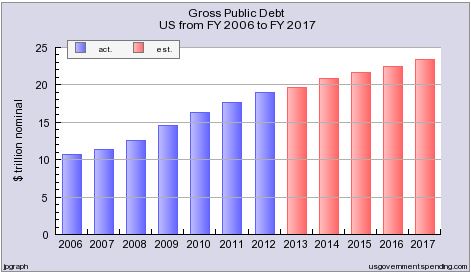
Gross public debt, Democrats control spending in 2007

Normal Americans who work for a living know that you cannot be generous with someone else’s money – you have to earn your own money and give your own money away if you want to be “generous”. And this is actually what the Bible says – be generous to others with your own money. There is no support in the Bible for discharging your obligations to people in need by having a secular leftist government subsidize their abortions, etc. But many Christians escape the need to be generous with their own money by voting for the secular government to take someone else’s money. This way, they can have the feelings of being generous without having to make the sacrifice themselves.

So here are my points in response to this “stolen valor” view of generosity, which seems to be so popular with dependent professors and dependent pastors who do not work in the private sector.

First, illegal immigration and refugee asylum typically costs us money, since unskilled immigrants and asylum’d refugees do not typically pay as much in taxes as they using in taxpayer-funded benefits.

Evidence:

  • Under current law, all unlawful immigrant households together have an aggregate annual deficit of around $54.5 billion.
  • In the interim phase (roughly the first 13 years after amnesty), the aggregate annual deficit would fall to $43.4 billion.
  • At the end of the interim phase, former unlawful immigrant households would become fully eligible for means-tested welfare and health care benefits under the Affordable Care Act. The aggregate annual deficit would soar to around $106 billion.
  • In the retirement phase, the annual aggregate deficit would be around $160 billion. It would slowly decline as former unlawful immigrants gradually expire.

These costs would have to be borne by already overburdened U.S. taxpayers. (All figures are in 2010 dollars.)

Meanwhile, the same people who want big government to help the poor probably do not even realize that the national debt has doubled under Obama to $20 trillion, as of January 2017. Now do the people who want to give away all these benefits via big government intend to pay for it with their own money as the Bible says? No, they intend to pass the costs onto generations yet unborn via the national debt. They want to feel generous themselves, but with someone else’s money. There is a word for that – we call that slavery. It turns out that big government Christians really are in favor of slavery. They want to force the next generation to work tomorrow, so that they can feel generous today.

Government not serious about protecting the public

Second, we know that big government cannot be trusted to deport criminals, because we saw that on display in the Kate Steinle affair, where an illegal immigrant who had many prior convictions was released to commit worse crimes. If you think that illegal immgrants get deported after committing serious crimes, you really need to reconsider how trustworthy government is about border security.

For example, Senate Democrats blocked a bill to crack down on sanctuary cities.  Although amnesty and asylum for refugees sounds good, it relies on big government being serious about enforcing the law, and protecting the public. During the Obama administration, we have seen the Snowden leak, the Clinton private e-mail server which was hacked by foreign governments, the Benghazi coverup, the arms smuggling to drug cartels by the ATF, the China hack, the wikileaks leak by gay private Bradley Manning who got a taxpayer funded sex change, etc.

Previously, we saw how the parents of the Boston bombers were granted asylum as Chechen refugees. That was a failure of national security. And the FBI has already explained that our procedures for vetting refugees is inadequate. The refugees, by the way, are selected by the United Nations and a Muslim organization affiliated with the Muslim Brotherhood. So it’s just wishful thinking to think that this is a priority for the government. And recall that about 5 seconds after Obama bragged about how he had “contained” ISIS (Islamic State), the Paris attack happened. Democrats do not care about national security, so we cannot trust them to vet refugees. The people who want Syrian refugees to come in are depending on big government to take national security seriously. But we have zero evidence that they can do that.

Here’s Hillary Clinton:

Hillary Clinton focused on her real enemy – Americans who disagree with her – in a campaign speech on Thursday.
In a statement her own campaign Tweeted out as her marquee comment, Clinton declared: “Let’s be clear: Islam is not our adversary. Muslims are peaceful and tolerant people and have nothing whatsoever to do with terrorism.”

The UK Daily Mail describes Clinton as “reading her speech at a brisk clip from a teleprompter at the Council on Foreign Relations in New York City,” but slowing down to mock Republicans over the phrase “radical Islamic terrorism,” which “Republicans often accuse President Barack Obama of purposefully avoiding.”

The Daily Mail cheekily notes that Clinton “referred repeatedly to ‘radical jihadism’ as a global scourge, but didn’t explain how the concept of jihadism is consistent with the notion that adherents of the world’s second largest religion are wholly uninvolved.”

Remember, this is the person who sent and received classified e-mails on a private unsecure email server, and blamed a terrorist attack on a YouTube video – for political gain. And it’s people like her who are promising us that they are serious about deporting illegal immigrants who commit crimes, and vetting refugees who are coming from Muslim countries.

What I have found in asking people who want amnesty and asylum for refugees is that they are incredibly uninformed about things like the national debt, the costs, the risks, etc. I don’t see why people trust the government to enforce border security law, deport lawbreakers, and vet refugees carefully. I think people who clown around advocating for policies based on their feelings and a misreading of the Bible need to be more cautious and humble. You don’t know how the world works, so shut your ignorant mouths before you get more people killed, and pass more debt onto the next generation. If you want to do something for refugees, do it yourself. If you want to do something for the poor in other countries, do it with your own money.