Tag Archives: Baby

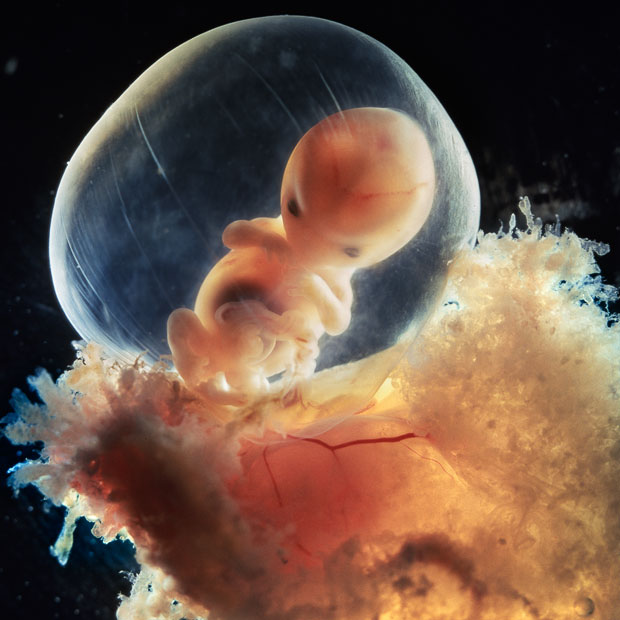
Unborn babies adapt their development based on cues from mom

Unborn baby scheming about the progress of science

From CNN:

When does learning begin? As I explain in the talk I gave at TED, learning starts much earlier than many of us would have imagined: in the womb.

I was surprised as anyone when I first encountered this notion. I’m a science writer, and my job is to trawl the murky depths of the academic journals, looking for something shiny and new — a sparkling idea that catches my eye in the gloom.

[…]What it all adds up to is this: much of what a pregnant woman encounters in her daily life — the air she breathes, the food and drink she consumes, the chemicals she’s exposed to, even the emotions she feels — are shared in some fashion with her fetus. They make up a mix of influences as individual and idiosyncratic as the woman herself. The fetus treats these maternal contributions as information, as what I like to call biological postcards from the world outside.

By attending to such messages, the fetus learns the answers to questions critical to its survival: Will it be born into a world of abundance, or scarcity? Will it be safe and protected, or will it face constant dangers and threats? Will it live a long, fruitful life, or a short, harried one?

The pregnant woman’s diet and stress level, in particular, provide important clues to prevailing conditions, a finger lifted to the wind. The resulting tuning and tweaking of the fetus’s brain and other organs are part of what give humans their enormous flexibility, their ability to thrive in environments as varied as the snow-swept tundra in Siberia and the golden-grassed savanna in Africa.

The recognition that learning actually begins before birth leads us to a striking new conception of the fetus, the pregnant woman and the relationship between them.

The fetus, we now know, is not an inert blob, but an active and dynamic creature, responding and adapting as it readies itself for life in the particular world it will soon enter. The pregnant woman is neither a passive incubator nor a source of always-imminent harm to her fetus, but a powerful and often positive influence on her child even before it’s born. And pregnancy is not a nine-month wait for the big event of birth, but a crucial period unto itself — “a staging period for well-being and disease in later life,” as one scientist puts it.

This crucial period has become a promising new target for prevention, raising hopes of conquering public health scourges like obesity and heart disease by intervening before birth. By “teaching” fetuses the appropriate lessons while they’re still in utero, we could potentially end vicious cycles of poverty, infirmity and illness and initiate virtuous cycles of health, strength and stability.

For those who would like to hear an excellent, formal academic debate on abortion, I will steer you towards this debate between the ACLU’s Nadine Strossen and Life Training Institute’s Scott Klusendorf. You’ve probably never heard anything like this debate – it features real arguments on both sides that will help you to decide whether abortion is moral or not. Over 50 million unborn children have been aborted in the United States since abortion was legalized. Is it time for us to be more careful about with sex? Maybe it’s not just another form of recreation.

For those of you who would like something to read, I recommend “The Case for Life” by Scott Klusendorf for beginners. Advanced students will benefit more from”Defending Life” by Francis J. Beckwith, published by Cambridge University Press.
Gendercide: Planned Parenthood and NARAL oppose ban on sex-selection abortions

Letitia, who blogs at Talitha, Koum, notified me about this article in Life News.

Excerpt:

As members of Congress hold a hearing today on legislation that would ban sex-selection abortions and abortions done if the unborn child is of a specific race, leading pro-abortion advocacy groups are strongly opposed to it.

Their opposition could explain why organizations like Planned Parenthood, NARAL and the ACLU almost never speak out against the horrible human rights abuses associated with the one-child policy in China – ranging from sex-selection abortions, to forced abortions, to coercive sterilizations and infanticides.

[…]Planned Parenthood, NARAL, ACLU and a total of 30 pro-abortion groups banded together for a letter opposing the legislation, the Prenatal Nondiscrimination Act.

The claim the bill, sponsored by pro-life Rep. Trent Franks, an Arizona Republican, is “simply more of the same from the anti-choice extremists choice extremists in the House” and they urged a no vote on it.

“[T]he bill will effectively exacerbate already existing disparities by limiting some women’s access to comprehensive reproductive health care and penalizing health care providers,” they allege.

They claim:  “Instead of addressing health disparities and ensuring accessible and culturally competent medical care for all women, the Prenatal Nondiscrimination Act will further isolate and stigmatize some women — particularly those in the Asian American and Pacific Islander and African American communities — from exercising their fundamental human right to make and implement decisions about their reproductive lives.”

Nancy Northup, President of Center for Reproductive Rights talked about her group’s opposition to the bill with Fox News and said it is an “anti-choice” measure that she claims is a “trumped up bill for a trumped up problem,” and a “ridiculous waste of congressional resources at a time when the U.S. economy is faltering.”

“This bill is a cynical and offensive attempt to evoke race and sex discrimination when actually it’s about taking women’s rights away,” she said.

Got that? If you want to kill a baby simply because it’s a girl, and you wanted a boy, then Planned Parenthood and NARAL are all in favor of that. They support sex-selection abortions. They don’t just permit it, they lobby in favor of it. That’s how “pro-woman” they are.

Here’s an article from the Economist that explains how gendercide is happening in India and China.

Excerpt:

In January 2010 the Chinese Academy of Social Sciences (CASS) showed what can happen to a country when girl babies don’t count. Within ten years, the academy said, one in five young men would be unable to find a bride because of the dearth of young women—a figure unprecedented in a country at peace.

The number is based on the sexual discrepancy among people aged 19 and below. According to CASS, China in 2020 will have 30m-40m more men of this age than young women. For comparison, there are 23m boys below the age of 20 in Germany, France and Britain combined and around 40m American boys and young men. So within ten years, China faces the prospect of having the equivalent of the whole young male population of America, or almost twice that of Europe’s three largest countries, with little prospect of marriage, untethered to a home of their own and without the stake in society that marriage and children provide.

Gendercide—to borrow the title of a 1985 book by Mary Anne Warren—is often seen as an unintended consequence of China’s one-child policy, or as a product of poverty or ignorance. But that cannot be the whole story. The surplus of bachelors—called in China guanggun, or “bare branches”— seems to have accelerated between 1990 and 2005, in ways not obviously linked to the one-child policy, which was introduced in 1979. And, as is becoming clear, the war against baby girls is not confined to China.

Parts of India have sex ratios as skewed as anything in its northern neighbour. Other East Asian countries—South Korea, Singapore and Taiwan—have peculiarly high numbers of male births. So, since the collapse of the Soviet Union, have former communist countries in the Caucasus and the western Balkans. Even subsets of America’s population are following suit, though not the population as a whole.

The real cause, argues Nick Eberstadt, a demographer at the American Enterprise Institute, a think-tank in Washington, DC, is not any country’s particular policy but “the fateful collision between overweening son preference, the use of rapidly spreading prenatal sex-determination technology and declining fertility.” These are global trends. And the selective destruction of baby girls is global, too.

Boys are slightly more likely to die in infancy than girls. To compensate, more boys are born than girls so there will be equal numbers of young men and women at puberty. In all societies that record births, between 103 and 106 boys are normally born for every 100 girls. The ratio has been so stable over time that it appears to be the natural order of things.

That order has changed fundamentally in the past 25 years. In China the sex ratio for the generation born between 1985 and 1989 was 108, already just outside the natural range. For the generation born in 2000-04, it was 124 (ie, 124 boys were born in those years for every 100 girls). According to CASS the ratio today is 123 boys per 100 girls. These rates are biologically impossible without human intervention.

Letitia has written a post about the prevalence of sex-selection abortions in the Asian community. Go here to read that. And Letitia also writes about the legalization of sex-selection abortions in Sweden here.

You can learn more about the Republican bill to end sex-selection and race-selection abortions.

Will Obama force Catholics to buy insurance that covers abortions?

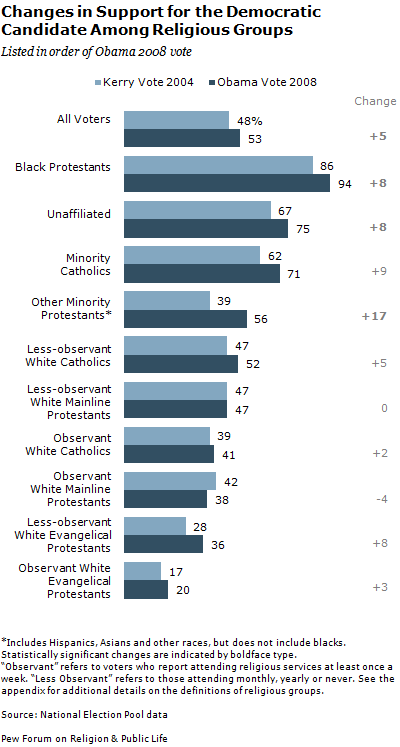
Which religions supported Obama most in 2008?

From CNS News.

Excerpt:

President Barack Obama has not yet decided whether to go forward with a proposed regulation under the health care law he signed last year that would force Catholic individuals and instutions to act against the teachings of the Catholic church.

In August, Health and Human Service Secretary Kathleen Sebelius proposed a regulation–that would take affect next fall–that would require all health care plans to cover sterilizations and all FDA-approved contraceptives, including abortifacients. The proposed regulation includes a very narrow religious exemption that does not cover individual Catholics, or Catholic universities, hospitals or charitable institutions.

The U.S. Conference of Catholic Bishops have called the regulation an “unprecedented attack on religious liberty” and have called on American Catholics to contact HHS and demand that the regulation be rescinded.

[…]Because of Obamacare’s mandate that all individuals must buy health insurance, the “preventive services” regulation would mean individual American Catholics would be forced to buy health insurance that pays for sterilizations, contraceptives and abortions–all of which violate Catholic moral teachings.

Many major Catholic institutions and Catholic business owners would be forced to choose between dropping health insurance coverage for their employees and students or violating their religious beliefs.

“Indeed, such nationwide government coercion of religious people and groups to sell, broker, or purchase ‘services’ to which they have a moral or religious objection represents an unprecedented attack on religious liberty,” the bishops said in commentary on the proposed regulation they submitted to HHS.

As an evangelical Protestant, I get so confused when I see many people who label themselves as “Catholic” voting to equate abortion with health care.

Insurance is about sharing costs. Why should people who choose not to have sex outside of marriage (like me) be compelled to pay the bills of people who freely choose to engage in risky, recreational sex? When you subsidize something, you get more of it. So why should pro-lifers be forced subsidize something that we don’t want more of? Why should pro-lifers want to make it less costly for people to engage in behaviors that result in the killing of an innocent child?