
Tag Archives: Baby

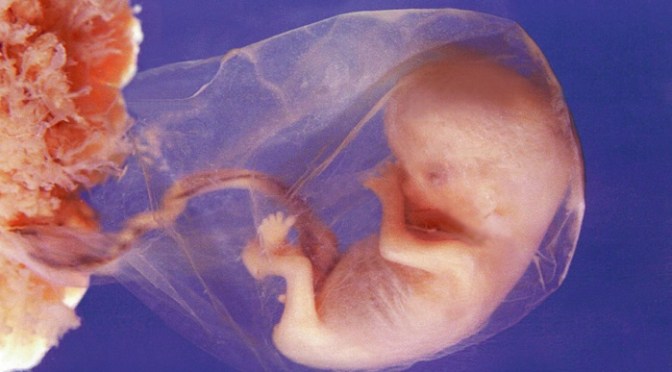
If unborn babies don’t have consciousness or don’t feel pain, may we kill them?

Was having a conversation by e-mail yesterday with a pro-abortion atheist, and he gave two reasons why he supported abortion in the first and second trimester. First, he said that unborn babies can’t feel pain, so it’s OK to kill them. Second, he said that unborn babies don’t have consciousness, so it’s OK to kill them. I thought it might be useful to link to something that answers both of these objections.

Frank Beckwith is the author of “Defending Life: A Moral and Legal Case Against Abortion Choice“, which was published by Cambridge University Press, a top academic press. But before Cambridge University Press, Beckwith wrote four easy-to-understand essays for the Christian Research Journal. Part IV is the one that has the response to the two questions raised by my atheist friend.

Part I. The Appeal to Pity

Part II. Arguments from Pity, Tolerance, and Ad Hominem

Part III. Is The Unborn Human Less Than Human?

Part IV. When Does a Human Become a Person?

Excerpt:

Some ethicists argue that the unborn becomes fully human sometime after brain development has begun, when it becomes sentient: capable of experiencing sensations such as pain. The reason for choosing sentience as the criterion is that a being that cannot experience anything (i.e., a presentient unborn entity) cannot be harmed. Of course, if this position is correct, then the unborn becomes fully human probably during the second trimester and at least by the third trimester. Therefore, one does not violate anyone’s rights when one aborts a nonsentient unborn entity. [13]

There are several problems with this argument. First, it confuses harm with hurt and the experience of harm with the reality of harm. [14] One can be harmed without experiencing the hurt that sometimes follows from that harm, and which we often mistake for the harm itself. For example, a temporarily comatose person who is suffocated to death “experiences no harm,” but he is nevertheless harmed. Hence, one does not have to experience harm, which is sometimes manifested in hurt, in order to be truly harmed.

Second, if sentience is the criterion of full humanness, then the reversibly comatose, the momentarily unconscious, and the sleeping would all have to be declared nonpersons. Like the presentient unborn, these individuals are all at the moment nonsentient though they have the natural inherent capacity to be sentient. Yet to countenance their executions would be morally reprehensible. Therefore, one cannot countenance the execution of some unborn entities simply because they are not currently sentient.

Someone may reply that while these objections make important points, there is a problem of false analogy in the second objection: the reversibly comatose, the momentarily unconscious, and the sleeping once functioned as sentient beings, though they are now in a temporary state of nonsentience. The presentient unborn, on the other hand, were never sentient. Hence, one is fully human if one was sentient “in the past” and will probably become sentient again in the future, but this cannot be said of the presentient unborn.

There are at least three problems with this response. First, to claim that a person can be sentient, become nonsentient, and then return to sentience is to assume there is some underlying personal unity to this individual that enables us to say that the person who has returned to sentience is the same person who was sentient prior to becoming nonsentient. But this would mean that sentience is not a necessary condition for personhood. (Neither is it a sufficient condition, for that matter, since nonhuman animals are sentient.) Consequently, it does not make sense to say that a person comes into existence when sentience arises, but it does make sense to say that a fully human entity is a person who has the natural inherent capacity to give rise to sentience. A presentient unborn human entity does have this capacity. Therefore, an ordinary unborn human entity is a person, and hence, fully human.

Second, Ray points out that this attempt to exclude many of the unborn from the class of the fully human is “ad hoc and counterintuitive.” He asks us to “consider the treatment of comatose patients. We would not discriminate against one merely for rarely or never having been sentient in the past while another otherwise comparable patient had been sentient….In such cases, potential counts for everything.” [15]

Third, why should sentience “in the past” be the decisive factor in deciding whether an entity is fully human when the presentient human being “is one with a natural, inherent capacity for performing personal acts?” [16] Since we have already seen that one does not have to experience harm in order to be harmed, it seems more consistent with our moral sensibilities to assert that what makes it wrong to kill the reversibly comatose, the sleeping, the momentarily unconscious, and the presentient unborn is that they all possess the natural inherent capacity to perform personal acts. And what makes it morally right to kill plants and to pull the plug on the respirator-dependent brain dead, who were sentient “in the past,” is that their deaths cannot deprive them of their natural inherent capacity to function as persons, since they do not possess such a capacity.

These four essays are a very good introduction to common responses to pro-abortion arguments. I recommend that people get familiar with this, as once you look into it, you will see that the abortion issue can be debated with as much confidence as William Lane Craig defends Christian theism. You will have the same access to scientific evidence and rational arguments on this topic, and so you will have the upper hand. And that’s fun.

The best introductory book on the abortion / right to life issue is “The Case for Life” by pro-life debater Scott Klusendorf. The best comprehensive book is a tie between “The Ethics of Abortion” by Christopher Kaczor, and Frank Beckwith’s “Defending Life: A Moral and Legal Case Against Abortion Choice“.

Gay marriage debate: Michael Brown debates Eric Smaw on same-sex marriage

About the debate:

On April 21, 2011 at 7:30pm at UCF’s Health and Public Affairs Building (Room 119), Rollins College professor, Dr. Eric Smaw and author and seminary professor Dr. Michael L. Brown will debate the question “Should same sex marriage be legalized in America?” The event will be held at 4000 Central Florida Blvd and is open to the public. After the formal portion of the debate, Brown and Smaw will field questions from the audience.

About the speakers:

Dr. Smaw will be responding in the affirmative. He earned his Ph.D. in Philosophy of Law from the University of Kentucky in 2005. His areas of expertise are philosophy of law, international law, human rights, ethics, and modern philosophy. He has published articles on human rights, terrorism, and cosmopolitanism. His most recent publication is “Swaying in the Balance: Civil Liberties, National Security, and Justice in Times of Emergency”.

Dr. Brown will be responding in the negative. He earned his Ph.D. in Near Eastern Languages and Literatures from New York University and is a nationally known evangelical lecturer and radio host. He is the author of numerous scholarly articles and twenty books, including the recently published study “A Queer Thing Happened to America”, which is quickly being recognized as the definitive work on the history and effects of gay activism on American culture.

Here are the first two parts:

Part 1 of 10:

Part 2 of 10:

The rest of the segments are here.

Summaries of the opening speeches

Summary of Dr. Brown’s opening speech:

There is no compelling reasons by the state should change the definition of marriage

The reason the state conveys benefits for marriage is because marriage is beneficial for the state

Traditional marriage is recognized by the state for several reasons:
– it domesticates men
– it protects women
– it provides a stable, nurturing environment for children

Marriage has three public purposes:
– to bind men and women together for RESPONSIBLE procreation
– to get the benefit
– to provide children with two parents who are bonded to them biologically
– to create the next generation of people to keep the society going

Normally, opposite sex couples create children

Homosexual couples can NEVER create children together

Men and women are differences that are complementary

Monogamy is the norm for opposite sex couples.

For gay men, open relationships / cheating is the norm.
This is because women have a tempering effect on sexuality.

There is no evidence that recognizing same-sex civil unions and marriages have changed this trend.

Same-sex marriage guarantees that children will either not have a father or a mother
So which of the sexes is dispensable when raising children?

For example, consider Dawn Stefanowicz, who grew up with a gay father and no mother
She never got a chance to see a man model love and protect a women within a marriage
That makes an enormous difference in a woman’s life – in the way she relates to men

Even with scientific advancements, every baby has a mother and a father

If we change the definition of marriage so that it is based on consent, then why limit it to just two people
If marriage is not the union of male and female, then why have only TWO people
In Canada, you have civil liberties lawyers arguing for for polygamy
In the United States, Professor David Epstein was in a consensual relationship with his daughter
Should incestuous relationships also be celebrated as marriage? Why not?
Should polyamorous relationships also be celebrated as marriage? Why not?

Sexual orientation is not the same as race
Men are women are different in significant ways, but different races are not
You need separate bathrooms for men and women, but not for people of different races

Summary of Dr. Smaw’s opening speech: (He ended his speech after only 10 minutes)

You can redefine marriage so that it no longer based on the public purposes he mentioned (controlling procreation, fusing complementary male and female natures, providing children with mothers and fathers who are biologically linked to them, providing children with a comparatively stable development environment that offers comparatively less instability, promiscuity and domestic violence rates compared to cohabitation, etc.), but is instead based on consent and feelings, and that redefinition of marriage won’t open marriage up to polygamy, polyamory, etc.

If you like feminism, then you should allow same-sex marriage

If you like abortion rights, then you should allow same-sex marriage

Homosexuals participate in society by working at various jobs, so they are participating in society

Homosexuals should be given the same tax breaks as married people because they work at various jobs for money

Working at a job for money achieves the same public purpose as procreating and staying together to raise children in a stable environment

You can listen to the rest for the rebuttals, and cross-examination. Oh yes – there was cross-examination! It starts two thirds of the way through Part 5, if you want to jump to it. And sparks were flying! There is also Q&A from the audience of students.

This is such a great debate – I love to hear two passionate guys disagreeing about something. I love to hear both sides of the issues. There is always something to learn by listening to the other side. It makes me more effective and more tolerant when I stand up to defend my side of the argument.

By the way, my own secular case against same-sex marriage is right here, if you want to see how I would debate this issue. Also check out the recent studies on the effects of gay parenting on children.

Gay marriage debate: Michael Brown debates Eric Smaw on same-sex marriage

About the debate:

On April 21, 2011 at 7:30pm at UCF’s Health and Public Affairs Building (Room 119), Rollins College professor, Dr. Eric Smaw and author and seminary professor Dr. Michael L. Brown will debate the question “Should same sex marriage be legalized in America?” The event will be held at 4000 Central Florida Blvd and is open to the public. After the formal portion of the debate, Brown and Smaw will field questions from the audience.

About the speakers:

Dr. Smaw will be responding in the affirmative. He earned his Ph.D. in Philosophy of Law from the University of Kentucky in 2005. His areas of expertise are philosophy of law, international law, human rights, ethics, and modern philosophy. He has published articles on human rights, terrorism, and cosmopolitanism. His most recent publication is “Swaying in the Balance: Civil Liberties, National Security, and Justice in Times of Emergency”.

Dr. Brown will be responding in the negative. He earned his Ph.D. in Near Eastern Languages and Literatures from New York University and is a nationally known evangelical lecturer and radio host. He is the author of numerous scholarly articles and twenty books, including the recently published study “A Queer Thing Happened to America”, which is quickly being recognized as the definitive work on the history and effects of gay activism on American culture.

Here are the first two parts:

Part 1 of 10:

Part 2 of 10:

The rest of the segments are here.

Summaries of the opening speeches

Summary of Dr. Brown’s opening speech:

There is no compelling reasons by the state should change the definition of marriage

The reason the state conveys benefits for marriage is because marriage is beneficial for the state

Traditional marriage is recognized by the state for several reasons:
– it domesticates men
– it protects women
– it provides a stable, nurturing environment for children

Marriage has three public purposes:
– to bind men and women together for RESPONSIBLE procreation
– to get the benefit
– to provide children with two parents who are bonded to them biologically
– to create the next generation of people to keep the society going

Normally, opposite sex couples create children

Homosexual couples can NEVER create children together

Men and women are differences that are complementary

Monogamy is the norm for opposite sex couples.

For gay men, open relationships / cheating is the norm.
This is because women have a tempering effect on sexuality.

There is no evidence that recognizing same-sex civil unions and marriages have changed this trend.

Same-sex marriage guarantees that children will either not have a father or a mother
So which of the sexes is dispensable when raising children?

For example, consider Dawn Stefanowicz, who grew up with a gay father and no mother
She never got a chance to see a man model love and protect a women within a marriage
That makes an enormous difference in a woman’s life – in the way she relates to men

Even with scientific advancements, every baby has a mother and a father

If we change the definition of marriage so that it is based on consent, then why limit it to just two people
If marriage is not the union of male and female, then why have only TWO people
In Canada, you have civil liberties lawyers arguing for for polygamy
In the United States, Professor David Epstein was in a consensual relationship with his daughter
Should incestuous relationships also be celebrated as marriage? Why not?
Should polyamorous relationships also be celebrated as marriage? Why not?

Sexual orientation is not the same as race
Men are women are different in significant ways, but different races are not
You need separate bathrooms for men and women, but not for people of different races

Summary of Dr. Smaw’s opening speech: (He ended his speech after only 10 minutes)

You can redefine marriage so that it no longer based on the public purposes he mentioned (controlling procreation, fusing complementary male and female natures, providing children with mothers and fathers who are biologically linked to them, providing children with a comparatively stable development environment that offers comparatively less instability, promiscuity and domestic violence rates compared to cohabitation, etc.), but is instead based on consent and feelings, and that redefinition of marriage won’t open marriage up to polygamy, polyamory, etc.

If you like feminism, then you should allow same-sex marriage

If you like abortion rights, then you should allow same-sex marriage

Homosexuals participate in society by working at various jobs, so they are participating in society

Homosexuals should be given the same tax breaks as married people because they work at various jobs for money

Working at a job for money achieves the same public purpose as procreating and staying together to raise children in a stable environment

You can listen to the rest for the rebuttals, and cross-examination. Oh yes – there was cross-examination! It starts two thirds of the way through Part 5, if you want to jump to it. And sparks were flying! There is also Q&A from the audience of students.

This is such a great debate – I love to hear two passionate guys disagreeing about something. I love to hear both sides of the issues. There is always something to learn by listening to the other side. It makes me more effective and more tolerant when I stand up to defend my side of the argument.

By the way, my own secular case against same-sex marriage is right here, if you want to see how I would debate this issue. Also check out the recent studies on the effects of gay parenting on children.