Tag Archives: Atheism

Gosnell movie set to open in October 2018 in 100 theaters

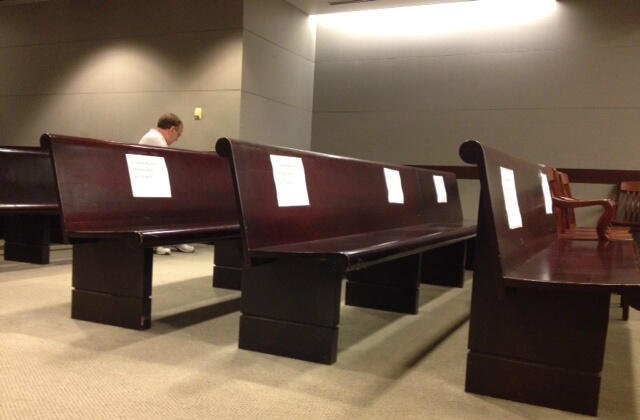
Empty benches where the mainstream media was supposed to be during the trial
Empty benches where the mainstream media ought to be during the Gosnell trial

At the time of the Gosnell story, I remember that there was a nationwide, wall-to-wall media blackout. Every single mainstream media source was colluding with the others not to report on the story. It was impossible to get news for weeks, until finally the mainstream media’s pro-abortion, pro-infanticide bias became the story, and they had to start reporting on the trial.

For example, Life News reported that it took ABC News 56 days to begin covering the story, and they only did it because pro-lifers marched on their headquarters:

Fifty six days after the grisly trial of abortionist Kermit Gosnell began, ABC broke its self-imposed blackout and finally offered coverage.

World News anchor Diane Sawyer belatedly told viewers that Gosnell was convicted on three counts of first degree murder against newborn babies, as well as on a slew of other charges. Terry Moran explained, “For two months, jurors heard often shocking, grisly testimony.” He described the details as a “house of horrors.” A house of horrors that ABC took 56 days to notice.

As the Media Research Center has aggressively documented, ABC went from March 18, 2013 (the trial’s start) through Monday afternoon with no coverage. Yet during the same time, the network devoted a staggering 187 minutes (or 70 segments) to other shocking criminal cases, such as Jodi Arias and Amanda Knox.

CNS News did a comparison between the Gosnell murder trial and the coverage of the gay NBA player:

In the eight days since NBA player Jason Collins announced he was gay, the news media have covered the story in 2,381 places. But in the first eight days of the trial of Dr. Kermit Gosnell and his “House of Horrors” abortion business, the media covered the story in 115 places, meaning that Collins’ “gay” news received more than 1,970.4% more news coverage.

Given the media blackout, I wanted to blog about the new movie about the Gosnell murders. Although the Gosnell movie was filmed in 2015, it’s only being released next month. It turns out that the same sort of people who covered up for Gosnell in the mainstream media also got the release of the movie delayed.

A National Review story by the director explains what the movie is about and why its release was delayed.

Excerpt:

The film has a gritty “just the facts, ma’am” style, is well acted, with powerful, moving performances by Dean Cain, Sarah Jane Morris, and Michael Beach, among many others, and moves like a bullet train. So why has it taken three years to be released?

I realize, looking back, that I was quite naïve about how this film would be received. I truly believed that if we did it the right way, even the so-called Hollywood Left would appreciate our fairness in telling the story, see its value, and, furthermore, share our goals in getting this important story before the public.

Sadly, I was wrong. As I said, this town runs on fear — the fear not only of failure but, more insidiously, of being shunned because of your political opinions. […]More than once, I was asked questions like “Are you crazy?” or “Are you sure you want to do this?”

[…]Fear is destructive and dangerous. Fear is what allowed Gosnell to commit multiple murders. The powers-that-be were afraid to allow inspections of his clinic, even after multiple complaints, for fear of being called racist or “anti-woman.”

I was looking for some background on the two people behind the Gosnell movie, and I found an article by Terrell Clemmons over on the Salvo magazine web site. It turns out that the filmmakers were neutral on abortion before they looked into investigation of the Gosnell abortion clinic.

Excerpt:

Phelim McAleer was in Pennsylvania in early 2013 doing a series of screenings of his film FrackNation. As he often did when travelling, he checked the local paper for interesting court cases underway, and a case concerning a doctor in Philadelphia caught his attention. And so it happened that on one of his days off, he walked into the courtroom where abortionist Kermit Gosnell was standing trial for a slew of charges including (but not limited to) murder, infanticide, and multiple violations of state abortion law.

Phelim had seen a lot in his twenty-five years in journalism (he started his career in a part of Northern Ireland known as “Bandit Country”), but the evidence he saw that day in Room 304 of the Philadelphia Justice Center surpassed anything he’d previously encountered. The photos displayed up on a big screen—pictures of well-formed babies, some of whose necks had been snipped with scissors after live birth—were more horrific than anything he’d ever seen. All of this was shocking in itself, but what was even more astounding to him as a journalist was that the press gallery behind him was completely empty. There were no national journalists covering this case. Not one. How could this be?

He returned home to Los Angeles and told his journalist partner and wife, Ann McElhinney, that he had found the next project they would work on. At first, Ann wanted nothing to do with it. This subject was foreign territory for them, way outside their wheelhouse. Besides, both she and Phelim had always considered themselves neutral on abortion. Why venture into such a hornet’s nest?

Phelim ordered the court transcripts anyway, and Ann read them. Afterward, she agreed, Yes, they would make this film. It was more than an assent or a shared inclination. It was a conviction. Here was information of significant public interest, and it was shameful that no one was putting it out. A film about this had to be made; therefore, they would make it.

The film will open in 100 theaters, and when I looked, I saw that it was actually going to be a drive for me to get to the closest one.

It’s not surprising to me that the atheists in the mainstream media would seek to suppress the Gosnell story by not covering it. When you jettison objective morality from your worldview, you tend to fall back on a definition of morality that is more like “peer approval”. The mainstream media probably just thinks, if fewer people know the truth about this story, then they’ll still think I’m a good person for being pro-abortion. They lied and covered-up because their personal sense of moral goodness was at stake.

New study: belief in free will linked to ability to behave morally and to help others

J. Warner Wallace: God's Crime Scene
J. Warner Wallace: God’s Crime Scene

This is a re-post because I am travelling today.

A while back I finished reading “God’s Crime Scene”, the new book by J. Warner Wallace. I wanted to post something about some studies he mentioned in Chapter 6, on free will. This is one of the places where he found evidence in a surprising area.

Wallace says that free will makes more sense if theism is true, because we have non-material souls that interact with our bodies, but are not causally determined by them. On atheism, only matter exists, and you can’t get free will (or consciousness) from matter. So atheists like Sam Harris and Alex Rosenberg, for example, deny free will, because they are materialists and atheists.

Anyway, here’s what he writes on p. 256:

In 2008, researchers from the University of Minnesota and the University of British Columbia conducted experiments highlighting the relationship between a belief in determinism and immoral behavior. They found students who were exposed to deterministic literature prior to taking a test were more likely to cheat on the test than students who were not exposed to literature advocating determinism. The researchers concluded those who deny free will are more inclined to believe their efforts to act morally are futile and are, therefore, less likely to do so.

In addition, a study conducted by researchers from Florida State University and the University of Kentucky found participants who were exposed to deterministic literature were more likely to act aggressively and less likely to be helpful toward others.” Even determinist Michael Gazzaniga conceded: “It seems that not only do we believe we control our actions, but it is good for everyone to believe it.”” The existence of free will is a common characteristic of our experience, and when we deny we have this sort of free agency, there are detrimental consequences.

I decided to look up these studies.

Here’s the abstract for first study: (2008)

Does moral behavior draw on a belief in free will? Two experiments examined whether inducing participants to believe that human behavior is predetermined would encourage cheating. In Experiment 1, participants read either text that encouraged a belief in determinism (i.e., that portrayed behavior as the consequence of environmental and genetic factors) or neutral text. Exposure to the deterministic message increased cheating on a task in which participants could passively allow a flawed computer program to reveal answers to mathematical problems that they had been instructed to solve themselves. Moreover, increased cheating behavior was mediated by decreased belief in free will. In Experiment 2, participants who read deterministic statements cheated by overpaying themselves for performance on a cognitive task; participants who read statements endorsing free will did not. These findings suggest that the debate over free will has societal, as well as scientific and theoretical, implications.

And the abstract for the second study: (2009)

Laypersons’ belief in free will may foster a sense of thoughtful reflection and willingness to exert energy, thereby promoting helpfulness and reducing aggression, and so disbelief in free will may make behavior more reliant on selfish, automatic impulses and therefore less socially desirable. Three studies tested the hypothesis that disbelief in free will would be linked with decreased helping and increased aggression. In Experiment 1, induced disbelief in free will reduced willingness to help others. Experiment 2 showed that chronic disbelief in free will was associated with reduced helping behavior. In Experiment 3, participants induced disbelief in free will caused participants to act more aggressively than others. Although the findings do not speak to the existence of free will, the current results suggest that disbelief in free will reduces helping and increases aggression.

So what to make of this?

If you’re an atheist, then your worldview is telling you that what you are doing now is the result of genetic programming and sensory inputs. You’re not conscious. You can’t reason. You make no free choices, including moral choices. Naturally, someone who believes this is going to struggle with prescriptive morality, including self-sacrificial care and concern for others. Their worldview undermines the rationality of the moral point of view. You might find atheists acting morally for their own purposes, but their worldview doesn’t rationally ground it. This is a big problem for people who can see objective morality woven into the universe – and themselves – because they have the awareness of objective right and wrong.

I think what atheists like to say is “I can be moral, too”. That’s not interesting. What is interesting is whether it is rational for you to be moral when things start to get a bit uncomfortable. When I look at the adultery of Dawkins, the polyamory of Carrier, the divorces of Shermer and Atkins, etc. I am not seeing anything that really wows me. They all deny free will of course, and think that trying to resist temptation is a waste of time. What difference would it make if they did, anyway – there’s no afterlife on atheism.

Wallace explains how the awareness of free will and moral choices caused him to turn away from atheism, in this blog post.

He writes:

As an atheist, I chose to cling to naturalism, in spite of the fact that I lived each day as though I was capable of using my mind to make moral choices based on more than my own opinion. In addition, I sought meaning and purpose beyond my own hedonistic preferences, as though meaning was to be discovered, rather than created. I called myself a naturalist while embracing three characteristics of reality that simply cannot be explained by naturalism. As a Christian, I’m now able to acknowledge the “grounding” for these features of reality. My philosophical worldview is consistent with my practical experience of the world.

I think atheists who want to be honest about their own experience of first-person consciousness, free will, moral realism, etc. will do well to just accept that theism rationally grounds all of these things, and so you should accept theism. Theism is real. If you like morality, and want to be a virtuous person, then you should accept theism.

What got me started on apologetics? William Lane Craig debate transcripts

William Lane Craig lecturing to university students

Yes, William Lane Craig debate transcripts. In fact, I still read them from time to time to keep up my skills.

Here’s one of my favorites, the Craig-Nielsen debate on grounding morality without God

Summary:

THE CRAIG-NIELSEN DEBATE: GOD, MORALITY, AND EVIL
William Lane Craig and Kai Nielsen
with annotations by William Lane Craig
February 1991, University of Western Ontario

Best part:

Finally, he raises the issue of immortality and says, “Death doesn’t undermine moral values. In fact, things that we value become all the more precious.” Well, in one sense he’s right. It’s the absence of God that undermines the objectivity of moral values, not death. But let’s suppose that there are objective moral values. What would be undermined by the lack of immortality? I think two things.

First, I think there would be no reason to adopt the moral point of view. Since you’re going to die, everyone ends up the same. It doesn’t make any difference whether you live as a Hitler or a Mother Teresa. There is no relationship between your moral living and your ultimate fate. And so in that sense, death undermines the reason for adopting the moral point of view rather that just being an egoist and living for self.

Second, there’s no basis for self-sacrifice on this point of view. Why should an atheist, who knows everything is going to end in death, do things that are morally right that go against self-interest? For example, a few years ago there was a terrible mid-winter air disaster in Washington, DC, as a plane crashed into a bridge spanning the Potomac River, spilling its passengers into the icy waters. And as the helicopters came to rescue these people, attention focused on one man who again and again passed by the rope ladder rather than be pulled to safety himself. Seven times he did this, and when they came again, he was gone. The whole nation turned its eyes to this man in respect and admiration for the noble act of self-sacrifice that he did. And yet on the atheistic view, that man wasn’t noble. He did the stupidest thing possible. He should have gone for the rope ladder first, pushed others away, if necessary, in order to survive! But to give up all the brief existence he will ever have for others he didn’t even know? Why? It seems to me, then, that it’s not simply the absence of God that undermines objective moral values, but ethical living is also undermined by the atheistic point of view because you then have no reason to adopt the moral point of view and you have no basis for acts of self-sacrifice.

By contrast, on the Christian view, where you have both God and immortality, you have the necessary presuppositions for the affirmation of objective moral values and for consistent living of the ethical life.

And another of my favorites, the Craig-Taylor debate on the ontological grounding of morality.

Summary:

Is The Basis Of Morality Natural Or Supernatural?
Richard Taylor and William Lane Craig
October 1993, Union College, Schenectady, New York

Sample Craig:

(2) I argued that moral accountability also exists under the supernaturalist view, and Professor Taylor didn’t deny the point.

(II) What about my critique, then, of naturalism? I said that naturalism doesn’t provide a sound foundation for morality, and here I made two points:

(1) On the naturalist view, objective right and wrong do not exist. Again, Professor Taylor doesn’t deny this point; he just says, “Well, to say that they’re conventional doesn’t mean they’re contemptible.” Well, granted; but it does mean they’re arbitrary, they’re non–objective. There’s no more difference between moral right and wrong than driving on the right–hand side of the road versus the left–hand side of the road. It’s simply a societal convention. And the modern evolutionist thinks these conventions are just based in socio–biological evolution. According to Michael Ruse, a professor of the philosophy of science,

The position of the modern evolutionist…is that humans have an awareness of morality…because such an awareness is of biological worth. Morality is a biological adaptation, no less than are hands and feet and teeth…. Considered as a rationally justifiable set of claims about an objective something, [ethics] is illusory. I appreciate that when somebody says, ‘Love thy neighbor as thyself,’ they think they are referring above and beyond themselves…. Nevertheless…such reference is truly without foundation. Morality is just an aid to survival and reproduction and…any deeper meaning is illusory….{26}

This is essentially the same view as Professor Taylor’s. Moral values are simply rooted in socio–biological evolution, that have passed down as certain taboos and certain commands, but they have no objective validity in terms of their moral rightness or wrongness. Professor Taylor says, “But I have a high regard for people who are truly moral and decent.” I don’t deny that. Of course he does! But the point is that in his ethics, in his philosophy, he has no basis for that affirmation. What I bring is not a new set of values—I think we pretty much hold those in common—but I’m offering a secure foundation for those values that we all want to hold dear.

You see, on Professor Taylor’s view, there really isn’t any objective morality. I think every one of us here tonight would agree that it’s wrong to kill babies and that the holocaust was morally wrong. But in his book Professor Taylor says, “The infanticide practiced by the Greeks of antiquity did not violate their customs. If we say it was nevertheless wrong, we are only saying that it is forbidden by our ethical and legal rules. And the abominations practiced by the Nazis…are forbidden by our rules, and not, obviously, by theirs.”{27} I submit that that is simply a patently false view of moral values and that naturalism, therefore, can’t provide any objective basis for right and wrong.

And another of my favorites, the Craig-Tooley debate on the problem of evil.

Summary:

A Classic Debate on the Existence of God
Dr. William Lane Craig & Dr. Michael Tooley
November 1994, University of Colorado at Boulder

Sample Craig:

(2) Christian doctrines increase the probability of the coexistence of God and the evils in the world. Let me just mention a couple of these.

(i) On the Christian view, the purpose of life is not happiness as such in this life. Rather it is the knowledge of God—which will ultimately produce true and everlasting happiness. What that means is that many evils occur in this life which might be utterly pointless with respect to producing human happiness. But they might not be pointless with respect to producing the knowledge of God. Dr. Tooley assumes when he talks about changes that would make this world a better place, that the purpose of life is basically to be happy in this life. And I certainly admit that you could make changes that might appear to make this life a better place, make it happier. But that’s not God’s purpose. So if you understand that the purpose of life is not happiness as such, I think that you can see that the existence of evil doesn’t necessarily cast any improbability upon God’s existence.

(ii) It’s also the Christian view that God’s purpose spills over into eternal life. In the afterlife God will bestow a glory and happiness upon us that is incomparable to what we’ve suffered here on earth. And the longer we spend in eternity with Him, the more the sufferings in this life shrink by comparison to an infinitesimal instant. Dr. Tooley admits in his article that it is possible that immortality could justify such evils. But, he says, it’s “very unlikely” that there is life after death. Well, I have two comments. First, I’d like him to prove that it’s unlikely that there is life after death.{26} Second, I suggest that the resurrection of Jesus gives us grounds for hoping in life after death, and I’ve attempted to justify that historically. So given these Christian doctrines, I think you can see that the existence of God and evil is not so improbable after all.

[…]

(4) Finally, I think that there is actually an argument for God from evil. It would go like this:

(i) If God does not exist, objective moral values do not exist. If there is no God, moral values are either socio-biological by-products or just expressions of personal preference.

(ii) Evil exists. That’s the premise of the atheist. There is real evil in the world.

(iii) Therefore, objective values do exist. Some things are really wrong.

(iv) Therefore, God exists.

Thus the presence of evil in the world actually demonstrates God’s existence because in the absence of God, there wouldn’t be any distinction objectively between good and evil, between right and wrong. So although evil in one sense calls into question God’s existence, in a much deeper sense, I think, it actually requires God’s existence.

So in the light of these four responses, I think that the argument from evil, as difficult and emotionally pressing as it might be, in the end doesn’t constitute a good argument against the existence of God. So I think the four arguments given against the existence of God by Dr. Tooley are inconclusive. You’ve still got my six arguments for God’s existence, and therefore I still think that on balance the evidence favors theism as the more rational worldview.

There are more debate transcripts on Craig’s Reasonable Faith web site.