Tag Archives: Atheism

New study: 90% of species on Earth today originated 100,000 to 200,000 years ago

Christianity and the progress of science

Well, it’s Friday, so I thought we would all benefit from reading about a brand new peer-reviewed study that should be the final nail in the coffin of naturalistic evolution. At least for those with an open mind who are not wedded to the philosophical assumption of naturalism.

Phys.org (which is committed dogmatically to fully naturalistic evolution) reports:

Mark Stoeckle from The Rockefeller University in New York and David Thaler at the University of Basel in Switzerland, who together published findings last week sure to jostle, if not overturn, more than one settled idea about how evolution unfolds.

It is textbook biology, for example, that species with large, far-flung populations—think ants, rats, humans—will become more genetically diverse over time.

But is that true?

“The answer is no,” said Stoeckle, lead author of the study, published in the journal Human Evolution.

For the planet’s 7.6 billion people, 500 million house sparrows, or 100,000 sandpipers, genetic diversity “is about the same,” he told AFP.

The study’s most startling result, perhaps, is that nine out of 10 species on Earth today, including humans, came into being 100,000 to 200,000 years ago.

“This conclusion is very surprising, and I fought against it as hard as I could,” Thaler told AFP.

That reaction is understandable: How does one explain the fact that 90 percent of animal life, genetically speaking, is roughly the same age?

Oh, oh. Pick me, pick me. I know the answer. The answer is that the biological information in living systems was put there by an intelligent agent. You know, the same way that information in books is put there by intelligent agents. And the same way that information in computer code is put there by intelligent agents. And the same way that information in blog posts is put there by intelligent agents. We know what introduces information from our own experience.

Well, what about mutation and selection? Couldn’t they create all this information in a couple hundred thousand years? Well, no. You see, mutation and selection have been tested in the lab to see how much information they can produce over generations and generations. And the conclusion is clear: it is impossible for blind forces to create the amount of information we see in living systems in the short time that is available. In fact, the whole history of the universe is not enough time for evolutionary mechanisms to create the information we have in front of us.

Before we leave the paper reported by Phys.org, here is something about whether we see the gradual emergence of complexity via lots of transitional forms in nature.

Not so much:

[…][A]nother unexpected finding from the study—species have very clear genetic boundaries, and there’s nothing much in between.

“If individuals are stars, then species are galaxies,” said Thaler. “They are compact clusters in the vastness of empty sequence space.”

The absence of “in-between” species is something that also perplexed Darwin, he said.

Indeed. So perplexing.

The evidence we gain from the progress of science is always perplexing to people who assume naturalism, and then try to shoehorn reality to match their religious assumptions. I have an idea. Why don’t we just make science the search for truth, no holds barred? Wouldn’t that be a much better way to do science? Let’s just do science honestly, and stop trying to make it prove things that are comfortable for us.

If the origin of the universe, the fine-tuning of the universe for intelligent life, the origin of the first living system, and the sudden origin of body plans in the Cambrian explosion are impossible to account for on naturalism, then maybe we need to jettison the philosophical assumption of naturalism, and just go where the evidence leads? What’s wrong with that?
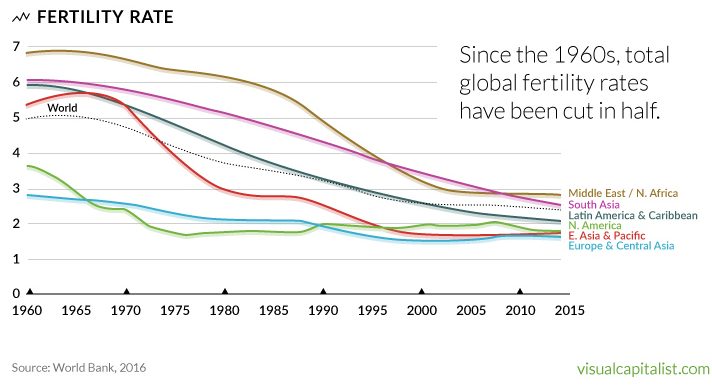
U.S. birth rate hits record low, despite secular left’s obsession with “overpopulation”

Total fertility rates have decreased globally by about half since 1960.

I had lunch with one of my co-workers on the secular left recently. I asked him what his biggest concern with the world. After telling me that he was a “libertarian”, he said that he was alarmed that people were having too many babies. I asked him what he wanted to do about it. He said keep abortion legal, and use the government to stop people from reproducing. Some libertarian!

Anyway, he was just factually wrong about the overpopulation, and I had to launch into a long, detailed explanation of replacement rates, birth rates across the world, and how the prosperity created by capitalism has caused birth rates to decline in even poorer countries. I also explained to him that once a country dips below the replacement fertility rate (2.1 births per woman), it never returns. I concluded my refutation of his assertion by stating that he should be more worried about underpopulation than overpopulation.

Anyway, I had to repeat the same explanation again with another secular leftist that same week. So when I saw this recent Daily Caller article about a new report from the US Centers for Disease Control, I figured I might as well equip you guys to respond to other people with the same wrong view.

It says:

The United States birth rate hit a record low in 2018 with numbers reflecting the lowest birthrates in the past 30 years, reports say.

A new report from the National Center for Health Statistics at the US Centers for Disease Control and Prevention reveals that almost every age group of women under 35 showed birth rate declines in 2018. The provisional number of births in the U.S. in 2018 was 3,788,235, down 2% since 2017. For every 1,000 women, the fertility rate declined 2% from 2017 to 1,728.0 births.

Birth rates had reached a record low in 2017 as well, marking a continuing trend of declining birth rates over the past four years, according to CNN.

[…]These 2018 birth rate numbers are below the necessary threshold needed for population replacement, which is 2,100 births per 1,000 women, CNN reports.

So we’re down to 1.73 births in the USA, which is below the 2.1 rate needed to maintain current population levels.

This new report isn’t an outlier. It confirms what we knew about from previous reports.

Here’s an earlier report from the far-left Pew Research Center, reported by the radically-leftist Slate, of all places.

Excerpt:

A report issued last month by the Pew Research Center found that immigrant births fell from 102 per 1,000 women in 2007 to 87.8 per 1,000 in 2012. That helped bring the overall U.S. birthrate to a mere 64 per 1,000 women—not enough to sustain our current population.

Moreover, the poor, highly fertile countries that once churned out immigrants by the boatload are now experiencing birthrate declines of their own. From 1960 to 2009, Mexico’s fertility rate tumbled from 7.3 live births per woman to 2.4, India’s dropped from six to 2.5, and Brazil’s fell from 6.15 to 1.9. Even in sub-Saharan Africa, where the average birthrate remains a relatively blistering 4.66, fertility is projected to fall below replacement level by the 2070s. This change in developing countries will affect not only the U.S. population, of course, but eventually the world’s.

Now I have a couple tools for you to share to those people who might have irrational views of this issue.

Useful videos

This video explains what’s wrong with overpopulation fears:

And this one explains what the replacement rate number is:

You can share those for people who don’t have time to read. It at least makes the point, even if it doesn’t link to a reputable report.

A useful podcast

This podcast featuring famous economist Dr. Jennifer Roback Morse will be useful for you to understand why the overpopulation myth is something you should be concerned about.

The MP3 file is here. (from 1/22/2010)

Topics:

  • how the transition from country to city discourages child-bearing
  • how religion impacts how many children parents have
  • what is the US birth rate, is it high enough?
  • can we just import immigrants to alleviate the low birth rate?
  • has increased prosperity encouraged people to have more children?
  • how has the purpose of sex changed after the sexual revolution?
  • how does the demographic crisis threaten entitlement programs?
  • what do we learn from the declining birth rate in Japan?
  • how does population growth impact stock market performance?

This podcast explains how some countries aren’t making enough young workers to pay for the social programs needed by a growing number of elderly people wanting to retire.

Please share the post if you found it useful.

Atheist gets her PhD in astronomy and astrophysics and finds evidence for God

Christianity and the progress of science

Christian apologist Terrell Clemmons tweeted this testimony by Sarah Salviander, a research scientist in astronomy and astrophysics at the prestigious University of Texas at Austin.

Dr. Salviander writes:

I was born in the U.S., but grew up in Canada. My parents were socialists and political activists who thought British Columbia would be a better place for us to live, since it had the only socialist government in North America at the time. My parents were also atheists, though they eschewed that label in favor of “agnostic.” They were kind, loving, and moral, but religion played no part in my life. Instead, my childhood revolved around education, particularly science. I remember how important it was to my parents that my brother and I did well in school.

I just want to point out that I hope that all you Christian parents are taking seriously the obligation to make your kids do well in school, because even if they start out as atheists when they are young, they can still find their way back to God through study, as Sarah did.

She had a bad start, that’s for sure:

I grew up in the 1970s and 1980s, a time when science fiction was enjoying a renaissance, thanks largely to the popularity of Star Wars. I remember how fascinated I was by the original Star Wars trilogy. It had almost nothing to do with science—it’s more properly characterized as space opera—but it got me thinking about space in a big way. I also loved the original Star Trek, which was more science fiction. The stoic and logical character of Mr. Spock was particularly appealing to me. Popular science was also experiencing a renaissance at that time, which had a lot to do with Carl Sagan’s television show, Cosmos, which I adored. The combination of these influences led to such an intense wonder about outer space and the universe, that by the time I was nine years old I knew I would be a space scientist someday.

Canada was already post-Christian by the 1970s, so I grew up with no religion. In retrospect, it’s amazing that for the first 25 years of my life, I met only three people who identified as Christian. My view of Christianity was negative from an early age, and by the time I was in my twenties, I was actively hostile toward Christianity. Looking back, I realized a lot of this was the unconscious absorption of the general hostility toward Christianity that is common in places like Canada and Europe; my hostility certainly wasn’t based on actually knowing anything about Christianity. I had come to believe that Christianity made people weak and foolish; I thought it was philosophically trivial. I was ignorant not only of the Bible, but also of the deep philosophy of Christianity and the scientific discoveries that shed new light on the origins of the universe and life on Earth.

She documents a phase of following Ayn Rand and embracing “Objectivism”, but eventually she rejects it for failing to answer the big questions of life.

More:

I began to focus all of my energy on my studies, and became very dedicated to my physics and math courses. I joined campus clubs, started to make friends, and, for the first time in my life, I was meeting Christians. They weren’t like Objectivists—they were joyous and content. And, they were smart, too. I was astonished to find that my physics professors, whom I admired, were Christian. Their personal example began to have an influence on me, and I found myself growing less hostile to Christianity.

This is why I think it is so important for Christian parents to raise their children to get advanced degrees… either to become professors themselves, or to finance others (e.g. – our own children) to do advanced degrees. It is so important for university students to see Christian professors on campus. And failing that, it’s important that we bring Christian speakers in to debate non-Christian speakers on the important issues. This will not happen unless we recognize how important it is, and then make a plan to achieve it.

More:

I had joined a group in the Center for Astrophysics and Space Sciences (CASS) that was researching evidence for the big bang. The cosmic background radiation—the leftover radiation from the big bang—provides the strongest evidence for the theory, but cosmologists need other, independent lines of evidence to confirm it. My group was studying deuterium abundances in the early universe. Deuterium is an isotope of hydrogen, and its abundance in the early universe is sensitive to the amount of ordinary mass contained in the entire universe. Believe it or not, this one measurement tells us whether the big bang model is correct.

If anyone is interested in how this works, I’ll describe it, but for now I’ll spare you the gruesome details. Suffice it to say that an amazing convergence of physical properties is necessary in order to study deuterium abundances in the early universe, and yet this convergence is exactly what we get. I remember being astounded by this, blown away, completely and utterly awed. It seemed incredible to me that there was a way to find the answer to this question we had about the universe. In fact, it seems that every question we have about the universe is answerable. There’s no reason it has to be this way, and it made me think of Einstein’s observation that the most incomprehensible thing about the world is that it’s comprehensible. I started to sense an underlying order to the universe. Without knowing it, I was awakening to what Psalm 19 tells us so clearly, “The heavens declare the glory of God; the skies proclaim the work of his hands.”

That summer, I’d picked up a copy of The Count of Monte Cristo by Alexandre Dumas and was reading it in my off hours. Previous to this, I’d only known it as an exciting story of revenge, since that’s what the countless movie and TV adaptations always focused on. But it’s more than just a revenge story, it’s a philosophically deep examination of forgiveness and God’s role in giving justice. I was surprised by this, and was starting to realize that the concept of God and religion was not as philosophically trivial as I had thought.

All of this culminated one day, as I was walking across that beautiful La Jolla campus. I stopped in my tracks when it hit me—I believed in God! I was so happy; it was like a weight had been lifted from my heart. I realized that most of the pain I’d experienced in my life was of my own making, but that God had used it to make me wiser and more compassionate. It was a great relief to discover that there was a reason for suffering, and that it was because God was loving and just. God could not be perfectly just unless I—just like everyone else—was made to suffer for the bad things I’d done.

The Count of Monte Cristo is one of my favorite, favorite books as well, and had the same impact on me as it did on her.

OK, that’s enough for this post. Go read the rest, and please share it.

I spoke to her recently and she told me that she is working on several projects that are designed to get people more familiar with science and Bible issues. This woman is an expert Christian apologist and her life will have an influence. Are you going to be like her? Will you mentor others to be like her? Will you marry someone like her? Will you raise children who are like her? I think we should all have a plan to study the areas that are important and have an influence for God with what we learn.

Positive arguments for Christian theism