Tag Archives: Atheism

How should we respond to doubts and challenges to Christian beliefs or practices?

The tracks are out ahead, and Spider-Man has to save the day
The tracks are out ahead, but Spider-Man arrives just in time to save the day!

Something happened this week that really provided the watching non-Christian world with a good example of what it means to be an authentic Christian. It was such a good story, that I shared it with my non-Christian co-workers. They were so impressed that they asked me to go to lunch with them so they could tell me why they abandoned their faiths after being raised Christian.

The story starts with a famous Christian musician named Marty Sampsons expressing doubts about Christianity, because he was exposed to challenges to his faith, and not getting any answers from people in the church. Instead, when he expressed his doubts, people who had formerly treated him very well started to insult him and post condemning Bible verses on his Instagram. Instead of listening to his questions, and actually putting in some effort to craft a plan and where everyone could work together, his critics just refused to learn anything or do anything with him to work on the problem.

To be honest, this is often what church people do when they are confronted with challenging thoughts or behaviors. In my office, one of my co-workers who had been raised in the church and then left it in college asked me “what did you expect? People leave the church all the time because this is how Christian parents and church people respond to doubts and challenges. They insult you, drag up everything personal that you ever told them, and slander you to other people. It’s a hate mob. They specialize in being judgmental. They don’t put in any effort to actually solve the problem. And that’s exactly why people DON’T go to church.” He actually used the word “unchristian” to describe church-trained Christians who responded to Mary Sampsons.

I have to admit, my co-worker had a point. I’ve experienced the unwillingness of Christians to take doubts and challenges seriously myself. When I express concerns about whether the church is preparing young people for the challenges of college, the church parents and leaders always stand above me, and reply with Bible verses, sermons, commands, judgments or worse. They don’t want to get down into the trenches and work with me to solve the problem. And there’s always the offer to “pray about it”. That response seems to just dump every problem on God. What I’d really like to see is people in the church who interrupt their happy lives in order to do something self-sacrificially with the people who have the challenges, in order to solve the problem.

Most of the people who responded to Marty Sampsons on his Instagram were not effective to solve the actual problem. But there were two exceptions.

CBN had the story:

Two Christian apologists have reached out with some helpful ideas for Marty Sampson, the former worship leader and songwriter for Hillsong Worship who publicly announced he was struggling to believe anymore.

Using their online platforms, they’re offering resources to assist the singer. Apologist and author William Lane Craig made Sampson the subject of his Aug. 26 podcast titled A Musician Struggles With His Faith. In the 23-minute program, Craig answers Sampson’s questions dealing with his doubts about the Christian faith.

[…][Dr.] Craig also recommended for fellow believers to support Sampson in his search for the answers to his questions, instead of blasting him with judgmental comments.

“Now is not the time for condemnation and criticism,” Craig told his listeners. “Now is the time to say, ‘Here are some resources that can help you in your search, and I’ll come alongside you and help you as I can.'”

Craig is a research professor of philosophy at Talbot School of Theology and a professor of philosophy at Houston Baptist University and the founder of the ministry Reasonable Faith.

Likewise, apologist and author Mike Licona and his wife, Debbie, posted a YouTube video in which they discuss Sampson’s questions for those Christians who may find themselves doubting their faith. In the 38-minute video, the couple talks about several books and other resources for people to use.

In the video, Licona, associate professor in theology at Houston Baptist University and the president of the ministry Risen Jesus, said the questions “are difficult questions, and they’re deserving of thoughtful, reasonable answers.”

Debbie Licona, the wife of famous evidential Christian apologist Michael Licona, also arranged a discussion between two Christian scholars and an atheist scholar about the resurrection.

And here’s why this was the right thing to do:

  1. Marty felt edified by the Debbie-arranged discussion, and he was not insulted by it. It was certainly much more practical and thoughtful than the responses on his Instagram, where some Christians just posted Bible verses threatening him with Hell.
  2. The right way to engage a non-Christian is always self-sacrificial love. If you are taking your time, money and effort to think of a plan, and then self-sacrificially invest in that person co-operatively, then you are doing love the right way. Debbie’s approach is correct because she is putting in work in order to get involved in the other person’s life from alongside them, not standing over them.
  3. Debbie’s approach follows the evidence-focused model in the Bible. God is always having his prophets or his Son use evidence to confirm their claims to non-believers. Just think of Moses and Pharaoh, or Elijah on Mount Carmel, or Jesus with the healing of the paralytic or the resurrection.
  4. Salvation is a gift from God. God is the General who is in charge of the overall effort to save someone from their rebellion against him. Individual Christians are just some of the tools he uses to achieve his aims. Outcomes are none of our business. Our business is to pursue his goals for other people in a manner that is consistent with Christ’s example of self-denial, self-sacrifice, humility and use of evidence.

So, the next time someone asks you questions about Christianity, or refuses to go to church, or whatever, you need to remember who you are working for, and respond like Debbie did. Don’t act in a way that pushes them further away from God. Take challenges to Christian belief and practice seriously. Control your tongue. Read books. Invest yourself. Come alongside the challenger, and solve the problem co-operatively.

Do Christians have a higher divorce rate than atheists?

Investigation in progress

I’ve been having discussions with atheists lately, and finding out that in the atheist community, a lot of false beliefs persist because they (as a group) insulate themselves from rational inquiry. Basically, one of them says something that makes Christians look bad, and the rest of them believe it without ever looking into it, or even listening to a critical point of view. Anything that makes Christians look stupid and/or evil is believed without question.

It’s not just the big lies like “the universe is eternal”, “Jesus never existed”, “unborn babies aren’t human beings”, “the multiverse explains away the cosmic fine-tuning”, “the origin of life is a solved problem: aliens seeded the Earth with life”, “the Cambrian explosion occurred over tens of millions of years”, “moral realism is perfectly rational in an accidental universe where humans evolved randomly”, etc.. Sometimes, it’s just ordinary stuff like divorce rates between Christians and atheists.

I thought I would re-post this USA Today article from 2011 about that.

Excerpt:

It’s been proclaimed from pulpits and blogs for years — Christians divorce as much as everyone else in America.

But some scholars and family activists are questioning the oft-cited statistics, saying Christians who attend church regularly are more likely to remain wed.

“It’s a useful myth,” said Bradley Wright, a University of Connecticut sociologist who recently wrote “Christians Are Hate-Filled Hypocrites … and Other Lies You’ve Been Told.”

“Because if a pastor wants to preach about how Christians should take their marriages more seriously, he or she can trot out this statistic to get them to listen to him or her.”

The various findings on religion and divorce hinge on what kind of Christians are being discussed.

Wright combed through the General Social Survey, a vast demographic study conducted by the National Opinion Research Center at the University of Chicago, and found that Christians, like adherents of other religions, have a divorce rate of about 42%. The rate among religiously unaffiliated Americans is 50%.

When Wright examined the statistics on evangelicals, he found worship attendance has a big influence on the numbers. Six in 10 evangelicals who never attend had been divorced or separated, compared to just 38% of weekly attendees.

[…]Brad Wilcox, director of the National Marriage Project at the University of Virginia, agrees there’s been some confusion.

“You do hear, both in Christian and non-Christian circles, that Christians are no different from anyone else when it comes to divorce and that is not true if you are focusing on Christians who are regular church attendees,” he said.

Wilcox’s analysis of the National Survey of Families and Households has found that Americans who attend religious services several times a month were about 35% less likely to divorce than those with no religious affiliation.

Nominal conservative Protestants, on the other hand, were 20% more likely to divorce than the religiously unaffiliated.

“There’s something about being a nominal ‘Christian’ that is linked to a lot of negative outcomes when it comes to family life,” Wilcox said.

So, please do bookmark this information for the next time you hear an atheist make this argument. Obviously, you can’t expect people who are not serious about their religion to be bound by the moral duties imposed by that religion. People who attend church regularly are probably more serious about their religion, and also probably more informed about what their holy book says. If their holy book is the Bible, then there are very few options for divorce.

An article from Focus on the Family by Amy Tracy explains when divorce is allowed according to the Bible.

God is very clear, however, that He hates divorce (Malachi 2:16). He also says, “So they are no longer two, but one. Therefore what God has joined together, let man not separate” (Matthew 19:6). According to the New Testament, there are two justifications for divorce: infidelity (Matthew 5:32) and desertion (1 Corinthians 7:15).

So divorce is not something a Bible believing Christian can do for frivolous reasons, unless he wants to be in rebellion against God. Not everyone who claims to be a Christian is a Christian. But if you take the time to evaluate someone and make sure they are really a Christian, then it will greatly reduce the risk of no-fault divorce.

The future of marriage in the church

We’re probably not going to keep our low divorce rate unless we start to get serious about learning how to discuss moral issues practically, using evidence. Take premarital sex as an example. I’ve never been in a church where they explained the hormones that are released during sex that cause you to bond to the person you’re having sex with. You would have to look in books or listen to lectures in order to understand the problem with having sex with someone you are not committed to – how it causes you to hold back your emotions for fear of a break-up. The church doesn’t have much to say about the social effects of single motherhood by choice or the effects of gay parenting on children. Nor do they have any positive vision to offer men about how they can serve God by marrying carefully. Now is probably a good time to start thinking deeply about how to have a good relationship, how to have a good marriage, how to raise children who will make a difference.

New study: As Christianity declines, so do stable relationships and marriage

Man and woman working on a computer upgrade
Man and woman working on a computer upgrade together

Mark Regnerus is a sociologist at the University of Texas, Austin. He publishes a lot of his books with Oxford University Press. So, his research methods are generally seen as reliable. I noticed that he had done a survey of views on religion, sexuality and marriage in 2018, and he published a popular level article about it earlier this week. I think it’s worth taking a look at his findings.

He writes:

Let me offer a word about the survey. I call it the American Political and Social Behavior survey, which interviewed 5,285 Americans in November 2018, just days after the midterm election. The data collection was conducted by Ipsos… a research firm with a very strong record of generating high-quality data for academic projects.

Here are his findings:

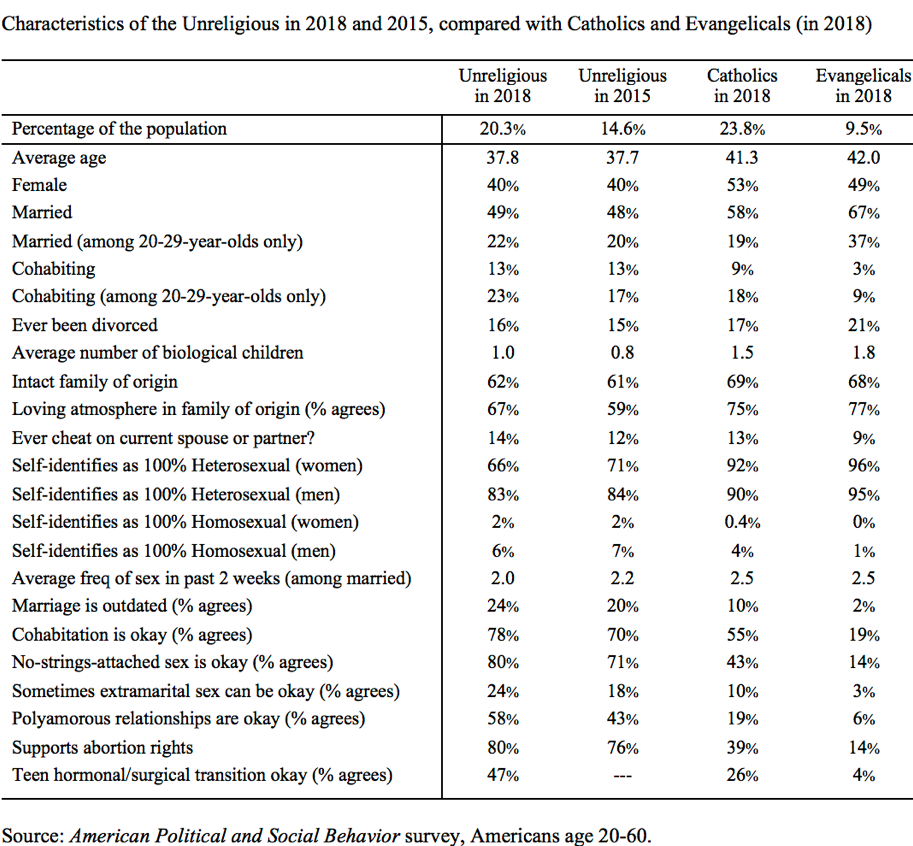
Views of unreligious, Catholic and evangelical Americans
Views of unreligious, Catholic and evangelical Americans (click to expand)

This is interesting:

Even when I limit the group to respondents below age thirty—which is just north of the median age at marriage in the United States—it is notable that 22 percent of the unreligious are married and 23 percent are currently cohabiting, not radically different from the 19 and 18 percent of Catholics that are married and cohabiting, respectively. For comparison, 37 and 9 percent of younger evangelicals are married and cohabiting, respectively. The cohabiting habits of the unreligious, however, have shifted—note the uptick in cohabitation—six percentage points in just under four years. That amounts to a 35 percent increase. Since it’s unlikely that the unreligious have recently changed their minds about the morality or pragmatics of living together, my bet is in the other direction: cohabiting leads many to no longer identify as religious at all.

Got that part in bold? Their attitudes are changing because of their sexual behaviors. So, if you want to reverse the decline of Christianity, we’re going to need to come up with some arguments and evidence to counter the sexual revolution. And on this blog, we’ve done that many times, looking at studies showing the future instability of marriages that occur after cohabitation. I’ve never heard a church preach on that, though. And it’s not something that even many Christian apologists focus on. Most Christian apologists, particularly the women, tend to focus on soft arguments,. They stay away from arguments about morality, because it’s divisive and abrasive to their desired audience. However, if the goal is persuading people that Christianity is a viable worldview, then we need to focus more on sexuality.

More Regnerus:

[O]n each of seven attitude measures I examined, the unreligious are notably more permissive than even the spiritual-but-not-religious (not shown). Nearly 80 percent of unreligious Americans agree (or strongly agree) that cohabitation is okay, no-strings-attached sex is okay, and abortion should be a legal right. This is all unsurprising. But even some of the more radically “progressive” attitudes demonstrate strong support among the unreligious: 24 percent agree that it is “sometimes permissible for a married person to have sex with someone other than his/her spouse.” (I thought perhaps women would differ from men here, but they didn’t—or at least not by much.) Although few Americans are actually in polyamorous living arrangements, the unreligious would support them should someone choose such an arrangement; 58 percent of them agreed that “it is okay for three or more consenting adults to live together in a sexual/romantic relationship,” a percentage that is far more supportive than Catholics or evangelicals. Among the latter, only 6 percent thinks polyamory could be okay.

A more interesting theme, however, is the surge in support for such alternatives. On each statement, note the rise in agreement that has occurred in just under four years. Polyamory tops the list—a 35-percent leap in the share of unreligious who now endorse polyamorous arrangements (from 43 to 58 percent). Even support for extramarital affairs grew by one-third (from 18 to 24 percent). The unreligious aren’t alone here. Catholics, too, have witnessed liberalization in attitudes. Evangelical numbers display a more modest uptick, and from lower starting points.

The non-religious people in my office who were raised Christian like to tell me that the existence of the Christian God isn’t important to them, because they can achieve marriage via cohabitation, and behave like good people without the need for any sort of framework to rationally ground it. They think that you can just pull out God, and the marriage will stay the same. They expect the people they start relationships with to act on Christian morality, even if the worldview was rejected as superstitious nonsense. But as you can see from the data, removing God has an enormous effect on the person’s ability to be stable and faithful.  The truth is that when you take out the vertical relationships with God, then the blueprint for the relationship becomes completely different. Relationships used to be seen as an enterprise where each person’s primary commitment was to lead and protect their spouse before delivering them to God with faith intact. Now, relationships are contingent on continuous happiness.

More Regnerus:

Only 66 percent of unreligious women say they are “100% Despite the permissive reputation of the unreligious, their actual marital sexual frequency is lower than that of Catholic and evangelical couples—at two instances in the past two weeks. As has been documented extensively in the past few years, the frequency of sex among American couples—whether cohabiting or married—has been declining at statistically significant rates. This pattern has not spared the godless.

I think this is interesting. I believe that men are facing an epidemic of sex-withholding from their wives, and I have an idea why that is. Today, women most commonly use sex to “jump start” a relationship with men who they perceive as “high value”, but who refuse to commit to them. This behavior is not focused on men who have commitment abilities, e.g. – provider, moral leader, spiritual leader, accurate worldview rooted in logic and evidence. Instead, most women use sex to get men who have the appearance of high value, e.g. – tall, tattoos, piercings, violent tendencies, exciting, fun, etc. Having established that pattern over and over with no-commitment bad boys, they marry someone who they see as beneath them, and then withhold sex. Commitment isn’t worthy of sex. It’s the man’s appearance and entertainment value that makes him worthy of sex. The comparison of this low-quality man to previous partners makes women more likely to initiate divorce for “unhappiness” later on.