Tag Archives: Atheism

Jeff Hester debates William Lane Craig on the topic “Is Belief in God Rational in a Scientific Age?”

This is an accurate protrayal of what went down in this debate

I was very excited to see a recent debate by Christian philosopher William Lane Craig against atheist astronomer Jeff Hester. When I summarize a debate, I do a fair, objective summary if the atheist is intelligent and informed, as with Peter Millican, Walter Sinnott-Armstrong or Austin Dacey. But the following summary is rated VS for Very Snarky, and you’ll soon see why.

The debate itself starts at 29 minutes:

The audio is very poor.

Dr. Craig’s opening speech

Dr. Craig went first, and he presented 4 arguments, as well as the ontological argument which I won’t summarize or discuss. He later added another argument for theism from the existence of the universe that does not require an origin of the universe.

A1. Counter-examples

Theists who are elite scientists cannot be “irrational”, for example: Allan Sandage, Gustav Tammann, George Ellis, Don Page, Christopher Isham

A2. Kalam cosmological argument

  1. Whatever begins to exist requires a cause.
  2. The universe began to exist.
  3. Therefore, the universe requires a cause.

A3. Fine-tuning of the universe to permit complex intelligent life

  1. The fine-tuning of the universe is due either to physical necessity, chance or design.
  2. It is not due to physical necessity or chance.
  3. Therefore it is due to design.

A4. Moral argument

  1. If God does not exist, objective moral values and duties do not exist.
  2. Objective moral values and duties do exist.
  3. Therefore, God exists.

Dr. Hester’s opening speech

Dr. Hester went second and presented two arguments which both committed the genetic fallacy, a logical fallacy that makes the arguments have no force.

Hester starts his opening speech by asserting that Albert Einstein was irrational, because he denied quantum mechanics.

Hester explains that he became an atheist at 15. This would have been before the evidence for the origin of the universe became widespread, before we had very many examples of fine-tuning, before the discovery that the origin of life problem is a problem of the origin of complex, specifed information, etc. What kind of reasons can a 15-year-old child have for becoming an atheist? It’s hard to say, but I would suspect that they were psychological. Children often desire autonomy from moral authorities. They want to be free to pursue pleasure. They don’t want to be thought of as superstitious and morally straight by their non-religious peers.

Later on in the debate, Hester volunteers that he hated his father because his father professed to be a Christian, but he was focused on his career and making money. In the absence of any arguments for atheism, it’s reasonable to speculate that Hester became an atheist for psychological reasons. And as we’ll see, just like the typical 15-year-old child, he has no rational basis for atheism. What’s astonishing is how he continues to hold to the atheism of his teens when it has been falsified over and over by scientific discoveries in the years since.

Dr. Craig’s deductive arguments do  have premises that reach a conclusion through the laws of logic. On the contrary, he just asserts that God exists as his conclusion, and then says that this assertion is the best explanation of a gap in our scientific knowledge. Some of the gaps in our scientific knowledge he uses in his arguments are: 1) he doesn’t understand why the Sun moves through the sky, so God exists, 2) he doesn’t understand why the wind blows, so God exists.

What counts as “rational” are things that have not been disproved. The progress of science has shown that the universe did not need a casuse in order to begin to exist, and also there is no cosmic fine-tuning.

A1. The success of evolution in the software industry proves that there is no God

All hardware and software is developed using genetic algorithms that exactly match Darwinian processes. All the major computer companies like Google, Microsoft, Amazon, Apple, etc. are just generating products using mutation and selection to evolve products over long periods of time. If you look over a typical software engineering degree, it’s all about Darwinian evolution, and nothing about design patterns, object-oriented design, etc.

This widespread use of evolution in the software industry undermines all of the arguments for God’s existence. Evolution caused the origin of the universe. Evolution explains why the universe is fine-tuned for life. Evolution, which requires replication already be in place in order to work, explains the origin of the first self-replicating organism.

A2. Theist’s view of the world is just a result of peer pressure from their tribes

All of Dr. Craig’s logical arguments supported by scientific evidence don’t matter, because he got them from a primitive tribe of Christians that existed 2000 years ago. Everyone gets their view of origins, morality, meaning in life, death, etc. from their tribes. Except me, I’m getting my beliefs from reason and evidence because I’m a smart atheist. I don’t have an atheist tribe in the university that would sanction me if I disagreed with nonsense like homosexuality is 100% genetic, transgenderism, man-made catastrophic global warming, fully naturalistic evolution, aliens seeded the Earth with life, infanticide is moral, socialism works, overpopulation will cause mass starvation, nuclear winter, etc. Also, my argument isn’t the genetic fallacy at all, because smart atheists don’t commit elementary logical fallacies that even a first-year philosophy student would know.

A3. Our brains evolved so our rational faculties are unreliable, so God does not exist

The logical reasoning that Dr. Craig uses to argue for theism are all nonsense, because human minds just have an illusion of consciousness, an illusion of rationality, and an illusion of free will. Everything Dr. Craig says is just deluded nonsense caused by chemicals in his brain. He has cognitive biases the undermine all his logical arguments and scientific evidence. He just invented an imaginary friend with super powers. Except me, I’m a smart atheist, so I actually have real consciousness, real reasoning powers, and no cognitive biases. Also, my argument isn’t the genetic fallacy at all, because my arguments would not get an F in a first-year philosophy course.

Discussion

I’m not going to summarize everything in the discussion, or the question and answer time. I’m just going to list out some of the more interesting points.

Dr. Craig asks him how it is that he has managed to escape these biases from tribalism, projection, etc. He talks about how brave and noble atheist rebels are. The moderator asks him the same question. He repeats how brave and noble atheist rebels are.

Dr. Hester is asked whether he affirms a causeless beginning of the universe or an eternal universe. He replies he states that the universe came into being without a cause, because causality doesn’t apply to the beignning of the universe. He also asserts with explanation that Borde, Guth and Vilenkin have undermined the kalam cosmological argument, mentioning a web site.

Dr. Craig replied to this phantom argument after the debate on Facebook:

Speaking of which, although I haven’t had time to consult the website mentioned by Dr. Hester concerning Guth and Vilenkin on the kalam cosmological argument, I know the work of these two gentlemen well enough to predict what one will find there. Since neither one is yet a theist (so much, by the way, for the dreaded confirmation bias!), they have to reject at least one of the premises of the kalam cosmological argument.

Guth wants to deny premiss (2) The universe began to exist–for which Vilenkin has rebuked him. Guth would avoid the implications of their theorem by holding our hope for the Carroll-Chen model, which denies the single condition of the BGV theorem. This gambit is, however, unsuccessful, since the Carroll-Chen model does so only by positing a reversal of the arrow of time at some point in the finite past. This is not only highly non-physical, but fails to avert the universe’s beginning, since that time-reversed, mirror universe is no sense in our past. The model really postulates two different universes with a common beginning.

So Vilenkin is forced to deny premiss (1) Whatever begins to exists has a cause. He says that if the positive energy associated with matter exactly counterbalances the negative energy associated with gravity, then the net sum of the energy is zero, and so the conservation of energy is not violated if the universe pops into being from nothing! But this is like saying that if your assets exactly balance your debts, then your net worth is zero, and so there does not need to be a cause of your financial situation! As Christopher Isham points out, there still needs to be “ontic seeding” in order to create the positive and negative energy in the first place, even if on balance their sum is zero.

Dr. Hester is asked how he explains the evidence for fine-tuning. He literally says that “Life is fine-tuned for the Universe”, i.e. – that evolution will create living beings regardless of the laws of physics, constants, etc. For example, he thinks that in a universe with a weaker stong force, which would have only hyrogen atoms, evolution would still evolve life. And in a universe that recollapses in a hot fireball, and never forms stars or planets, evolution would produce life. Physicist Luke Barnes, who was commenting on the YouTube chat for the video, said this:

“Life is fine-tuned for the Universe” – complete ignorance of the field. Read a book.

Hester tries to cite Jeremy England to try to argue for life appearing regardless of what the laws of physics are. Barnes comments:

Jeremy England’s work supports no such claim.

Hester appealed to the multiverse, which faces numerous theoretical and observational difficulties. For example, the multiverse models have to have some mechanism to spawn different universes, but these mechanisms themselves require fine-tuning, as Robin Collins argues. And the multiverse is falsified observationally by the Boltzmann brains problem. It was so ironic that Hester claimed to be so committed to testing theories. The mutliverse theory cannot be tested experimentally, and must be accepted on faith.

Dr. Hester is asked how he grounds morality on atheism. He says there are no objective moral values and duties. He instead lists off a bunch of Christian beliefs which he thinks are objectively wrong. Even his statements about these moral issues are misinformed. For example, he asserts that homosexuality is causally determined by biology, but this is contradicted by identical twin studies that have a rate of 20-40% where both twins are gay.

Dr. Hester is asked about free will, which is required in order to make moral choices. He denies the existence of free will, which undermines his earlier statements about morality. Morality is only possible if humans can make free choices to act in accordance with a moral standard. So, he claims that Christians are immoral, then he claims that they have no freedom to act other than they do.

Dr. Hester also volunteered that his father believed in the prosperity gospel, and tithed in order to be rewarded with money by God. Dr. Craig immediately says “no wonder you’re in rebellion against Christianity”. Indeed.

Dr. Hester is asked about his view that human beings are unable to unable to perceive the world objectively. How is he able to perceive the world objectively, when all of the rest of us are unable to? His response is that he is just smarter than everyone else because his ideas have never been falsified by testing.

Scoring the debate

Dr. Craig’s 5 arguments went unrefuted. Hester’s argument about genetic algorithms was ludicrous to anyone who understands software engineering. His arguments about tribalism and unreliable mental faculties were self-refuting, and committed the genetic fallcy. At several points, Hester denied mainstream science in favor of untested and untestable speculations. It was the worst defeat of atheism I have ever witnessed. He was uninformed and arrogant. He didn’t know what he was talking about, and he tried to resort to speculative, mystical bullshit to cover up his failure to meet Dr. Craig’s challenge.

William Lane Craig debates Alex Rosenberg: Does God Exist? Video, audio and summary

British Spitfire and German Messerschmitt Me 109 locked in a dogfight

Here is the video of the debate:

Here is my summary of the Craig-Rosenberg debate, which occurred on February 1st, 2013 at Purdue University.

The debaters

Below is the summary.

Dr. Craig’s opening speech:

The topic: What are the arguments that make belief in God reasonable or unreasonable?
First speech: arguments for reasonableness of belief in God
Second speech: respond to arguments against reasonableness of belief in God

Eight arguments:

  1. Contingency argument: God – a transcendent, personal being – is the explanation of why a contingent universe exists.
  2. Cosmological argument: God is the cause of the beginning of the universe, which is attested by physics and cosmology.
  3. Applicability of mathematics to nature: God is the best explanation for the applicability of mathematics to nature.
  4. Fine-tuning argument: God is the best explanation of the fine-tuning of the universe to permit life.
  5. Intentionality of conscious states: God is the best explanation of the intentionality of our mental states.
  6. The moral argument: God is the best explanation for the existence of objective moral values and duties.
  7. The resurrection of Jesus: God is the best explanation for the core of historical facts accepted by most ancient historians across the ideological spectrum.
  8. Religious experience: God is the best explanation of our immediate experience and knowledge of his existence.

Dr. Rosenberg’s opening speech

First argument: The fallacy of ad hominem

  • I don’t know whether to laugh or to cry
  • Dr. Craig has said all of that before in other debates
  • You didn’t need to come out on this cold night
  • Craig’s arguments have all been refuted
  • Dr. Craig just doesn’t listen
  • Dr. Craig is not interested in getting at the truth
  • Dr. Craig is just interested in scoring debate points
  • The adversarial system is the wrong approach to decide truth
  • Dr. Craig is very confident about his take of physics

Second argument: The fallacy of arguing from authority

  • 95% of members of the NAS are atheists
  • Therefore Dr. Craig cannot use science

Third argument: Effects don’t require causes

  • I am going to pretend that Craig said that “every effect requires a cause”
  • Quantum mechanics shows that some effects occur without causes
  • A particle of uranium (which is not nothing, it is something) decays without a cause
  • This uncaused effect is the same as the universe coming into being out of nothing uncaused
  • Therefore the principle of sufficient reason is false

Fourth argument: Silicon-based life and the multiverse

  • If these constants had been different, maybe we would have other kinds of intelligent life, like silicon-based life
  • Carbon-based life is not the only kind of life, maybe you can have other kinds of life, none of which have been observed
  • There could be different kinds of life in other areas of the universe that we can’t see
  • There are things we can’t see that disprove the current physics that we can see
  • Quantum foam is evidence that a multiverse exists
  • The multiverse would solve the problem of fine-tuning

Fifth argument: The Euthyphro dilemma

  • The moral argument is refuted by Euthyphro dilemma
  • Dr. Craig is such a moron that he has never heard of the Euthyphro dilemma ever before
  • This is found in the first and simplest of Plato’s dialogs
  • Why is Dr. Craig so stupid that he has not read this simple dialog ever before?
  • Evolution explains why humans evolve arbitrary customs and conventions that vary by time and place
  • Alternative moral theories: utilitarianism, social contract, etc. that don’t require God

Sixth argument: Mormonism undermines Dr. Craig’s three minimal facts about Jesus

  • Why is Dr. Craig so stupid and ignorant to persist in pushing such an ignorant, stupid argument?
  • Mormonism is a silly religion that is not historically well founded
  • Therefore, Jesus was not buried
  • Islam is a silly religion that is not historically grounded
  • Therefore, the tomb was not found empty
  • Scientology is a silly religion that is not historically grounded
  • Therefore, the eyewitnesses didn’t have post-mortem appearances
  • Eyewitness testimony is unreliable in some cases
  • Therefore, eyewitness testimony was unreliable in this case
  • Apparitions of Mary are bizarre
  • Therefore, the majority of historians are wrong to think that the disciples saw post-mortem appearances

Seventh argument: Deductive problem of evil

  • Evil and suffering are logically incompatible with an all good, all powerful God

Eight argument: God is not just to allow evil and suffering

  • God cannot make the evils of this life right in the afterlife

Dr. Craig’s first rebuttal

Dr. Rosenberg sketched the deductive argument from evil.

Dr. Rosenberg presupposes naturalism. Naturalism is a false theory of knowledge:

1. It’s too restrictive: There are truths that cannot be proved by natural science.
2. It’s self-refuting: no scientific proof for naturalism exists.

That’s why epistemological naturalism is considered false by most philosophers of science.

But more importantly than that: Epistemological naturalism does not imply metaphysical naturalism. (E.g. – W. Quine)

Dr. Rosenberg has to present arguments in favor of (metaphysical) naturalism, not just assume that (metaphysical) naturalism is true.

Dr. Craig presented eight arguments against metaphysical naturalism taken from Rosenberg’s own book:

1. The argument from the intentionality (aboutness) of mental states implies non-physical minds (dualism), which is incompatible with naturalism
2. The existence of meaning in language is incompatible with naturalism, Rosenberg even says that all the sentences in his own book are meaningless
3. The existence of truth is incompatible with naturalism
4. The argument from moral praise and blame is incompatible with naturalism
5. Libertarian freedom (free will) is incompatible with naturalism
6. Purpose is incompatible with naturalism
7. The enduring concept of self is incompatible with naturalism
8. The experience of first-person subjectivity (“I”) is incompatible with naturalism

Metaphysical naturalism is false: it is irrational and it contradicts our experience of ourselves.

And epistemological naturalism is compatible with theism.

Rebutting Dr. Rosenberg’s responses:

1. Contingency: no response

2. Cosmological: he mis-states the first premise to say every effect… when it is whatever begins to exist…, the origin of the universe was not from a vacuum, virtual particles come from a vacuum not nothing, there are interpretations of QM that are compatible with determinism. Rosenberg has to believe that the entire universe popped into being from non-being.

3. Mathematics: no response

4. Fine-tuning: the multiverse is refuted by empirical observations of the universe. Without fine-tuning, it’s not that we still have silicon to make life out of. It’s that we lose basic minimal things like chemical diversity, matter, stars, planets, etc. No life of any kind, not just no carbon-based life.

5. Intentionality: no response.

6. Moral argument: the answer to the dilemma is that you split the dilemma: God is the standard of good, and the commands flow from his unchanging moral nature. The commands are not arbitrary, and the standard is not external to God. Dr. Rosenberg is a nihilist and he cannot ground good and evil on his nihilistic view.

7. Resurrection: The Gospels are early eyewitness testimony. Mormonism and Islam have nothing to do with the minimal set of historical facts about Jesus agreed to by the majority of ancient historians across the ideological spectrum, general statements against eyewitnesses do not refute the specific eyewitness testimony in this case.

8. Religious experience: No response.

Dr. Rosenberg’s first rebuttal

I wrote a book and you should buy it, because it got me invited to this debate. Let me repeat the title a few times for you. Please buy it.

Dr. Craig is right, there are multiple interpretations of QM, not just the one I presented, including deterministic ones.

All the disturbing implications of naturalism that Dr. Craig stated follow from metaphysical naturalism, and metaphysical naturalism is true. (Note: he equates science with metaphysical naturalism)

Science proves that metaphysical naturalism is true, but I won’t say what specific scientific tests prove my philosophical assumption of metaphysical naturalism.

I’ll pretend that the Big Bang (science) doesn’t disprove naturalism, like Dr. Craig said. Again. (covers ears) La la la, there is no Big Bang.

We didn’t come here to debate epistemological naturalism and metaphysical naturalism.

Let me explain the problem of intentionality since I’m so smart and no one knows what it means.

There are many answers to this problem of intentionality.

My answer is that most scientists are naturalists, therefore naturalism is true, regardless of the argument from intentionality of mental states.

That’s how I would respond to one of the eight problems with naturalism that Dr. Craig raised. I won’t answer the other seven problems.

It is an argument from ignorance to argue that the applicability of mathematics to the universe requires a designer, because there are non-Euclidean geometries. Craig’s argument, which he gets from people like respected physicists like Eugene Wigner, is bizarre. It is bizarre, therefore I refute Eugene Wigner and all the other scholars who make that argument. It is bizarre! Bizarre!

Deductive problem of evil: there is no response to this argument, certainly not Alvin Plantinga’s free will defense. The deductive argument from evil has not been entirely abandoned at all! It’s not like arch-atheist J.L. Mackie himself admits that the deductive problem of evil doesn’t lead to a logical inconsistency between evil and God.

Dr. Craig has to tell me why God allows evil or God doesn’t exist.

It is offensive that Dr. Craig cannot tell me why God allows every evil and suffering that occurs.

He literally said this: “I will become a Christian if Dr. Craig can tell me why God allowed EVERY EVIL THAT OCCURRED IN THE LAST 3.5 BILLION YEARS”

Dr. Craig’s second rebuttal

We are not in a position to know why God allows specific instances of evil and suffering.

God cannot force people to freely do anything – freedom is not compatible with determinism. Freedom is a good, but freedom opens up the possibility of moral evil. You cannot have the good of free will without allowing people to choose to do morally evil things.

God can permit evil and suffering in order to bring more people into a relationship with him.

The atheist has to show that God could allow less evil and achieve more knowledge of God in order to say there is too much evil.

The purpose of life is not happiness, but knowledge of God.

Dr. Craig quotes agnostic Paul Draper (Purdue) and Peter Van Inwagen (Notre Dame) to state that the deductive problem of evil is dead because of free will and morally sufficient reasons for permitting evil.

1. Contingency: no response.

2. Cosmological: QM does not apply, because the universe came from nothing, not a vacuum, and QM only works in a vacuum.

3. Mathematics: He mentions alternatives like non-Euclidean geometry, but we have to explain the structure of THIS universe.

4. Fine-tuning: ???

5. Intentional states: intentional mental states proves that minds exist, which fits with theism better than it fits with atheism.

6. Moral argument: You need God to ground morality, and Dr. Rosenberg believes in morality. He needs God to ground objective moral values and duties.

7. Historical argument: He has to respond to the minimal facts supported by the consensus of ancient historians across the ideological spectrum.

8. The problems of naturalism: He says that you can’t have science without naturalism, but you can have science with EPISTEMOLOGICAL NATURALISM, and theists accept science and methodological naturalism. We don’t accept METAPHYSCIAL NATURALISM because of the eight problems Craig presented, like intentionality, first-person, persistence of self, etc. You can believe in both science and theism, by embracing epistemological naturalism, while rejecting methaphysical naturalism.

Dr. Rosenberg’s second rebuttal

Dr. Craig hasn’t answered many of my points, I won’t say which ones though.

Debates don’t work as a way of deciding what’s true, so we should overturn the entire criminal justice system.

The principle of sufficient reason is false because it is disconfirmed by quantum mechanics. And quantum mechanics (vacuum and virtual particles that exist for a short time) is similar to the origin of the universe (nothing and entire universe and 14 billion years).

We know that alpha particles come into being without cause all the time from a quantum vacuum for a tiny sub-second duration before going out of existence, so we can say that the entire physical universe came into being for 14 billion years from absolute nothing which is not a quantum vacuum.

Peter Van Inwagen is the best metaphysician working today, and he says that my deductive argument from evil is not decisive, it’s not a successful argument. (Why is he undermining his own problem of evil argument????!)

Dr. Craig invoked Plantinga’s free will defense to the deductive POE. Freedom allows us to do evil. God could have given us free will without evil and suffering. I won’t show how, but I’ll just assert it, because debates are such a bad forum for supplying evidence for my speculative assertions.

If you answer the question 3 + 5 as being 8, then you don’t have free will – you are biologically determined if you answer 8, because everyone answers 8, and that means everyone is biologically determined with no free will.

Why can’t God give us free will and then prevent us from making a free choice?

No scholars date the gospels earlier than 60-70 AD, especially not atheists like James Crossley who dates Mark to 40 AD. Therefore Jesus’ burial isn’t historical, like the majority of scholars across the broad spectrum of scholarship agree it is.

The original New Testament documents were written in Aramaic.

All New Testament scholars are orthodox Christians, like atheist Robert Funk for example.

Dr. Craig’s concluding speech

In order to sustain the deductive argument from evil, Dr. Rosenberg must show that God could create a world of free creatures with less evil.

Principle of Sufficient Reason: not using the general principle of sufficient reason, but a more modest version of this states that contingent things should have an explanation for their existence. And we know that the universe is a contingent.

The New Testament was not written in Aramaic, they were written in Greek. Dr. Rosenberg is wrong there too.

(Dr. Craig spends the rest of his concluding speech giving his testimony and urging people to investigate the New testament).

Dr. Rosenberg’s concluding speech

Some long-dead French guy named Laplace said that he has no need of that (God) hypothesis. He did not know about any of Dr. Craig’s arguments made in this debate tonight when he said that, though.

There is no need to explain how the universe began or how the universe is finely-tuned if you just assume metaphysical naturalism on faith.

The Easter Bunny, therefore atheism.

Most scientists are atheists, therefore atheism.

You can do a lot of science without God, just don’t look at the origin of the universe, the fine-tuning of the universe, or the other parts of science that Craig mentioned, as well as the origin of life, the Cambrian explosion, the habitability argument, and so on.

You can be a Christian, but good Christians should not use arguments and evidence.

Good Christians should be irrational and ignorant. Bad Christians look for arguments and evidence from science and history.

Good Christians should embrace the absurd. Bad Christians want to search for truth and use logic and evidence.

How the WMAP satellite confirmed nucleosynthesis predictions and falsified atheism

Christianity and the progress of science

Prior to certain scientific discoveries, most people thought that the universe had always been here, and no need to ask who or what may have caused it. But today, that’s all changed. Today, the standard model of the origin of the universe is that all the matter and energy in the universe came into being in an event scientists call “The Big Bang”. At the creation event, space and time themselves began to exist, and there is no material reality that preceded them.

So a couple of quotes to show that.

An initial cosmological singularity… forms a past temporal extremity to the universe. We cannot continue physical reasoning, or even the concept of spacetime, through such an extremity… On this view the big bang represents the creation event; the creation not only of all the matter and energy in the universe, but also of spacetime itself.

Source: P. C. W. Davies, “Spacetime Singularities in Cosmology,” in The Study of Time III, ed. J. T. Fraser (Berlin: Springer Verlag ).

And another quote:

[A]lmost everyone now believes that the universe, and time itself, had a beginning at the big bang.

Source: Stephen Hawking and Roger Penrose, The Nature of Space and Time, The Isaac Newton Institute Series of Lectures (Princeton, N. J.: Princeton University Press, 1996), p. 20.

So, there are several scientific discoveries that led scientists to accept the creation event, and one of the most interesting and famous is the discovery of how elements heavier than hydrogen were formed.

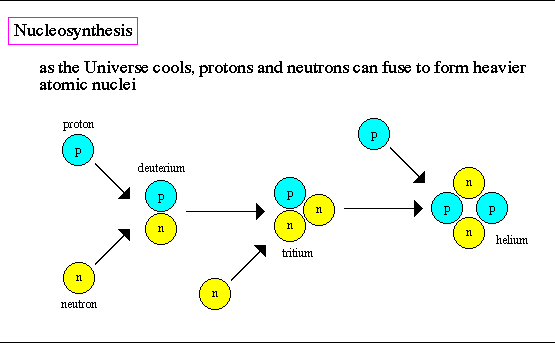
Nucleosynthesis: forming heavier elements by fusion

Here’s the history of how that discovery happened, from the National Aeronautics and Space Administration (NASA) web site:

The term nucleosynthesis refers to the formation of heavier elements, atomic nuclei with many protons and neutrons, from the fusion of lighter elements. The Big Bang theory predicts that the early universe was a very hot place. One second after the Big Bang, the temperature of the universe was roughly 10 billion degrees and was filled with a sea of neutrons, protons, electrons, anti-electrons (positrons), photons and neutrinos. As the universe cooled, the neutrons either decayed into protons and electrons or combined with protons to make deuterium (an isotope of hydrogen). During the first three minutes of the universe, most of the deuterium combined to make helium. Trace amounts of lithium were also produced at this time. This process of light element formation in the early universe is called “Big Bang nucleosynthesis” (BBN).

The creation hypothesis predicts that there will be specific amounts of these light elements formed as the universe cools down. Do the predictions match with observations?

Yes they do:

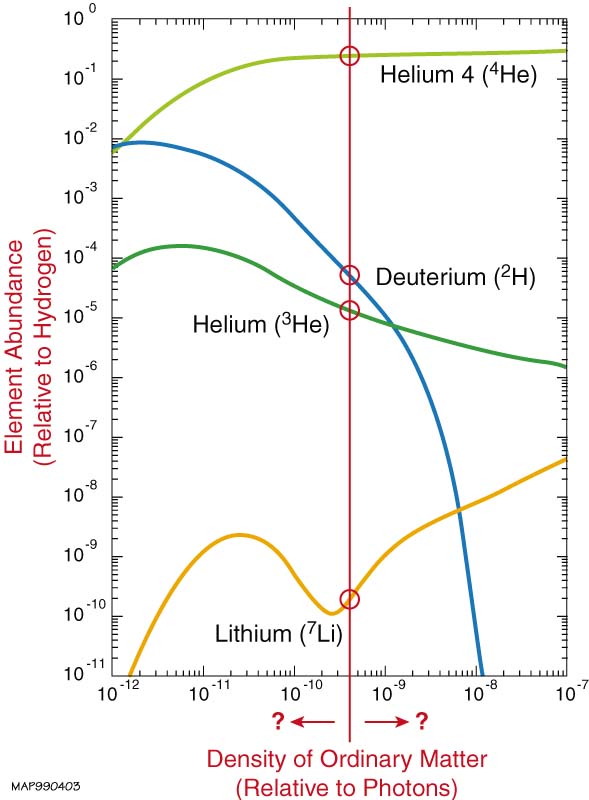
The predicted abundance of deuterium, helium and lithium depends on the density of ordinary matter in the early universe, as shown in the figure at left. These results indicate that the yield of helium is relatively insensitive to the abundance of ordinary matter, above a certain threshold. We generically expect about 24% of the ordinary matter in the universe to be helium produced in the Big Bang. This is in very good agreement with observations and is another major triumph for the Big Bang theory.

Moreover, WMAP satellite measurements of mass density agree with our observations of these light element abundances.

Here are the observations from the WMAP satellite:

Scientific observations match predictions

And here is how those WMAP measurements confirm the Big Bang creation event:

However, the Big Bang model can be tested further. Given a precise measurement of the abundance of ordinary matter, the predicted abundances of the other light elements becomes highly constrained. The WMAP satellite is able to directly measure the ordinary matter density and finds a value of 4.6% (±0.2%), indicated by the vertical red line in the graph. This leads to predicted abundances shown by the circles in the graph, which are in good agreement with observed abundances. This is an important and detailed test of nucleosynthesis and is further evidence in support of the Big Bang theory. 

“An important and detailed test”.

For completeness, we should learn how elements heavier than these light elements are formed:

Elements heavier than lithium are all synthesized in stars. During the late stages of stellar evolution, massive stars burn helium to carbon, oxygen, silicon, sulfur, and iron. Elements heavier than iron are produced in two ways: in the outer envelopes of super-giant stars and in the explosion of a supernovae. All carbon-based life on Earth is literally composed of stardust.

That’s a wonderful thing to tell a young lady when you are on a date: “your body is made of stardust”. In fact, as I have argued before, this star formation, which creates the elements necessary for intelligent life, can only be built if the fundamental constants and quantities in the universe are finely-tuned.

Now, you would think that atheists would be happy to find observations that confirm the origin of the universe out of nothing, but they are not. Actually, they are in denial.

Here’s a statement from the Secular Humanist Manifesto, which explains what atheists believe about the universe:

Religious humanists regard the universe as self-existing and not created.

For a couple of examples of how atheistic scientists respond to the evidence for a cosmic beginning, you can check out this post, where we get responses from cosmologist Lawrence Krauss, and physical chemist Peter Atkins.

You cannot have the creation of the universe be true AND a self-existing, eternal universe ALSO be true. Someone has to be wrong. Either the science is wrong, or the atheist manifesto is wrong. I know where I stand.

Positive arguments for Christian theism