Tag Archives: Apologetics

Jim Wallace discusses the problem of unanswered prayer

Video is here. (H/T Apologetics 315)

This problem is similar to the problem of divine hiddenness and the problem of evil and suffering. God’s purpose in his relationship with you is not to make you happy. His purpose for relating to you is so that you can know him and enter into a love relationship with him. God is not a toy for you to play with for comfort, and then to put away. With respect to God’s relationship with you, and purpose for you, your happiness is expendable. It may be that you will have to put off trying to make yourself happy until you die… because there are so many other higher-priority things to do with God and other people.

Why I pray

As a Christian, I am especially concerned for other Christians because we have to worry about out relationship with God more than being happy. So I try to make an effort to love and support other Christians who are hurt in the execution of their duty. If you think of prayer as a way of talking to God about your relationship with him, and your relationships with other people (especially Christians), then I think you will have fewer disappointments. At least, that’s what I’ve observed in my experience. When I pray, I ask God to draw people I am working on toward him. And I pray for victory in the execution of my duty.

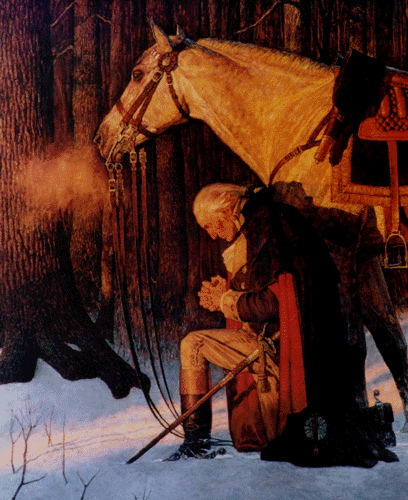
Here’s George Washington praying:

George Washington and Old Nelson pray

You can read more about George Washington and his triumph against the odds at the battle of Trenton here.

And an American soldier praying:

American soldier prays

And everybody should know about the General Patton weather prayer at Bastogne:

Here’s the prayer.

Do the right thing. Focus on your mission – to know and love God in Christ, and to know and love others. Don’t think about your own needs. Don’t ask God to make you happy. You have no right to be happy.

Here’s a simple guide to prayer from Campus Crusade for Christ.

Are Christian churches and parents producing solid young Christians?

Let’s look at the facts from a recent Pew Research survey.

Excerpt:

A recent report by the Pew Research Center’s Forum on Religion and Public Life seems to validate concerns among Christian leaders that younger generations of Americans are losing the spiritual moorings that have helped keep their nation strong from its founding.

Analyzing the extent to which the religious views of America’s “millennials” — adults between the ages of 18 and 29 — differ from those of adults over 30, the Pew Forum’s “Religion Among the Millennials” report found that they are in general less affiliated with a particular religious faith than their over-30 counterparts, attend religious services less often, and say that religion is less important to them.

Here are some of the findings of the report:

  • Twenty five percent of 18-to-29-year-old adults say they are religiously unaffiliated, describing themselves variously as “atheist,” “agnostic,” or “nothing in particular.” By contrast, about 19 percent of adults in their 30s, 15 percent of those in their 40s, 14 percent of those in their 50s, and less than ten percent of those 60 and older identify themselves as unaffiliated.
  • Only 45 percent of adults under age 30 say that religion is important to them, compared with almost 60 percent of adults 30 and older.
  • Sixty-five percent of 18 to 29-year-olds say they are “absolutely” certain of the existence of God, compared with 73 percent of their 30-and-older counterparts.

What about surveys conducted by Christians?

The findings of the Pew report appear to reflect the results of similar surveys conducted by both Catholic and evangelical researchers. For example, a recent survey by the Marist College Institute for Public Opinion found that over 80 percent of Catholic adults aged 18 to 30 think that “morals are relative” and that “there is no definite right or wrong for everybody.”

Similarly, a 2008 study by evangelical pollster George Barna found that half of all adults in America say that Christianity is just one of many faith options… Barna found that unlike previous generations, over 70 percent of American adults today have jettisoned an organized approach to their faith and are more likely to come up with their own set of religious beliefs, with over 80 percent of young Americans under the age of 25 inclined to customize their faith.

And from Christian Newswire:

“In today’s world Christian children and teens are in serious crisis,” says Larry Fowler, Executive Director of Global Training for Awana and author of the new book Raising a Modern-Day Joseph: A Timeless Strategy for Growing Great Kids, (David C. Cook, January, 2009.) “What we see happening in the world is merely a reflection of what is happening in the church. Most Christian teens succumb to the world and fall away from the Lord by the time they leave home.” According to Josh McDowell Ministries, denominations are seeing anywhere from 69 to 94 percent of teens leave the church after high school.

[…]Statistics show that even children who grow up in Christian homes, go to church on a regular basis, and participate in youth group activities are abandoning their faith at an alarming rate.

Naturally, my approach to fixing this failure of churches and parents is to leverage philosophical theology to define Christian claims and then leverage apologetics to sustain those claims in the public square. I would emphasize mainstream science apologetics in order to do that. As for the problem of young people being uncomfortable with moral judgments, we need to do a better job of explaining to them WHY some things are wrong.

Here are some -isms that the church and parents may want to try to address:

  • postmodernism – the view that truth, especially religious and moral truth, cannot be known
  • relativism – the view that each person defines their own reality by personal preferences
  • pluralism – the view that all religions are basically the same – they make us act good
  • universalism – the view that all religions are valid ways of knowing ultimate reality
  • syncretism – the view that the truth claims of all religions do not conflict

Perhaps we should be focusing more time talking about truth and morality, using reason and evidence. I think that the critical mass of people in the church are against my plan – they have decided that the purpose of Christianity is to make people have happy feelings and to be part of an inclusive community. It’s not clear to me how happy feelings and an inclusive community are related to the goals of the Christian faith, but that’s what people seem to have decided on, anyway. They didn’t ask me, and they don’t ask me.

Apologetics advocacy

What is the best single book on the pro-life position?

Do you like to argue about controversial things?

Here’s an excellent book review of the best pro-life book for ordinary people. It’s by Scott Klusndorf of the Life Training Institute.

Excerpt:

The Case for Life by Scott Klusendorf is an absolutely outstanding defense of the pro-life position with regard to the abortion debate. Being familiar with Scott’s work through Stand to Reason I was looking forward to this book with much anticipation. Scott is one of the most able, articulate, persuasive, and winsome pro-life speakers in the country and his book does not fail to deliver.

He’s got chapter-by-chapter breakdowns! This is a serious book review.

Here are some of the chapters:

In chapter five Scott addresses the nature of truth and the topic of moral relativism, a view of morality our culture is saturated with to the core. Addressing this topic becomes absolutely necessary given its prevalence and the fact that often the claims of pro-lifers are misunderstood. This is seen in such cliches as “Don’t like abortion? Don’t have one!” or “I’m personally opposed to abortion but I think it should remain legal.” In short, pro-lifers are not making subjective preference claims when they say abortion is morally wrong but rather objective truth claims. Scott lays out some fundamental problems with moral relativism as well as a brief history outlining the move from moral realism to moral non-realism.

In chapter six Scott exposes the myth of moral neutrality. Both sides of the abortion debate have views they want to legislate and it is impossible for the state to remain neutral. However, it is often pro-lifers who are accused of trying to “legislate morality” while pro-abortion choice advocates get a free pass. In short, pro-lifers are dismissed as “religious” because of an unwillingness by pro-abortion choice advocates to address the issues. This is intellectually dishonest. How bout we stick with science?

And more:

In chapters ten through fifteen Scott addresses some of the most common arguments put forth by pro-abortion choice advocates. These include “Women will die from illegal abortions,” “You shouldn’t force your view on others,” “Pro-lifers should broaden their focus,” “Rape justifies abortion,” “Men can’t get pregnant,” and “It’s my body, I’ll decide.” The fundamental problem with most of these objections is that they beg the question. They assume the unborn is not a human person.

I’d read about those arguments in Frank Beckwith’s “Politically Incorrect Death”, but that’s out of print, and his new book with Cambridge University Press is too technical (although it looks good on my shelf at work). The Klusendorf book is a much better book for most people.

One more chapter – I’ve never seen chapters like this before:

In chapter sixteen Scott outlines four essential tasks that pastors concerned with biblical truth need to accomplish:

First, Christian pastors need to emphasize a biblical view of human value and ensure their congregation understands that abortion unjustly takes the life of an innocent human being. Second, they need to equip their congregation with pro-life apologetics so they can compete in the marketplace of ideas. Third, they need to emphasize the healing power of the gospel of Jesus Christ and preach repentance and forgiveness for post-abortion men and women. Finally, Christian pastors need to overcome their fear that abortion is a distraction, their fear of driving people away who might otherwise hear the gospel, and their fear of offending people with abortion-related content.

Even my Dad read this book. And he loved it!