the topic of failure is not one that is often discussed by Christians
failure #1: failure in the Christian life which is the result of sin
failure #2: when a Christian is defeated while trying to serve God
the consequences for failure #1 can be worse for the Christian
the consequences for failure #2 can be worse for the world as whole
how is it possible for a person to fail when they are obeying God? (#2)
how can it be that God can call someone to a task then let them fail?
failure is not persecution – persecution is normal for Christians
failure is not trials – testing is normal for Christians to grow
Bill’s failure:
Bill had submitted all the coursework for his second doctoral degree
but he had to pass a comprehensive oral examination
he failed to pass the comprehensive exam
Bill and Jan and his supporters had all prayed for him to pass
how could God allow this to happen?
Solution to the problem:
God’s will for us may be that we fail at the things we try in life
there are things that God may teach us through failure
Bill learned that human relationships are more important than careers
we need to realize that “success” in life is not worldly success
true success is getting to know God well during your life
and failure may be the best way to get to know God well
it may even be possible to fail to know God while achieving a lot
the real measure of a man is loving God and loving your fellow man
Practical:
give thanks to God regardless of your circumstances
try to learn from your failure
never give up
The ending of Bill’s story:
Bill spent an entire year preparing for a re-take of his exam
Bill was awarded his second doctorate “magna cum laude” (with great distinction)
Bill learned that American students are not well prepared for exams
the year of studying remedied his inadequate American education
in retrospect, he is thankful for the failure – he learned more
If you like this, you should pick up Craig’s book “Hard Questions, Real Answers“, which has a chapter on this problem. And here is a similar lecture that Dr. Craig gave at his home church in Atlanta on the same topic. I’m not posting this because I’ve had a catastrophic failure or anything. But I think in this economy, I am seeing a lot of my plans dashed and I am being forced to circle the wagons a little and take fewer risks. I am being forced to aim for smaller goals, and plan for future difficulties. It does bother me that I can’t comfortably take risks to achieve the best goals that I want to achieve. But I have to play the hand I’m dealt, and do what looks doable right now. Some of my friends are having the same problem of having to recalculate what is probable and what is possible.
I overheard a conversation on the airplane coming back from my vacation in Wisconsin. A Christian gentleman was vigorously sharing his faith with a gentleman in the seat directly behind me. There are some things we can learn, both good and bad, from what I overheard and take his effort—which was a good one—and channel it in a little bit more constructive direction.
So I am going to give you eight points of application.
And here are my favorites from his list:
3. Try to stay away from religious language, terminology, and religious affect. This person was very religious in his whole approach. I think this is hard for us as Christians because we are brought up in a Christian environment and it’s natural for us to talk this way, but it sounds weird to people outside of that environment. I think there are a lot of people who may be, in principle, interested in a bona fide, genuine relationship with God through Jesus Christ but who are not interested in the Christian religion as they perceive it. This is where I think a lot of the emergent guys have a legitimate bone to pick with Evangelicalism. Let’s try not to sound like Bible-thumping fundamentalists if we can avoid it, even if that’s what we are, because there’s no need to sound that way if it puts people off. Find another way to communicate the message. Just talk in a straightforward manner. Be conscious of using religious language the other person may not understand or may think is strange. Avoid all of that so they can hear the message you’re trying to communicate.
4. Focus on the truth, not personal benefits of Christianity. I appreciated the gentleman’s approach in that he kept talking about truth. One person he was talking to said he liked reincarnation. The Christian man said that even if he liked reincarnation that that didn’t make it true if it’s not true. Liking something is not going to change reality. That’s a great point. He was focusing on the truth claims of Jesus. He wasn’t giving a bunch of promises. He wasn’t saying, “Jesus is my ice cream. He’s a great flavor. Try him to see if you like him, too.” Or, “Try Jesus because he’ll make your life so wonderful.” Focus on truth and not personal benefits.
5. Give evidence. This gentleman was giving all kinds of evidence for his seatmates to consider. Good for him! You should too. You know why? Because people in the Bible did, too. Jesus, Paul, Peter, all the Apostles. If you look at the details of how they communicated their faith they gave evidence for the truth of what they were saying about Jesus. In fact, if you want to get the content of the Gospel, one of the most famous passages for the articulation of the Gospel is the beginning of 1 Corinthian 15. Paul gives all kinds of evidence. It’s all right there as he is explaining the Gospel. We see that all through the New Testament. So give evidences. It’s appropriate. People do respond to that even in a postmodern age.
I remember that I was once working in Chicago, and after a particular good apologetics discussion with a team of engineers, I apologized to them all for being so exclusive and a fundamentalist. These guys all had MS and PhD degrees in computer science from top schools like Stanford, Purdue, U of I, NIU and Northwestern. They said “you’re not a fundamentalist”. And I said, “but I am ultra-conservative in my theology!”. And they said “That’s ok – as long as you have considered different points of view and you have objective evidence, then somehow it doesn’t sound fundamentalist”.
I think that’s something that we need to work on. When Christianity is about truth, it’s open to investigation using public evidence. At work, I have explained the structure of DNA molecules in the office and had people rolling their chairs out of their cubicles to come and see me draw amino acid chains on a white board, and calculate the probabilities with a calculator. You can be a fundamentalist, without sounding like a fundamentalist. You just have to focus on public, testable evidence.
Look here:
Make religion about truth – not personal preferences. They respect that way of talking – as long as you bring the science and the history.
Saturday, Feb. 22nd, 2014 schedule: (ALL TIMES CENTRAL)
9:00 a.m. Tim Maudlin, ”Cosmology, Theology and Meaning”
10:00 a.m. Robin Collins, “God and the Fine-tuning of the Universe for Discovery”
11:00 a.m. Lunch (New Orleans Style Red Beans & Rice) Cafeteria
12:30 p.m. Alex Rosenberg, “How Physics Fakes Design, and Makes Things Difficult for Theism”
1:30 p.m. James Sinclair, “Cosmology and Cosmologists Within the ‘Does God Exist’ Question”
2:30 p.m. Concluding Comments from Sean Carroll and William Lane Craig
For Eastern times, add an hour.
Click here for the the live-stream. Note: You have to click on this link and go back to the main page each time a response ends, because the youtube link is different for each response.
Is there a recording?
I do have a recording of last night’s debates, but I’m not posting it unless I get permission.
Quick thoughts on the debate:
Carroll was as good of a speaker as Craig in terms of style. Very easy to listen to, very quick on his feet, very civil. There was no clear winner on style.
It was difficult to assess the truth value of scientific points being made, especially for the layperson. I explained a few of them in my posts earlier this week, but I think laypeople might struggle with them if they are hearing about these things for the first time.
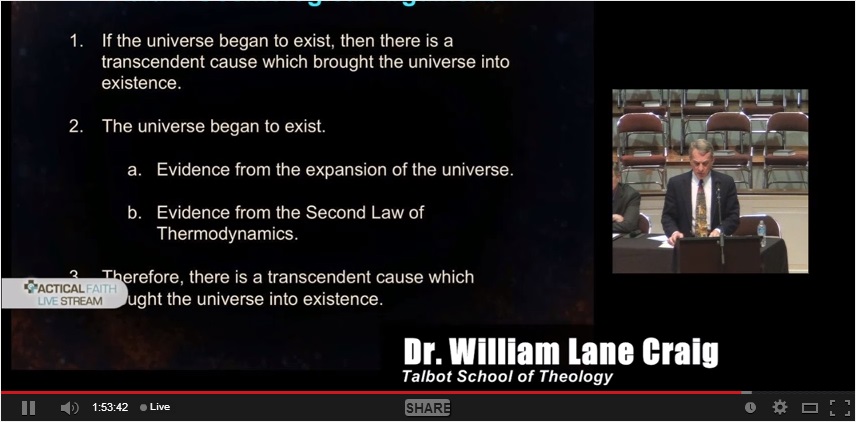
A couple of Craig’s slides: (click for larger images)
Slide 1 of 2:
Dr. Craig slide #1 of 2
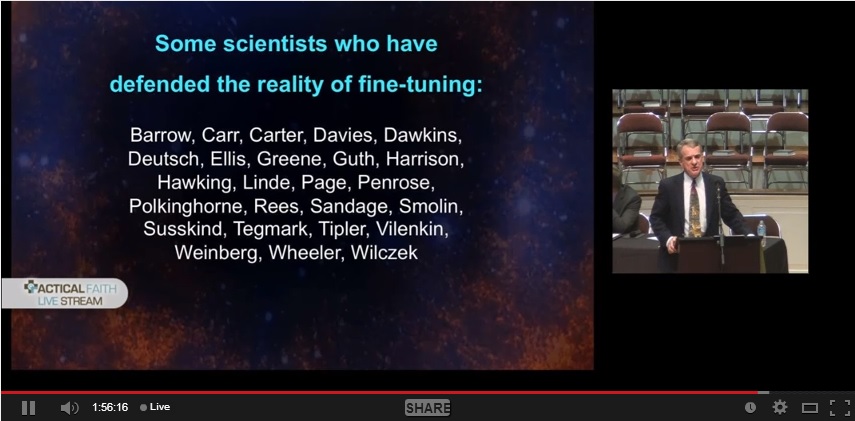
Slide 2 of 2:
Dr. Craig slide #2 of 2
Quick summary: (this is not complete, because I couldn’t get everything they were saying noted)
Dr. Craig defended two arguments: 1) the kalam cosmological argument and the fine-tuning argument.
Dr. Craig supported the origin of the universe with 1) the expansion of the universe and 2) the second law of thermodynamics.
Dr. Craig said that the BGV theorem supports a beginning for the universe.
Dr. Craig said that the consensus of scientists did not accept Carroll’s naturalistic cosmology, quoting Stephen Hawking in support.
Dr. Craig said that multiverse models fall victim to the Boltzmann brain problem, where we should observe Boltzmann brains coming into existence and then phasing out again far more probably than embodied minds. But we observe embodied minds, and no Boltzmann brains.
Dr. Carroll said that science cannot study metaphysical questions.
Dr. Carroll said that science is about making models that may or may not be consistent with the experimental data.
Dr. Carroll said that the BGV theorem does not support a beginning for the universe.
Dr. Carroll proposed 17 alternative cosmologies, but did not provide a shred of scientific evidence for any of them, the way that Craig did for the standard model.
Dr. Carroll refuted Dr. Craig’s citation of Stephen Hawking, and Craig yielded the point.
Dr. Carroll speculated that science might progress to the point where the fine-tuning can be explained without an intelligent cause, and he gave an example of where that happened (inflation).
Dr. Craig argued that all 17 of the models suggested by Carroll either conflicted with evidence, had serious problems or did require a beginning.
Dr. Craig argued that Carroll’s own model required a beginning.
Dr. Craig argued that Carroll’s own model fell victim to the Boltzmann brain problem.
Dr. Craig argued that Carroll’s own model violated the second law of thermodynamics.
Dr. Craig re-stated his point that the baby universe spawning in Carroll’s model was speculative and incomplete, and cited Christopher Weaver’s work.
Dr. Carroll denied that things that pop into being out of nothing require a transcendent cause.
Dr. Carroll reiterated that science can only make naturalistic models, and that he did not have to answer questions about ultimate causes.
Dr. Carroll showed a photo of Alan Guth expressing his opinion that the universe is “probably” eternal. No evidence was given for this assertion.
Dr. Carroll said that the fine-tuning was not done in an optimal way, because one fine-tuned value was lower than it needed to be, and it should be exactly what it needed to be if God did it.
Dr. Carroll said that a finely-tuned universe is more probably in naturalism than in theism, because God can do anything he wants and doesn’t need a fine-tuned universe.
Dr. Carroll said he would stop defending his model now, and would instead defend Aguirre-Gratton.
Dr. Craig gave three reasons why the universe popping into being out of nothing requires a transcendent cause.
First, he said that nothing cannot cause anything to happen, because nothing is nothing.
Second, he said that if things pop into being out of nothing, then why don’t we see it happening all the time with other things.
Third, he said that we have no reason to dismiss the causal principle, especially when it is the basis of scientific inquiry and has been so fruitful in the progress of science.
Dr. Craig reiterated that baby universes in Carroll’s model would be dominated by Boltzmann brains, and we don’t observe that.
Dr. Craig said that even on the quantum gravity models that Carroll mentioned, there would still be a beginning.
Dr. Carroll said that Craig mustn’t say “popped into being” but instead that “there was a first moment of time”.
Dr. Carroll said that his model does indeed violate the second law of thermodynamics “YES!”.
At this point Carroll stopped talking about the topic of the debate and started expressing personal opinions about religion. It’s funny how often atheists do this in debates.
Dr. Carroll said that most theists don’t believe in God because of cosmology, but because of community and feelings.
Dr. Carroll said that science had learned a lot in the last 2000 years, so theism was false.
Dr. Carroll said that most philosophers don’t think that God exists, so theism was false.
Dr. Carroll said microscopes and telescopes were absent 2000 years ago, so theism was false.
Dr. Carroll said that religion should be about community and feelings, not about what is true.
Conclusion:
My conclusion was that Carroll lost because he is just satisfied to throw theories out and not to argue that they are true by citing evidence. Carroll never seemed to be interested in finding out what is true, but instead he just wanted to tell a story that didn’t include God, and assert that by Occam’s Razor, his story was a better explanation. I am not impressed with theoretical speculations, although the layperson might be. I kept waiting for him to respond to Craig’s points about how his model was falsified by experimental evidence and observations, e.g. – the Boltzmann brains or the baby universe generation, and he never cited the evidence I wanted him to cite. Craig did have some evidence for his views, but he could have been stronger in making his case. He could have shown the e-mail from Vilenkin that stated that he had understood the BGV theorem, and was using it correctly, for example.
For me the winning side comes down to evidence. The standard model is the standard model because of scientific evidence. Until that evidence is overturned, then speculative models are of no interest to anyone who is evidence-driven. Speculations are not science. A philosophical presupposition of metaphysical naturalism is not science.
The nice thing is that Robin Collins, one of Craig’s respondents, went deep into the science of the fine-tuning, especially on one of my favorite data points, the cosmic microwave background radiation. The paper he presented is now posted on his web site (H/T Christian Apologetics Alliance). I posted about the CMBR before in my post about particle physicist Michael Strauss lecture on cosmology and fine-tuning at Stanford University and the his more recent lecture at the University of Texas. Note that Strauss is an experimental physicist, not a theoretical physicist like Carroll.
Unfortunately, naturalistic respondent Tim Maudlin said nothing at all of value, choosing to use his time to speak about the evils of the coal industry and the threat of global warming, despite the fact that the IPCC says there has been no significant global warming in the past 17 years.
The last two respondents have started speaking. I’m expecting the philosopher Alex Rosenberg to stay away from the science, and then we’ll hear from the experimental scientist James Sinclair. Rosenberg spoke on Darwinian evoloution being incompatible with theism, and it was interesting, but off topic for this debate. James Sinclair is speaking now, and is giving a technical paper on cosmology.
I may be posting a more accurate summary sometime next week, especially if they release either the audio or the video. If not, this will be it.
UPDATE: here’s another review by Randy Everist of Possible Worlds blog. He explains the back-and-forth over Boltzmann brains and the BGV theorem in more detail.