Tag Archives: Apologetics

How should Christians respond to the Supreme Court’s decision to redefine marriage?

Gay activist vandalizes pro-marriage sign

In case you haven’t heard, the Supreme Court voted to redefine marriage to remove the focus on creating and raising children in stable relationships. Now marriage is just for any two or more people who have feelings for each other, and when the feelings go, so does the marriage. The commitment is gone, the child-centered focus is gone. It’s just about the needs of selfish adults.

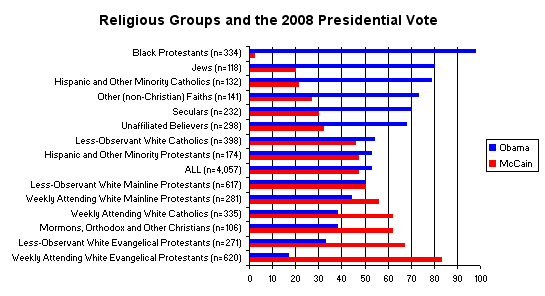
Which Religions Voted for Obama in 2008?

And more:

2008 voting broken by religious groups
2008 voting broken down by religious groups

So, remember that when you are processing today’s decision on gay marriage – not every person who calls herself a Christian actually is what she claims to be. For many of them, religion is just a custom, like the clothes they wear, or the food they eat. They don’t really believe a word of the Bible, and just want to dance and sing in church for the sake of their own happiness. There is nothing cognitive going on in some churches. No understanding, no authenticity.

You can read Justice Scalia’s dissent to the decision here.

How should Christians respond?

This post by Lenny Esposito at Come Reason made me laugh. He writes about how Christians should respond to same-sex marriage, since the Supreme Court is about to rule on it, and is guaranteed to rule against natural marriage.

Lenny has arguments against same-sex marriage that are made on the basis of logic and evidence. But not everyone is happy with his approach.

He writes:

I did receive a few responses from people who wrote something to the effect of “All we need is the Gospel. Share the Word with them.” I’ve run into such thinking before, with those who question the necessity of rigorous training in logic and apologetics. They think such things are “of men.” They admonish me and other believers to simply let loose the “the sword of the Spirit, which is the word of God” (Eph. 6:17) to fight our battles.

I think such talk is sincere but misguided. First of all, we live in a post-Christian culture. The Bible is not taken to be the final answer on issues such as same-sex marriage. That’s why if I quote the Bible to a person who supports homosexual unions, it really doesn’t sway them at all. In fact, many times it solidifies their stance since they see themselves as more modern and progressive than some 2,000 year-old book.

Anyone who has been paying attention to the changes of belief about this issue can quickly see my point. We’ve been offering Biblical admonition against homosexuality and same-sex marriage for over 30 years. Which way did the culture shift? Which way did the Church shift? According to a newly released Pew study, over 60% of Catholic and mainline Protestants support same-sex marriage.1 Even among Evangelicals, the support for same-sex marriage has DOUBLED in the last ten years.2 All this even though the scriptural admonitions against homosexuality are clear and have been discussed repeatedly, especially in churches.

In the words of Dr. Phil, “How’s that workin’ for ya?” I can answer that: it isn’t.

I’m actually not sure that any churches have talked about the Bible says about any issue in the real world. Mine certainly never does, and the pastors are all quite proud of preaching the gospel every week and never talking about current events, law or policy. It’s just Bible, Bible, Bible all the time, and never a word about how it is supported by evidence, or how it applies to real world issues. No wonder churched Christians get the idea that Christianity is just about their emotional state, and not about reality.

More from Lenny:

While I do believe that the Christians who think quoting scripture is the proper way to face these questions are sincere, they are trying to make scripture into something that it is not. They think scriptures are some kind of secret weapon that cannot be resisted. They see it as a sort of mystical summons of the Holy Spirit who will magically change those with whom they’re engaging; a few phrases that one only needs to voice in order to change people’s hearts and minds.

But “the Word” is not a magical incantation and it’s wrong to think of it that way. Such is an unbiblical view of scripture itself. Yes, the Holy Spirit is the one who transforms lives. It is he would is responsible for our understanding our sinfulness and our need for Christ. But that doesn’t mean the Spirit will reshape every unregenerate idea, even among believers. That’s why Paul didn’t quote scripture to the Athenians in Acts 17 when he witnessed to them. Instead, he used popular poets and thinkers they were familiar with to make his point. When Paul was held prisoner in Jerusalem, he didn’t quote scripture to his captors, but appealed to Roman law (Acts 22:25) in order to escape flogging.

I thought it was worth quoting what Lenny said. I think he is more familiar with the normal church  background where people rely on feelings and nudges and intuitions, and are hyper-spiritual about everything.

So what do you think? Is he right about this?

He didn’t provide a case against same-sex marriage in his post, so I’ll just link to my case against same-sex marriage, and summarize the main points below:

  1. Celebrating same-sex unions is bad for children
  2. Celebrating same-sex unions is bad for public health
  3. Celebrating same-sex unions is bad for business and religious liberty

And of course there have been more recent studies since I wrote that which are relevant, like this one that I blogged about previously. There’s much more to the case for natural marriage than my 3 points, but it’s a start.
William Lane Craig debates Walter Sinnott-Armstrong: evil, suffering and God

This is one of the top 4 best debates that William Lane Craig has done in my opinion. (The other three are Craig-Millican debate and the first and second Craig-Dacey debates).

Sinnott-Armstrong is very courteous, respectful and intelligent scholar and he is very good at defending his side. This is a very cordial and engaging debate, and because it was held in front of a church audience, it was targeted to laymen and not academics. So if you are looking for a good first debate to watch, this is it!

The MP3 file is here.

There is also a book based on this debate, published by Oxford University Press. I was actually able to find a PDF of it online. I should also remind people that you can get the wonderful Craig-Hitchens debate DVD from Amazon.com if you are looking for a debate to watch, or show in your church, this is the one to start with.

The debaters:

The format:

  • WSA: 15 minutes
  • WLC: 15 minutes
  • Debaters discussion: 6 minutes
  • Moderated discussion: 10 minutes
  • Audience Q&A: 18 minutes
  • WSA: 5 minutes
  • WLC: 5 minutes

SUMMARY:

WSA opening speech:

Evil is incompatible with the concept of God (three features all-powerful, all-god, all-knowing)

God’s additional attributes: eternal, effective and personal (a person)

He will be debating against the Christian God in this debate, specifically

Contention: no being has all of the three features of the concept of God

His argument: is not a deductive argument, but an inductive/probabilistic argument

Examples of pointless, unjustified suffering: a sick child who dies, earthquakes, famines

The inductive argument from evil:

  1.  If there were an all-powerful and all-good God, then there would not be any evil in the world unless that evil is logically necessary for some adequately compensating good.
  2.  There is evil in the world.
  3.  Some of that evil is not logically necessary for some adequately compensating good.
  4. Therefore, there can’t be a God who is all-powerful and all-good.

Defining terms:

  • Evil: anything that all rational people avoid for themselves, unless they have some adequate reason to want that evil for themselves (e.g. – pain, disability, death)
  • Adequate reason: some evils do have an adequate reason, like going to the dentist – you avoid a worse evil by having a filling

God could prevent tooth decay with no pain

God can even change the laws of physics in order to make people not suffer

Responses by Christians:

  • Evil as a punishment for sin: but evil is not distributed in accordance with sin, like babies
  • Children who suffer will go straight to Heaven: but it would be better to go to Heaven and not suffer
  • Free will: this response doesn’t account for natural evil, like disease, earthquakes, lightning
  • Character formation theodicy: there are other ways for God to form character, by showing movies
  • Character formation theodicy: it’s not fair to let X suffer so that Y will know God
  • God allows evil to turn people towards him: God would be an egomaniac to do that
  • We are not in a position to know that any particular evil is pointless: if we don’t see a reason then there is no reason
  • Inductive evil is minor compared to the evidences for God: arguments for a Creator do not prove that God is good

WLC opening speech:

Summarizing Walter’s argument

  1. If God exists, gratuitous evil does not exist.
  2. Gratuitous evil exists.
  3. Therefore, God does not exist.

Gratuitous evil means evil that God has no morally sufficient reason to permit. WSA doesn’t think that all evil is incompatible with God’s existence, just gratuitous evil.

Everyone admits that there are instances of evil and suffering such that we cannot see the morally sufficient reason why God would allow it to occur.

The claim of the atheist is that if they cannot see that there is a moral justification for allowing some instance evil, then there is no moral justification for that instance of evil.

Here are three reasons why we should not expect to know the morally sufficient reasons why God permits apparently pointless evil.

  1. the ripple effect: the morally sufficient reason for allowing some instance of evil may only be seen in another place or another time
  2. Three Christian doctrines undermine the claim that specific evils really are gratuitous
  3. Walter’s own premise 1 allows us to argue for God’s existence, which means that evil is not gratuitous

Christian doctrines from 2.:

  • The purpose of life is not happiness, and it is not God’s job to make us happy – we are here to know God. Many evils are gratuitous if we are concerned about being happy, but they are not gratuitous for producing the knowledge of God. What WSA has to show is that God could reduce the amount of suffering in the world while still retaining the same amount of knowledge of God’s existence and character.
  • Man is in rebellion, and many of the evils we see are caused by humans misusing their free will to harm others and cause suffering
  • For those who accept Christ, suffering is redeemed by eternal life with God, which is a benefit that far outweighs any sufferings and evils we experience in our earthly lives

Arguing for God in 3.

  1. If God exists, gratuitous evil does not exist.
  2. God exists
  3. Therefore, gratuitous evil does not exist.

Four reasons to think that God exists (premise 2 from above):

  • the kalam cosmological argument
  • the fine-tuning argument
  • the moral argument
  • the argument from evil

Are atheists able to perform the greatest moral duty?

Goodness Without God: is it possible?

J. Warner Wallace looks at what Jesus says the most important commandment is, and then asks whether atheists can be justified morally if Jesus is right.

He writes:

I was an atheist for the first thirty-five years of my life. While I was a committed (and often aggressive) non-believer, most people who knew me would probably have described me as a “nice guy”. My behavior wasn’t all that different than many of my Christian friends. I worked with many other atheist police officers. We were often suspicious of the Christians in our midst and the people we arrested who claimed to be Christians. Even as atheists we were familiar with Jesus’ directive to “love your neighbor as yourself.” My partner, Tim, used to say, “If there is a good God and a good Heaven, I think I will be there when it’s all over. I’m a good person. I try to ‘do the right thing’. I’m not a bad guy; I put bad people in jail. So I’m not worried about it.” Tim held a “works based” moral worldview and he was sure his good deeds would earn him a spot in Heaven if he was wrong about the existence of God. But Tim (and I) were unfamiliar with Jesus’ teaching in its full context, and now, years later as a Christian, I’ve come to understand why the first part of the “Greatest Command” is even more important than the second.

When approached by a skeptic, Jesus affirmed the greatest commandments of God in the following way:

Matthew 22:35-40
One of them, a lawyer, asked Him a question, testing Him, “Teacher, which is the great commandment in the Law?” And He said to him, “‘You shall love the Lord your God with all your heart, and with all your soul, and with all your mind.’ This is the great and foremost commandment. The second is like it, ‘You shall love your neighbor as yourself.’ On these two commandments depend the whole Law and the Prophets.”

Most unbelievers recognize the value of the second half of this command (“You shall love your neighbor as yourself”) but deny the value of the first part (“‘You shall love the Lord your God with all your heart, and with all your soul, and with all your mind.”) There’s a reason, however, why Jesus listed these two commands in this specific order. The first command (loving God) is the “great and foremost commandment” because it is required to achieve the second command (loving others). You can’t truly do the right thing unless you understand the relationship between these two commands:

Read the rest at Cold Case Christianity.

I’ve made the same point here many times, but I have never been an atheist and I don’t make the point in the same winsome way that Wallace does.

I think his post is worth sending along to any atheists you may know who think themselves justified. I think it is a mistake for people to derive their own version of morality based on the time and place where they are, and then think that picking and choosing the parts they like will justify them with God. Remember, a recent survey of atheists found that 97% of them favor abortion rights. I think this is consistent with the atheist view that there are no human rights, including a right to life. Moreover, in my experience, I have found that most atheists have no problem with the government stomping all over the consciences of Christians when it comes to things like gay rights. It’s important to show them that there is a standard independent of their personal opinions, justifications and rationalizations. And that they don’t measure up to it. You can make up your own morality all you want,