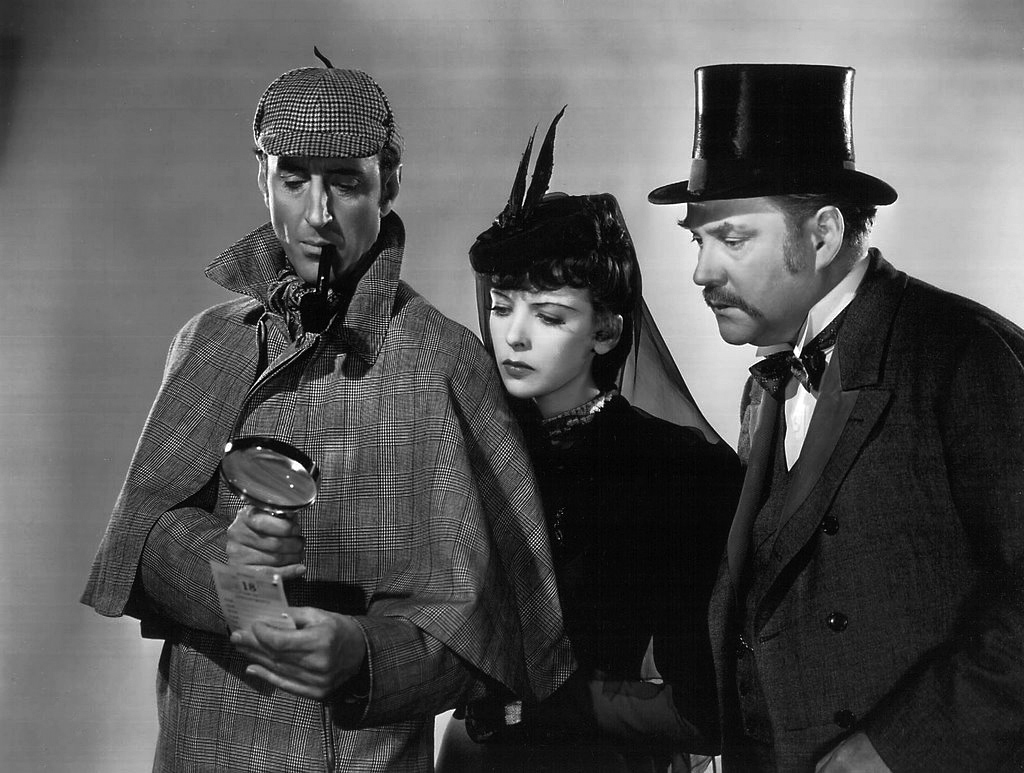
Sherlock Holmes and John Watson are going to take a look at the data
The criterion of embarrassment is just one of the historical criteria used to select the parts of a piece of ancient literature that is likely to be historical. Other things in the source may have happened, but we can’t know them as history. If significant parts of a text are historical, it is possible to accept it as historical until there are specific reasons to say that some part of it is NOT historical.
Here is William Lane Craig’s list of criteria for a saying or event to be historical:
Historical congruence: S fits in with known historical facts concerning the context in which S is said to have occurred.
Independent, early attestation: S appears in multiple sources which are near to the time at which S is alleged to have occurred and which depend neither upon each other nor a common source.
Embarrassment: S is awkward or counter-productive for the persons who serve as the source of information for S.
Dissimilarity: S is unlike antecedent Jewish thought-forms and/or unlike subsequent Christian thought-forms.
Semitisms: traces in the narrative of Aramaic or Hebrew linguistic forms.
Coherence: S is consistent with already established facts about Jesus.
The criteria is the same for liberal historians and conservative historians, although some historians weight one criteria more than others when trying to evaluate the historicity of different New Testament parts.
Here’s Christian apologist Dr. Frank Turek explaining what the criterion is, and some examples:
Franks’s a great speaker, you should watch that.
What’s amazing is that even liberal historians will give you facts that are embarrassing to the authors as “historical”.
Anyway, here are 8 examples of parts of the New Testament that exhibit the criterion of embarrassment, thanks to theologian C. Michael Patton.
Jesus’ Baptism
Jesus’ Family Did Not Believe
John the Baptist’s Doubt
The Disciples Doubted After the Resurrection
Jesus Does not Know the Time of His Coming
Women are the First to Witness the Resurrection
Jesus Cursed a Fig Tree
Death and Resurrection of Christ
I think 6 and 8 are the ones I want you to take away with you when you finish this post.
Here they are:
Women are the First to Witness the Resurrection
This is one that is often brought up. Craig Keener puts it well enough: “The witness of women at the tomb is very likely historical, precisely because it was so offensive to the larger culture — not the sort of testimony one would invent. Not all testimony was regarded as being of equal merit; the trustworthiness of witnesses was considered essential. Yet most of Jesus’ Jewish contemporaries held much less esteem for the testimony of women than for that of men; this suspicion reflects a broader Mediterranean limited trust of women’s speech and testimony also enshrined in Roman law.” (Keener, The Historical Jesus, 331)
And:
Death and Resurrection of Christ
This easily escapes our notice since the basic story of Christ is so well known. However, both the death and resurrection of Christ are, from the standpoint of the culture of the day, embarrassing and damaging. Concerning the death of Christ on a cross, Paul sees this problem: “But we preach Christ crucified: a stumbling block to Jews and foolishness to Gentiles” (1 Cor. 1:23). The word used for “stumbling block” is skandalon. Louw-Nida defines this as “that which causes offense and thus arouses opposition.” Why? Because the Jews would never have thought their Messiah would have been hung on a tree. “Cursed is one who hangs on a tree” (Gal. 3:13; Deut 21:23). The Greeks thought of the resurrection as foolishness as they were dualist, essentially believing that the material world was evil and the spiritual world good. They would have scoffed at the idea that Christ returned to physical form. This is why later Greeks attempted to adapt the Christ story, doing away with the physical resurrection. Marcion is the most famous promoter of this view (see Docitism).
Now, when you are talking about the New Testament to your non-believing friends, you definitely want to draw attention to passages that are embarrassing to the authors. It will help you to be more convincing when you explain the New Testament like a historian.
By the way, you can read an entire post I did on all the criteria that historians use to evaluate ancient historical documents.
14: The logical coherence of the doctrine of the Trinity
15: The logical coherence of the doctrine of the Incarnation
16: The logical coherence of the doctrine of the Atonement
17: The logical coherence of the doctrine of the Hell
18: Responding to objections to God’s knowledge of the future
My favorite chapters in this book are the ones by Mark Linville on evolution and morality, and the chapter by Robert H. Stein on historical criteria and methodology. This is not an introductory book, this book is an intermediate-level book. You want to read the two Jim Wallace books and the Lee Strobel “Case For” books before you tackle this one.
Much of the book is philosophy and philosophy of religion and philosophical theology. Well, I guess everyone knows that I hate non-STEM disciplines, and I only read philosophy because it’s useful for Christian apologetics. If you are like me, and think that only STEM disciplines have value, then this book is for you. You will be able to make use of it in your case-making adventures. It. Works. This is the stuff that gets William Lane Craig invited to all the best universities to debate against all the best atheists. And he beats them all up with it, too.
James Crossley is my favorite atheist ancient historian, such a straight shooter. He’s on the skeptical left, but he has a no-baloney way of talking that I really like. I was so excited to summarize this, and there’s not a speck of snark in this summary. Crossley dates the gospel of Mark 37-43 A.D., far earlier than most scholars. Justin Brierley does a great job as moderator. Gary Habermas is OK, but he is not familiar with any useful arguments for God’s existence, (kalam, fine-tuning, origin of life, Cambrian explosion, etc.), and that is a problem in this debate.
Christian philosopher and historian Gary Habermas has been at the forefront of the ‘minimal facts’ approach as evidence for the resurrection of Jesus.
He debates the commonly agreed facts with agnostic New Testament scholar James Crossley and they discuss whether the miracle of the resurrection can be a historically valid explanation of the evidence.
Note: this is the first of two shows they are doing together!!
Habermas: the minimal facts are the facts that even the majority of skeptical scholars will accept
Habermas list of minimal facts: (near universal acceptance)
Jesus died by Roman crucifixion
After his death, his disciples had experiences that they believed were appearances of the risen Jesus
The disciples were transformed by their experiences and proclaimed his resurrection and were willing to die for their belief in the resurrection
The proclamation of his resurrection was early
James was converted by a post-mortem experience
Paul was converted by a post-mortem experience
Habermas list of widely-accepted facts:
Burial for Jesus in a private tomb
The private tomb found empty
The disciples despaired after Jesus was crucified
The proclamation of the resurrection started in Jerusalem
Changing the worship day from Saturday to Sunday
Crossley’s views on the minimal and widely-accepted facts:
Crossley: I am in broad agreement with what Gary said
Crossley: “the resurrection appearances are some of the hardest, best evidence we have” because it’s in early 1 Cor 15:3-8 creed
Crossley: people were convinced that they had seen the risen Christ
The burial in a private tomb:
Crossley: I have my doubts about the private tomb burial and the empty tomb
Crossley: Mark’s gospel has the burial in a private tomb by Joseph of Arimethea, and Mark is the earliest gospel
Crossley: I don’t have a doubt, it’s just that there are other possible alternatives, and then the tradition was invented later – but that’s just a possibility
Crossley: there is not enough evidence to make a decision either way on the burial
The empty tomb:
Habermas: there are multiple lines of evidence for the empty tomb
Habermas: the reason it’s not one of my minimal facts is because a quarter to a third of skeptical scholars reject it
The transformation of the followers of Jesus:
Crossley: “yes, clearly, I don’t think you can argue with that, it’s fairly obvious”
The conversions of James and Paul:
Crossley: “yes, because it’s based on 1 Corinthians 15:3-8, that report, that was handed on to him”
Where Habermas and Crossley agree:
Habermas: you agree with the 6 facts in the minimal facts list, and you have problems with 2 of 5 facts from the widely accepted list
Crossley: Yes
The empty tomb:
Crossley: Two problems: first, 1 Corinthians 15:3-8 doesn’t mention it, but it “probably assumes the idea that Jesus left behind an empty tomb when resurrected, I am convinced by some of the conservative arguments on that one, but it’s not hard evidence for there actually being an empty tomb”
Crossley: Second, “the other early source we have ends with no resurrection appearances”, it makes him a bit skeptical of the empty tomb
Habermas: the empty tomb is not a minimal fact, I want 90% agreement by skeptical scholars for it to be a minimal fact
Habermas: I have never included the empty tomb in my list of minimal facts
Brierley: William Lane Craig puts it in his list of minimal facts
Habermas: It is very well attested, so if that’s what you mean, then it’s a minimal fact, but it doesn’t have the 90% agreement like the other minimal facts
Habermas: I have 21 arguments for the empty tomb, and none of them require early dating of sources or traditional authorship of the gospels, e.g. – the women discovered the empty tomb, the pre-Markan source, the implications of 1 Cor 15 has some force, the sermons summary in Acts 13 which Bart Ehrman dates to 31 or 32 A.D. has putting a body down and a body coming up without being corrupted
Why is 1 Corinthians 15:3-8 more respected as a source than the gospels?
Habermas: There is a unanimous New Testament conclusion, across the board, from conservative to liberal, that in 1 Cor 15:3-8 Paul is presenting creedal data, Richard Bauckham says that this goes back to the early 30s A.D., Paul got this from the eyewitnesses he mentions in Galatians 1 and 2
Crossley: [reads 1 Corinthians:3-8 out loud], now that’s a tradition that’s handed on, this is Paul, we know this is Paul, writing mid-50s, this is kind of gold, this is the evidence I wish we had across the board
Why doesn’t James accept the resurrection:
Crossley: Historians should not conclude that the supernatural is real, concluding the supernatural is outside of history
Crossley: I am more interested in what people believed at that time
Brierley: as a historian, are you required to give an explanation of the commonly-accepted facts
Crossley: yes, historians must give their explanation for the facts
Crossley: we know people have visions, and how the cultural context determines the content of visions, e.g. – the background of martyrdom
Brierley: so you would go for the hallucination hypothesis?
Crossley: yes, but I prefer not to use that word
Should historians rule out the supernatural?
Habermas: let’s not ask what caused the event, let’s just see if the disciples thought they saw him before he died, that he died on the cross, and then believed they saw him after he died, like you might see someone in the supermarket
Habermas: I’m not asking whether a miracle occurred, I just want to know whether Jesus was seen after he died on the cross
Crossley: that sounds like the angle I’m coming at this from
Crossley: the problem is that there is a supernatural element to some of the appearances, so it’s not a supermarket appearances
Brierley: it’s not angels and hallelujah in the sky
Habermas: nothing like that, no light in the early accounts, fairly mundane
Does James agree that people believed they saw Jesus after his death?
Crossley: yes, I think that’s fairly clear that we do
Crossley: but historians cannot prove claims that what happened to Jesus was supernatural
Brierley: your view is so far from what I see on Internet atheists sites, where they say it’s all legendary accumulation, fairy tales
Crossley: I’m perfect comfortable with the idea – and I think it happened – that people created stories, invented stories
Crossley: there are too many cases where people are sincerely professing that they thought they saw Jesus after his death
Would you expect the disciples to have visions of a resurrected Jesus if nothing happened to him?
Habermas: the dividing line is: did something happen to Jesus, or did something happen to his disciples?
Habermas: the view that people were seeing a kind of ghostly Jesus (non-bodily) – a Jedi Jesus – after his death is a resurrection view, but I hold to a bodily resurrection view
Brierley: N.T. Wright says a resurrected Jesus was contrary to expectations – should we expect the disciples to have a vision of Jesus as resurrected?
Crossley: Wright generalizes too much thinking that there was a single view of the resurrection (the general resurrection at the end of the age), there are a variety of views, some are contradictory
Crossley: Herod Antipas thought that Jesus might be John the Baptist returned from the dead, and he knew Jesus was flesh and blood, there is the story of the dead rising in the earthquake in Matthew, there are stories of the resurrection in Maccabees, and this would influence what people expected
Habermas: the earliest Christian view was *bodily* resurrection
Crossley: yes, I think that’s right
Crossley: In Mark 6, they thought Jesus was a ghost, so there is room for disagreement
Why should a historian not rule out a supernatural explanation?
Habermas: to get to supernatural, you have to go to philosophy – it’s a worldview problem
Habermas: he predicted his own death and resurrection
Habermas: one factor is the uniqueness of Jesus
Habermas: the early church had belief in the bodily resurrection, and a high Christology out of the gate
Habermas: you might look at evidence for corroborated near-death experiences that raise the possibility of an afterlife
Crossley: I’m content to leave it at the level of what people believe and not draw any larger conclusions
Crossley: regarding the predicting his own death, the gospels are written after, so it’s not clear that these predictions predate Jesus’ death
Crossley: it’s not surprising that Jesus would have predicted his own death, and that he might have foreseen God vindicating him
If you admit to the possibility of miracles, is the data sufficient to conclude that the best explanation of the facts is resurrection?
Crossley: If we assume that God exists, and that God intervenes in history, and that this was obvious to everyone, then “of course”
Brierley: Are you committed to a naturalistic view of history?
Crossley: Not quite, broadly, yes, I am saying this all I can do
Brierley: should James be open to a supernatural explanation?
Habermas: if you adopt methodological naturalism,it colors how look at the data is seen, just like supernaturalism does



 WINTERY KNIGHT