Tag Archives: Apologetics

Simon Brace on the nature of spiritual warfare and a plea to churches

C.S. Lewis has some words to live by for you

This passionate, challenging lecture has been getting shared a lot on Facebook, so I thought that I would do a summary of it.

First, you can grab the MP3 file here.

Note that this talk is given by a very conservative evangelical Christian who is speaking to Christians. So this is not intended for a non-Christian audience. However, non-Christians are free to tune in if you want to hear a really passionate, fire-breathing conservative evangelical go non-linear over the superficial turn that the evangelical church has taken. If you are familiar with J.P. Moreland’s view that spiritual warfare is really about disputing speculations and falsehoods using logic and evidence, then you’ll know the meaning of the term “spiritual warfare” he has in mind. When he says spiritual warfare, he means apologetics: knowledge and preparation.

I would really caution you not to listen to this if you are not passionate about defending God’s honor. It will overwhelm and upset you. Having said that, this lecture reflects my convictions about the churches need to drop anti-intellectualism and take up apologetics. And not pre-suppositional apologetics, which I think is ineffective, but evidential apologetics. Evidential apologetics is effective, which is why everyone in the Bible used it.

About the speaker:

Simon Brace is the Director of Evangelism of Southern Evangelical Seminary. Simon was born in Zimbabwe and grew up in South Africa. Simon has a construction background and has lived in a number of countries and travelled extensively. He has a MA in Apologetics and BA in Religious Studies and is currently working on an MA in Philosophy at SES. Simon leads TEAM which is the missions program of SES on local, national, and international trips. In addition, Simon has worked with Ratio Christi at SES, and has an extensive knowledge of Ratio Christi’s history and operation. Simon currently resides in North Carolina with his wife Nel and children, Eva and Olivia.

I liked the second part of the lecture more than the first part, so there is less summarizing of the first part.

Topics:

  • What does the New Testament say about spiritual warfare in Ephesians?
  • Christian slogans about spiritual warfare sound pious, but they are mistaken
  • Today, Christianity is focused on piety and zeal, not on study and knowledge
  • The result is that Christianity in the West is in a state of erosion and decline
  • What we are doing about spiritual warfare is not working to stop the decline
  • Preaching, publishing, programs, retreats, etc. are not very useful for spiritual warfare
  • Enthusiasm and passion without knowledge  are not very useful for spiritual warfare
  • The Church has a theoretical understanding of spiritual warfare, but no real capability
  • Doesn’t work: trying to make Christianity seem popular and cool
  • Doesn’t work: making Christian music and art that non-Christians will like
  • Doesn’t work: pastors trying to be relevant by having cool clothes and cool haircuts
  • Doesn’t work: fundamentalists getting angry about peripheral issues
  • Doesn’t work: not read things apart from the Bible and sound foolish when speaking in the public square
  • Doesn’t work: church leaders think that careful exegesis and expository preaching is a good answer to skeptics
  • What works: we need to train people who are prepared and willing to defend the truth of the Christian faith
  • Evangelicalism has a deep suspicion of reading things outside the Bible, so they are unable to refute anything
  • Evangelicals are hyper-spiritualized and hysterical, focusing on demons, prophecy and end-times, etc.
  • Evangelicals have a pagan view of using their minds to alter reality, which is irrational and superstitious
  • Evangelicals like conservative celebrity preachers who do nothing to correct anti-intellectualism in the church
  • Evangelicals are focused on their personal relationships with Jesus instead of their whole worldview
  • Evangelicals focus too much on homeschooling and not enough on how to impact the secular universities
  • Church programs for youth are about “strumming guitars and eating pizza once a week”, not apologetics
  • Evangelicals have an over-inflated view of the effectiveness of their (non-intellectual) evangelism methods
  • The primary focus and primary responsibility in spiritual warfare is not dealing with supernatural evil
  • The real focus and responsibility in spiritual warfare is specified in 2 Cor 10:3-5
  • What we ought to be doing is defeating speculations (false ideas), using logical arguments and evidence
  • Defending the faith is not memorizing Bible verses and throwing them out randomly
  • Defending the faith is not just preaching the gospel
  • Demolishing an argument requires understanding arguments: premises, conclusions, the laws of logic
  • We should exchange our pious Bible memorizing skills and the like for a class in critical thinking
  • The New Testament requires that elders be capable of refuting those who oppose sound doctrine (Titus 1:9)
  • It is not enough to preach a good sermon, elders have to be able to defend the Christian faith as well
  • People who run conservative seminaries do not mandate that M.Div graduates study apologetics
  • Famous pastors like Driscoll, Begg, etc. need to teach other pastors to emphasize apologetics in church
  • People in church won’t engage the culture unless they have reasons and evidence to believe Christianity is true
  • We need a balance of both piety and intellectual engagement
  • We need to make our evangelism rooted in the intellect in order to have an influence at the university
  • Mission organizations also have a responsibility to defend the faith and not merely preach (1 Peter 3:15)

And here is his closing quote from C.S. Lewis:

To be ignorant and simple now not to be able to meet the enemies on their own ground would be to throw down our weapons and to betray our uneducated brethren who have, under God, no defense but us against the intellectual attacks of the heathen. Good philosophy must exist, if for no other reason, because bad philosophy needs to be answered.

I was really humbled by this, because I sort of knew that the church was anti-intellectual, but I didn’t really reflect on how everyone else in society thinks that we are anti-intellectual. It’s troubling. The quickest way to make Biblical Christianity respectable again is to hit the books and defeat all comers in intellectual disputations. Are we ready to make the sacrifices to do that?.

The Muratorian fragment, dated 170 A.D., affirms 22 out of 27 New Testament books

The Muratorian fragment / The Muratorian canon
The Muratorian fragment / The Muratorian canon (click for larger image)

I sometimes hear this odd objection that the books that were to be included in the Bible were not decided until the 4th century. I think it comes from some Hollywood movie, or maybe a TV show. Anyway, this post should help fix that myth.

I’m going to quote from New Testament expert Dr. Michael J. Kruger from his blog.

He writes:

One of the key data points in any discussion of canon is something called the Muratorian fragment (also known as the Muratorian canon).  This fragment, named after its discoverer Ludovico Antonio Muratori, contains our earliest list of the books in the New Testament.  While the fragment itself dates from the 7th or 8th century, the list it contains was originally written in Greek and dates back to the end of the second century (c.180).

[…]What is noteworthy for our purposes here is that the Muratorian fragment affirms 22 of the 27 books of the New Testament.  These include the four Gospels, Acts, all 13 epistles of Paul, Jude, 1 John, 2 John (and possibly 3rd John), and Revelation.  This means that at a remarkably early point (end of the second century), the central core of the New Testament canon was already established and in place.

Although there is still dispute about some books, that does not negate the fact that the main books we use (the gospels, Acts, the letters of Paul) are all considered to be canon by 180 A.D., much before any famous church councils ever happened. And those books were decided on because they were in widespread use and respected by everyone.

What about the books that were in dispute? Do they throw any core doctrines into doubt?

Second, if there was a core collection of New Testament books, then the theological trajectory of early Christianity had already been determined prior to the debates about the peripheral books being resolved.  So, regardless of the outcome of discussion over books like 2 Peter or James, Christianity’s core doctrines of the person of Christ, the work of Christ, the means of salvation, etc., were already in place and already established.  The acceptance or rejection of books like 2 Peter would not change that fact.

By the way, I’d actually heard that the date for this fragment was 170 A.D., so it might even be earlier than Dr. Krueger says.

I did search around a bit for something to break the tie between me and Krueger, because I couldn’t remember my source for the date. I found this book “Jesus, Gospel Tradition and Paul in the Context of Jewish and Greco-Roman Antiquity” by David E. Aune, and he writes on p. 22:

The four Gospels are also referred to in the Canon Muratorianus, a seventh or eighth century manuscript originally translated from Greek into a deponent form of Latin and widely regarded as having been produced ca. 170 CE. Though the beginning of this canonical list is fragmentary (though obviously referring to Mark), the first two clear references to New Testament books are to Luke and John (lines 2, 9): tertio euangelii librum secando Lucan guard evangeliorutn lohannis ex decipolis.” (“The third book of the Gospel is that according to Luke … The fourth of the Gospels is that of John, [one) of the disciples”).

So, that’s why the date in the title of this post is 170 A.D., and not the later 180 A.D. he mentions. And that’s why there’s no reason to be skeptical that the Bible we have today is any different than the Bible that everybody in the early church had.

New York church makes space for non-Christians to ask questions

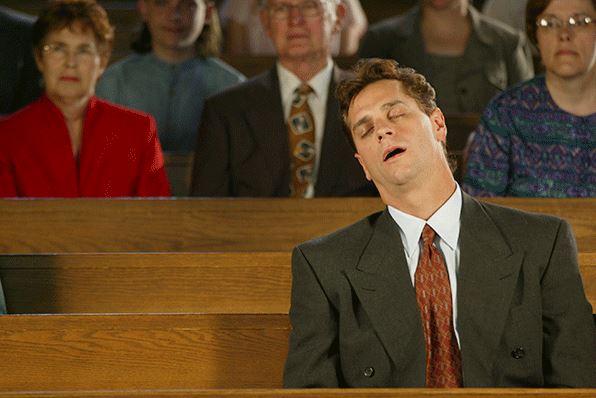
Church sucks, that's why men are bored there
Is church boring? How can you make it more interesting for people?

This is from the radically leftist New York Times, of all places.

It says:

When Craig Ellis was growing up, he picked up the sort of adventure book meant for a boy looking to serve God. The book, “Shadow of the Almighty,” told the story of Jim Elliot, a young American evangelist killed while doing mission work in Ecuador.

The narrative of this Christian martyr did for Mr. Ellis what a superhero comic might have done for his peers: It got him pondering purpose, struggle and sacrifice. The book also provided a model for how a Christian should spread the news of salvation while working in treacherous territory, at great personal risk.

Very little in “Shadow of the Almighty,” however, prepared Mr. Ellis for where he stood on a recent Tuesday, in a room with industrial carpet and a dropped ceiling at Redeemer Presbyterian Church on the Upper West Side of Manhattan, where people lined up on Sunday morning are more likely awaiting a table for brunch than taking communion.

Mr. Ellis, 39, welcomed the dozen men and women seated before him. “This is a space,” he said, “for people who consider themselves non-Christian and are coming in from the outside.”

His weekly sessions, called the WS Café in a reference to the neighborhood, are at a new frontier of evangelism, one that seeks converts among a fervent and growing number of atheists in this country. The sessions started in September as a push by Redeemer Presbyterian’s prominent pastor, the Rev. Tim Keller, to preach the gospel to skeptics.

How are they doing it?

By not quoting the Bible as if it were inerrant to people who don’t think it is. But using evidence from outside the Bible to explain what’s in the Bible.

More:

On that recent Tuesday evening, Mr. Ellis, the pastor’s assistant, was sharing a lectern with the Rev. Bijan Mirtolooi, the assistant pastor for the 83rd Street church. In the chairs around them sat people like Frank Ying, 33, who works for a technology start-up. Brought up in the Dallas area by immigrant parents who had been raised amid the official atheism of the People’s Republic of China, Mr. Ying tried exploring Christianity with his high school classmates, even accompanying them to megachurches, only to be put off by their fundamentalism.

“You have all these questions,” he recalled. “And you have all these long, drawn-out conversations. ‘What do you believe? How much of the Bible do you take literally?’ And these people stop short and say, ‘You’ve just got to have faith.’ But I’ve always been more pragmatic, so that wasn’t good enough.”

Mr. Ying heard about Redeemer Presbyterian from a few acquaintances after moving to Manhattan several years ago. He dipped his toe slowly, watching a YouTube video of Dr. Keller in conversation with a journalist and a historian, emissaries of the secular world. By now, Mr. Ying is a regular at the WS Café, not because he believes, but because his doubts get heard.

Each session has a central topic, and on the recent Tuesday it was about why Jesus needed to be crucified. As part of framing a wide-open conversation, a list of quotations on the subject even included this zinger from Mr. Hitchens: “I find something repulsive about the idea of vicarious redemption.”

Mr. Ellis and Mr. Mirtolooi cited popular culture (movies like “The Revenant,” “Inside Out”) and real-life examples (the way a parent sacrifices free time to raise a child) in order to make palpable the concept of suffering leading to the remission of sin. Very deliberately, they did not lean heavily on Scripture.

“The difference with the Café is what you’re using as your authorities,” Mr. Ellis said later. “Typically, in a Christian class, the Bible is your authenticity. To this group, the Bible is just another book. You can use it, but it’s just one piece of the puzzle. You rely on those your listeners would find credible — scientists, philosophers, authors — and you show how Christianity makes sense.”

[…]The point of their exchange was not winning a soul now as much as keeping a mind open to the possibility someday. “Now I find that I’m very comfortable going to church on a Sunday, listening to the sermons,” Mr. Ying said. “I can explore more and not have religious people put down their foot and say, ‘This is how it is.’ ”

This reminds me of the conversation I had when I went to work for a tech start-up right out of college. You had to have a graduate degree to work in this company. I remember talking to a buy who had a PhD from Northwestern, and my boss who had his undergrad from UIUC and his Masters from Purdue. I had just answered one of their questions, and then apologized for taking the conservative point of view – hoping I hadn’t offended them. I said “I’m a fundamentalist”. And the PhD guy said, “you’re not a fundamentalist. You have your view, but you know all the other views, too”.

I think that in the workplace or in the school, it’s important to know all the other views, too. We don’t want to play into this stereotype that the secular leftists have of us. We should be able to sit still and listen, and put their view forward better than they can themselves. You won’t learn how to do that in church, though. Church teaches you to only be able to talk to people about your faith if they assume that the Bible is the inerrant Word of God (which it is, but non-Christians don’t believe that!) You have to learn how to speak to non-Christians effectively on your own, by reading and watching debates. Sad, but true.