British Spitfire and German Messerschmitt Me 109 locked in a dogfight
Here’s the video of the debate:
Carroll was as good of a speaker as Craig in terms of style. Very easy to listen to, very quick on his feet, very civil. There was no clear winner on style.
It was difficult to assess the truth value of scientific points being made, especially for the layperson. I explained a few of them in my posts earlier this week, but I think laypeople might struggle with them if they are hearing about these things for the first time.
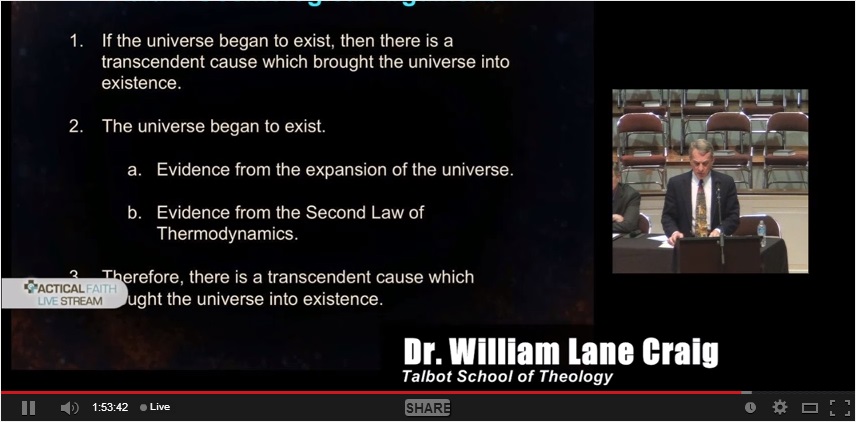
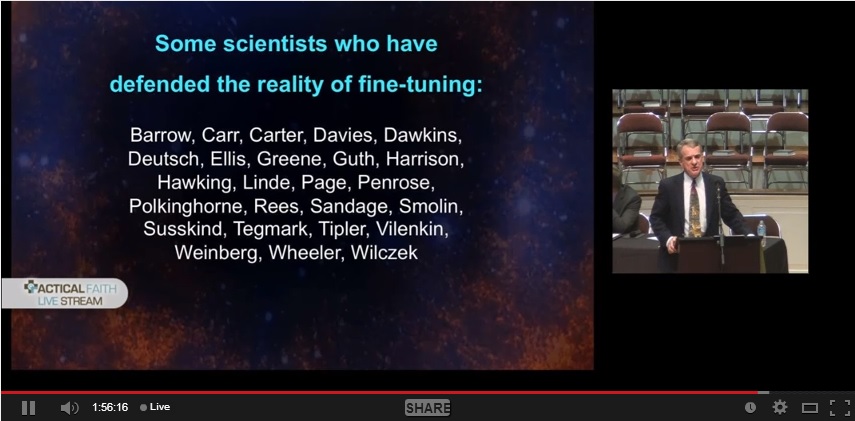
A couple of Craig’s slides: (click for larger images)
Slide 1 of 2:
Dr. Craig slide #1 of 2
Slide 2 of 2:
Dr. Craig slide #2 of 2
Quick summary: (this is not complete, because I couldn’t get everything they were saying noted)
Dr. Craig defended two arguments: 1) the kalam cosmological argument and the fine-tuning argument.
Dr. Craig supported the origin of the universe with 1) the expansion of the universe and 2) the second law of thermodynamics.
Dr. Craig said that the BGV theorem supports a beginning for the universe.
Dr. Craig said that the consensus of scientists did not accept Carroll’s naturalistic cosmology, quoting Stephen Hawking in support.
Dr. Craig said that multiverse models fall victim to the Boltzmann brain problem, where we should observe Boltzmann brains coming into existence and then phasing out again far more probably than embodied minds. But we observe embodied minds, and no Boltzmann brains.
Dr. Carroll said that science cannot study metaphysical questions.
Dr. Carroll said that science is about making models that may or may not be consistent with the experimental data.
Dr. Carroll said that the BGV theorem does not support a beginning for the universe.
Dr. Carroll proposed 17 alternative cosmologies, but did not provide a shred of scientific evidence for any of them, the way that Craig did for the standard model.
Dr. Carroll refuted Dr. Craig’s citation of Stephen Hawking, and Craig yielded the point.
Dr. Carroll speculated that science might progress to the point where the fine-tuning can be explained without an intelligent cause, and he gave an example of where that happened (inflation).
Dr. Craig argued that all 17 of the models suggested by Carroll either conflicted with evidence, had serious problems or did require a beginning.
Dr. Craig argued that Carroll’s own model required a beginning.
Dr. Craig argued that Carroll’s own model fell victim to the Boltzmann brain problem.
Dr. Craig argued that Carroll’s own model violated the second law of thermodynamics.
Dr. Craig re-stated his point that the baby universe spawning in Carroll’s model was speculative and incomplete, and cited Christopher Weaver’s work.
Dr. Carroll denied that things that pop into being out of nothing require a transcendent cause.
Dr. Carroll reiterated that science can only make naturalistic models, and that he did not have to answer questions about ultimate causes.
Dr. Carroll showed a photo of Alan Guth expressing his opinion that the universe is “probably” eternal. No evidence was given for this assertion.
Dr. Carroll said that the fine-tuning was not done in an optimal way, because one fine-tuned value was lower than it needed to be, and it should be exactly what it needed to be if God did it.
Dr. Carroll said that a finely-tuned universe is more probably in naturalism than in theism, because God can do anything he wants and doesn’t need a fine-tuned universe.
Dr. Carroll said he would stop defending his model now, and would instead defend Aguirre-Gratton.
Dr. Craig gave three reasons why the universe popping into being out of nothing requires a transcendent cause.
First, he said that nothing cannot cause anything to happen, because nothing is nothing.
Second, he said that if things pop into being out of nothing, then why don’t we see it happening all the time with other things.
Third, he said that we have no reason to dismiss the causal principle, especially when it is the basis of scientific inquiry and has been so fruitful in the progress of science.
Dr. Craig reiterated that baby universes in Carroll’s model would be dominated by Boltzmann brains, and we don’t observe that.
Dr. Craig said that even on the quantum gravity models that Carroll mentioned, there would still be a beginning.
Dr. Carroll said that Craig mustn’t say “popped into being” but instead that “there was a first moment of time”.
Dr. Carroll said that his model does indeed violate the second law of thermodynamics “YES!”.
At this point Carroll stopped talking about the topic of the debate and started expressing personal opinions about religion. It’s funny how often atheists do this in debates.
Dr. Carroll said that most theists don’t believe in God because of cosmology, but because of community and feelings.
Dr. Carroll said that science had learned a lot in the last 2000 years, so theism was false.
Dr. Carroll said that most philosophers don’t think that God exists, so theism was false.
Dr. Carroll said microscopes and telescopes were absent 2000 years ago, so theism was false.
Dr. Carroll said that religion should be about community and feelings, not about what is true.
Conclusion:
My conclusion was that Carroll lost because he is just satisfied to throw theories out and not to argue that they are true by citing evidence. Carroll never seemed to be interested in finding out what is true, but instead he just wanted to tell a story that didn’t include God, and assert that by Occam’s Razor, his story was a better explanation. I am not impressed with theoretical speculations, although the layperson might be. I kept waiting for him to respond to Craig’s points about how his model was falsified by experimental evidence and observations, e.g. – the Boltzmann brains or the baby universe generation, and he never cited the evidence I wanted him to cite. Craig did have some evidence for his views, but he could have been stronger in making his case. He could have shown the e-mail from Vilenkin that stated that he had understood the BGV theorem, and was using it correctly, for example.
For me the winning side comes down to evidence. The standard model is the standard model because of scientific evidence. Until that evidence is overturned, then speculative models are of no interest to anyone who is evidence-driven. Speculations are not science. A philosophical presupposition of metaphysical naturalism is not science.
If you want to see a good lecture on scientific evidence related to cosmology, then there is the particle physicist Michael Strauss lecture on cosmology and fine-tuning at Stanford University and his more recent lecture at the University of Texas. Note that Strauss is an experimental physicist, not a theoretical physicist like Carroll.
Here’s another review of the debate by Randy Everist of Possible Worlds blog. He explains the back-and-forth over Boltzmann brains and the BGV theorem in more detail.
Have you ever heard an atheist tell you that naturalistic evolution is an answer to the moral argument? I have. And I found a good reply to this challenge in the book “Contending With Christianity’s Critics“. The chapter that responds to the challenge is authored by Dr. Mark D. Linville. It is only 13 pages long. I have a link to the PDF at the bottom of this post.
PhD in Philosophy with a minor in South Asian Studies and a specialization in Philosophy of Religion, University of Wisconsin-Madison
MA in Philosophy, University of Wisconsin-Madison
MA in Philosophy of Religion, Trinity Evangelical Divinity School
MA in Theology, Cincinnati Christian Seminary
BA in Biblical Studies, Florida Christian College
Here is his thesis of the essay:
Darwin’s account of the origins of human morality is at once elegant, ingenious, and, I shall argue, woefully inadequate. In particular, that account, on its standard interpretation, does not explain morality, but, rather, explains it away . We learn from Darwin not how there could be objective moral facts, but how we could have come to believe—perhaps erroneously—that there are.
Further, the naturalist, who does not believe that there is such a personal being as God, is in principle committed to Darwinism, including a Darwinian account of the basic contours of human moral psychology. I’ll use the term evolutionary naturalism to refer to this combination of naturalism and Darwinism. And so the naturalist is saddled with a view that explains morality away. Whatever reason we have for believing in moral facts is also a reason for thinking naturalism is false. I conclude the essay with a brief account of a theistic conception of morality, and argue that the theist is in a better position to affirm the objectivity of morality.
And here’s a sample to get your attention:
But even if we are assured that a “normal” person will be prompted by the social instincts and that those instincts are typically flanked and reinforced by a set of moral emotions, we still do not have a truly normative account of moral obligation. There is nothing in Darwin’s own account to indicate that the ensuing sense of guilt—a guilty feeling—is indicative of actual moral guilt resulting from the violation of an objective moral law. The revenge taken by one’s own conscience amounts to a sort of second-order propensity to feel a certain way given one’s past relation to conflicting first-order propensities (e.g., the father’s impulse to save his child versus his impulse to save himself). Unless we import normative considerations from some other source, it seems that, whether it is a first or second-order inclination,one’s being prompted by it is more readily understood as a descriptive feature of one’s own psychology than material for a normative assessment of one’s behavior or character. And, assuming that there is anything to this observation, an ascent into even higher levels of propensities (“I feel guilty for not having felt guilty for not being remorseful over not obeying my social instincts…”) introduces nothing of normative import. Suppose you encounter a man who neither feels the pull of social, paternal or familial instincts nor is in the least bit concerned over his apparent lack of conscience. What, from a strictly Darwinian perspective, can one say to him that is of any serious moral import? “You are not moved to action by the impulses that move most of us.” Right. So?
The problem afflicts contemporary construals of an evolutionary account of human morality. Consider Michael Shermer’s explanation for the evolution of a moral sense—the “science of good and evil.” He explains,
By a moral sense, I mean a moral feeling or emotion generated by actions. For example, positive emotions such as righteousness and pride are experienced as the psychological feeling of doing “good.” These moral emotions likely evolved out of behaviors that were reinforced as being good either for the individual or for the group.2
Shermer goes on to compare such moral emotions to other emotions and sensations that are universally experienced, such as hunger and the sexual urge. He then addresses the question of moral motivation.
In this evolutionary theory of morality, asking “Why should we be moral?” is like asking “Why should we be hungry?” or “Why should we be horny?” For that matter, we could ask, “Why should we be jealous?” or “Why should we fall in love?” The answer is that it is as much a part of human nature to be moral as it is to be hungry, horny, jealous, and in love.3
Thus, according to Shermer, given an evolutionary account, such a question is simply a non-starter. Moral motivation is a given as it is wired in as one of our basic drives. Of course, one might point out that Shermer’s “moral emotions” often do need encouragement in a way that, say, “horniness,” does not. More importantly, Shermer apparently fails to notice that if asking “Why should I be moral?” is like asking, “Why should I be horny?” then asserting, “You ought to be moral” is like asserting, “You ought to be horny.” As goes the interrogative, so goes the imperative. But if the latter seems out of place, then, on Shermer’s view, so is the former.
One might thus observe that if morality is anything at all, it is irreducibly normative in nature. But the Darwinian account winds up reducing morality to descriptive features of human psychology. Like the libido, either the moral sense is present and active or it is not. If it is, then we might expect one to behave accordingly. If not, why, then, as a famous blues man once put it, “the boogie woogie just ain’t in me.” And so the resulting “morality” is that in name only.
In light of such considerations, it is tempting to conclude with C. S. Lewis that, if the naturalist remembered his philosophy out of school, he would recognize that any claim to the effect that “I ought” is on a par with “I itch,” in that it is nothing more than a descriptive piece of autobiography with no essential reference to any actual obligations.
When it comes to morality, we are not interested in mere descriptions of behavior. We want to know about prescriptions of behavior, and whether why we should care about following those prescriptions. We are interested in what grounds our sense of moral obligation in reality. What underwrites our sense of moral obligation? If it is just rooted in feelings, then why should we obey our moral sense when obeying it goes against out self-interest? Feelings are subjective things, and doing the right thing in a real objective state of affairs requires more than just feelings. There has to be a real objective state of affairs that makes it rational for us to do the right thing, even when the right thing is against our own self-interest. That’s what morality is – objective moral obligations overriding subjective feelings. I wouldn’t trust someone to be moral if it were just based on their feelings.
Bart Ehrman is well known as a US New Testament Scholar who lost his Christian faith and now questions many core precepts of Christianity, including the Resurrection of Jesus. When Mike Licona had doubts he devoted himself to investigating the evidence and became convinced that Jesus resurrection is the only rational explanation for the facts.
They debate key historical facts about the resurrection – are the letters of Paul that report the resurrection and the Gospel accounts trustworthy or theologised and changed with time? What about apparent contradictions between the Gospels? Does the consensus of scholars count as evidence, or is there a Christian bias? Can a miracle count as an explanation for historical data?
Snarky summary of the radio debate: (items with * are my made-up paraphrases/clarifications)
This has got to be one of my silliest summaries, but Ehrman makes me so annoyed.
Ehrman:
– my new book is about forgeries in the ancient world
– some books were falsely attributed to prominent Christian figures
– there are mistakes in the Bible
– there are mistakes in the resurrection narratives
– the defeat of inerrancy led to his conversion to liberal Christianity
– the problem of evil and suffering caused him to become a non-Christian
Licona:
– there are minimal facts that are agreed to by a broad spectrum of scholars
– the minimal facts are accepted because they pass standard historical criteria
– Fact 1: Jesus died by crucifixion
– Fact 2: Individuals and groups had visions of Jesus after his death
– Fact 3: Paul, a skeptic and an enemy, had an appearance of Jesus that converted him
– these facts are agreed to atheist scholars, liberal scholars, etc.
– virtually 100% of scholars agree with these three facts
– there is no naturalistic explanation of these three facts
– therefore, the best explanation of these three facts is that God raised Jesus from the dead
Ehrman:
– all historians would accept these three facts, except for maybe the group appearances
– the death of Jesus is irrelevant to the resurrection
– the second and third point can be collapsed together
– so really there is only one fact
Moderator:
– the crucifixion is relevant because Muslims don’t admit that fact
– the crucifixion important because it establishes a resurrection, not a resuscitation
Ehrman:
– well, if the point is that he died, then yes, this does require a resurrection
Licona:
– the crucifixion refutes Muslims who deny that Jesus died
– the crucifixion refutes the apparent death theory (swoon theory)
– the death is required for a bodily resurrection
– it’s important to know what facts most scholars, regardless of worldview, agree on
– it’s important to emphasize that Licona is working from historical bedrock facts
– the resurrection is the best explanation for the historical bedrock facts
Ehrman:
– you are trying to list 3 things, but really it is just one thing – the appearances
– and not ALL scholars agree that the group visions occurred
Licona:
– name one prominent scholar who denies the group appearances
Ehrman:
– the radically leftist atheist nutcase John Dominic Crossan denies the group appearances
* Crossan is so far on the left that I look like a nutcase for even citing him
* Crossan believes in the Secret Gospel of Mark, which is a hoax – but I still cite Crossan
* Crossan believes that the synoptics are LATER than gnostic forged gospels – but I still cite Crossan
* Crossan presupposes atheism, so he cannot admit to miracle stories as a pre-supposition – but I still cite Crossan
* Crossan pre-supposes religious pluralism, so he cannot allow any exclusive claims Christians make – but I still cite Crossan
* Crossan is a good historian, it’s just that he is so far to the left that no one – NO ONE – agrees with his all of crazy theories
* I think it is a good idea to cite historians who pre-suppose atheism and political correctness before they sit down to do history
Licona:
– let me explain why most scholars accept the individual and group post-mortem appearances
– the best source for the appearances is the early creed recorded by Paul in 1 Cor 15:3-8
– Paul himself had an appearance of Jesus after Jesus’ death
– Paul received this material from a source very soon after the appearances – within 1-3 years
– we know that Paul met with Jesus disciples multiple times prior to writing
– Paul probably received it from Peter and James, who were themselves eyewitnesses
Moderator:
– this early dating presumably rules out legend
Licona:
– well legends CAN start quickly
– it does show that Paul was an eyewitness
– it does show that Paul was in contact with reliable eyewitnesses
Ehrman:
– 1 Corinthians is written around 55 AD, twenty-five years after Jesus died
– it is not implausible that Paul got the creed from the disciples, who were eyewitnesses
– but you don’t need a long time for legends to emerge, so that is a possibility
Licona:
– only about 3% of people could read and write back them
– instead, people had enormous capacity for memorization
– the Pharisees were particularly good at memorization
– Jews were very serious about passing along traditions accurately
– Paul, a prominent Pharisee, would have been capable of passing on early creeds accurately
– Paul, in 1 Cor 7, shows that he is willing to separate his opinions from authentic tradition
– Paul had an opportunity in 1 Cor 7 to put words into Jesus’ mouth, but he wouldn’t do it
Ehrman:
– cultural anthropologists show that things do get changed in some oral cultures
– in these oral cultures, it is assumed that the story teller will change the story
– only in written cultures are they careful to avoid changing the story
– in the New Testament, you can compare the same story in two different gospels, there are differences
Licona:
– Ehrman is right that the gospel writers pick and choose things from the oral tradition that they want to include in their gospels
– different oral tradition transmission schemes have more or less embellishment
– african tribes embellish more, rabbinic teaching embellishes less
* Jesus’ followers would have viewed him as a rabbi, and been careful about adding to his teachings
– Paul, an eyewitness, probably received the creed in 1 Cor 15 from other eyewitnesses
– Paul speaks about going twice to Jerusalem in Galatians
– he is meeting with Peter and James to check his facts
Ehrman:
– when you look at Mark and John, there are lots of differences in the narrative
Licona:
– I agree that the gospels have differences, but the oral tradition is likely fixed
Ehrman:
– but Mark and John have different sayings
– why doesn’t Mark have the same explicit high Christology that John has?
Licona:
– first, John is trying to weave the oral tradition into a compelling story
– and second, when you look in Mark, the high Christology is there in the Son of Man sayings
– the apocalyptic Son of Man is in Mark, and everywhere in the New Testament
Ehrman:
– the “apocalyptic Son of Man” isn’t in John
Licona:
– what about in John 9 with the man who was born blind
Ehrman:
– where is the apocalyptic part?
Licona:
– the healed man worships Jesus because he is the Son of Man
– that links to the apocalypic passages in the Old Testament
Moderator:
– what about the differences between the gospels?
Ehrman:
* well, now is the time for me to set up an inerrantist straw man and then knock it down!
* who was at the empty tomb: one angel or two angels? we don’t know, so the whole Bible is false!
* I used to be an inerrantist, so one minor difference is enough for me to dump the whole Bible
* I’ll kill you, you stupid straw man! I hate you, Moody Bible Institute! You lied to me!
Licona:
– many of these problems can be solved by realizing that the gospel writers compress time
– the stories don’t have to list ALL the characters in every scene
– you don’t have to force the Bible to meet some sort of wooden chronology
– the main thing is that the events happened, not that the descriptions match word for word across sources
Ehrman:
– you can’t infer a miracle from history, David Hume says so
* extraordinary claims require extraordinary evidence, David Hume says so
* no I don’t know what begging the question is, I’m not a philosopher
* no I don’t remember when Bill Craig kicked my ass on this Hume objection in our debate
– the New Testament gospels contradict each other at every point, they are not reliable at all!
* they cannot even agree what Jesus’ name is! There are 1 trillion variants of Jesus’ name!
* “one angel vs two angels” proves that the gospels contradict each other at every point
* my expansive list of FOUR theologically insignificant variants proves that the gospels contradict each other at every point
Licona:
– um, the gospels agree on the central narrative and disagree on the peripherals
– and they agree on the minimal facts I presented, even if they disagree about the number of angels
Ehrman:
* they have to agree on everything and be inerrant! The Moody Straw Man Bible Institute says so!
* I really really really need to have the number of angels be the same, or Jesus didn’t die on the cross
Licona:
– but you don’t deny any of the three minimal facts I presented (crucifixion, appearances, Paul)
Ehrman:
– well, I don’t know if the group appearances occurred – maybe they did
– i think Jesus died on the cross, and I think that people said they saw him alive afterward
Licona:
– if you deny the minimal facts, then you are outside the majority of scholars
Ehrman:
– the majority of scholars who agree to the minimal facts you presented are Christians
* Gerd Ludemann is an atheist Christian
* James Crossley is an atheist Christian
* Hector Avalos is an atheist Christian
* the majority of the atheist scholars are all Christians!
– VIRTUALLY EVERYBODY IN THE SOCIETY OF BIBLICAL LITERATURE IS A CHRISTIAN!!! (Yes, he said that)
Ehrman:
– but he CLAIMS TO BE A CHRISTIAN so that means HE IS A CHRISTIAN
* all you have to do to be a Christian is claim to be one
* you can even deny the existence of God and the divinity of Christ and still be one, you bigot!
Licona:
– would Jesus or the apostles recognize a Christian as being someone who doubts God’s existence
Ehrman:
– my view is that Jesus and the apostles would not recognize evangelical Christians as Christians
* a non-theist can be a Christian just by claiming to be one, but evangelical Christians are not Christians even if they claim to be Christians
– Christians can’t record accurate history about the resurrection because they are biased
Licona:
– on your view, if a person is a Christian then he can’t write about the evidence for the resurrection
– so then similarly, you would not allow Jews to write about the historicity of the Holocaust
– because you think that if people have an interest in what they are recording then they can’t be objective
– but you have to consider the evidence we have, taking the biases of the sources into account
Ehrman:
– but the only people who believe in the resurrection are Christians!
Licona:
– well, people can consider the evidence for the resurrection as non-Christians
– and then if they accept it they can become Christians
Moderator:
– what about your bias? you don’t believe in God – doesn’t that pre-supposition affect how you do history?
Ehrman:
– well, I presuppose naturalism, so I can’t admit to anything in history that implicates supernatural causes
* no I have never heard of the arguments for the Big Bang, fine-tuning, origin of life, Cambrian explosion, irreducible complexity, limits on mutations creating information, habitability and so on – I never heard about that stuff from my atheist university professors and even if I had I would have been expelled for talking about it because that would make people feel bad about their sinning
Licona:
– so it’s not bias you are concerned about, it’s that you don’t want history to contradict your untested religion of naturalism?
– why not just do the history without pre-suppositions to gather the minimal facts and then see what the best explanation is?
Ehrman:
* well God is out of bounds as an explanation because I could not have got my PhD if I mentioned God
* I really needed my smart atheist professors to like me and give me good grades so God is RIGHT OUT
* ideas like a real God and moral laws and Hell makes my atheist professors uncomfortable and that means low grades for me
* I’m not really interested in butting heads with professors – it’s easier to just agree with them and move on to selling books to the gullible
* My books are much more sensational than Dan Brown books, so please buy lots of them!
Licona:
– what if the historical evidence is good enough to show that Jesus rose from the dead?
Ehrman:
– well I would not call someone rising from the dead a miracle – I would call it weird
* I also think that the Big Bang is “weird” but that doesn’t prove that God created the universe out of nothing
* if it’s a miracle then I’m going to have to not sin, and maybe even go to Hell, and we can’t have that
Licona:
– well, you accept the three minimal facts
– what if we try all the naturalistic explanations for those three facts and there are problems with all of them?
– what if the resurrection is the best explanation for the three minimal facts?
Ehrman:
– but I want to arbitrarily rule God put because I want to pre-suppose naturalism
– there is not historical reason I have to rule put supernatural explanations a priori
Licona:
– I think you are struggling with the theological implications of a historical conclusion
Ehrman:
– well when you do theology, you have to avoid grounding your theology on science or history
– theology has to be completely made up or it’s not good theology
Licona:
– I think you are letting your dislike of the implications of the resurrection determine your historical conclusions
– you have to use historical methods to gather the minimal facts that every scholar accepts, regardless of worldview
– then you weigh ALL the hypotheses, natural and supernatural, that could account for these minimal facts
– then you choose the hypothesis that best explains the minimal facts