
Tag Archives: Accountability

What are the minimal requirements for rational morality?

UPDATE: Welcome readers from the the Western Experience! Thanks for the link, Jason!

Last week, I posted a list of 13 questions that Christians could use to get discussions going with their atheist friends. Basically, you ask your atheist friend out to lunch, ask them the questions. We got 10 responses to the questions, which I summarized here. And I had lunch with another one of my friends, another Jewish atheist, who goes to a Reformed synagogue, as well.

Basically, the questionnaire’s purpose is to establish whether atheism provides a rational foundation for moral behavior. Specifically, can atheism account for the minimal requirements for rational moral behavior (see below).

1) Objective moral values

There needs to be a way to distinguish what is good from what is bad. For example, the moral standard might specify that being kind to children is good, but torturing them for fun is bad. If the standard is purely subjective, then people could believe anything and each person would be justified in doing right in their own eyes. Even a “social contract” is just based on people’s opinions. So we need a standard that applies regardless of what people’s individual and collective opinions are.

2) Objective moral duties

Moral duties (moral obligations) refer to the actions that are obligatory based on the moral values defined in 1). Suppose we spot you 1) as an atheist. Why are you obligated to do the good thing, rather than the bad thing? To whom is this obligation owed? Why is rational for you to limit your actions based upon this obligation when it is against your self-interest? Why let other people’s expectations decide what is good for you, especially if you can avoid the consequences of their disapproval?

3) Moral accountability

Suppose we spot you 1) and 2) as an atheist. What difference does it make to you if you just go ahead and disregard your moral obligations to whomever? Is there any reward or punishment for your choice to do right or do wrong? What’s in it for you?

4) Free will

In order for agents to make free moral choices, they must be able to act or abstain from acting by exercising their free will. If there is no free will, then moral choices are impossible. If there are no moral choices, then no one can be held responsible for anything they do. If there is no moral responsibility, then there can be no praise and blame. But then it becomes impossible to praise any action as good or evil.

5) Ultimate significance

Finally, beyond the concept of reward and punishment in 3), we can also ask the question “what does it matter?”. Suppose you do live a good life and you get a reward: 1000 chocolate sundaes. And when you’ve finished eating them, you die for real and that’s the end. In other words, the reward is satisfying, but not really meaningful, ultimately. It’s hard to see how moral actions can be meaningful, ultimately, unless their consequences last on into the future.

Tomorrow, I will explain why the answers given by the atheists show that the worldview of atheism offers none of these 5 requirements, and that therefore morality is really, really, really irrational on atheism. Atheist can look over their shoulders at their neighbors, and act like them in order to feel happy that they are acting consistently with the arbitrary fashions of their herd, but that’s all they can do, on atheism.

Further study

You can get the full story on the requirements for rational morality in a published, peer-reviewed paper written by William Lane Craig here. You can also hear and see him present the paper to an audience of students and faculty at the Georgia Institute of Technology in 2008. The audio is clipped at 67 minutes, the video is the full 84 minutes. There is 45 minutes of Q&A, with many atheist challengers.

The video of this lecture is the best material you can get on this issue, and the Q&A from the hostile audience is vital to the lesson. More debates on atheism and morality can be found on the debate and lecture page.

You can find a post contrasting the morality of an authentic, consistent Christian with an authentic, consistent non-Christian here. A post examining how atheism is responsible for the deaths of 100 million innocent people in the 20th century alone is here. A post analyzing the tiny number of deaths that religion was responsible for is here.
Bill Maher mocks Carrie Prejean’s stand on marriage

Spotted this video over at Hot Air, posted by AllahPundit, who is an atheist. He is beginning to question whether atheism leads to great heights of moral behavior. You’ll recall that this is one of the factors that convinced A.N. Wilson, as well as the Wintery Knight himself.

Atheism maintains that the universe is an accident, that there is no objective moral standard, no free will, no accountability when you die, no ultimate significance to our actions, no after-life, and no one to whom moral duty is owed. Bill Maher is a committed atheist. Let’s see what counts as morality on atheism.

And here is an excerpt from AllahPundit’s comments:

A quickie from last night’s show displaying all the charm and subtlety we’ve come to expect, and surely the first time in his life that he’s had an unkind word to say about breast implants. There’s something cosmically apt about him attacking her: No one in American media better embodies the lefty paradox of libertinism paired with judgmentalism, therefore no one’s better qualified to prosecute her for the left’s capital crime of hypocrisy.

Why are atheists making moral judgments in an accidental universe, where their moral standards are just their own personal preferences, or at best the arbitrary conventions of their society? Why even attribute blame to Carrie Prejean if she doesn’t even have free will, which is an impossibility on atheism, since we are just mindless matter?

There are some things that other people do that I don’t like based on personal preferences. For example, I do not like people who spend a lot of time following sports or watching popular movies in the theater. But I don’t insult them for not complying with my preferences. And that’s all morality is, on atheism. Individual preferences and cultural conventions.

You can only judge others if there is an objective standard that is binding on this other person. What sense does it make to mock and deride people who have different preferences than you do? It seems as if atheists do believe in objective morality, however inconsistently. But only when judging others, never when judging themselves.

Bobby Jindal cuts spending in Lousiana and imposes accountability

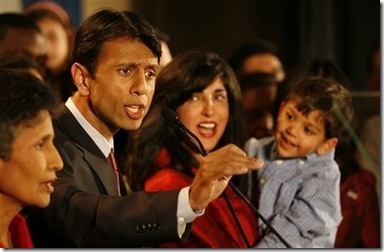
Bobby and Supriya Jindal
Bobby and Supriya Jindal: no teleprompter needed

UPDATE: Welcome visitors from the Anchoress! Thanks for the link! New visitors, please take a look around. My blog is 50% news and policy analysis, 50% defending Christianity in practical ways.

Found this recent blog post over at Governor Bobby Jindal’s blog. (H/T The Maritime Sentry).

Previously, I had blogged about his refusal to take bailout funds, his defense of Rush Limbaugh on CNN, and his plans for education reform in Louisiana.

In the new post, he talks about cutting spending and imposing more reporting and accountability on the government departments:

Our budget will decrease by 9.8 percent compared to last year’s budget, including a 12.7 percent decrease in state funds… We have asked agencies and departments across state government to provide meaningful performance data, so that we can target underperforming and out-of-date programs while protecting high performing programs from severe reductions.

He outlines specific measures to deal with the economic downturn:

School funding based on performance

First, are calling on the Board of Regents to implement a new funding formula that will reform higher education spending. While the current formula too often rewards enrollment alone and results in duplication, a new formula should reward performance, and, for example, encourage schools to target specific programs that will provide degrees in high demand professions – aligning funding with our state’s economic needs.

Eliminate unnecessary government departments

Next, we will create a Commission on Streamlining Government, whose mission will be to examine agencies and departments throughout state government to ensure that their roles and missions are still relevant today.

Improve efficiency of civil service

Third, we will work to reduce the size of state government by implementing civil service reforms that encourage state workers to do their jobs well – not just to reach tenure.

Facilitate future spending cuts

Dedicated funds will have to be just as transparent as discretionary funds, and will sunset every four years beginning in 2010. We will change the current laws so that discretionary funds can be cut up to 10 percent, whereas currently they can only be cut 5 percent, and to remove the two year limit on cutting these funds.

Improve transparency and accountability in education spending

Finally, we will reform the current MFP funding process for our state’s K-12 schools. As the MFP funds are given to school district as a block grant, there is not enough accountability for how the funds are spent. We will require that beginning in FY11 districts must fully account for how these dollars are spent, and the Department of Education will develop an easy to use website allowing taxpayers to see how their hard-earned dollars are being spent.

The post goes on to discuss other initiatives, such as increasing economic growth. And that is when you read this startling statement:

The retention and expansion of jobs has been a top priority of this administration, and we will continue working to expand our economy in the coming months and years. In December, we were the only state in the nation to add jobs, and in January, we were the only state in the nation whose unemployment rate when down and not up.

Sigh. Shouldn’t we have elected Bobby Jindal instead of Mr. Teleprompter-Reader?

To find out more about Bobby Jindal, check out these links:

Interview with Rush Limbaugh (PDF)
The American Spectator: Hope Floats on the Bayou
RedState.com: Bobby Jindal Saves Louisiana
Townhall.com: The Future of Conservatism (Isn’t Running for President)
The Weekly Standard: Another Winner from Winn Parish
The National Review: The Governor Is Right
The Wall Street Journal: Bayou Boy Wonder
Townhall.com: Want real hope and change? Try Louisiana