Along with all manner of dire and dreary budget data reflecting President Obama’s budget and economic policies to date, CBO provides its assessment of what would happen if the President and Congress sit on their respective hands and fail to defuse the threats of Taxmageddon and the fiscal cliff. The answer is fairly simple: recession.
As CBO so diplomatically put it, “such fiscal tightening will lead to economic conditions in 2013 that will probably be considered a recession.”
Taxmageddon is the $500 billion tax hike slated to take effect on January 1, while the fiscal cliff consists of Taxmageddon plus various spending reductions—among them the sequestration left over from the disastrous negotiations that led to the Budget Control Act in 2011.
According to CBO’s analysis, if Congress defuses Taxmageddon and the fiscal cliff, then the economy will grow at a tepid 1.7 percent in 2013 and the unemployment rate will remain stuck around 8 percent. But if President Obama and Congress play chicken with Taxmageddon and fail to act, then the economy will contract by about 0.5 percent and the unemployment rate will shoot up to 9.1 percent, about halfway back to the peak from the past recession.
Forget percentages—what does this mean in actual jobs lost if President Obama and Congress fail to act? It means roughly 1.6 million more Americans will be out of work—on top of the 12.8 million who already want to work but can’t find jobs.
Just about every relevant school of economics, from the President’s pure Keynesianism to supply-side and neoclassical persuasions, tells much the same tale on net: Raising tax rates on a weak economy produces a weaker economy. It’s not terribly complicated.
Here’s my advice: This time, let’s elect someone with someone with experience in business administration and economics.
The tax increases scheduled to take effect in January 2013 – dubbed Taxmageddon – could have the American people spending more days than ever working to pay for federal and state government, areport from the Tax Foundation shows.
A host of tax rates are scheduled to rise in January 2013 – when George W. Bush-era tax rates and the annual patch for the Alternative Minimum Tax expire – leading to a tax increase of approximately $500 billion in 2013, according to the conservative Heritage Foundation.
The Congressional Budget Office reported in January that taxes would increase by $4.6 trillion over ten years, if Congress allows the rates to rise as scheduled at the end of this year.
Tax Foundation economist William McBride estimated that this historic tax increase would push Tax Freedom Day to its latest point ever.
Tax Freedom Day is the day when – theoretically – Americans begin working for themselves and can stop paying for government. It assumes that 100 percent of a person’s wages go to paying for federal and state tax burdens. The day when government operations are fully paid for is Tax Freedom Day.
In 2012, Tax Freedom Day was April 17. However, Taxmageddon may push it until the end of April or beyond, McBride reported in a blog post on the foundation’s website. At the federal level, the 2012 tax increases would add 11 days to the Tax Freedom Day calculation, pushing it to April 28.
Adding in rising state and local tax revenues could push Tax Freedom Day beyond its May 1 record.
The Taxmageddon provisions adding to the cost of government – measured in the days that Americans will spend paying for it – are as follows:
Bush tax rates – 2.6 days
Alternative Minimum Tax – 2.2 days
Small business tax cuts – 0.4 days
Corporate income tax – 3.4 days
Payroll tax cut – 2.5 days
Estate tax – 0.2 days
One of the problems with all of this voting for bigger government is that there is less money for people to make their marriages and families work. The more we vote for bigger government, the less we haves as individuals for our own plans, including our marriage and family plans.
Taking a pass on reining in government growth, President Obama unveiled a record $3.8 trillion election-year budget plan Monday, calling for stimulus-style spending on roads and schools and tax hikes on the wealthy to help pay the costs. The ideas landed with a thud on Capitol Hill.
Though the Pentagon and a number of Cabinet agencies would get squeezed, Obama would leave the spiraling growth of health care programs for the elderly and the poor largely unchecked. The plan claims $4 trillion in deficit savings over the coming decade, but most of it would be through tax increases Republicans oppose, lower war costs already in motion and budget cuts enacted last year in a debt pact with GOP lawmakers.
[…]By the administration’s reckoning, the deficit would drop to $901 billion next year – still requiring the government to borrow 24 cents of every dollar it spends – and would settle in the $600 billion-plus range by 2015.The deficit for the current budget year, which ends Sept. 30, would hit $1.3 trillion, a near record and the fourth straight year of trillion-plus red ink.
Obama’s budget blueprint reprises a long roster of prior proposals: raising taxes on couples making more than $250,000 a year; eliminating numerous tax breaks for oil and gas companies and approving a series of smaller tax and fee proposals. Similar proposals failed even when the Democrats controlled Congress.
The Pentagon would cut purchases of Navy ships and F-35 Joint Strike Fighters – and trim 100,000 troops from its rolls over coming years – while NASA would scrap two missions to Mars.
But there are spending increases, too: The Obama plan seeks $476 billion for transportation projects including roads, bridges and a much-criticized high-speed rail initiative.
Spending in the President’s budget rises inexorably from today’s $3.8 trillion to $5.8 trillion in 2022. Throughout the decade, outlays hold stubbornly above 22 percent of gross domestic product (GDP), more than twice the New Deal’s share of the economy in its peak years. In constant dollars, outlays are more than three times the peak of World War II.
In 2012, his budget results deliver a fourth consecutive annual deficit exceeding $1 trillion and then make it worse with another round of not-so-shovel-ready construction projects and government “investments” totaling $178 billion. Among these are the typical road, bridge, and school construction, but then they go alarmingly beyond the usual “infrastructure” arguments to fund teachers’ pay.
Obama’s future deficit reduction comes mainly from Budget Control Act cuts already in place, $848 billion in discredited phantom “savings” from the wind-down of operations in Iraq and Afghanistan, taking credit for reductions in 2011 appropriations, and roughly $1.8 trillion in unnecessary tax increases on those earning above $250,000 and the oil and gas industry.
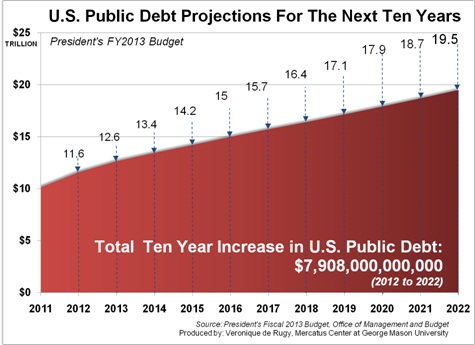
Yet even with the hefty tax increases and illusory savings, the President’s deficits over the next decade never fall below $575 billion (in 2018) and climb back to $704 billion (in 2022)—but again only assuming the tax increases and mystical savings cited above.
Debt held by the public in the President’s budget rises from 74.2 percent of GDP today to an economically hazardous 76.5 percent of GDP in 2022. These are historically high debt levels: the post–World War II average is just 43 percent. Moreover, the President’s debt estimates are low because of the unreal nature of much of his proposed deficit reduction.
Regarding the most critical fiscal challenge of the day—the need to restructure Medicare, Medicaid, and Social Security—the President has once again taken a pass. By the middle of this century, these three programs and Obamacare will consume about 18 percent of GDP, soaking up all the historical average of federal tax revenue. The notion of “protecting” them through benign neglect only ensures their collapse, and the longer Congress and the President wait to address the problem, the more wrenching will be the consequences. But the President merely reruns previous ideas, such as more cuts to medical providers, ignoring the need for fundamental reform.
For other entitlements, the President repeats a range of mere chipping-around-the-edges proposals from last year’s budget, many of which are really tax or fee increases, not spending reductions.
In short, the President’s budget is the same worn-out collection of higher spending and higher taxes he has offered three times before—with the same inevitable result of more spending, higher taxes, and still more government debt.
Here’s a Republican reaction from Senator Bob Corker:

 WINTERY KNIGHT