Tag Archives: 2012

Santorum and Gingrich expose Romney’s liberal record in Sunday’s NBC debate

Here’s a clip from the NBC debate on Sunday.

Here’s Rick Santorum on same-sex marriage:

You can watch the full video of the NBC debate here (70 minutes).

What about Mitt Romney?

Here’s an excellent ad by Newt explaining Mitt Romney’s record on tax hikes:

Mitt Romney has a net worth of $250 million dollars. He was born in a rich family and has no experience of what ordinary Americans are facing.

Romney has a pro-abortion record and pro-gay-marriage recordMitt Romney raised taxes by $740 million as governor of Massachusetts. He passed Romneycare in Massachusetts, which is substantially similar to Obamacare. Why is he running as a Republican? I don’t see anything in his record that would cause me to believe that he is a Republican.

You can see Mitt Romney explaining all of his liberal views in his own words in these videos.

Is Rick Santorum conservative or liberal? What are Rick Santorum’s political views?

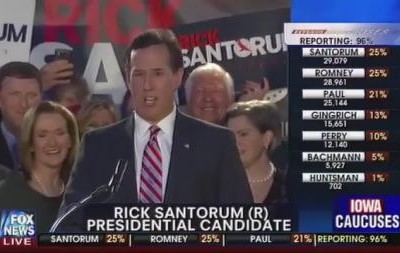
Rick Santorum Iowa Caucuses

Quin Hilyer explains, in the pro-Romney National Review, of all places.

Excerpt:

On taxes, for instance, Santorum has always been superb. The Club for Growth’s white paper on Santorum, calling his tax stances “very strong,” confirms that “Santorum has consistently supported broad-based tax cuts and opposed tax increases either by sponsoring key legislation or by casting votes on relevant bills.”

His record on a host of other conservative issues is as solid as that of any politician in the past two decades. He has been firmly and repeatedly against all sorts of regulatory abuse, against McCain-Feingold and other restrictions on political speech, for school choice, for tort reform, for a strong military, and for a balanced-budget amendment.

Obviously he has been as stalwart a defender of social conservatism, for 20 full years, as any other public figure. And as virtually every conservative involved in the judicial wars during Santorum’s time in the Senate has confirmed, in person or in print, Santorum and his staff were the go-to people in the Senate when you needed to find tireless, committed advocates for conservative jurists. Santorum is, wrote Ed Whelan of the Ethics and Public Policy Center, “the candidate in whom I have by far the greatest confidence” in terms of how likely he would be “to appoint excellent Supreme Court justices and lower-court judges and to work tenaciously to get them confirmed.”

Meanwhile, as Santorum frequently (and entirely accurately) reminds anybody who will listen, his work on the single most important conservative policy reform of the past half century, the 1996 welfare-to-work effort that cut spending and poverty rates simultaneously, was seminal, indefatigable, and remarkably effective. Iowa’s Sen. Chuck Grassley explained to the Des Moines Register a week ago that he was unconvinced about welfare reform until Santorum paid him an office call and “took a lot of time to convince me of his point of view… The sincerity and effort that he has to get his point across in the presidential campaign is almost a total reflection of how he operated as a United States senator.” Grassley yielded and voted for reform.

More broadly, until Rep. Paul Ryan’s recent prominence, nobody in Congress has been as passionate and fearless an advocate for entitlement reform as Santorum. Medicaid block grants. Investment accounts for Social Security. Medicare payments controlled by the beneficiaries rather than third-party payers. Choice rather than government mandates. Indeed, Santorum was the first candidate this year to fully embrace Ryan’s proposed reforms — with this exception, as he reminded me in a phone interview on Thursday: “I’ve criticized Ryan on one thing: waiting ten years [for many of the reforms to kick in]. We can’t afford to wait. We’ve got to start now.”

[…]As for overall spending and his much-discussed history of support for “earmarks” (a position also shared by tightwad Ron Paul), conservative groups’ ratings show that Santorum was better than the average Republican, despite representing a state far bluer than those of most of his Republican colleagues. He demonstrated particular courage in his support for the Freedom to Farm Act and in frequent opposition to floor amendments that would have put additional spending in appropriations bills. Denizens of Capitol Hill in the 1990s fondly remember Santorum’s repeated use of a prop during floor debate called the “Spendometer,” which he used to make a persuasive (and entertaining) case against wasteful federal largesse.

Out of office, he vociferously opposed TARP, the various “stimulus” packages, and the bailouts of car companies and of Fannie Mae and Freddie Mac. All those stances were perfectly in line with the voting record he had established in the House and Senate.

Evangelical Christian stalwart Gary Bauer is endorsing Rick Santorum.

Excerpt:

Social conservative leader and former presidential candidate Gary Bauer will endorse Rick Santorum in South Carolina, he confirmed to The Hill on Saturday.

Bauer said that he didn’t want to get into the details of the endorsement since it was officially still embargoed, but confirmed his support and said he’ll work to get other social conservatives on board for Santorum.

“I want to do whatever I can to convince my colleagues that Sen. Santorum is the right man,” he told The Hill.

[…]Bauer has organized a Friday meeting with top social conservatives in Texas to see if they can coalesce behind one candidate. He said the point of the meeting is not to try to stop Mitt Romney from being the Republican nominee, but that he believes Santorum would be the best candidate to beat President Obama, as well as the best commander in chief.

It’s worth remembering what Rick Santorum did to encourage critical thinking in public school science education, too. This is good news for us who want to have evidence for and against things like naturalistic macro-evolution and anthropogenic catastrophic global warming presented to students. That’s above and beyond the basics of conservatism, right there – and he’s solid on school choice.

The best thing about Santorum, though, is that he has a working class background and he isn’t afraid to debate with people instead of just speaking about his beliefs and generalities. He tries to convince people, and to reason things out with them.

Mitt Romney raised taxes by $740 million while he was governor of Massachusetts

Deroy Murdock explains in this Scripps Howard News Service article.

Excerpt:

Hot on the heels of his eight-vote Iowa-caucus landslide, Willard Mitt Romney is crisscrossing New Hampshire before Tuesday’s key primary. Romney is masquerading as a limited-government, free-market executive from next-door Massachusetts. From the Golden Gate to the Granite State, voters should greet Romney’s impersonation with a quarry full of skepticism.

In fact, Romney increased taxes by $309 million, mainly on corporations. These tax hikes, described by Romney apologists as “loophole closures,” totaled $128 million in 2003, $95.5 in 2004, and $85 million in 2005. That final year, Romney proposed $170 million in higher business taxes, the Boston Globe reports. However, the Bay State’s liberal, Democratic legislature balked and only approved an $85 million increase.

“Tax rates on many corporations almost doubled because of legislation supported by Romney,” Boston Science Corporation chairman Peter Nicholas explained in the January 6, 2008 Boston Herald. Also, Romney raised the tax on subchapter S corporations owned by business trusts from 5.3 percent to 9.9 percent — an 85 percent hike.

“Romney went further than any other governor in trying to wring money out of corporations,” the Council on State Taxation’s Joseph Crosby complained.

Romney also created or increased fees by $432 million. He was not dragooned into this by greedy Democratic lawmakers; Romney himself proposed these items. In 2003 alone, Romney concocted or boosted 88 fees. Romney charged more for marriage licenses (from $6 to $12), gun registrations (from $25 to $75), a used-car sales tax ($10 million), gasoline deliveries ($60 million), real-estate transfers ($175 million), and more. Particularly obnoxious was Romney’s $10 fee per Certificate of Blindness. Romney also billed blind people $15 each for discount-travel ID cards.

While Romney can take credit for a $275 million capital-gains tax rebate, property-tax relief for seniors, and a two-day, tax-free shopping holiday, he also must take responsibility for signing $740.5 million in higher taxes, plus that $85 million in business taxes that he requested and legislators rejected.

“Romney did not even fight higher death-tax rates,” notes former California State Assembly Minority Whip Steve Baldwin, a Romney critic. “When the (Massachusetts) legislature considered this issue, Romney’s official position was ‘no position.’ This echoed Barack Obama’s ‘present’ votes in the Illinois State Senate.”

As Romney drained his constituents’ pockets, the Public Policy Institute of New York’s Cost of Doing Business Index rated Massachusetts in 2006 as America’s fourth costliest state in which to practice free enterprise. The Tax Foundation dropped Massachusetts from America’s 29th most business-friendly state to No. 36. The Tax Foundation also calculated that, under Romney, Massachusetts’ per-capita tax burden increased from 9.3 percent to 9.9 percent. In real dollars, the Romney-era per-capita tax burden grew by $1,175.71.

As if impoverishing his own taxpayers were not bad enough, Romney’s March 5, 2003 signature raised taxes on non-residents retroactive to that January 1. Perpetrating taxation without representation, Romney’s law declared that, “gross income derived from… any trade or business, including any employment,” would be taxable, “regardless of the taxpayer’s residence or domicile in the year it is received.”

Consequently, according to data furnished by the Massachusetts Department of Revenue, between 2002 and 2006, New Hampshire residents who work or do business in the Bay State shipped Massachusetts $95 million above what they paid when Romney arrived. The average tax paid by New Hampshirities to Massachusetts grew by 19.1 percent, from $2,392 in 2002 to $2,850 in 2006.

Romney has a pro-abortion record and pro-gay-marriage record. Not only did he pass Romneycare in Massachusetts, but now we know that he also raised taxes. Why is he running as a Republican? I don’t see anything in his record that would cause me to believe that he is a Republican.

You can see Mitt Romney explaining all of his liberal views in his own words in these videos.