
Study: raising children without a father causes harm to the children

Lets take a closer look at a puzzle

I thought it might be a good idea to take a look at a recent research paper on father absence. My purpose in posting this study is to remind people to think about what children need when making relationship decisions. Fathers are more of a necessity for children than a nice-to-have.

The paper about a large-scale study was posted at NCBI NIH.

The abstract says:

The literature on father absence is frequently criticized for its use of cross-sectional data and methods that fail to take account of possible omitted variable bias and reverse causality. We review studies that have responded to this critique by employing a variety of innovative research designs to identify the causal effect of father absence, including studies using lagged dependent variable models, growth curve models, individual fixed effects models, sibling fixed effects models, natural experiments, and propensity score matching models. Our assessment is that studies using more rigorous designs continue to find negative effects of father absence on offspring well-being, although the magnitude of these effects is smaller than what is found using traditional cross-sectional designs. The evidence is strongest and most consistent for outcomes such as high school graduation, children’s social-emotional adjustment, and adult mental health.

I was curious to see what specific problems fatherlessness causes for children, according to this redo of previous studies.

The conclusion explains:

The body of knowledge about the causal effects of father absence on child well-being has grown during the early twenty-first century as researchers have increasingly adopted innovative methodological approaches to isolate causal effects. We reviewed 47 such articles and find that, on the whole, articles that take one of the more rigorous approaches to handling the problems of omitted variable bias and reverse causality continue to document negative effects of father absence on child well-being, though these effects are stronger during certain stages of the life course and for certain outcomes.

We find strong evidence that father absence negatively affects children’s social-emotional development, particularly by increasing externalizing behavior. These effects may be more pronounced if father absence occurs during early childhood than during middle childhood, and they may be more pronounced for boys than for girls. There is weaker evidence of an effect of father absence on children’s cognitive ability.

Effects on social-emotional development persist into adolescence, for which we find strong evidence that father absence increases adolescents’ risky behavior, such as smoking or early childbearing. The evidence of an effect on adolescent cognitive ability continues to be weaker, but we do find strong and consistent negative effects of father absence on high school graduation. The latter finding suggests that the effects on educational attainment operate by increasing problem behaviors rather than by impairing cognitive ability.

The research base examining the longer-term effects of father absence on adult outcomes is considerably smaller, but here too we see the strongest evidence for a causal effect on adult mental health, suggesting that the psychological harms of father absence experienced during childhood persist throughout the life course. The evidence that father absence affects adult economic or family outcomes is much weaker. A handful of studies find negative effects on employment in adulthood, but there is little consistent evidence of negative effects on marriage or divorce, on income or earnings, or on college education.

Despite the robust evidence that father absence affects social-emotional outcomes throughout the life course, these studies also clearly show a role for selection in the relationship between family structure and child outcomes. In general, estimates from IFE, SFE, and PSM models are smaller than those from conventional models that do not control for selection bias. Similarly, studies that compare parental death and divorce often find that even if both have significant effects on well-being, the estimates of the effect of divorce are larger than those of parental death, which can also be read as evidence of partial selection.

Right now, we’re living in a time where people think that it’s ok to do whatever they feel like doing. People seem to treat relationships as if they are meant to provide the grown-ups with satisfaction, and the needs of the children are often neglected. Any kind of warning or appeal to evidence is dismissed by those who want to bend and break the rules.

Well, when you take a look at the studies, you actually find that there are rules about how to go about relationships in order to achieve results. It seems to me that children’s needs ought to be an important consideration when making relationship decisions. Men shouldn’t have babies with bad mothers, and women shouldn’t have babies with bad fathers. It ought to be an important criterion for choosing a mate and conducting a relationship: are we making decisions protecting children and giving them what they need?

And it turns out that there are studies that tell you how to prepare for making a stable commitment, too. Like this one, which found that the number of premarital sex partners reduces relationship stability and quality. This is just an example, there are many more studies that provide a lot more information about how to do things right.

I think today, people want to make decisions about what to do based on feelings. If it feels good, do it. But this approach doesn’t work anywhere in life. It doesn’t work when choosing a major, when choosing a job, when choosing how to spend money. It just never works. Nothing useful is ever achieved by putting feelings above reason and evidence.

People shouldn’t be surprised when they break the rules and then get negative outcomes. It just takes a little reading first to find out what is likely to work and what isn’t. There are real victims to bad decisions. There are mistakes that can’t be fixed with happy talk and a positive attitude. We seem to have gotten addicted to the idea that every damaging mistake can be fixed by making everyone around say happy words about the mistake. But the truth is that when you make bad decisions, the damage exists independently of what people say about it.

It’s not the mean people making moral judgments that causes fatherless kids to have higher anxiety or be more violent or get pregnant earlier or abuse drugs. It’s the fatherlessness. The only hope that children have to avoid the consequences of bad decisions by parents is for the moral people to set boundaries and teach moral wisdom with evidence.
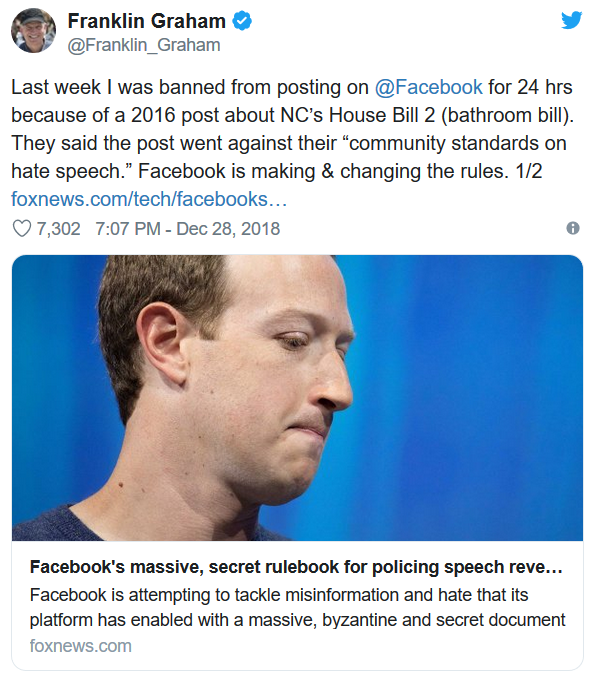

Facebook bans Franklin Graham for “hate speech”, Google YouTube shadow-bans pro-life videos

Facebook banned Franklin Graham for "hate speech"
Facebook banned Franklin Graham for posting “hate speech”

There were some really interesting stories of censorship by big technology on the weekend. First story is about famous Christian pastor and evangelist Franklin Graham, son of Billy Graham. Facebook didn’t like what he shared, so they decided to ban him from their platform.

The Washington Times reports:

The Rev. Franklin Graham was kicked off Facebook for defending North Carolina’s “bathroom bill,” which the social-media giant’s review team decided was hate speech.

Facebook acknowledged over the weekend it had banned the prominent evangelist over transgender issues and called the 24-hour ban a mistake that it had already undone. But Mr. Graham was having none of it Sunday, calling the move “a personal attack towards me” and an example of the censorship that Silicon Valley has in store for Christians and/or conservatives.

A spokesman for Facebook told the Charlotte Observer on condition of anonymity that the review team had decided a 2016 post violated rules against “dehumanizing language” and exclusion of people based on, among other things, sexual orientation and gender self-identification. The post was deleted and Mr. Graham prevented from using the service for 24 hours.

I was thinking about this story when another news story popped up, this one about a transgender woman (a biological man) who screamed obscenities and treatened violence against a male store clerk and a female customer at a GameStop store.

Here’s the video: (WARNING: AWFUL VULGAR LANGUAGE)

And the story was reported by Daily Wire:

The video starts with the trans individual cussing out the male GameStop clerk after being offered store credit rather than a refund.

“I don’t want credit, you’re going to give me my f***ing money back,” the customer yells.

A woman not in the view of the camera took issue with the trans person’s vulgar language.

“Excuse me, sir, there’s a young man in here — you need to watch your mouth,” she says in a calm voice.

The trans person instantly becomes aggressive, screaming, “Excuse me — it is ma’am! It is ma’am!”

“I’m sorry. I can call the police if you’d like me to. You need to settle down,” the woman responds, keeping her calm tone.

“You need to settle down!” the enraged customer screams back at her, pointing at her face. “You need to settle down and mind your business!”

The trans person then turns to the clerk: “Ma’am! Once again: ma’am!”

“I said, ‘both of you,'” contends the young employee.

“No, you said, ‘sir’; once again, it’s ma’am!” the trans person screams in response, before threatening to fight him. “Mother f***er! Take it outside! You wanna call me ‘sir’ again? I will show you a f***ing sir!”

The aggressive customer then kicks downs products in the store and walks toward the exit door, but then turns back around.

[…]”I plan on telling the entire LGBTQ community,” he tells the employee. “You’re going to lose money over this.”

Indeed, anyone who disagrees with the LGBTQ community will lose money over it. And maybe even their means of earning money, too. That’s the way things are going these days, and the big technology companies certainly agree with punishing the wicked for their “hate speech”.

Meanwhile, over at YouTube, which is owned by Google, pro-life videos are being shadow-banned, because a pro-abortion journalist complained that she didn’t like seeing pro-life material in her search results.

The Daily Wire reports:

After a reporter from the leftist site Slate contacted YouTube, complaining that search results when using the term “abortion” featured a plethora of videos that were anti-abortion, including some from the pro-life group Live Action and others featuring staunch pro-life advocate Daily Wire Editor-in-Chief Ben Shapiro, suddenly the platform reputedly reflected a change with more videos featured that were pro-abortion or simply not pro-life.

On December 23, Shapiro’s various videos were found behind at least 40 others; videos from Live Action, whose videos have garnered over 140 million views, were far beyond the 150th video to be seen.

April Glaser, writing for Slate, trumpeted her part in effecting the apparent change at YouTube. She started by comparing the results of conducting a search for “abortion” on Google as opposed to YouTube:

When you Google “abortion,” the top results are relatively staid considering the divisiveness of the topic in American life. There’s a link to information about the procedure from Planned Parenthood, a Google map of nearby abortion providers, a link to an overview of anti-abortion and pro-choice arguments from the nonpartisan procon.org, and links to various news sources like the New York Times and the New Yorker.

Glaser writes that she emailed YouTube on December 14 complaining about the search results, and voila! She wrote on December 21, “By the end of this week, the top results (which are dynamic) included a news segment in Tamil, a video in which the director Penny Marshall (who died this week) ‘Opens Up on Drugs and Her Abortion,’ and a clip of an anti-abortion advocate responding to the abortion-legalization law passed in Ireland. Anti-abortion content meant to enrage or provoke viewers was no longer purely dominating the results, though they still looked very different from the generally more sober Google results.”

So, if you’re wondering how the big Silicon Valley / Seattle technology companies work, it’s simple. If you disagree with their far-left socially progressive agenda, then they either ban you outright, or they drop your content down in their search results.

Google’s censorship of Wintery Knight

In my own case, the number of Google search referrals from this blog has dropped 90% since Google lost the 2016 election to Trump. That’s when Google decided to get serious about censoring my content and dropping it in their search results. Once upon a time, Google would send me 1000 search referrals for every 1 sent by DuckDuckGo. But now, DuckDuckGo is sending me more search referrals than Google. If I search for keywords I’ve written about, my results are far, far back in Google’s search results. But on Duck Duck Go, my blog is usually in the top 10. My friends have verified this.

If you haven’t tried DuckDuckGo, please give it a try, and switch. They are now using Bing for maps, and Yelp for store reviews. The search results are more accurate than Google’s biased results.

William Lane Craig debates Walter Sinnott-Armstrong: evil, suffering and God

Two bears fight it out, and may the best bear win!

This is one of the top 4 best debates that William Lane Craig has done in my opinion. (The other three are Craig-Millican debate and the first and second Craig-Dacey debates).

Sinnott-Armstrong is very courteous, respectful and intelligent scholar and he is very good at defending his side. This is a very cordial and engaging debate, and because it was held in front of a church audience, it was targeted to laymen and not academics. So if you are looking for a good first debate to watch, this is it! Normally, Dr. Craig debates at major universities in front of students and faculty.

There is also a book based on this debate, published by Oxford University Press. I was actually able to find a PDF of it online. I should also remind people that you can get the wonderful Craig-Hitchens debate DVD from Amazon.com if you are looking for a debate to watch, or show in your church, this is the one to start with.

The debaters:

The format:

  • WSA: 15 minutes
  • WLC: 15 minutes
  • Debaters discussion: 6 minutes
  • Moderated discussion: 10 minutes
  • Audience Q&A: 18 minutes
  • WSA: 5 minutes
  • WLC: 5 minutes

SUMMARY:

WSA opening speech:

Evil is incompatible with the concept of God (three features all-powerful, all-god, all-knowing)

God’s additional attributes: eternal, effective and personal (a person)

He will be debating against the Christian God in this debate, specifically

Contention: no being has all of the three features of the concept of God

His argument: is not a deductive argument, but an inductive/probabilistic argument

Examples of pointless, unjustified suffering: a sick child who dies, earthquakes, famines

The inductive argument from evil:

  1.  If there were an all-powerful and all-good God, then there would not be any evil in the world unless that evil is logically necessary for some adequately compensating good.
  2.  There is evil in the world.
  3.  Some of that evil is not logically necessary for some adequately compensating good.
  4. Therefore, there can’t be a God who is all-powerful and all-good.

Defining terms:

  • Evil: anything that all rational people avoid for themselves, unless they have some adequate reason to want that evil for themselves (e.g. – pain, disability, death)
  • Adequate reason: some evils do have an adequate reason, like going to the dentist – you avoid a worse evil by having a filling

God could prevent tooth decay with no pain

God can even change the laws of physics in order to make people not suffer

Responses by Christians:

  • Evil as a punishment for sin: but evil is not distributed in accordance with sin, like babies
  • Children who suffer will go straight to Heaven: but it would be better to go to Heaven and not suffer
  • Free will: this response doesn’t account for natural evil, like disease, earthquakes, lightning
  • Character formation theodicy: there are other ways for God to form character, by showing movies
  • Character formation theodicy: it’s not fair to let X suffer so that Y will know God
  • God allows evil to turn people towards him: God would be an egomaniac to do that
  • We are not in a position to know that any particular evil is pointless: if we don’t see a reason then there is no reason
  • Inductive evil is minor compared to the evidences for God: arguments for a Creator do not prove that God is good

WLC opening speech:

Summarizing Walter’s argument

  1. If God exists, gratuitous evil does not exist.
  2. Gratuitous evil exists.
  3. Therefore, God does not exist.

Gratuitous evil means evil that God has no morally sufficient reason to permit. WSA doesn’t think that all evil is incompatible with God’s existence, just gratuitous evil.

Everyone admits that there are instances of evil and suffering such that we cannot see the morally sufficient reason why God would allow it to occur.

The claim of the atheist is that if they cannot see that there is a moral justification for allowing some instance evil, then there is no moral justification for that instance of evil.

Here are three reasons why we should not expect to know the morally sufficient reasons why God permits apparently pointless evil.

  1. the ripple effect: the morally sufficient reason for allowing some instance of evil may only be seen in another place or another time
  2. Three Christian doctrines undermine the claim that specific evils really are gratuitous
  3. Walter’s own premise 1 allows us to argue for God’s existence, which means that evil is not gratuitous

Christian doctrines from 2.:

  • The purpose of life is not happiness, and it is not God’s job to make us happy – we are here to know God. Many evils are gratuitous if we are concerned about being happy, but they are not gratuitous for producing the knowledge of God. What WSA has to show is that God could reduce the amount of suffering in the world while still retaining the same amount of knowledge of God’s existence and character.
  • Man is in rebellion, and many of the evils we see are caused by humans misusing their free will to harm others and cause suffering
  • For those who accept Christ, suffering is redeemed by eternal life with God, which is a benefit that far outweighs any sufferings and evils we experience in our earthly lives

Arguing for God in 3.

  1. If God exists, gratuitous evil does not exist.
  2. God exists
  3. Therefore, gratuitous evil does not exist.

Four reasons to think that God exists (premise 2 from above):

  • the kalam cosmological argument
  • the fine-tuning argument
  • the moral argument
  • the argument from evil