The kalam cosmological argument defended in a peer-reviewed science journal

Christianity and the progress of science

Here’s the peer-reviewed article. It appears in a scientific journal focused on astrophysics.

Here’s the abstract:

Both cosmology and philosophy trace their roots to the wonder felt by the ancient Greeks as they contemplated the universe. The ultimate question remains why the universe exists rather than nothing. This question led Leibniz to postulate the existence of a metaphysically necessary being, which he identified as God. Leibniz’s critics, however, disputed this identification, claiming that the space-time universe itself may be the metaphysically necessary being. The discovery during this century that the universe began to exist, however, calls into question the universe’s status as metaphysically necessary, since any necessary being must be eternal in its existence. Although various cosmogonic models claiming to avert the beginning of the universe predicted by the standard model have been and continue to be offered, no model involving an eternal universe has proved as plausible as the standard model. Unless we are to assert that the universe simply sprang into being uncaused out of nothing, we are thus led to Leibniz’s conclusion. Several objections to inferring a supernatural cause of the origin of the universe are considered and found to be unsound.

The whole text of the article is posted online here.

Here’s an excerpt in which the author, Dr. William Lane Craig, explains the Big Bang cosmology:

The monumental significance of the Friedman-Lemaitre model lay in its historization of the universe. As one commentator has remarked, up to this time the idea of the expansion of the universe “was absolutely beyond comprehension. Throughout all of human history the universe was regarded as fixed and immutable and the idea that it might actually be changing was inconceivable.”{8} But if the Friedman-Lemaitre model were correct, the universe could no longer be adequately treated as a static entity existing, in effect, timelessly. Rather the universe has a history, and time will not be matter of indifference for our investigation of the cosmos. In 1929 Edwin Hubble’s measurements of the red-shift in the optical spectra of light from distant galaxies,{9} which was taken to indicate a universal recessional motion of the light sources in the line of sight, provided a dramatic verification of the Friedman-Lemaitre model. Incredibly, what Hubble had discovered was the isotropic expansion of the universe predicted by Friedman and Lemaitre. It marked a veritable turning point in the history of science. “Of all the great predictions that science has ever made over the centuries,” exclaims John Wheeler, “was there ever one greater than this, to predict, and predict correctly, and predict against all expectation a phenomenon so fantastic as the expansion of the universe?”{10}

As a GTR-based theory, the Friedman-Lemaitre model does not describe the expansion of the material content of the universe into a pre-existing, empty, Newtonian space, but rather the expansion of space itself. This has the astonishing implication that as one reverses the expansion and extrapolates back in time, space-time curvature becomes progressively greater until one finally arrives at a singular state at which space-time curvature becomes infinite. This state therefore constitutes an edge or boundary to space-time itself. P. C. W. Davies comments,

An initial cosmological singularity . . . forms a past temporal extremity to the universe. We cannot continue physical reasoning, or even the concept of spacetime, through such an extremity. . . . On this view the big bang represents the creation event; the creation not only of all the matter and energy in the universe, but also of spacetime itself.{11}

The popular expression “Big Bang,” originally a derisive term coined by Fred Hoyle to characterize the beginning of the universe predicted by the Friedman-Lemaitre model, is thus potentially misleading, since the expansion cannot be visualized from the outside (there being no “outside,” just as there is no “before” with respect to the Big Bang).{12}

The standard Big Bang model thus describes a universe which is not eternal in the past, but which came into being a finite time ago. Moreover,–and this deserves underscoring–the origin it posits is an absolute origin ex nihilo. For not only all matter and energy, but space and time themselves come into being at the initial cosmological singularity. As Barrow and Tipler emphasize, “At this singularity, space and time came into existence; literally nothing existed before the singularity, so, if the Universe originated at such a singularity, we would truly have a creation ex nihilo.“{13}

[…]On such a model the universe originates ex nihilo in the sense that at the initial singularity it is true that There is no earlier space-time point or it is false that Something existed prior to the singularity.

Every theist should be able to understand and defend this argument. It is a scientific refutation of materialism, and it is supported by six lines of scientific evidence – all of which emerged as science has progressed.

Scientific evidence:

  1. Einstein’s theory of general relativity (GTR)
  2. the red-shifting of light from distant galaxies implies an expanding universe
  3. the cosmic background radiation (which also disproves the oscillating model of the universe)
  4. the second law of thermodynamics applied to star formation theory
  5. hydrogen-helium abundance predictions
  6. radioactive element abundance predictions

Those are the scientific discoveries that have led us to the beginning of the universe, which support’s Dr. Craig’s argument.

This is the kind of evidence I expect all Christian theists to be using when discussing the question of whether God exists. Scientific evidence. When talking to non-Christians, we first need to show that we understand science, because science is a reliable and respected way of getting knowledge about the universe. Non-Christians do not accept the Bible, but they do accept science, so we begin evangelism with science. Science (experimental, testable, repeatable science) should set limits on what anyone can believe – including non-Christians, who might otherwise not be inclined to listen to Bible verses and theology. Important: it’s not a good idea to discuss the resurrection of Jesus with a person who does not accept the scientific evidence for a Creator of the universe.

A helpful short video:

The Big Bang is not compatible with atheism

According to the Secular Humanist Manifesto, atheism is committed to an eternally existing universe, (See the first item: “Religious humanists regard the universe as self-existing and not created.”). If something non-material brought all existing matter into being, that would be a supernatural cause, and atheists deny that anything supernatural exists. The standard Big Bang theory requires that all the matter in the universe come into being out of nothing. This falsifies eternal models of the universe, which are required by the atheistic worldview.
Marine Captain earned Medal of Honor fighting communists in North Korea

First, let’s go from the top down to set the context for the profile of William E. Barber.

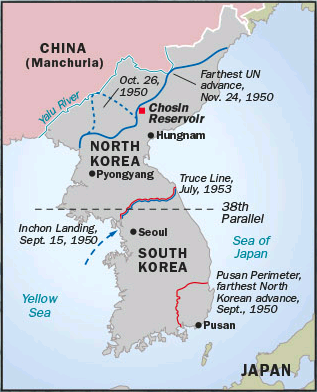
Map of the Korean War

In the summer of 1950, North Korean communists launch a completely unprovoked attack across the 38th parallel against their peaceful, democratic neighbors, the South Koreans. The Americans immediately sent an invasion force by sea to drive them out. The North Koreans easily manage to take over the capital Seoul, and the allies are left with only one port in the southeast – Pusan. In September of 1950, American forces land an invasion force at Inchon, cutting off the North Korean invasion force surrounding Pusan. The North Koreans retreat, and there is hope that American forces will be home by Christmas. But then, unbeknownst to the Americans, the Chines communists  invade North Korea from the north and surround the American forces near the Chosin reservoir, threatening to annihilate an entire Marine division.

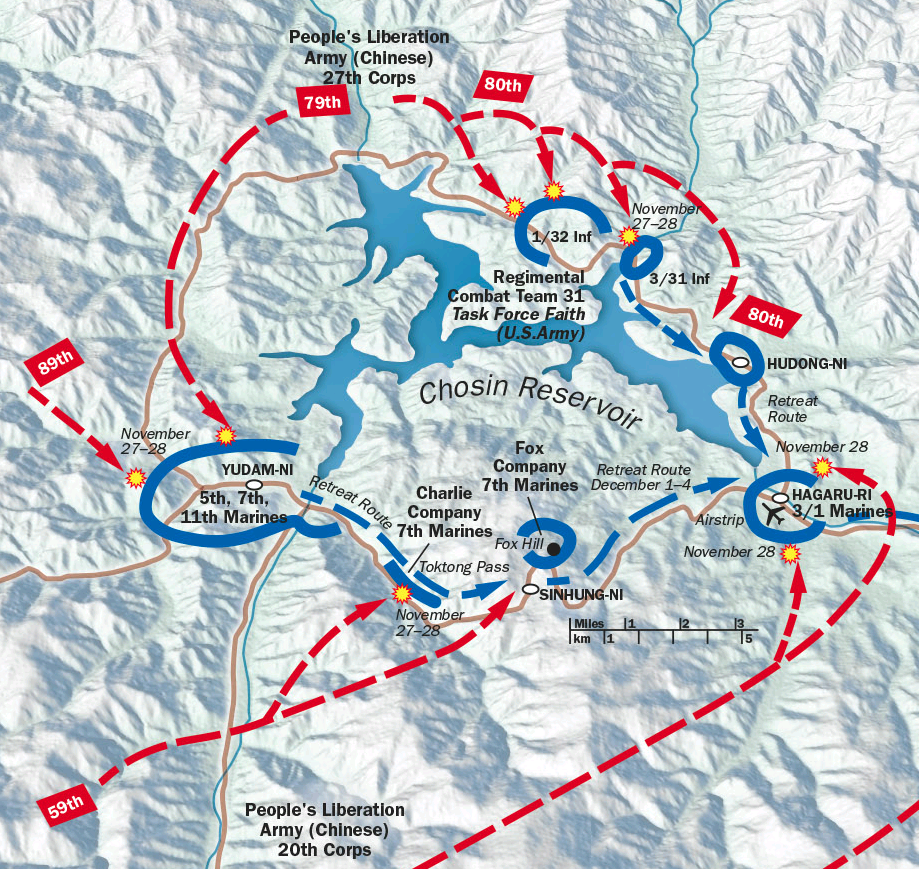
The Marines at Yudam-Ni are surrounded and must retreat to Hagaru-Ri

As you can see from the map, there are a whole bunch of American troops fighting to the north/east and south/west of the Chosin Reservoir. The marines near Yudam-Ni need to retreat along a road called the MSR (main supply road) back to Hagaru-Ri. But in order to conduct that retreat, they have to hold onto the vital Toktong pass, which is overwatched by Fox company from their position on Fox Hill. Can Charlie company and Fox company hold off the entire Chinese 59th division (10,000 men) with only two companies (about 250 men each)?

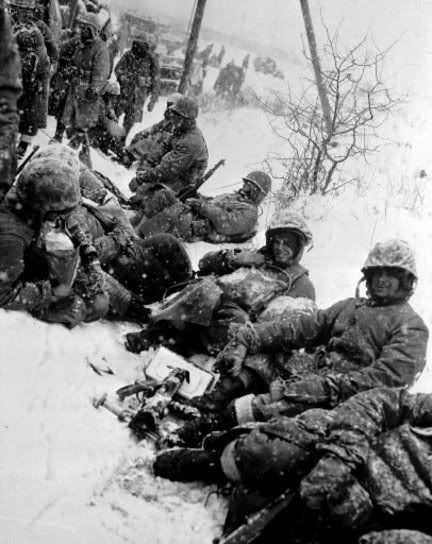
U.S. Marines "The Chosin Few", December 1950
U.S. Marines “The Chosin Few”, December 1950

Well, the book I read (which Dina gave me for Christmas), was about Fox company and their defense of the Toktong pass. This is what the leftist New York Times had to say about the man in charge of Fox company (“F company”) in a 2002 article:

Col. William E. Barber, who won the Medal of Honor for his leadership of a vastly outnumbered company under siege on a snowy hilltop in one of the worst defeats in Marine history, the Battle of the Chosin Reservoir in 1950, died on April 19 at his home in Irvine, Calif. He was 82.

The cause was bone-marrow cancer, said Jerry Courtier, a friend who hopes to write Colonel Barber’s biography.

The reservoir is south of the Yalu River, which separates North Korea from China. After the Americans had pushed the North Koreans almost to the Yalu, 150,000 Chinese troops unexpectedly crossed the river into North Korea. Colonel Barber’s unit, Company F of the Second Battalion of the Seventh Marines, First Marine Division, was on a hill that commanded the Toktong Pass, a vital gap between Yudam Ni and Hagaru Ri, two towns separated by 78 miles.

The stakes were huge. If F Company yielded its position, 8,000 marines at Yudam Ni would be cut off from the 3,000 at Haguru Ri by tens of thousands of Chinese troops.

Through five days and six nights in subzero weather and often swirling snow, Colonel Barber, then a captain, inspired his men, outnumbered more than five to one, to cling to their tenuous positions. He was shot in a bone near his groin on the second day but continued to make the rounds of the hill. He likened the wound to a bee sting.

When the unit was ordered to withdraw and fight its way to safety, Captain Barber refused. Three times, the enemy broke through the line, only to be repulsed.

”I knew that we could probably hold, and I knew that if we didn’t hold we could exact a very heavy toll,” he said in an interview in 1976 with The Los Angeles Times.

His citation for the nation’s top medal said that he commanded his men from a stretcher. But Hector A. Cafferata Jr., who as a rifleman won the Medal of Honor in the same battle, insisted that Captain Barber refused the stretcher.

”He walked the line, he kept us together,” said Mr. Cafferata, who was beside Captain Barber when he was shot.

In the mayhem, the Chinese blew whistles, beat cymbals and tooted bugles as they repeatedly attacked. Coffee froze before men could drink it, and some of the wounded died because plasma froze with no way to thaw it.

When the battle was over, more than 1,000 enemy soldiers were dead. Of Captain Barber’s original 240 men, 82 were able to walk away.

Gen. Raymond G. Davis, who was a lieutenant colonel in the Marines, received a Medal of Honor for leading the unit that rescued F Company.

William Earl Barber was born on Nov. 30, 1919, in Dehart, Ky. He attended what is now Morehead State University in Morehead, Ky., for two years and enlisted in the Marines, at the age of 21, in 1940.

He was so good at shooting a rifle that he was made a weapons instructor. After volunteering for parachute training, he demonstrated such proficiency that he became a parachute instructor.

In World War II, he was promoted to sergeant in 1942 and commissioned a second lieutenant in 1943. He was a rifle platoon commander at Camp Pendleton, Calif., when his unit was shipped to the Pacific.

Colonel Barber was in the first wave to hit Iwo Jima, where he was wounded twice. He received the Silver Star for bravery in addition to two Purple Hearts. At a ceremony on the 50th anniversary of the battle in 1995, he said:

”I am older now, as you are, but I can still see the colors of that February morning. The sky. The island. And sometimes I think I can hear the noise of battle.”

He was treated in Japan for his wounds and returned to the United States, where he worked as a recruiter, among other positions. He was promoted to captain in 1949 and was in the force that occupied Japan.

When he joined F Company in Korea, he saw a raggedy unshaven bunch and immediately ordered the the troops to shave, shine their shoes and look like marines. He suggested that his new charges resembled Pancho Villa’s bandits.

”He was one tough guy,” Mr. Cafferata said. ”He was by the book.”

He was by the book. He enlisted in the Marines because he was grateful to his country for allowing him to escape poverty and go into college, and he wanted to give something back.

You can read a review of the book I read about Fox company, and read about some of the details of what it was like for those men. You’ll never look at your own troubles the same way again. You can also read about Barber’s Medal of Honor citation here.

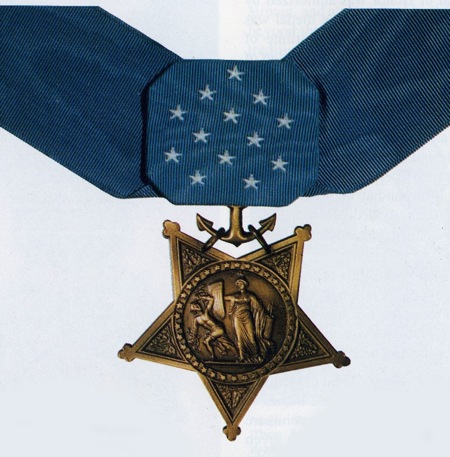
The Medal of Honor, Navy and Marines variant

So, now that I am done with that book, I have moved on to another Korean War book that Dina gave me, this one about George company. The Korean War might have been our most just war – defending a peaceful democratic ally from a totalitarian communist regime. You just have to compare North Korea and South Korea today to understand the stakes. North Korea is basically a godless concentration camp that tortures and murders its people if they so much as think the wrong thoughts about the atheist state. South Korea is free and prosperous, where the people have human rights, like the right to free speech and freedom of religion.

It’s important for me to read about the hardships that real heroes face, so that I don’t complain too much about my own tiny struggles. When you read about the struggles of great American soldiers, so many good things happen to you. Your own problems get smaller, your humility and gratitude get bigger. And you are reminded about why America is a great country, and what American character is really like. These things are not taught by leftists in the public schools. They are not talked about by leftists in the mainstream media. They are not presented by leftists in the Hollywood film industry. If you want to know the real America, you have to find it yourself.

Why I admire people in the armed forces more than famous entertainers

I’ve noticed that many Christians can tell me a lot about famous entertainers. It doesn’t matter if it’s singers, musicians, actors, athletes, etc., they seem to know details of their biographies, achievements, etc. And it doesn’t really matter if those people are Christians, or whether they have performed actions consistent with a Christian worldview in their private lives.

Anyway, speaking for myself, I mostly admire two kinds of people. The first kind is the kind I blog about here all the time: Christian scholars engage non-Christians intellectually using logic and evidence. The second kind, as you can tell from my reading list, is people who distinguish themselves in conflict with those who oppose the principles and policies that allow me to live out my Christian life. And I am especially interested when people who are fighting evil (imperialists, Nazis, socialists, communists, leftists, etc.) exhibit Christ-like character in risking their lives to save others, or in giving their lives to save others.

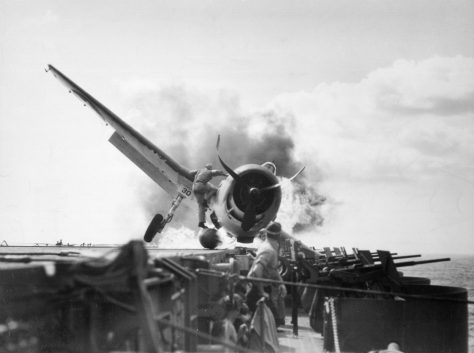
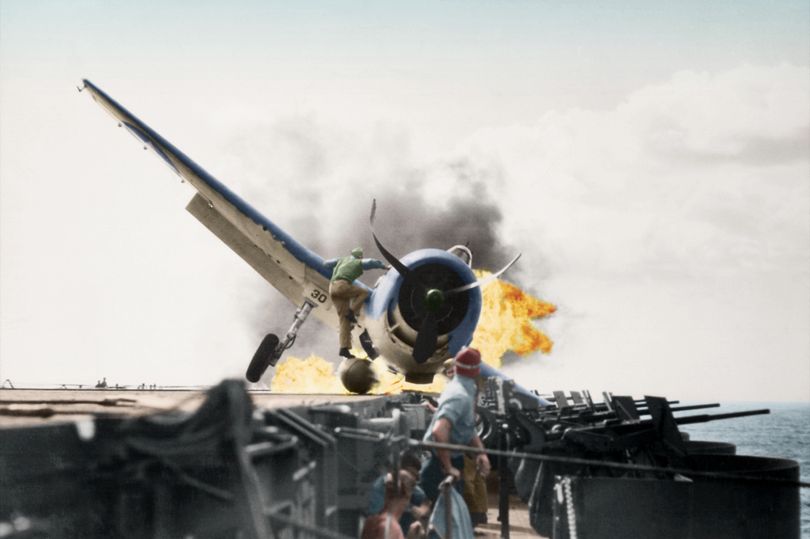
Lt. Walt Chewning charges unto burning F-6F Hellcat to save trapped pilot

Anyway, today is November 10th, so I have a war story to tell you that happened on November 10th, 1943.

Lieutenant (later Lieutenant Commander) Walter Lewis Chewning of Cynwyd, Pennsylvania, steps on the burning fuel tank of an F6F-3 Hellcat flown by Ensign (later Lieutenant) Byron Milton Johnson of Potter, Nebraska to effect a successful rescue of the pilot on November 10, 1943. Johnson had flown out to USS Enterprise from Barbers Point, Hawaii, enroute to Makin Atoll in the Gilberts to support the United States Army invasion, which occurred on November 20, 1943. The afternoon of November 10, Johnson took off in F6F Hellcat Number 30 for a routine training exercise. He immediately developed engine trouble and requested an emergency landing. He was waved off three times as he struggled to maintain control, but his tail hook caught the third arresting gear wire, and Johnson’s Hellcat was slammed into the deck, coming to rest in the port catwalk. The plane came to rest on its external belly fuel tank, which started to leak. As the engine vibrated horribly as the propeller bent itself on the deck, sparks ignited the fuel. The hard landing had jammed Johnson’s canopy closed, shearing the retaining pin; he could not exit the plane. Chewning, who had joined the ship October 2, 1943 as Enterprise new catapult officer, scrambled out of the catwalk and came through the smoke. Stepping on the burning belly tank, he forced open the canopy and pulled Johnson to safety.

He received the two highest non-combat medals available:

Chewning was awarded the Navy and Marine Corps Medal for his actions.

He was a well-educated and accomplished person before joining the Navy:

Chewning played soccer and Lacrosse at Cornell while studying Mechanical Engineering, breaking his rib and left ankle in one game. He graduated in 1936 and studied at the Massachusetts Institute of Technology before joining the Navy in January 1941. He was the assistant to the Chief Engineer at the Naval Aircraft Factory in Philadelphia, Pennsylvania before joining USS Enterprise. He served as Enterprise’s catapult officer until December 1944, when he transferred to Dutch Harbor Naval Air Station in Alaska as ordinance officer. Chewning served in the Navy until December 1949; he also was awarded the Bronze Star. After the war he assisted research and development for various aeronautical companies, the United States Air Force, and the fledgling National Aeronautics and Space Administration. Motion picture film of the crash, taken from Enterprise’s bridge, was shown as part of the television program “Victory at Sea” on January 25, 1953. Chewning and Johnson gave interviews to several newspapers about the accident after the program aired.

You can see a video clip of the rescue here, from 5:35 to 6:00. I found a colorized version of the picture above here:

Lt. Walt Chewning charges unto burning F-6F Hellcat to save trapped pilot

This image was colourized from the original by Paul Reynolds.

What I thought was interesting about Chewning was how he had everything going for him in terms of his education and career, but he chose to join the Navy anyway, in order to defend his country from Japanese imperialism. Those who understand how the Japanese treated prisoners and conquered peoples will know which side of that conflict was good, and which side was evil. Chewning wasn’t some sort of loser who took risks for fun and thrills. It had to be a risk where the prize was worth the risk. And he had the humility to consider others better than himself, so that their life was worth the risking of his own. Many people on the secular left who like to talk about how generous, compassionate and virtuous they are are unable to make moral judgments against evils like Japanese imperialism – much less take self-sacrificial action against them.

I just think that it’s important for young Christians to have the right kind of heroes. The heroes who are promoted to young Christians by the cultural elites are not usually the right role models. And there is a reason for that. The secular leftists don’t want young Christians to be emulating people who excel according to the standards of the Christian worldview. We are in a religion where self-sacrificial love is the centerpiece. Taking trouble on yourself for someone else. Doing your job, when it goes against your own self-interest. Let’s not allow a bunch of godless socialist celebrities to pick and choose who we hold in high regard.