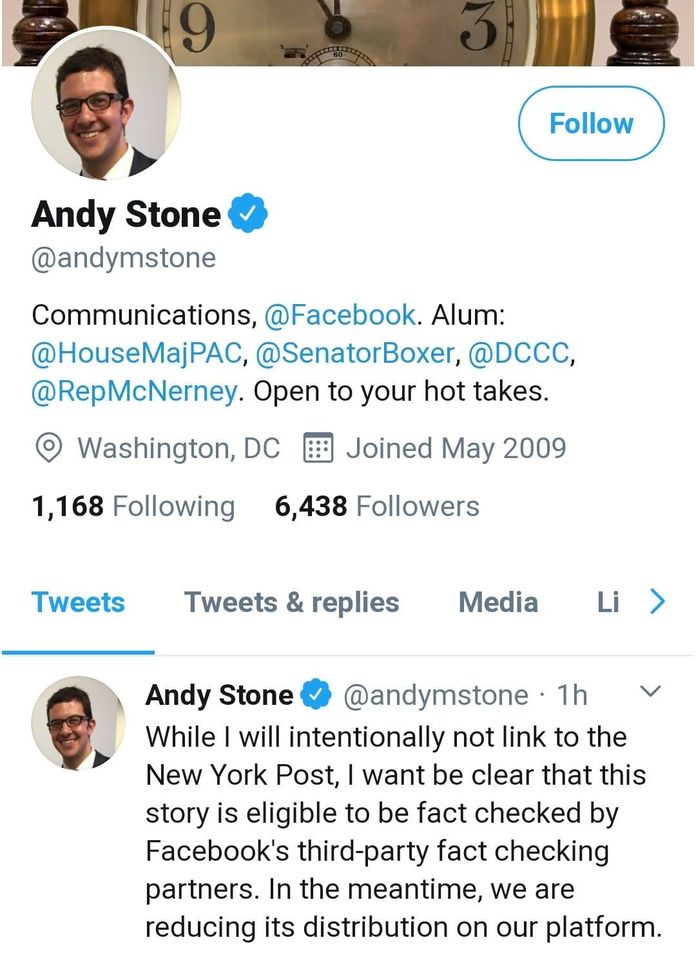
Facebook communications manager works for Democrat politicians and PACs
There was a very exciting story that emerged on Wednesday about the Democrat candidate for President. The story exposed an email that directly falsified something that the Democrat candidate for President said during a debate. Facebook decided to reduce distribution of the story, before they even did a fact check on it. Later on Twitter also blocked the story, because it’s
On Wednesday, the New York Post published a bombshell report indicating that Democratic presidential candidate Joe Biden repeatedly lied about never discussing his son Hunter Biden’s potentially criminal overseas business venture with him “or with anyone else” while Joe Biden was vice president.
Emails obtained by the Post, however, show correspondence between Ukrainian advisor Vadym Pozharskyi and Hunter proving that Hunter actually introduced Joe Biden to Pozharskyi.
“Thank you for inviting me to DC and giving me an opportunity to meet your father and spent [sic] some time together,” Pozharskyi wrote. At the time, Hunter Biden was raking in upwards of $50,000 a month in excess compensation for serving on the board of Burisma while his father served as the “public face” of White House policy towards Ukraine.
Less than a year later, as the Obama administration’s point person on Ukraine, Joe Biden pressured for the firing of the Ukrainian prosecutor investigating Hunter Biden’s firm.
The progressive mainstream news media ignored the story:
After legacy media completely ignored the major revelations in the Post story, with the New York Times, Washington Post, and CNN refusing to commit a single story to the bombshell report, Facebook and Twitter escalated the election interference by censoring the article.
And Facebook censored the story:
“While I will intentionally not link to the New York Post, I want be clear that this story is eligible to be fact checked by Facebook’s third-party fact checking partners,” wrote Facebook spokesperson and former Democratic staffer Andy Stone. “In the meantime, we are reducing its distribution on our platform.”
The Republicans are trying to make sure everyone can read it:
In response to big tech’s censorship Wednesday, House Judiciary Republicans re-published the New York Post’s piece on their website.
“We know Google tried to help Hillary Clinton win in 2016. And now Facebook and Twitter are trying to help Joe Biden win in 2020,” committee ranking member Jordan told The Federalist.
But that’s not all! Twitter also got in on the censoring of stories critical of the Democrat candidate for President.
Twitter suspended the New York Post’s account on Wednesday following its publication of a bombshell story indicating Hunter Biden monetized foreign companies’ access to his father, Joe Biden, while the latter was vice president. The emails come from a laptop left at a repair shop that appears to have belonged to Hunter Biden and is under FBI and Senate review.
Users are then directed to a page that claims the link is “potentially spammy or unsafe.”
The suspension comes after Twitter began blocking users from sharing or sending the article link on their platform. When unverified and verified users attempted to share the link, they were met with a message stating the link “has been identified by Twitter or our partners as being potentially harmful” and were directed to a page claiming the link could be “spammy or safe.”
Please share this post on social media, although you might get into trouble with the Big Tech fascists. Everything that makes the Democrats look bad is “false news” or “misleading” or “missing context”.
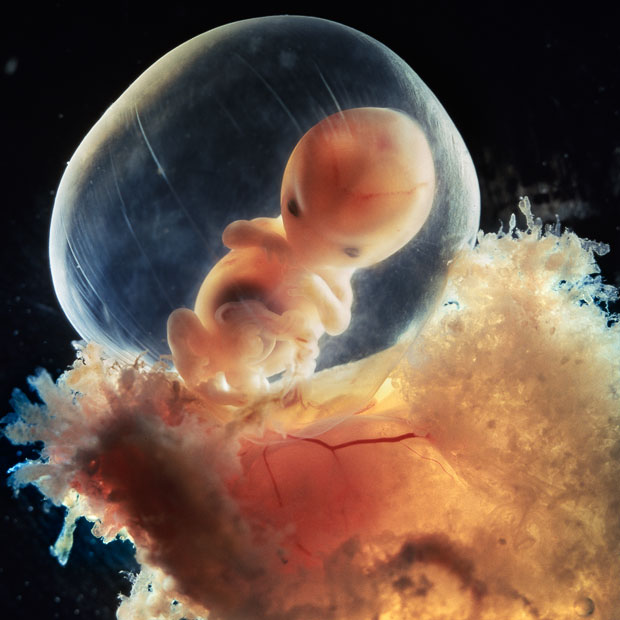
Was having a conversation by e-mail yesterday with a pro-abortion atheist, and he gave two reasons why he supported abortion in the first and second trimester. First, he said that unborn babies can’t feel pain, so it’s OK to kill them. Second, he said that unborn babies don’t have consciousness, so it’s OK to kill them. I thought it might be useful to link to something that answers both of these objections.
Frank Beckwith is the author of “Defending Life: A Moral and Legal Case Against Abortion Choice“, which was published by Cambridge University Press, a top academic press. But before Cambridge University Press, Beckwith wrote four easy-to-understand essays for the Christian Research Journal. Part IV is the one that has the response to the two questions raised by my atheist friend.
Some ethicists argue that the unborn becomes fully human sometime after brain development has begun, when it becomes sentient: capable of experiencing sensations such as pain. The reason for choosing sentience as the criterion is that a being that cannot experience anything (i.e., a presentient unborn entity) cannot be harmed. Of course, if this position is correct, then the unborn becomes fully human probably during the second trimester and at least by the third trimester. Therefore, one does not violate anyone’s rights when one aborts a nonsentient unborn entity. [13]
There are several problems with this argument. First, it confuses harm with hurt and the experience of harm with the reality of harm. [14] One can be harmed without experiencing the hurt that sometimes follows from that harm, and which we often mistake for the harm itself. For example, a temporarily comatose person who is suffocated to death “experiences no harm,” but he is nevertheless harmed. Hence, one does not have to experience harm, which is sometimes manifested in hurt, in order to be truly harmed.
Second, if sentience is the criterion of full humanness, then the reversibly comatose, the momentarily unconscious, and the sleeping would all have to be declared nonpersons. Like the presentient unborn, these individuals are all at the moment nonsentient though they have the natural inherent capacity to be sentient. Yet to countenance their executions would be morally reprehensible. Therefore, one cannot countenance the execution of some unborn entities simply because they are not currently sentient.
Someone may reply that while these objections make important points, there is a problem of false analogy in the second objection: the reversibly comatose, the momentarily unconscious, and the sleeping once functioned as sentient beings, though they are now in a temporary state of nonsentience. The presentient unborn, on the other hand, were never sentient. Hence, one is fully human if one was sentient “in the past” and will probably become sentient again in the future, but this cannot be said of the presentient unborn.
There are at least three problems with this response. First, to claim that a person can be sentient, become nonsentient, and then return to sentience is to assume there is some underlying personal unity to this individual that enables us to say that the person who has returned to sentience is the same person who was sentient prior to becoming nonsentient. But this would mean that sentience is not a necessary condition for personhood. (Neither is it a sufficient condition, for that matter, since nonhuman animals are sentient.) Consequently, it does not make sense to say that a person comes into existence when sentience arises, but it does make sense to say that a fully human entity is a person who has the natural inherent capacity to give rise to sentience. A presentient unborn human entity does have this capacity. Therefore, an ordinary unborn human entity is a person, and hence, fully human.
Second, Ray points out that this attempt to exclude many of the unborn from the class of the fully human is “ad hoc and counterintuitive.” He asks us to “consider the treatment of comatose patients. We would not discriminate against one merely for rarely or never having been sentient in the past while another otherwise comparable patient had been sentient….In such cases, potential counts for everything.” [15]
Third, why should sentience “in the past” be the decisive factor in deciding whether an entity is fully human when the presentient human being “is one with a natural, inherent capacity for performing personal acts?” [16] Since we have already seen that one does not have to experience harm in order to be harmed, it seems more consistent with our moral sensibilities to assert that what makes it wrong to kill the reversibly comatose, the sleeping, the momentarily unconscious, and the presentient unborn is that they all possess the natural inherent capacity to perform personal acts. And what makes it morally right to kill plants and to pull the plug on the respirator-dependent brain dead, who were sentient “in the past,” is that their deaths cannot deprive them of their natural inherent capacity to function as persons, since they do not possess such a capacity.
These four essays are a very good introduction to common responses to pro-abortion arguments. I recommend that people get familiar with this, as once you look into it, you will see that the abortion issue can be debated with as much confidence as William Lane Craig defends Christian theism. You will have the same access to scientific evidence and rational arguments on this topic, and so you will have the upper hand. And that’s fun.
Sherlock Holmes and John Watson: let’s take a look at the facts
I thought it might be a good idea to write something about whether the Bible is generally reliable as a historical document. Lots of people like to nitpick about things that are difficult to verify, but the strange thing is that even skeptical historians accept many of the core narratives found in the Bible. Let’s start with a Christian historian, then go to a non-Christian one.
Dr. Wallace… is a member of the Society of New Testament Studies, the Institute for Biblical Research, the Society of Biblical Literature, the American Society of Papyrologists, and the Evangelical Theological Society (of which he was president in 2016). He has been a consultant for several Bible translations. He has written, edited, or contributed to more than three dozen books, and has published articles in New Testament Studies, Novum Testamentum, Biblica, Westminster Theological Journal, Bulletin of Biblical Review, the Journal of the Evangelical Theological Society, and several other peer-reviewed journals. His Exegetical Syntax of the New Testament is the standard intermediate Greek grammar and has been translated into more than a half-dozen languages.
Here is an article by Dr. Wallace that corrects misconceptions about the transmission and translation of the Testament.
He lists five in particular:
Myth 1: The Bible has been translated so many times we can’t possibly get back to the original.
Myth 2: Words in red indicate the exact words spoken by Jesus of Nazareth.
Myth 3: Heretics have severely corrupted the text.
Myth 4: Orthodox scribes have severely corrupted the text.
Myth 5: The deity of Christ was invented by emperor Constantine.
Let’s look at #4 in particular, where the argument is that the text of the New Testament is so riddled with errors that we can’t get back to the original text.
It says:
Myth 4: Orthodox scribes have severely corrupted the text.
This is the opposite of myth #3. It finds its most scholarly affirmation in the writings of Dr. Bart Ehrman, chiefly The Orthodox Corruption of Scripture and Misquoting Jesus. Others have followed in his train, but they have gone far beyond what even he claims. For example, a very popular book among British Muslims (The History of the Qur’anic Text from Revelation to Compilation: a Comparative Study with the Old and New Testaments by M. M. Al-Azami) makes this claim:
The Orthodox Church, being the sect which eventually established supremacy over all the others, stood in fervent opposition to various ideas ([a.k.a.] ‘heresies’) which were in circulation. These included Adoptionism (the notion that Jesus was not God, but a man); Docetism (the opposite view, that he was God and not man); and Separationism (that the divine and human elements of Jesus Christ were two separate beings). In each case this sect, the one that would rise to become the Orthodox Church, deliberately corrupted the Scriptures so as to reflect its own theological visions of Christ, while demolishing that of all rival sects.”
This is a gross misrepresentation of the facts. Even Ehrman admitted in the appendix to Misquoting Jesus, “Essential Christian beliefs are not affected by textual variants in the manuscript tradition of the New Testament.” The extent to which, the reasons for which, and the nature of which the orthodox scribes corrupted the New Testament has been overblown. And the fact that such readings can be detected by comparison with the readings of other ancient manuscripts indicates that the fingerprints of the original text are still to be seen in the extant manuscripts.
Here is the full quote from the appendix of Misquoting Jesus:
“Bruce Metzger is one of the great scholars of modern times, and I dedicated the book to him because he was both my inspiration for going into textual criticism and the person who trained me in the field. I have nothing but respect and admiration for him. And even though we may disagree on important religious questions – he is a firmly committed Christian and I am not – we are in complete agreement on a number of very important historical and textual questions. If he and I were put in a room and asked to hammer out a consensus statement on what we think the original text of the New Testament probably looked like, there would be very few points of disagreement – maybe one or two dozen places out of many thousands. The position I argue for in ‘Misquoting Jesus’ does not actually stand at odds with Prof. Metzger’s position that the essential Christian beliefs are not affected by textual variants in the manuscript tradition of the New Testament.”
Finally, I think that the discovery of the Dead Sea Scrolls shows us that religious texts don’t change as much as we think they do over time.
Look:
The Dead Sea Scrolls play a crucial role in assessing the accurate preservation of the Old Testament. With its hundreds of manuscripts from every book except Esther, detailed comparisons can be made with more recent texts.
The Old Testament that we use today is translated from what is called the Masoretic Text. The Masoretes were Jewish scholars who between A.D. 500 and 950 gave the Old Testament the form that we use today. Until the Dead Sea Scrolls were found in 1947, the oldest Hebrew text of the Old Testament was the Masoretic Aleppo Codex which dates to A.D. 935.{5}
With the discovery of the Dead Sea Scrolls, we now had manuscripts that predated the Masoretic Text by about one thousand years. Scholars were anxious to see how the Dead Sea documents would match up with the Masoretic Text. If a significant amount of differences were found, we could conclude that our Old Testament Text had not been well preserved. Critics, along with religious groups such as Muslims and Mormons, often make the claim that the present day Old Testament has been corrupted and is not well preserved. According to these religious groups, this would explain the contradictions between the Old Testament and their religious teachings.
After years of careful study, it has been concluded that the Dead Sea Scrolls give substantial confirmation that our Old Testament has been accurately preserved. The scrolls were found to be almost identical with the Masoretic text. Hebrew Scholar Millar Burrows writes, “It is a matter of wonder that through something like one thousand years the text underwent so little alteration. As I said in my first article on the scroll, ‘Herein lies its chief importance, supporting the fidelity of the Masoretic tradition.'”{6}
A significant comparison study was conducted with the Isaiah Scroll written around 100 B.C. that was found among the Dead Sea documents and the book of Isaiah found in the Masoretic text. After much research, scholars found that the two texts were practically identical. Most variants were minor spelling differences, and none affected the meaning of the text.
One of the most respected Old Testament scholars, the late Gleason Archer, examined the two Isaiah scrolls found in Cave 1 and wrote, “Even though the two copies of Isaiah discovered in Qumran Cave 1 near the Dead Sea in 1947 were a thousand years earlier than the oldest dated manuscript previously known (A.D. 980), they proved to be word for word identical with our standard Hebrew Bible in more than 95 percent of the text. The five percent of variation consisted chiefly of obvious slips of the pen and variations in spelling.”{7}
Despite the thousand year gap, scholars found the Masoretic Text and Dead Sea Scrolls to be nearly identical. The Dead Sea Scrolls provide valuable evidence that the Old Testament had been accurately and carefully preserved.
I hope that this post will help those who think that we can’t get back to the text of the original New Testament documents.