
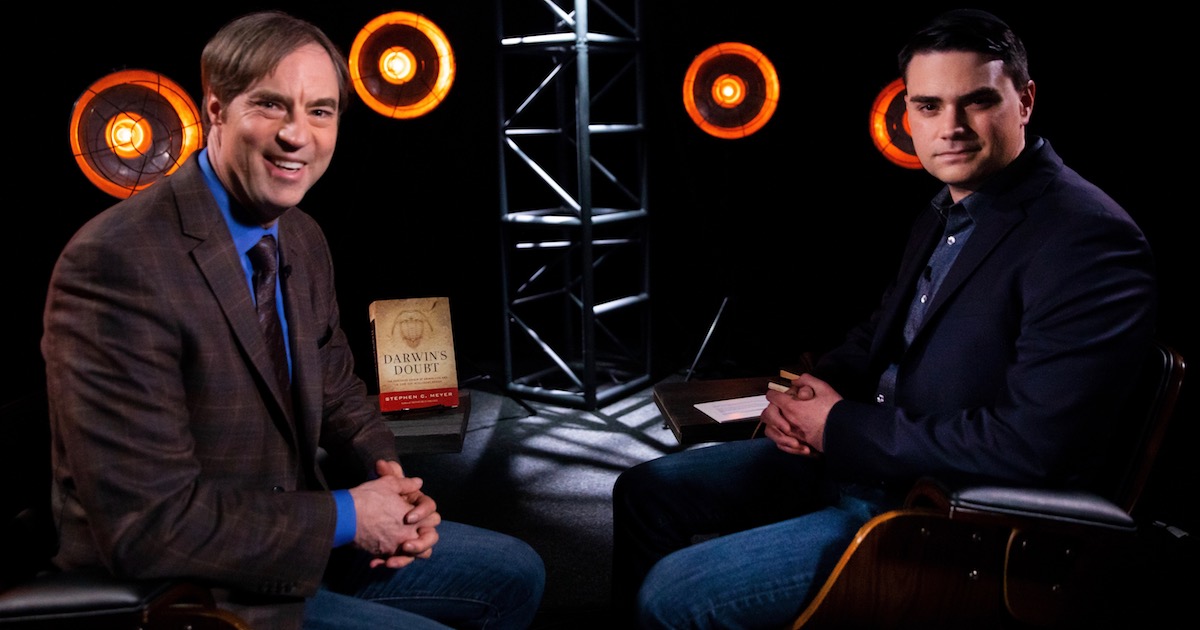
Video, audio and summary of intelligent design discussion, with Ben Shapiro and Stephen C. Meyer

Stephen C. Meyer and Ben Shapiro discuss evolution and intelligent design

(Re-posting this for those who missed it the first time around)

This is a must-see / must-hear conversation. Famous conservative Ben Shapiro discusses evolution and intelligent design with Dr. Stephen C. Meyer, author of “Signature in the Cell” (origin of life) and “Darwin’s Doubt” (fossil record). These are the two best books on intelligent design. Their conversation covers the most important issues in the origins debate.

So to start, here’s the full video:

Someone actually put out an outline on Youtube, with a time-based index, so I’ll just steal that as a base, and add to it:

  • 1:34 What is your scientific background? Science undergraduate degree, professional geologist, later did a PhD in philosophy of science from Cambridge University.
  • 2:39 What is the difference between intelligent design and creationism? Creationism starts from the Bible and posits a shorter history of the universe. ID starts from the data of the natural world and is neutral about the age of the Earth / universe. Meyer accepts the old-Earth.
  • 3:36 How is Intelligent Design a scientific theory? The discovery of DNA reveals that code is central to living systems. Intelligent design uses the method of “inference to the best explanation” in order to argue that the best explanation for the code is an intelligent agent.
  • 6:10 What evidence would have to arise to make Intelligent Design Falsifiable? If a naturalistic mechanism was discovered that could produce biological information using the probabilistic resources of the universe, and the time available, then intelligent design would be falsified.
  • 7:26 Is religion separate from science or intertwined within it? There are three views: science is totally separate from religion, science is in total conflict with religion, science and religion agree on some issues, e.g. – the origin of the universe and Genesis 1:1. There are areas where science and religion overlap.
  • 9:55 Why are the most prominent Darwinians also militant atheists? Evolution is a theory that tries to explain nature using naturalistic mechanisms, so it is compatible with atheism.
  • 10:45 What does the theory of evolution say? The term evolution has multiple meanings, and should be defined before discussions. It can refer to change over time. It can refer to animals changing slightly to adapt to enviromental changes. It can refer to the idea that all animals evolved from simpler life forms, and that there is a tree of life showing how different types of organisms share common ancestors. And it can refer to the idea that purely undirected processes can explain the history of life using purely materialistic forces. It’s that final view that intelligent design challenges.
  • 13:15 Where is the discontinuity in naturalistic processes in the development of life? The first discontinuity is the origin of simple life from non-living components. The second discontinuity is the sudden appearance of different body plans in a very narrow window of time in the Cambrian era.
  • 15:42 Why does information theory suggest that code requires some sort of designer? DNA is a true information-bearing system identical to the software in computers, e.g. – operating system, applications.
  • 19:45 Can information be created by random mutation, and favorable mutations preserved by natural selection? Just as in software code, instructions must be added in order to develop new functionality. Random additions of characters will almost always degrade biological function. The number of possible sequences that do nothing useful is vastly higher than the number of sequences that perform biological functions. Doug Axe did research on this at Cambridge University, and he found that the number of functional sequences of amino acids is 1 in 10 to the 77th power. Given the probabilistic resources (replicating organisms)and the time available, it is extremely unlikely to find sequences that have functional information by chance.
  • 25:05 What about Stephen Jay Gould’s model of punctuated equilibrium – doesn’t it explain the sudden jumps in information? Gould’s mechanism is accurate according to the fossil record, which shows a lot of jumps. But he did not have a naturalistic explanation for sudden jumps in biological function. Darwinian mechanisms work slowly and would (in theory) produce different body plans gradually. But this is not what the fossil record shows.
  • 27:22 What is the mechanism for injecting information in the theory of intelligent design? The information comes in from an intelligence when new major body plans appear, and minor variations within types could be explained by evolution.
  • 29:25 Does the Miller-Urey experiment provide a naturalistic explanation for the building blocks necessary for the origin of life? The MU experiment only produced a few types of amino acids, it doesn’t say anything about how to sequence the amino acids in order to form protein folds that can perform biological functions. The MU experiment also pre-supposes conditions on the early Earth (reducing gases) that do not match what was there (oxidyzing or neutral gases).
  • 32:00 Is the RNA world hypothesis is a good explanation for the origin of life? Evolution requires that replication already be in place, because evolution assumes that mutations appear during the replication. The RNA world hypothesis suggests that sequences contain information, but also catalyze origin of life chemistry. The problem with RNA world is that it starts with self-replicating systems. And those replicating systems require the scientist to inject information into the system to get even the simplest replication started.
  • 34:56 How do scientists respond to the critiques of Darwinism proposed by intelligent design advocates? By and large, they accept them. They think that mutation and selection works once living systems are in place, but they realize it has no explanation for the origin of life or the sudden origin of body plans. (Tells about the  conference of the Royal Society, where problems with Darwinian mechanisms were discussed, and the 2003 MIT Press book by Muller and Newman).
  • 37:16 Why do people hold to Darwinian evolution in the face of these problems? Many scientists presuppose methodological naturalism, which requires that any explanation for the origin of life and the origin of major body plans involve materialist explanations only. No intelligent agents are allowed. The problems occur when assumption of naturalism causes scientists to propose incorrect explanations for what we observe in nature. It’s also not clear how naturalistic mechanisms could produce organisms who are capable of reason and free will.
  • 40:43 Does naturalistic evolution have an answer for conscious minds, reasoning, free will? No, consider the work of atheist scholar Thomas Nagel, who argues in his book “Mind and Cosmos” (Oxford University Press 2012) that the existence of mind is a disproof of the neo-Darwinian explanation for life. Darwinism stops us from accepting the reality of minds.
  • 42:06 So do naturalistic evolutionists have to explain away the mind as an illusion? First, we humans have immediate experience of consciousness, reason and free will. Second, our whole legal system is based on the idea free will, because you can’t hold someone guilty unless they chose to do something they knew was wrong. Third, we have an epidemic of suicide among young people. This is caused by a crisis of meaning. Intelligent design opens up the possibility of their being a mind behind the universe, who we could have a relationships with.
  • 44:53 Why aren’t schools allowed to be honest about the problems with neo-Darwinian evolution? The intellignt design view is to that teachers should be allowed to teach all the vidence for Darwinian evolution, and also discuss some of the problems with the theory. Students learning science should not be told that everything is solved. Students learn science better when they are presented with peer-reviewed evidence for and against a theory, rather than being indoctrinated.
  • 47:37 Is intelligent design theory connected to God? Intelligent design infers from the information content in nature that a mind with capabilities like ours injected information into living systems. Intelligent design is agnostic about the designer, because in principle, embodied or unembodied agents could inject information into living systems. Intelligent design is friendly to theism, because theists will immediately identify the mind as God. Furthermore, the fine-tuning in the initial conditions of the universe is another intelligent design argument. In that case, since the design occurs at the beginning of the universe, the intelligent agent acting prior to the creation of the universe would have to be supernatural, i.e. – God.
  • 50:53 Can naturalists say that the imposition of “function” on a sequence is arbitrary, in the same way that the English language is arbitrary? This won’t work, because biological function is not arbitrary in the same way as language. Biological function is not arbitrary, because sequences can be tested for function objectively by observing whether sequences can perform functions necessary for life, e.g. – replication.
  • 52:43 Doesn’t the multiverse explain away the improbabilities of the fine-tuning, the origin of life, and the development of life? No, because all models of the multiverse require fine-tuning in the mechanism that generates the different universes.
  • 55:42 What about cosmological models that eliminate the beginning of the universe? The standard Big Bang model and the inflationary model both posit a beginning of the universe. There is also the Borde-Guth-Vilenkin theory which proves that any universe that is expanding requires a beginning. The only chance for naturalists is quantum cosmologies, but this doesn’t work because 1) it requires an abstract reality of mathematics to actualize the physical universe, but this presupposes a mind. 2)  The model requires an earlier input of information, which can only have come from a mind.

If you listen to this lecture, or watch the video, and you enjoyed it, then please share. If you have questions, I can try to answer them for you – just leave your question in the comments, or shoot me an e-mail, or message me from the blog’s Facebook page, or direct message me on Twitter. I’ve invested a lot of time in this, and have been studying intelligent design since the late 1990s.


New Census Bureau data: U.S. marriage rate reaches all time low

Marriage rates in the United States over time

This is the latest data from the American Community Survey data from the Census Bureau.

Over the last few decades, feminists thought that they could redefine many of the core aspects of marriage, and that men would still continue to marry. But the truth is that marriage used to be a pretty fair deal for men, now it just isn’t under the new rules.

Marriage used to mean:

  • Being the legally and socially recognized head of the household.
  • An expectation of regular sex.
  • Legal rights to children.
  • Lifetime commitment.
  • That you are guaranteed a chaste bride on your wedding night.

Feminism has destroyed all of these facets of marriage. Feminists want marriage to be all about them, and their needs. And they don’t want marriage to put any responsibilities, expectations or obligations on them.

I am pro-marriage, but for me pro-marriage means rolling back the feminist redefinitions of marriage.  That’s the only way to get men to be interested in marriage. Today, men are responding to the anti-marriage incentives created by feminists. Feminists offered men free sex without commitment, and they made marriage into a dangerous legal deathtrap. Men aren’t going to take risks like that. Especially when they have lost the authority to lead the home, and the other benefits of marriage for men. It’s a lot of risk, without any of the benefits. It’s a bad deal.

But it’s not just the legal risks, it’s the fact that men can’t afford marriage in a socialist country. Socialism requires higher taxes, and that leaves men with too little to take on the husband and father roles.

When you look at marriage rates in Canada and Europe, you understand that men are even LESS likely to choose marriage when they have to pay over 50% of what they earn in taxes. And so the marriage rate is declining. I think young, unmarried women are excited by the idea of raising taxes in order to get free stuff from government. That makes it unnecessary to marry at all, so they are free to play the field and obey no man. But there comes a point where taxes are so high that men simply can’t affort to take on a wife and multiple children. We are at that point now, and I expect it to spread up to the higher income brackets so that the marriage rate declines even further.

One final reason for men not marrying is because men don’t like secular leftist women. Young people are sliding to the left, and those values and beliefs are UNATTRACTIVE to marriage-minded men. Just because a secular leftist woman is able to get attention and sex from men, it doesn’t mean that she is able to get a lifelong commitment to love her, protect her, provide for her, and so on. No one likes secualr leftist women, and no one wants to marry them.

(Image source)

Jay Richards: eight common myths about wealth, poverty and the free market

I have a key that will unlock a puzzling mystery

Have you read Jay Richards’ book “Money, Greed and God?” Because if you haven’t, he’s written a series of articles that summarize the main points of the book.

The index post is here.

Here are the posts in the series:

  • Part 1: The Eight Most Common Myths about Wealth, Poverty, and Free Enterprise
  • Part 2: Can’t We Build A Just Society?
  • Part 3: The Piety Myth
  • Part 4: The Myth of the Zero Sum Game
  • Part 5: Is Wealth Created or Transferred?
  • Part 6: Is Free Enterprise Based on Greed?
  • Part 7: Hasn’t Christianity Always Opposed Free Enterprise?
  • Part 8: Does Free Enterprise Lead to An Ugly Consumerist Culture?
  • Part 9: Will We Use Up All Our Resources?
  • Part 10: Are Markets An Example of Providence?

Parts 4 and 5 are my favorites. It’s so hard to choose one to excerpt, but I must. I will choose… Part 4.

Here’s the problem:

Myth #3: The Zero Sum Game Myth – believing that trade requires a winner and a loser. 

One reason people believe this myth is because they misunderstand how economic value is determined. Economic thinkers with views as diverse as Adam Smith and Karl Marx believed economic value was determined by the labor theory of value. This theory stipulates that the cost to produce an object determines its economic value.

According to this theory, if you build a house that costs you $500,000 to build, that house is worth $500,000. But what if no one can or wants to buy the house? Then what is it worth?

Medieval church scholars put forth a very different theory, one derived from human nature: economic value is in the eye of the beholder. The economic value of an object is determined by how much someone is willing to give up to get that object. This is the subjective theory of value.

And here’s an example of how to avoid the problem:

How you determine economic value affects whether you view free enterprise as a zero-sum game, or a win-win game in which both participants benefit.

Let’s return to the example of the $500,000 house. As the developer of the house, you hire workers to build the house. You then sell it for more than $500,000. According to the labor theory of value, you have taken more than the good is actually worth. You’ve exploited the buyer and your workers by taking this surplus value. You win, they lose.

Yet this situation looks different according to the subjective theory of value. Here, everybody wins. You market and sell the house for more than it cost to produce, but not more than customers will freely pay. The buyer is not forced to pay a cost he doesn’t agree to. You are rewarded for your entrepreneurial effort. Your workers benefit, because you paid them the wages they agreed to when you hired them.

This illustration brings up a couple important points about free enterprise that are often overlooked:

1. Free exchange is a win-win game.

In win-win games, some players may end up better off than others, but everyone ends up better off than they were at the beginning. As the developer, you might make more than your workers. Yet the workers determined they would be better off by freely exchanging their labor for wages, than if they didn’t have the job at all.

A free market doesn’t guarantee that everyone wins in every competition. Rather, it allows many more win-win encounters than any other alternative.

2. The game is win-win because of rules set-up beforehand. 

A free market is not a free-for-all in which everybody can do what they want. Any exchange must be free on both sides. Rule of law, contracts, and property rights are needed to ensure exchanges are conducted rightly. As the developer of the house, you’d be held accountable if you broke your contract and failed to pay workers what you promised.

An exchange that is free on both sides, in which no one is forced or tricked into participating, is a win-win game.

On this view, what you really need to fear as a consumer is government intervention that restricts your choices in the marketplace, or makes some choices more expensive than they need to be (tariffs).

If you care about poverty, it’s often tempting to think that it can only be solved one way – by transferring wealth from the rich to the poor. But that is a very mistaken view, as any economist will tell you. The right way to create prosperity is by creating laws and policies that unleash individual creativity. Letting individuals create innovative products and services, letting them keep what they earn, making sure that the law doesn’t punish entrepreneurs – that incentivizes wealth creation. Fixing poverty does not mean transferring wealth, it means giving people more freedom to create wealth on their own. Free trade between nations is an important way that we encourage people to create better products and services that what they have available in their own countries.

Economists agree on the benefits of free trade

Who could possibly disagree with free trade? Well, many people on the left do. But economists across the spectrum of ideology (university and private sector and public sector) agree on the benefits of free trade.

Harvard economist Greg Mankiw explains what most professional economists agree on.

Excerpt:

Here is the list, together with the percentage of economists who agree:

  1. A ceiling on rents reduces the quantity and quality of housing available. (93%)
  2. Tariffs and import quotas usually reduce general economic welfare. (93%)
  3. Flexible and floating exchange rates offer an effective international monetary arrangement. (90%)
  4. Fiscal policy (e.g., tax cut and/or government expenditure increase) has a significant stimulative impact on a less than fully employed economy. (90%)
  5. The United States should not restrict employers from outsourcing work to foreign countries. (90%)
  6. The United States should eliminate agricultural subsidies. (85%)
  7. Local and state governments should eliminate subsidies to professional sports franchises. (85%)
  8. If the federal budget is to be balanced, it should be done over the business cycle rather than yearly. (85%)
  9. The gap between Social Security funds and expenditures will become unsustainably large within the next fifty years if current policies remain unchanged. (85%)
  10. Cash payments increase the welfare of recipients to a greater degree than do transfers-in-kind of equal cash value. (84%)
  11. A large federal budget deficit has an adverse effect on the economy. (83%)
  12. A minimum wage increases unemployment among young and unskilled workers. (79%)
  13. The government should restructure the welfare system along the lines of a “negative income tax.” (79%)
  14. Effluent taxes and marketable pollution permits represent a better approach to pollution control than imposition of pollution ceilings. (78%)

Socialist economic policies don’t work because they are making policies that are based on economic myths. We know that these myths are myths because of economics is a mathematical science, and because we have tried good and bad policies in different times and places. We have calculations and we have experience to know what works and what doesn’t work. If you want to help the poor, you have to respect what economists know about how wealth is created. The solution is not to “spread the wealth around”, it’s to encourage people to create more wealth by inventing things that people freely choose to buy.

If you made it this far, I have a fabulous parody video about the perils of tariffs and the benefits of free trade, made by Remy. He’s a libertarian, but that just means we don’t listen to him about foreign policy and morality. Only fiscal policy.