
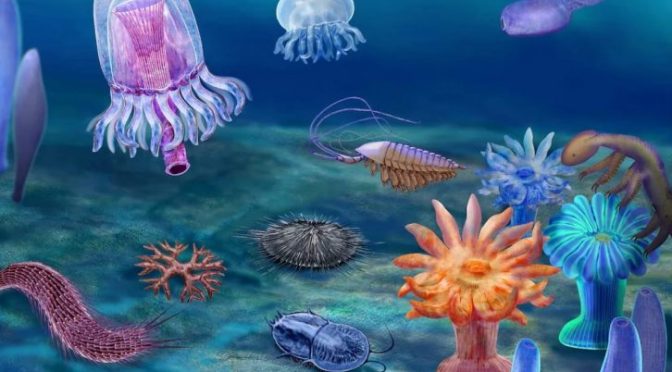
New study: stunning example of sudden, rapid genetic change in worm fossils

Normally in a post with a title like that, I would be linking an intelligent design web site, like Evolution News. But in this case, I didn’t even find this story at Evolution News, I found it at Science Daily. The author of the article definitely takes the side of Darwinian evolution. But remember, as we discussed with Dr. Günter Bechly, evolution has to work gradually, if it is going to work at all.

If you remember the episode of Knight and Rose Show with Dr. Bechly, he talked about how natural mechanisms could only introduce change very gradually, and that sudden leaps of complexity in the fossil record are better explained by intelligent design. Why? Well, consider the task of writing an essay on paper with a pen. You can understand how a human could come up with a 1000 word essay in an hour, but you wouldn’t be able to get the same result by dropping a bowling ball on a keyboard over and over.

A new study about worm genetics

Check out this article (archived) from Science Daily entitled “Defying Darwin: Scientists discover worms rewrote their DNA to survive on land”. The subtitle is “A comparative genome study of earthworms and their marine relatives could challenge Darwin’s theory of evolution by showing that worms colonized land in evolutionary jumps.”

Now for some excerpts, and please pay attention to the bias of the author. There’s a lot of could have, would have, should have in there. And a lot of assuming a mechanism that there is no evidence for. Remember, only designers can dump out functioning words and code in a short time. Natural mechanisms can’t do it.

The article says:

[…][A] research team led by the Institute of Evolutionary Biology (IBE), a mixed research centre belonging to the Spanish National Research Council (CSIC) and Pompeu Fabra University (UPF), points for the first time to a mechanism of rapid, massive genomic reorganisation which could have played a part in the transition of marine to land animals 200 million years ago. The team has shown that marine annelids (worms) reorganised their genome from top to bottom, leaving it unrecognisable, when they left the oceans.

I remember Dr. Bechly telling us in the podcast that naturalists cannot help themselves to jumps in complexity, because natural mechanisms can only work if there are no jumps at all. The latin phrase from philosopher Gottfried Wilhelm Leibniz is “natura non facit saltus” which means “nature makes no jumps”. Naturalists sometimes like to help themselves to jumps, and call it “punctuated equilibrium”, but punctuated equilibrium is not a mechanism for the rapid generation of genetic complexity. Rather, it merely describes what we find in the fossil record – long period of statis, and VERY short periods of huge jumps in complexity. Or “biological big bangs” as Dr. Bechly called them in his article about it.

The Science Daily article explains the findings of the study:

The analysis of these genomes has revealed an unexpected result: the annelids’ genomes were not transformed gradually, as Neo-Darwinian theory would predict, but in isolated explosions of deep genetic remodelling.

“Isolated explosions of genetic remodeling”. I can do that at work, when I refactor the code. But I’m an intelligent designer. Evolution can’t do refactoring like that.

Evaluating the Science Daily article

I asked Grok whether the article explained any specific naturalistic mechanism that explained the “isolated explosions” in genetic complexity, and Grok said:

In short, the article uses vivid phrasing to describe the fossil record and genetic findings but does not articulate a clear, plausible naturalistic mechanism for the sudden genetic changes beyond the general idea of genomic rearrangement.

About the supposed designing ability of “punctuated equilibrium”, Grok said:

Punctuated equilibrium is primarily descriptive. It characterizes the fossil record’s pattern—long periods of little change punctuated by rapid bursts of morphological innovation. It does not, by itself, provide a detailed mechanistic explanation for how sudden jumps in genetic complexity occur.

The theory posits that rapid evolutionary change happens in small, isolated populations over relatively short geological timescales (thousands to tens of thousands of years), which may not leave many transitional fossils. However, it relies on standard evolutionary mechanisms (mutation, selection, drift) operating faster in these contexts, without specifying unique genetic or molecular processes to account for dramatic increases in complexity.

Keep in mind that the best experiments on the speed of naturalistic mechanisms, such as the LTEE experiments by Richard Lenski, show that mutation and selection produce steady, incremental changes, not sudden explosions of complexity.

The best explanation for biological big bangs

In the article about biological big bangs, Dr. Bechly says:

The gradualistic core predictions of any unguided evolutionary mechanisms such as neo-Darwinism are strongly contradicted by the empirical evidence. The cumulative conflicting evidence from molecular biology, genetics, population genetics, and the discontinuous fossil record can no longer be explained away as anomalies or as artifacts such as under-sampling of an incomplete fossil record.

The total evidence is better explained with pulses of infusion of new information from outside of the system (top-down), rather than with a purely mechanistic stepwise bottom-up process. The only known cause in the universe that is able to produce significant amounts of new complex specified information is the activity of an intelligent conscious agent, so that intelligent design theory qualifies as superior alternative to unguided Darwinian evolution in an inference to the best explanation (abductive reasoning) among competing hypotheses.

This is not an argument from ignorance (i.e., God of the gaps) as is often incorrectly claimed by critics, but is based on empirical data and our positive knowledge about the regular causal structure of the universe and the type of causes that exclusively are known to produce certain effects.

I do think it’s important for everyone to be clear on what the science shows. Naturalists have to have the evidence that naturalistic mechanisms can do all the creating in the brief time available. We know that intelligent agents can make explosions of specific complexity (functional information) in brief periods of time. But we don’t know that naturalistic mechanisms can do it.

If you would like to watch a nice lecture featuring Dr. Bechly explaining the fossil record, and the biological big bangs, then you can find that here:

If you want something to listen to, check out our podcast episode on the fossil record with Dr. Bechly.
When I was a child, I read J.R.R. Tolkien’s “The Hobbit” and it changed my life

Since I mentioned “The Hobbit” in my biographical page at the top of the blog, I thought it might be worth explaining what I like about it. I still listen to my favorite chapter from it quite often before bed, to put me to sleep. If it doesn’t work, I listen to other chapters. But why choose that book? Well, because The Hobbit had a huge impact on me when I was growing up.

So, the first thing to say is that I didn’t grow up in a home with parents who had any plan for me. They were not involved in engineering me into anything. They just wanted good grades, and their method of getting that was yelling at me on report card day, then forgetting about school entirely, a few days later. As a result, I had to find my own morality and wisdom. The main things I read for that were the Bible, and later on, British literature, like Shakespeare and Spenser. But I’ll always remember the first “big” book that I ever read, and that was the “The Hobbit”.

The Cover

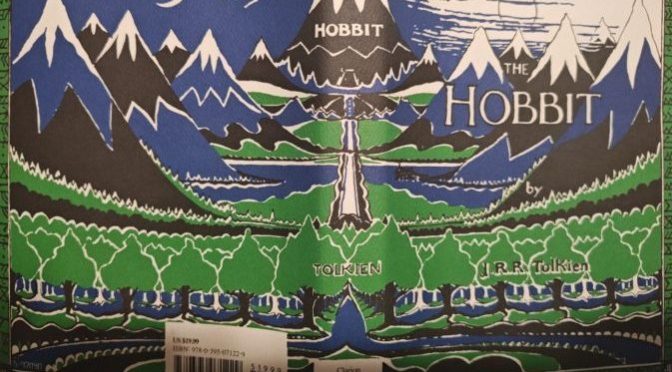
I noticed that there was a new printing of the book with the same cover design as the one that I read when I was small. I managed to get a gift copy of it from Desert Rose for my birthday. What I liked about the cover was the trees. If you look at the cover, there are multiple levels of trees, and you can see that the forest is deep, and you can’t see very far into it. I really liked that as a child. Somehow, that picture on the cover made me think about adventure, and then when I read the book, that really inspired me with the idea of going far away to earn my fortune. I remember that I didn’t read this book for school. I got it from the library.

My favorite chapter

My favorite chapter of “The Hobbit” is “Barrels Out of Bond”. That’s not the most popular chapter. But there is a phrase that appears in that chapter that’s also in the cover blurb from the first edition:

Bilbo Baggins was a hobbit who wanted to be left alone in quiet comfort. But the wizard Gandalf came along with a band of homeless dwarves. Soon Bilbo was drawn into their quest, facing evil orcs, savage wolves, giant spiders, and worse unknown dangers. Finally, it was Bilbo, alone and unaided, who had to confront the great dragon Smaug, the terror of an entire countryside

Did you notice that phrase, “alone and unaided”? I have it on my Twitter profile for my location. It comes from the “Barrels out of Bond” chapter.

So, let’s talk about the overall plot of the book. The plot is that a famous wizard named Gandalf asks Bilbo the hobbit to accompany a group of dwarves on an adventure. His job is to be the burglar, because hobbits are small and sneaky. They travel along until they reach a dark forest called Mirkwood. The dwarves are captured by the inhabitants of the forest – a band of wood elves. Bilbo is able to avoid capture, by slipping on his ring of invisibility that he found earlier. He follows the dwarves into the cave of the wood elves, because he doesn’t want to leave them behind. So, he gets stuck in the cave, wandering around, stealing food, and trying to keep from getting discovered and caught. All while trying to think about how to help the dwarves escape, and get on with their journey.

And then we find this passage:

“I am like a burglar that can’t get away, but must go on miserably burgling the same house day after day,” he thought. “This is the dreariest and dullest part of all this wretched, tiresome, uncomfortable adventure! I wish I was back in my hobbithole by my own warm fireside with the lamp shining!” He often wished, too, that he could get a message for help sent to the wizard, but that of course was quite impossible; and he soon realized that if anything was to be done, it would have to be done by Mr. Baggins, alone and unaided.

You can listen to the whole chapter here.

Bilbo isn’t your typical hero. He isn’t tall. He doesn’t have big muscles. He doesn’t beat up monsters because of his martial training. He doesn’t always know what to do. He sometimes makes mistakes. His strength is his character, especially his humility and selflessness. He isn’t motivated by the same selfish desires as many people are these days. He’s not motivated by greed. He’s not trying to impress anyone.

When I was small, it was important for me to be able to not fall into the traps of my environment. Finding out how to be different was important for me, because I was stuck in a home filled with negative talk and neglect, going to government schools, trapped in an socialist country. So, by reading books like the Hobbit, I was able to find virtues that were nowhere else in my environment.

More than the character was the idea of going on an adventure. That was one of the reasons why I left the country where I was born – so that I could come to America on a work permit, and seek my fortune. And keep seeking it, despite a lot of mistakes and setbacks. And not because outside people were leading me or helping me or engineering me to succeed. No family, no friends, no donations.

So the big lesson from the book  is that an adventurous spirit isn’t free – it has to be put into a boy by what he reads. You should make your children read “The Hobbit”. Put into their minds at a young age the idea that life is an adventure, that dangers and hardships are normal, and that character counts. Put into their minds that all goodness requires sacrifice. And to not worry so much about appearing important to other people.

How to respond to an atheist who complains about slavery in the Bible

I often hear atheists going on and on about how the Bible has this evil and that evil. Their favorite one seems to be slavery. Here are three things I say to atheists when they push this objection.

The Bible and slavery

First, you should explain to them what the Bible actually says about slavery. And then tell them about the person responsible for stopping slavery in the UK: a devout evangelical named William Wilberforce.

Here’s an article that works.

Excerpt:

We should compare Hebrew debt-servanthood (many translations render this “slavery”) more fairly to apprentice-like positions to pay off debts — much like the indentured servitude during America’s founding when people worked for approximately 7 years to pay off the debt for their passage to the New World. Then they became free.

In most cases, servanthood was more like a live-inemployee, temporarily embedded within the employer’s household. Even today, teams trade sports players to another team that has an owner, and these players belong to a franchise. This language hardly suggests slavery, but rather a formal contractual agreement to be fulfilled — like in the Old Testament.3

Atheism and moral judgments

Second, inform them that moral values are not rationally grounded on atheism. In an accidental universe, there is no way we ought to be. There is no design for humans that we have to comply with. There are no objective human rights, like the right to liberty (that would block slavery) or the right to life (that would block abortion). Although you may find that most atheists act nicely, the ones who really understand what atheism means and live it out consistently are not so nice.

Famous atheist Richard Dawkins has previously written this:

The total amount of suffering per year in the natural world is beyond all decent contemplation. During the minute that it takes me to compose this sentence, thousands of animals are being eaten alive, many others are running for their lives, whimpering with fear, others are slowly being devoured from within by rasping parasites, thousands of all kinds are dying of starvation, thirst, and disease. It must be so. If there ever is a time of plenty, this very fact will automatically lead to an increase in the population until the natural state of starvation and misery is restored. In a universe of electrons and selfish genes, blind physical forces and genetic replication, some people are going to get hurt, other people are going to get lucky, and you won’t find any rhyme or reason in it, nor any justice. The universe that we observe has precisely the properties we should expect if there is, at bottom, no design, no purpose, no evil, no good, nothing but pitiless indifference.

(“God’s Utility Function,” Scientific American, November, 1995, p. 85)

When atheists like Dawkins talk about morality, you have to understand that they are pretending. To them, morality is just about personal preferences and cultural conventions. They just think that questions of right and wrong are arbitrary. Things that are wrong in one time and place are right in another. Every view is as right as any other, depending on the time and place. That’s atheist morality.

What’s worse than slavery? Abortion!

Third, you should ask the atheist what he has done to oppose abortion. Abortion is worse than slavery, so if they are sincere in thinking that slavery is wrong, then they ought to think that abortion is wrong even more. So ask them what they’ve done to oppose the practice of abortion. That will tell you how sincere they are about slavery.

Here’s atheist Richard Dawkins explaining what he’s done to stop abortion:

That’s right. The head atheist supports killing born children.