Don’t dismiss best practices for Christian living as “legalism” and “denying grace”

On Sunday, I listened to a very interesting discussion between Sean McDowell and Jessica van der Wyngaard on Justin Brierley’s Unbelievable show. The topic was on the pros and cons of purity culture. I didn’t know a thing about “purity culture”, and had never read any books about it. I didn’t really disagree with anyone on the podcast, but I did want to say something about it in a blog post.

Description:

20 years ago Joshua Harris was the poster boy of the evangelical ‘purity movement’ having authored the bestselling book ‘I Kissed Dating Goodbye’. Today, Harris regrets writing the book, and has also recently changed his mind about Christianity.

Justin is joined by Jessica van der Wyngaard, director of the documentary film ‘I Survived I Kissed Dating Goodbye’, and Christian apologist Sean McDowell, to discuss purity culture, singleness and the Joshua Harris story.

The MP3 file is here.

First, here’s a brief summary of what everyone said on the podcast:

  • JW: the book urged people to give up dating in favor of courting and suggested other rules that would guarantee a successful marriage to your soul-mate
  • JW: some of the rules proposed by the book were not Biblical
  • JW: I’m not a virgin and I’m in early-30s, but I accept that we should teach what the Bible says about abstinence
  • SM: purity culture is the idea that if you remain sexually pure, God will give you a spouse and bless you in the future
  • SM: purity culture is the idea that if you have premarital sex, you will be tainted forever
  • SM: I’m afraid that those reacting against purity culture will build a sexual ethic solely based on their shame, their hurt, their concern about legalism, and this will not help the next generation
  • SM: let’s have a balanced Biblical approach to sexuality instead
  • SM: there is scientific data to back up the Bible’s teaching that marriages work better when sex occurs only within a marriage
  • SM: it’s a mistake to define your spiritual standing based on whether you are a virgin or not
  • SM: following the Bible’s rules for sexuality is an important part of discipleship
  • SM: the Bible is replete with examples of people restoring their standing before God through forgiveness and redemption

Right now, we are living in a secular culture where people are hooking up, having premarital sex, living together, and breaking up far more often than in the past. There is this pattern of choosing partners based on secular criteria: outward appearance and ability to entertain. And this approach to dating – choosing people for the wrong reasons, and trying to force a commitment using premarital sex – is now common practice, even among Christians.

I think people should have a plan to counter this trend that’s realistic and guided by studies and evidence. For example, studies show that people who have no sexual partners before marriage are more likely to still be married 10 years later. Studies show that cohabitation negatively impacts the stability of a future marriage. It’s difficult to accept that this is the way the world is, but if a stable marriage is a goal for you, then you should care about the best practices for having a stable marriage.

Take a different example. Suppose you have a lot of shame and bad feelings over having run up $90,000 of student loans. Now your retirement will be much more difficult. The answer to these feelings of shame is not to say that you can invoke “grace” and that will make everything OK. It won’t. It might help you to make better decisions going forward, but that debt is going to affect your future spouse, your future marriage and your future children.

There are real costs to these behaviors for your future, and being forgiven through Jesus’ atonement isn’t going to instantly make the effects of those choices disappear. It’s good to warn young people about these costs. It’s also good to help people who have made mistakes undo the damage by investing in them. I don’t want us to throw out evidence-based best practices as “legalism”, because they help us to reach the discipleship goals specified for us in the Bible.

The goals of the Bible (e.g. – not aborting, not divorcing) are good goals. If we find out from science that premarital promiscuity or cohabitation reduce our odds of achieving Biblical goals, then it’s a mistake to dismiss that evidence because it make us feel bad about our past. It’s not legalism to investigate evidence and consult wise advisors in order to choose how best to achieve goals like marriage. That’s actually being wise.  Making good decisions doesn’t give you the right to be proud and compare yourself to others, but it is good to make good decisions for yourself, and to share your reasoning with those who ask you.

I agree with the speakers that purity culture is wrong to promise people a happy marriage if they only keep their virginity. That’s just the prosperity gospel, and it really is not a Biblical view of the Christian life.

People who choose to have premarital sex haven’t separated themselves from marriage. But studies indicate that they have damaged the stability of their future marriage if they do nothing to counteract the effects of their choices. And I think there is more to counteracting these bad effects than just stating to your partner “Jesus forgives me, so you can’t judge me”. The focus of the “no-rules because I feel ashamed” crowd doesn’t seem to be on taking the damage seriously and fixing it. Their focus seems to be on not being judged.

I don’t think that a cursory response (“don’t judge me!”) is adequate to undo the damage from premarital sex. But if a person is willing to be honest about their past, and put in the work to understand the effects of premarital sex on their future marriage, renew their minds, and re-establishing their bonding ability, then they should be able to fully counteract the damage. I have met people who have done this, and you can see in their choices and lifestyle that there’s been a complete turning against their former use of sex for fun and attention and self-esteem. It’s not “idolizing virginity and idolizing marriage” to look at the data, and make choices that are likely to lead to a stable marriage.

The authors of the gospels of Mark and Luke knew eyewitnesses to the life of Jesus

Were the authors of the gospels of Mark and Luke connected to eyewitnesses to the life of Jesus? Well, it turns out that there are good reasons to think that Mark was linked to the eyewitness Peter, and Luke was linked to Paul, who had a post-mortem appearance of Jesus in 1 Cor 15:8, and who met with Peter and James in Galatians 1 and again in Galatians 2.

There is a list of evidence for Peter’s influence on Mark on the Cold Case Christianity blog.

Here’s my favorite one from the list:

Peter’s Embarrassments Have Been Omitted

There are many details in the Gospel of Mark consistent with Peter’s special input and influence,including omissions related to events involving Peter. How can Mark be a memoir of Peter if, in fact, the book contains so many omissions of events involving Peter specifically? It’s important to evaluate the entire catalogue of omissions pertaining to Peter to understand the answer here. The vast majority of these omissions involve incidents in which Peter did or said something rash or embarrassing. It’s not surprising these details were omitted by the author who wanted to protect Peter’s standing in the Christian community. Mark was quite discreet in his retelling of the narrative (other Gospel writers who were present at the time do, however, provide details of Peters ‘indiscretions’ in their own accounts. See Cold-Case Christianity for a more detailed explanation).

It makes me laugh to imagine Peter looking over Mark’s shoulder and saying “no, don’t put that in it” and “no, don’t tell them I did that”. Funny! But also very good evidence. The rest of Wallace’s list makes it even more clear.

And what about the gospel of Luke? Well, did you know that the author of Luke’s gospel knew Paul? If you read it carefully, you’ll see that Luke switches from describing history from an “I” perspective to describing things from a “we” perspective in the book of Acts (which he also wrote). Who is the “we” he is talking about?

Here’s famous Christian scholar William Lane Craig to explain:

Now who was this author we call Luke? He was clearly not an eyewitness to Jesus’s life. But we discover an important fact about him from the book of Acts. Beginning in the sixteenth chapter of Acts, when Paul reaches Troas in modern-day Turkey, the author suddenly starts using the first-person plural: “we set sail from Troas to Samothrace,” “we remained in Philippi some days,” “as we were going to the place of prayer,” etc. The most obvious explanation is that the author had joined Paul on his evangelistic tour of the Mediterranean cities. In chapter 21 he accompanies Paul back to Palestine and finally to Jerusalem. What this means is that the author of Luke-Acts was in fact in first hand contact with the eyewitnesses of Jesus’s life and ministry in Jerusalem.

[…]There is no avoiding the conclusion that Luke-Acts was written by a traveling companion of Paul who had the opportunity to interview eyewitnesses to Jesus’s life while in Jerusalem. Who were some of these eyewitnesses? Perhaps we can get some clue by subtracting from the Gospel of Luke everything found in the other gospels and seeing what is peculiar to Luke. What you discover is that many of Luke’s peculiar narratives are connected to women who followed Jesus: people like Joanna and Susanna, and significantly, Mary, Jesus’s mother.

Was the author reliable in getting the facts straight? The book of Acts enables us to answer that question decisively. The book of Acts overlaps significantly with secular history of the ancient world, and the historical accuracy of Acts is indisputable.

This has recently been demonstrated anew by Colin Hemer, a classical scholar who turned to New Testament studies, in his book The Book of Acts in the Setting of Hellenistic History. [5] Hemer goes through the book of Acts with a fine-toothed comb, pulling out a wealth of historical knowledge, ranging from what would have been common knowledge down to details which only a local person would know. Again and again Luke’s accuracy is demonstrated: from the sailings of the Alexandrian corn fleet to the coastal terrain of the Mediterranean islands to the peculiar titles of local officials, Luke gets it right.

I know a lot of people (like my Dad) read the Bible devotionally, looking for feelings or trying to “get right with God” so they get blessings. But I think it’s helpful to look at things from an evidential point of view – how am I going to make a case for this? When you look at things from that perspective, the Bible gets a whole lot more interesting. And you can talk about it with non-Christians when you know about these interesting details.

What specific policies did Never Trump activists and Evangelicals for Biden want?

I’m trying to decide from Biden’s actual governing what policies  Biden-support groups – Never Trump writers, pious Democrat pastors, and Evangelicals for Biden, etc. – wanted. I remember these people were anxious during the election to tell everyone how concerned they were about Trump’s past sins, and his manner of speaking.

Here’s an article from The Federalist about their boy Biden:

Last week, legal accountability group Judicial Watch dropped a bombshell: a nearly 600-page report proving the U.S. government has been buying and trafficking “fresh” aborted baby body parts. These body parts, purchased by the U.S. Food and Drug Administration to “humanize” mice and test biologic drugs in scientific experiments, came from babies up to 24-weeks-old gestation, just weeks from being born.

I’m pretty sure I remember one of those Never Trump people talking about how much they wanted the government to purchase sliced off parts of 24-week-old unborn babies. Maybe it was David French or Russell Moore or John Piper or Tim Keller? Or someone else… Anyway, did you know that 22-week-old unborn babies can survive outside the womb? Those were pretty developed unborn children. I can understand atheist abortion rights activists wanting policies like this. But I’m curious why Never Trump “conservatives” wanted it. Maybe they’re not conservative? And why did pious evangelicals for Biden want it? Maybe they’re neither pious nor evangelical.

Here’s another article from Daily Wire about more Biden policies:

President Joe Biden on Tuesday filed an appeal seeking to force doctors and hospitals to perform potentially harmful transgender-related procedures and surgeries even if they hold objections.

As outlined by BECKET Law’s Luke Goodrich, a court in January struck down the administration’s move to punish doctors who don’t perform transgender-related procedures for supposed “sex discrimination.” Biden on Tuesday officially appealed the ruling.

I’m pretty sure I remember one of those Never Trump people talking about how much they wanted to get their biological sex re-assigned for free by a Christian doctor. Maybe it was David French or Russell Moore or John Piper or Tim Keller? Or someone else… Anyway, did you know that Trump had opposed all these LGBT policies, and protected the conscience rights of Christian doctors? I knew that, because I was more concerned about policy than about virtue signaling my superior morals to people at church.

I noticed that Life News – a pro-life web site – is pretty upset about Biden’s policies so far.

They write:

Joe Biden is rapidly becoming the most pro-abortion president in U.S. history as he takes multiple actions to expand abortions and force taxpayers to subsidize them.

On Wednesday, the Biden administration released a rule that will force taxpayers to fund the abortion industry through the Title X family planning program.

The rule, issued by the U.S. Department of Health and Human Services, will end a pro-life regulation that President Donald Trump put in place to ensure Title X grants are not used to subsidize the killing of unborn babies in abortions.

Pro-life groups like Susan B. Anthony List and National Right to Life considered Trump to be the most pro-life president ever. I even wrote about all the specific actions, policies and nominations he did to help the pro-life cause. That’s the kind of article that our pious pastors and conservative leaders should have written, if they were serious about getting results instead of virtue-signaling. When it comes to politics, you have to look at the actions taken by the candidates – what did they achieve? – not their words.

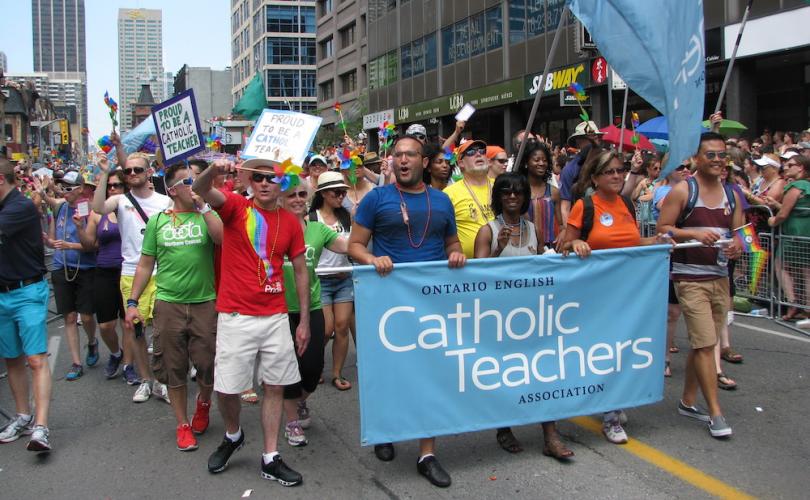
Catholic teachers march in favor of gay rights and perverted sex education

Why Christian men supported a bad candidate

So why do we have so many “conservative” Never Trump people and “pious” evangelical pastors and leaders supporting policies like these Biden policies? These people aren’t stupid. They know perfectly well what Biden said he was going to do. They shouldn’t be surprised at what he’s doing. It’s the job of organizations like the Southern Baptist ERLC to know what policies affect religious liberty. It’s their job to know what policies affect the rights of unborn children. It’s their job to know what policies affect the conscience rights of Christian medical professionals. So what happened?

Well, I know a few Never Trump men, so let me tell you what happened to them. They are married to women who don’t know very much about law and policy. Those women often have non-STEM degrees, no private sector experience, and if they work at all, they work as teachers – especially of very young children. They’re not used to speaking about policy to adults, other than other teachers of small children in the faculty lounge. Teachers talk about how people look, how they talk, how mean they are. They talk about teacher pay, being nice to illegal immigrants, and making the government provide free stuff for irresponsible people. They are terrified of standing up to bad behaviors like having babies out of wedlock or same-sex marriage. They don’t like to make moral judgments – they’re “compassionate”. And they worry a lot about how they are perceived by non-Christians. They don’t want to be seen as “mean”.

So, at least for the men I know, what happened is that these low-information wives – who are all active in their churches with essential oils and self-help books and feelings-based Bible study guides – all convinced their “conservative” evangelical husbands to support Biden’s policies, because of Trump’s “mean” appearance and words. And the strong, tough “conservative” evangelical men went along with it. They wanted a peaceful home, available sex, and not sleeping on the couch more than they wanted conservative policies.

During an online game, I asked one of these men I was playing with which policies he considered the most important, as a conservative Christian. His reply? “Teacher pay and universal healthcare”. His wife was a teacher, and I’m pretty sure he got those priorities from her. Keep in mind that universal healthcare means taxpayer-funded abortions and sex-changes. That’s how it works in countries like Canada, that have a true single-payer health care system.

We need to be careful about appointing weak men as conservative, Christian leaders. If they can’t stand up to their own wives, what good are they as leaders?