Is the vastness of the universe evidence against God’s existence?

Christianity and the progress of science

Physicist Hugh Ross writes about it in Salvo Magazine.

First a quick blurb about Hugh Ross:

Hugh Ross launched his career at age seven when he went to the library to find out why stars are hot. Physics and astronomy captured his curiosity and never let go. At age seventeen he became the youngest person ever to serve as director of observations for Vancouver’s Royal Astronomical Society. With the help of a provincial scholarship and a National Research Council (NRC) of Canada fellowship, he completed his undergraduate degree in physics (University of British Columbia) and graduate degrees in astronomy (University of Toronto). The NRC also sent him to the United States for postdoctoral studies. At Caltech he researched quasi-stellar objects, or “quasars,” some of the most distant and ancient objects in the universe.

Now back to the topic “Is the vastness of the universe incompatible with God’s existence?”

Here’s Ross’ introduction:

Scientists seem more difficult to please than the golden-haired girl of fairy-tale fame. While Goldilocks troubled herself over the just-right porridge, chair, and bed, astronomers appear preoccupied with the size of the universe.

In the days before telescopes, when an observer could count a few thousand stars in the night sky, many considered the universe too small and unimpressive to be the work of an almighty, all-knowing Creator. Only an infinite cosmos, they said, would befit an infinite deity. But then, others argued, an infinite cosmos might eliminate the need for a Creator.

Thanks to the Hubble space telescope, scientists now see that the universe contains roughly 200 billion large- and medium-sized galaxies and about a hundred times as many dwarf galaxies. The stars in those galaxies add up to about fifty billion trillion, and they comprise a mere one percent of the mass of the observable universe.

Because of the travel time of light, the universe humans can observe is really the universe of the past. What researchers know about the expansion and geometry of the universe informs us that the universe of today is at least several hundred times more enormous than the universe we can see. The universe is trillions of trillions of times larger and more spectacular than what the earliest astronomers presumed!

And yet, this new knowledge of the vastness of the universe has led to new complaints. In his book, God: The Failed Hypothesis, Victor Stenger says, “If God created the universe as a special place for humanity, he seems to have wasted an awfully large amount of space.” Stephen Hawking, in the best-selling science book of all time, A Brief History of Time, shares Stenger’s view: “Our solar system certainly is a prerequisite for our existence. . . . But there does not seem to be any need for all these other galaxies.” So now the universe is too big to befit the all-wise, all-powerful God of the Bible.

I like how he quotes an atheist physicist to get the challenge right. No sense in caricaturing the claim of your opponent.

I formalized Stenger’s argument like this:

  1. If all things in the universe are not done the way that Victor Stenger likes them, then there is no God.
  2. All things in the universe were not done the way Victor Stenger likes them.
  3. Therefore, there is no God.

I would deny premise 1, there, since there is no reason to believe that’s it’s true.

Anyway, let’s see what Hugh Ross says:

The hot big bang model (now firmly established by observations) tells us that at the moment of cosmic creation, the universe was infinitely or near-infinitely hot and compressed, and all the ordinary matter existed in the form of hydrogen. As the universe expanded, it cooled. The rate at which the universe expanded and cooled depended in large part on its mass—the greater the mass, the slower the expansion and cooling rate. The slower the expansion and cooling rate, the more time the universe would spend in the temperature range (13–150 million degrees Centigrade) at which nuclear fusion can occur.

Because of its mass, the universe spent about twenty seconds in the nuclear fusion temperature range when it was between three and four minutes old. As a result, 24.77 percent of the universe’s hydrogen (by mass) fused into helium. Thus, when stars began to form—about 380,000 years later—they started off composed of about 75 percent hydrogen, 25 percent helium, and trace amounts of deuterium, lithium, and beryllium.

In the nuclear furnaces of the stars themselves, more hydrogen fused into helium, and, in addition to the extra helium, all the rest of the elements that appear in the periodic table were synthesized (created). The capacity of stellar nuclear furnaces to produce an abundance of elements heavier than helium (all but two of the elements) depended critically on how much of the universe’s initial hydrogen was fused into helium and heavier elements during the first several minutes after the cosmic creation event. How much fusion of the universe’s primordial hydrogen actually occurred at this time depended, in turn, on the universe’s mass or mass density.

If the universe’s mass (or cosmic mass density) had been even the slightest bit less than a hundred times the fifty billion trillion stars occupying the observable universe, nuclear fusion during the first several minutes of its existence would have proceeded less efficiently. Thus, the cosmos would have been forever incapable of generating elements heavier than helium—elements such as carbon, nitrogen, oxygen, phosphorus, sodium, and potassium—all of which are essential for any conceivable kind of physical life.

On the other hand, if the universe’s mass had been even the slightest bit greater, nuclear fusion during the first several minutes after its beginning would have been too productive, and all the hydrogen in the universe eventually would have been fused (after just two generations of stars) into elements as heavy as iron or heavier. Again, all the most life-essential elements, including hydrogen itself, would have ceased to exist.

Basically, your body is made up of heavier elements, and if the universe was not as massive as it is (and as old as it is), then there would not be enough heavy elements to make you, or to make massive stars like our Sun which burn steady for long periods of time. We need the heavy elements and we need the steady source of heat.

Dr. Ross has another reason why God would use vast space and long periods of time, and if you want to read that, you can click here. I think that it’s important for us all to get used to the idea that we all need to understand science apologetics. God put these evidences into the universe for us to discover and use.

Michael Behe and Keith Fox debate theistic evolution vs intelligent design

Two tough rams butt heads, and may the best ram win!

Michael Behe and Keith Fox debate evolution and intelligent design. (See below for link to video)

Details:

Michael Behe is professor of biochemistry at Lehigh University, Pennsylvania and the founder of the modern Intelligent Design movement. His book “Darwin’s Black Box” ignited the controversy 14 years ago when it claimed that certain molecular machines and biological processes are “irreducibly complex” and cannot be explained by Darwinian evolution.

Keith Fox is Professor of biochemistry at the University of Southampton and chairman of Christians in Science. As a theistic evolutionist he believes that Evolution is the best explanation going for the complexity we see and that ID is a blind scientific alley and theologically unappealing to boot.

They debate whether micromachines in the cell such as the “bacterial flagellum” could have evolved by a Darwinian process of evolution. When inference to design is and isn’t acceptable in science. Whether random mutation can mathematically stack up to complex life, and whether God is reduced to a divine “tinkerer” by ID.

Here’s the debate:

Summary

Note: the following debate summary is rated “S” for Snarky. Reader discretion is advised.

Michael Behe:

  • ID is not Biblical creationism
  • ID is not religion
  • ID is a scientific research program
  • People refuse to discuss ID because of personal philosophical assumptions
  • ID is like the Big Bang – it is based on evidence, but it has broad religious implications

Keith Fox:

  • ID is not Biblical creationism, but it isn’t science

Michael Behe:

  • ID is compatible with common descent
  • ID is only opposed to unplanned, unguided evolution (Darwinism)
  • ID is not necessarily opposed to long periods of time

Behe’s first book – the bacterial flagellum

Keith Fox:

  • Here are a couple of papers that show how parts of the flagellum evolved
  • They are possible pathways

Michael Behe

  • No, those are studies that show that there are similarities between bacterial flagella in multiple organisms
  • Similarities of proteins between different organisms do not necessarily imply a developmental pathway
  • The problem of having the instructions to BUILD the flagellum still remains

Keith Fox:

  • Maybe parts of the flagellum had other functions before they were used in the flagellum
  • Maybe you can use the parts of the flagellum for other purposes
  • Maybe, one can imagine, it’s possible that!

Michael Behe:

  • No, parts have to be modified and re-purposed in order to be used for other functions

Keith Fox:

  • But maybe the proteins can be used in other systems for other things
  • I re-purpose parts from of designed things to other purposes in my house when I do maintenance

Michael Behe

  • Uh, yeah – but aren’t you an intelligent designer? What does your home maintenance have to do with Darwinian evolution?

Is ID another God-of-the-gaps argument?

Michael Behe:

  • Well consider the Big Bang… there was a build-up of scientific evidence for that theory
  • Just because a theory has religious implications, doesn’t mean that it isn’t true
  • You really have to look at the specific evidence for a theory, and not decide in advance

Keith Fox: (I’m paraphrasing/inventing/mocking from now on)

  • But the Big Bang is based on discoveries, and intelligent design is based on gaps in our scientific knowledge
  • What if I did have evidence of a step by step pathway (which I don’t right now)? Then I would win the argument – what would you do then?

Michael Behe:

  • Well, if tomorrow you do manage to find expiremental evidence of a pathway, which you don’t have today, then I would be wrong
  • ID is falsifiable by experimental evidence
  • But what about your your view? Is that falsifiable by experimental evidence?
  • What if someone goes into a lab (someone like Scott Minnich?) and performs gene knockout experiments, and publishes the results
  • You knock out a gene from the bacterial flagellum, you wait for a large number of generations, and it never develops the missing gene
  • You repeat this with every one of the 50 genes in the bacterial flagellum and it never recovers for any of the 50 genes
  • There is no pathway to build up even one of the 50 genes – according to actual experiments
  • What do Darwinists do with experimental evidence that falsifies Darwinism?

Keith Fox:

  • No, I would not accept that experimental evidence could falsify Darwinism
  • Just because known published experimental evidence that we have today falsifies Darwinism, it doesn’t mean Darwinism is false because it’s not falsifiable
  • We don’t know how Darwinism even works – it happened so long ago, and it’s not repeatable or testable, so how could lab ,experiments falsify it?
  • Darwinism is science and intelligent design is faith, though

Which side has the experimental evidence?

Michael Behe:

  • Consider the largest longest-running lab experiment of evolution, Richard Lenski’s experiments on e. coli
  • Lenski has presided over 50,000 generations, (millions of years of evolution)
  • The bacterium did evolve and they did get better but not by evolving features, but by disabling features

Keith Fox:

  • But those are just LAB EXPERIMENTS! What do lab experiments prove?
  • What if? What if? What if? You don’t know, it happened so long ago, and you weren’t there! You weren’t there!
  • (clutches Flying Spaghetti Monster idol tighter and sobs pitifully)

Michael Behe:

  • See, the thing is that I have actual experiements, and here’s some more evidence that just got published last week
  • So I’ve got evidence and then some more evidence and them some other evidence – experimental evidence
  • And all the evidence shows that adaptation is done losing traits not by gaining traits
  • And the published observations are what we see in nature as well

Keith Fox:

  • But doesn’t Darwinism explain some things that we observe?

Michael Behe:

  • Well, I am not saying that micro-evolution doesn’t explain some things – it explains bacterial resistance, and other micro-evolution
  • it just doesn’t explain macro-evolution, and that’s what the experiments show

Keith Fox:

  • But ID is a science stopper! It stops science! You can’t produce experimental evidence to falsify Darwinism – that would stop science!

Michael Behe:

  • Well, you have to understand that the Big Bang postulated a non-material cause to the entire physical universe and yet the experimental evidence was allowed to stand because it was testable and verifiable evidence, even if the theory does have religious implications
  • All explanations in science are design to settle a question and it stops rival explanations that are not as good at explaining the observations
  • Finding the best explanation stops further study because it is better than rival explanations

Keith Fox:

  • Well you have to come up with a materialist explanation because that’s the only kind that a functional atheist like me will allow

Michael Behe:

  • Well, what if the best explanation for an observed effect in nature is non-material, as with the Big Bang?

Keith Fox:

  • But I have to have a material explanation because I am a functional atheist! (i.e. – a theistic evolutionist = functional atheist)

Michael Behe:

  • Well what about the cosmic fine-tuning argument? Do you accept that?
  • That’s an inference to design based on the latest scientific discoveries

Keith Fox:

  • Well I do accept that argument, but I don’t accept design in biology
  • When you apply it to biology, somehow it’s bad and you can’t do that or you losing research money and get fired
  • Anyway, your argument is based on a gap in our current knowledge

Michael Behe:

  • No, back in Darwin’s time we had a gap in our knowledge – we didn’t know what the cell was – we thought it was jello
  • Now, we know what the cell is really like, it’s irreducibly complex, and you can’t build up those molecular machines in a step-wise manner
  • The inference to design is based on the progress of science revealing the increasing levels of complexity
  • In experiments, Darwinian mechanisms cannot build anything useful, instead genes are disabled or dropped
  • You guys don’t have the evidence to prove your view that naturalistic mechanisms can do the creating
  • You keep issuing promissory notes

Keith Fox:

  • Well, you’re just seeing design subjectively, because you are a non-scientist
  • I’m being objective when I tell you that we will discover a materialist explanation later on – really really soon now, maybe even tomorrow, yeah
  • You won’t accept my speculations and you insist on these published experiments
  • You’re subjective and I’m objective
  • Just give me more research money so I can hide the decline better

Michael Behe:

  • Uh, you’re the one who is subjective – I cited evidence, and you are the one who is speculating
  • You have arguments from credulity, and I’ve got the lab experiments
  • You refuse to be skeptical, I am the one who is being skeptical

Keith Fox:

  • Maybe, maybe, maybe! Maybe tomorrow! Maybe in a parallel universe! Maybe aliens from Planet 9 from Outer Space!
  • Who knows! I certainly don’t know! And that somehow means you don’t know either! See?

Michael Behe:

  • Well, to prove me wrong, go into the lab, and run experiments and evolve some new genes (using Darwinian mechanisms) that have new useful functionality

Are there limits to what evolution can do?

Michael Behe:

  • You need multiple changes in the genome to get a new helpful feature (let’s say two specific mutations)
  • One specific change is possible
  • the odds are against getting multiple beneficial changes are really really small – you need two SPECIFIC changes to occur in order

Keith Fox:

  • Well, lots of things are really unlikely – any permutation of dice rolls is as unlikely as any other

Michael Behe:

  • Well, we are talking about TWO SPECIFIC mutations that are needed to get a beneficial function – lots of other mutations are possible, but we are looking for a specific outcome that requires two SPECIFIC mutations out of the whole genome
  • You aren’t going to get useful outcomes unless you direct the mutations

Keith Fox:

  • But then why does God allow evil!!!!1!1!!one!!!

Should men prefer women who have earned STEM degrees?

A few people have asked me about my policy of preferring candidates for wife and mother who have earned STEM degree(s). In this post, I’ll explain 5 goals for my marriage. Then I’ll explain 6 reasons why a STEM degree helps me to execute that plan. Then I’ll answer 3 objections to the STEM degree requirement. Then I’ll explain the relevance of STEM for a woman’s marriage roles.

What is STEM?

So, to start, STEM is an acronym for Science, Technology, Engineering and Math. A STEM degree is a degree in a STEM field. This includes things like petroleum engineering, bioinformatics, and computer science. But it also includes things like economics, accounting and business. Basically, anything with math that involves solving problems in the real world. Anything that encourages logical reasoning and using evidence to sustain an argument.

My goals for marriage

So, here are my goals for marriage:

  • influence the church with apologetics
  • influence the university campus (students and professors) with apologetics
  • be involved in politics, advocate for conservative policy
  • open the house to students and neighbors to teach apologetics and demonstrate a loving marriage
  • raise 3-4 financially independent and influential children

Everything I want in a wife is related to this plan. I evaluate women according to these goals, because I want my marriage to make a difference for Christ and His Kingdom. I’m flexible on plans and requirements, so long as the proposed changes result in a greater impact for Christ and His Kingdom.

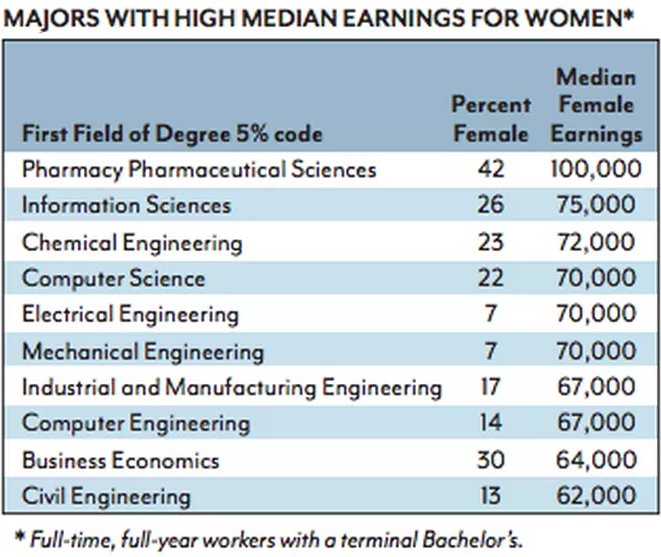
The best majors for women to avoid student loan debt

How a STEM degree relates to marriage

The plan is for my wife to earn a STEM degree, marry me, and work full-time until the first child is born. Then, she stops working and becomes a stay at home mom. She could return to work after the each child reaches 5 years old. My preference is that she not return to work, but instead homeschool the children, or at least monitor their education in private evangelical Christian schools as a stay-at-home mother.

So, how does a woman’s having a STEM degree help me to achieve my marriage plan goals?

Here are 6 ways:

1. STEM equips her to homeschool influential and effective children. A wife who has completed high school and college courses in math, science, engineering and/or technology will know how to either homeschool our kids, or monitor their homework and grades so they achieve good academic results. Think of how Asian families raise high-performing children. I want that.

2. STEM teaches her to produce results in the real world, e.g. – working code that solves a problem, lab results, bridges that support a load, etc. In the lab, decisions cannot be made based on feelings or peer approval. The lab doesn’t respect horoscopes, devotions, romance novels, essentual oils, romantic comedies, “The Secret” or “The Law of Attraction”.

3. STEM equips her to argue apologetics from her experience of using reason, evidence, reality-based testing. All Christians need to know how to defend their core beliefs (God exists, etc.) to non-Christians. That means doing what works. And what works is logical argumentation supported by evidence. The best kind of evidence is scientific evidence. Then historical evidence. Confidence comes from competence at practical, real-world disciplines.

4. STEM degrees are a path to high paying jobs. Women who are debt-free are better to marry, because they don’t delay the process of buying a house and having children. Any kind of debt has to be paid off first. I’m not looking for a big spender, I’m looking for someone who can earn and save. The more children we can afford to have, the bigger our influence will be. Also, women who choose STEM demonstrate that they can delay gratification, and not be a slave to FOMO, YOLO, “living in the moment”, etc.

5. STEM equips women to find work easily, so she doesn’t feel pressured to accept a bad marriage proposal. She can move out and start saving money. She can buy apologetics books, lectures and debates. She can buy books on economics, marriage and parenting. She can prepare herself to attract the right man, and she can evaluate men to see if they are prepared for marriage.

6. Both the STEM departments AND the STEM workplaces less likely to be woke than non-STEM departments and workplaces. She will be able to hold to her convictions more easily in an environment where results matter more than having the “right” (left) opinions.

Objections to preferring a wife with a STEM degree

1. A woman with a STEM degree will not want to quit her job and become a stay at home mom during the critical period from birth to age 2, or even better, age 5.

2. A woman who takes years off for child-bearing and early childhood years will not be able to resume her job at the same level of pay.

3. Even in STEM departments, a woman will be exposed to an environment with secular left indoctrination, drunkenness and promiscuity. She is unlikely to come out of college as a virgin.

Responses to objections to the STEM requirement

Points 1) and 2) apply to every kind of degree, not just STEM. Any woman who does 4 years of college in any field will be “wasting” it if she stops working. First, in my plan, her education is to equip her to educate her children, because I trust her more than any teacher or stranger to do that important job. Teachers are not paid to produce results – they are unionized, and not paid based on performance. Second, even women with STEM degrees would generally prefer to work part-time or not at all. They want to stay with their young children. Third, we don’t need the money. That’s why I suffered through my BS and MS to earn 6 figures and have a 7 figure net worth. We don’t need her to work.

For point 3), I’m not saying that EVERY woman who graduates with a STEM degree is perfect for marriage. I’m saying that a STEM degree helps to have a marriage that is influential for Christ and His Kingdom. I’m open to other majors, so long as they address the concerns and goals I specified. I’m even open to a different plan. But the overriding concern is that the marriage count for something for the Boss. Even with a STEM degree, the man still has to ask the woman questions about politics and parenting. He still has to evaluate her sobriety, chastity and frugality. A STEM degree is just a starting point.

The difference STEM makes for apologetics

I think it’s obvious that having a wife who has taken courses and even worked a few years before the first child arrives helps her to be able to educate her kids and / or monitor their performance. But it also allows her use apologetics more persuasively on the university campus, in the church, and if we open up the home to college students and neighbors for movies / meals / discussions.

For example, take the fine-tuning argument. A knowledge of physics and chemistry helps you to explain why changing the fundamental forces results in a universe that does not support complex, embodied life. A knowledge of probability theory (e.g. – product rule) helps you to argue for intelligent design in the origin of life. And what about logic? Even in computer science, we had to study symbolic logic, the rules of inference, conditional proofs, Bayes’ Theorem, etc.

My wife’s job is to make the big picture of education clear to the kids, so they know what they can do in the real-world with what they are learning. So many Christians underperformed in school because they didn’t know the relevance of what they were learning for the task of defending their Christian worldviews. My wife’s job is to know how the material being taught relates to real-world goals, like defending Christianity. This is how parents produce children who grow up to be William Lane Craig, Stephen C. Meyer, Luke Barnes or Michael Licona. Boldness comes from knowledge.

Conclusion

First, I hope this post convinces women to start planning for their marriages early. You need to know things that matter for two reasons: 1) to attract a quality man, 2) to evaluate men and filter out the good ones. That means you need to know things like apologetics, politics, etc. Having money helps to buy learning material.

Second, I hope this post convinces men to stop choosing women based on youth and beauty. Your choice of wife will have a huge effect on your influence. Choose a capable, competent partner who complements your strengths with different strengths. Men spend their days in the workplace, where we cannot say much about religion and politics. If you marry an intelligent conservative Christian woman, she can be your voice to the university, the church, and the public square. Not to mention raising effective children. Therefore, choose wisely.

Acknowledgements

My wise friend Laura helped me with this post. Please check out her 10-part series for women on how to choose a husband.