Black Christians disappointed by Southern Baptist Convention vote on CRT

Last week, the leaders of the Southern Baptist denomination, a large Protestant denomination, decided to have a convention. They voted down a resolution (resolution 9) that condemned Critical Race Theory. Unfortunately, no black conservatives were allowed to speak about CRT at the convention.

This is from the Tennessee Star:

Live from Music Row Wednesday morning on The Tennessee Star Report with Michael Patrick Leahy – broadcast on Nashville’s Talk Radio 98.3 and 1510 WLAC weekdays from 5:00 a.m. to 8:00 a.m. –  host Leahy welcomed all-star panelist, Dr. Carol Swain, to the newsmakers line to talk about her experience at the Southern Baptist Convention where she and other minority messengers were prevented from speaking up on Critical Race Theory.

Leahy: We are joined on the newsmaker line right now by our good friend All-Star panelist, Carol Swain. Good morning, Carol.

Swain: Good morning, Michael. How are you? I’ve missed you.

Leahy: Well, you’ve been so busy on the national airwaves every time I turned Fox News, there she is. Carol Swain, articulately making the conservative case. Carol, you were at the Southern Baptist Convention. And I guess there was a bit of skullduggery afoot there. Fill us in, please.

Swain: Yes, it is my first time attending a Southern Baptist Convention. And I arranged my life to give two days to this convention because I wanted to participate. And I was most interested in the Critical Race Theory issue and a resolution that the Conservative Baptist Network crafted and put forward.

And I am on the steering committee of that network. Our resolution was killed by the resolutions committee. And they put forth a substitute that was vaguely worded and did not mention intersexuality or Critical Race Theory itself.

[…]…then they shut down any debate about how the issue was handled.

[…]I was there to try to explain to people how dangerous Critical Race Theory is and how it manifests itself and how it is destroying churches. I never got to speak during the time of the business meeting. And they used parliamentarian rules to control what it’s about, I guess, at meetings.

But two people were allowed to speak for their resolution. One person spoke briefly against it and then someone called for the vote. And this was after someone from the stage had given this impassioned plea that we don’t want to look bad to the world and all of this stuff like that.

As a black Christian conservative, I’m very familiar with conservative black leaders like Dr. Carol Swain. She’s done several videos for Dennis Prager’s famous Prager University.

I recently watched an interview with Candace Owens, as well:

I recently heard her talk about “Up From Slavery” by Booker T. Washington – a book I also have blogged about – on the Daily Wire Book Club podcast:

Very accomplished woman. She knows a lot about race and racism in America. She lived through it. I would think that her perspective would be valuable.

Here’s another black Christian I like, Dr. Voddie Baucham. He has a new book out called “Fault Lines”, which is amazing. I’m currently reading it, after watching some of his lectures and sermons online.

Here’s one I really liked, about homosexuality and transgenderism:

And another one, about cultural Marxism:

Here’s what Dr. Baucham had to say about the Southern Baptist convention, as reported by Capstone Report:

The Southern Baptist Convention messengers were cowards for not repudiating Critical Race Theory by name, said Dr. Voddie Baucham on the Todd Starnes Show.

“I don’t think it was so much buying in (to CRT) as much as white guilt and cowardice,” Dr. Baucham said. “It was obvious building up to the Convention that the issue at hand was Resolution 9 on Critical Race Theory and Intersectionality from two years ago and how that was going to be responded to. And when you respond to it with a Resolution that refuses to even name Critical Race Theory and Intersectionality, that is an act of cowardice.”

Dr. Baucham urged conservative Christians to continue in the fight against Critical Race Theory.

“I think we continue to press the issue,” Dr. Baucham said. “I think we continue to name this for what it is and continue to expose the tenets of this ideology. I think we continue to demonstrate that this it antithetical to biblical truth.”

Dr. Baucham described Critical Race Theory as a “demonic ideology” that the Church must fight. The “hegemonic power” that these Critical Theories are fighting is, “at the end of the day, Christianity,” he said.

What I like about Voddie is that he isn’t afraid to name names. Here’s a useful quote from his new book Fault Lines, explaining some of the famous people and groups on both sides of the debate.

Why are people and groups like Thabiti Anyabwile, Tim Keller, Russell Moore, the Southern Baptist Convention, the Ethics and Religious Liberty Commission, 9Marks, the Gospel Coalition, and Together for the Gospel (T4G) being identified with Critical Social Justice on one side of the fault, and people like John MacArthur, Tom Ascol, Owen Strachan, Douglas Wilson, and the late R.C. Sproul being identified on the other? These are groups and ministries that have embraced CRT, and those are problematic. But there is a larger group that is sympathetic to it because of their desire to fight what they see as a problem of racial injustice.


Baucham, Voddie. Fault Lines: the Social Justice Movement and Evangelicalism’s Looming Catastrophe. Salem Books, an Imprint of Regnery Publishing, 2021; pp. 2-3.

Do you recognize any names in the group that supports Critical Race Theory? I used to read some of those people, but then I just stopped, because they were too liberal for me. I never read anything by John Piper or Max Lucado or Philip Yancey. The liberal Christians never had anything convincing to say against atheism, feminism or socialism. Like Mormons, they always seemed to appeal to emotions and mysticism. So I didn’t read their books.

Instead, I like to read people who have evidence, like Hugh Ross, Walter Bradley, Wayne Grudem, Stephen C. Meyer, Michael Behe, Michael Licona, William Lane Craig, Gary Habermas, Scott Klusendorf, Robert Gagnon, etc. It’s much easier for me to be bold in defending Christianity when I am ready with an answer. I’m not really interested in surrendering to the secular left just so that they will like me. I’d rather stand up to them, and win a debate against them. It’s more work, but I would rather do the work than be lazy, ignorant and cowardly.

It’s my understanding that Southern Baptist seminaries do not teach evidential apologetics at all. Just some pious fideism, that they’ve re-branded as “presuppositional apologetics”. And what do they do for evangelism? They’ve adopted the Mormon standard of speaking Bible verses, then hoping for an emotional reaction to them, i.e. – “a burning in the bosom”. Can you really expect fideists to stand up to the secular left? They’re anti-intellectual fideists.

When I look at the Bible, I see Jesus using evidence to convince his opponents. He uses evidence to confirm his theological claims. But the Southern Baptists seemed to have left the use of evidence far behind. No wonder they are capitulating to non-Christians. When you give up on truth, all that’s left is to try to get people to like you with marketing gimmicks.

Did “thousands of women” die in “back alley abortions” before Roe v. Wade?

I get into debates about abortion, and sometimes my opponent will complain that if Roe v. Wade were overturned, then thousands of women would die in illegal abortions. Well, if that ever happens to you, this post will help you to know how to respond to it.

First of all, if Roe v. Wade were overturned, then each of the 50 states would pass legislation deciding when abortions would be legal.

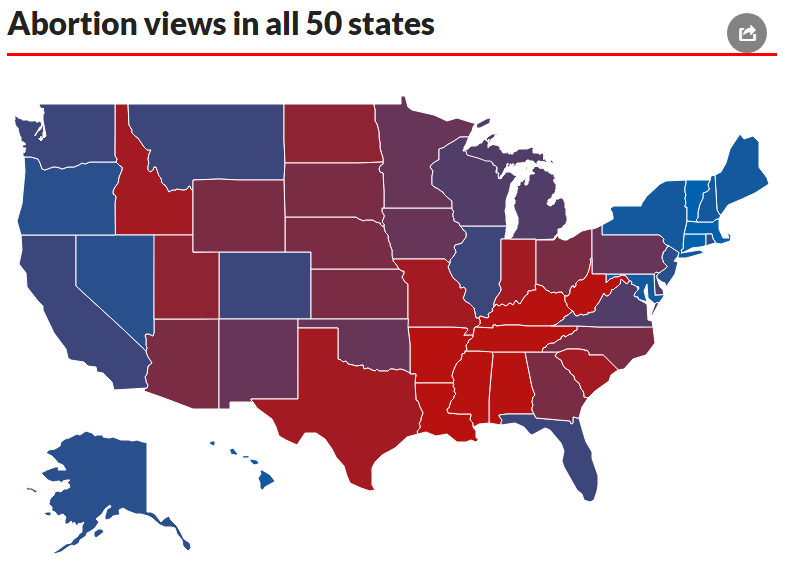
Here’s a map taken from the Washington Examiner:

Abortion rights after Roe v. Wade is overturned

Red states are more pro-life than blue states in this map. For example, New York is ranked #6, and Tennessee is ranked #45.

So, if a woman did have irresponsible sex with a hot bad boy, then she easily could terminate her child in one of the blue states.

Second, the number thrown around by abortion advocates is not accurate. It’s simply not true that “thousands of women” were dying from poorly-performed abortions when abortion was still illegal. Actually, abortions were performed by trained medical personnel, but it just wasn’t reported to the police.

Here’s a recent article from the radically leftist Washington Post:

Erica Sackin, a Planned Parenthood spokeswoman, directed us to a 2014 policy statement issued by the American College of Obstetricians and Gynecologists (ACOG): “It is estimated that before 1973, 1.2 million U.S. women resorted to illegal abortion each year and that unsafe abortions caused as many as 5,000 annual deaths.”

There is no citation in the statement for the estimate of “as many as 5,000 annual deaths,” even though many of the other sentences are carefully documented. None of the citations around this sentence supports the figure, and there is no explanation about how it was calculated.

[…]Meanwhile, Sackin also sent a variety of reports, many of which were referenced in a footnote in a document published by NARAL Pro-Choice America. One of the citations especially caught our eye: Frederick Taussig, “Abortion Spontaneous and Induced: Medical and Social Aspects,” (1936).

Why was a study from 1936 being cited? Because in 1936, we didn’t have antibiotics! People were dying all the time from any kind of surgery – not just abortion.

More:

The advent of antibiotics such as penicillin and improved medical procedures suddenly made abortion less risky. Another prominent researcher, Christopher Tietze, argued in a 1948 paper that the number of deaths from abortion was rapidly declining because of three reasons: contraceptive methods had improved so fewer women were getting pregnant, abortion providers were getting better at avoiding infections, and many lives had been saved because of the introduction of sulfa drugs and penicillin.

[…]The data collected by Tietze showed 2,677 deaths from abortion in 1933, compared with 888 in 1945, with much of the decline in septic cases associated with illegal abortions. (The numbers also include deaths from “therapeutic abortions,” permitted by law, and “spontaneous abortions.”)

By 1959, a leading researcher wrote: “Abortion is no longer a dangerous procedure. This applies not just to therapeutic abortions as performed in hospitals but also to so-called illegal abortions as done by physicians. In 1957, there were only 260 deaths in the whole country attributed to abortions of any kind. In New York City in 1921, there were 144 abortion deaths, in 1951 there were only 15.”

The writer was Mary Steichen Calderone, at the time medical director of Planned Parenthood. She attributed the decline in the mortality rate to antibiotics and the fact that 90 percent of illegal abortions were done by trained physicians.

OK, so abortion advocates cite the study from 1936, which already relies on questionable estimates, because they know that the later numbers are far, far lower – thanks to the widespread use of antibiotics. They’re lying, essentially, because lying helps them to persuade people who think with their feelings, and don’t look too closely at facts.

Third, there are over 2,000 pregnancy care ministries and clinics operating throughout the continental United States. Women who want help with pregnancy or adoption can get help from one of these clinics.

Fourth, even if women hurt themselves during abortions, that wouldn’t be a reason to legalize abortion. Bank robbers hurt themselves during bank robberies, and drug dealers hurt themselves during drug deals. We do not legalize criminal activities just because criminals get hurt during the commission of those activities. So the real question is, what is the unborn? If the unborn is a living human being, then abortion on demand takes the life of an innocent human being without justification, and should therefore be illegal.

Peter J. Williams debates Bart Ehrman on his book “Misquoting Jesus”

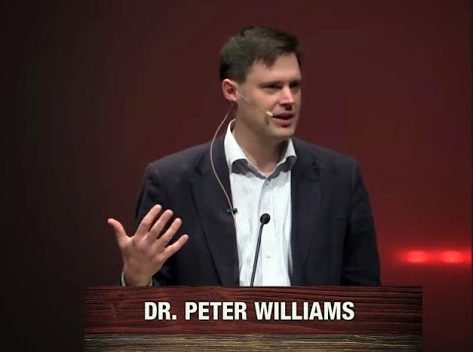
Dr. Peter J. Williams, an expert on New Testament reliability

I have to re-post this debate between Bart Ehrman and Peter J. Williams, because Dr. Williams just followed me on Twitter. I noticed that he had re-tweeted one of the two senators I follow on Twitter, so I re-tweeted him. I like Tom Cotton and Josh Hawley, and he re-tweeted Senator Hawley talking about free speech.

Bart Ehrman posted the debate audio on YouTube:

Details:

Bart Ehrman is the US author of the bestselling book “Misquoting Jesus” (In the UK “Whose word is it?”).  He calls into question the authority of the New Testament as scribal changes over time have changed the documents.

So can we trust the scripture? Bible scholar Peter Williams believes in the reliability of the New Testament and that Bart’s prognosis is far too pessimistic.

This post is a re-post from 2011. I have been listening to this lecture by Peter J. Williams on “Misquoting Jesus” this week, and it reminded me to re-post this debate. (I checked to make sure the MP3 link is still good, and it is)

Summary of the Williams-Ehrman debate:

Note: this summary is snarky. If you want an accurate view of the debate, then listen to it. My summary is meant to be humorous.

Ehrman:

  • I had a mystical experience in childhood and became an evangelical Christian
  • I went to Moody Bible Institute, and they told me that the Bible was inerrant
  • For a while, I was committed to the view that there are no mistakes in the Bible
  • At Princeton, I was taught and graded by professors who did not accept inerrancy
  • By a strange coincidence, I began to see that the Bible did have errors after all!
  • We don’t have the original documents written by the original authors, we only have thousands of copies
  • if the words of the Bible are not completely inerrant, then none of it is historical
  • if all of the words in all the copies of the Bible are not identical, then none of it is historical

Williams:

  • I would say the New and Old testaments are the Word of God
  • We don’t need to have the original Greek writings in order to believe in the authority of the Bible
  • I believe in inerrancy, but doesn’t mean there are no problems
  • the doctrine of inerrancy has always referred to the original Greek copies, not the translations

Moderator:

  • what are the main points of Misquoting Jesus?

Ehrman:

  • we don’t have the originals of any of the books of the New Testament
  • we have copies that are much later, sometimes even centuries later!!1!
  • the copies we have all differ from one another – they were changed by scribes!!1!
  • we have 5000 manuscripts in the original Greek language
  • there are hundreds of thousands of differences!!1!
  • most of the differences don’t matter
  • some differences are significant for meaning or doctrine
  • errors are propagated because the next scribe inherits the mistake of their source copy
  • a large gap between the time of writing and the first extant copy means more errors have crept in

Williams:

  • the reason we have so many variants is because the number of manuscripts is large

Angry Jesus or compassionate Jesus in Mark

Ehrman:

  • most manuscripts say that Jesus was compassionate when healing a leper, but one says he was angry
  • it makes a huge huge huge really really big difference if Jesus is compassionate or angry
  • the whole Bible needs to be thrown out because of this one word between different in one manuscript

Williams:

  • this variant is important for understanding the passage, but it has no great meaning
  • the change is probably just an accident – the two words are very similar visually in Greek
  • it’s just an accident – it emerged in one manuscript, and it impacted a few more
  • the tiny number of manuscripts that have the error are geographically isolated
  • I’m pretty sure that WK prefers the angry Jesus anyway – so who cares?

Ehrman:

  • no! someone changed it deliberately! it’s a conspiracy! you should buy my book! it’s a *big deal*!!!!!1!!1!one!!eleventy-one!

The woman caught in adultery in John

Ehrman:

  • it is isn’t in any of the earliest manuscripts
  • this is an apocryphical story that some scribe deliberately inserted into the text
  • most people don’t even know about this! it’s a cover-up! you need to buy my scandalous book!

Williams:

  • that’s right, it’s a late addition by some overzealous scribe
  • and it’s clearly marked as such in every modern Bible translation
  • the only people who don’t know about this are people who don’t read footnotes in their Bible
  • and in any case, this isn’t a loss of the original words of the New Testament – it’s an addition

Grace of God or apart from God in Hebrews

Ehrman:

  • well this is just a one word difference, but it makes a huge huge really really big difference!
  • the words are very similar, so it’s could be an accident I guess
  • but it wasn’t! this was a deliberate change! it’s a conspiracy! it’s a cover-up! scandal!
  • buy my book! It’s almost as good as Dan Brown!

Moderator:

  • hmmmn…. I kind of like “apart from God” – why is this such a big scandal again?

Ehrman:

  • you don’t care? how can you not care? it has to be inerrant! or the whole thing is false!
  • Moody Bible Institute says!

Williams:

  • yeah Bart is always saying that every change is deliberate but it’s just an accident
  • the words are very similar, just a few letters are different, this is clearly an accident
  • I have no problem with apart from God, or by the Grace of God
  • please move on and stop screaming and running around and knocking things over

Moderator:

  • but what if pastors try to use this passage in a sermon?

Williams:

  • well, one word doesn’t make a big different, the meaning that appears is fine for preaching
  • it’s only a problem for people who treat the Bible as a magic book with magical incantations
  • they get mad because if one word is out of place then the whole thing doesn’t work for their spell
  • then they try to cast happiness spells but the spells don’t work and they experience suffering
  • the suffering surprises them since they think that fundamentalism should guarantee them happiness
  • then they become apostates and get on TV where they look wide-eyed and talk crazy

Ehrman:

  • hey! are you talking about me? a lot of people buy my books! i am a big success!
  • it is very important that people don’t feel bad about their sinning you know!

Is Misquoting Jesus an attack?

Williams:

  • it’s rhetorically imbalanced and misleading
  • it tries to highlight change and instability and ignore the majority of the text that is stable
  • he makes a big deal out of 5 or so verses that are different from the mainstream text
  • he says that scribes deliberately changed the scriptures, but he doesn’t prove that
  • it’s just as likely that the differences are just scribal errors made by accident

Ehrman:

  • well, maybe the variants aren’t a big deal, but what about one angel vs. two angels?
  • that’s a significant issue! significant enough for me to become an apostate – a rich apostate
  • if one word is different because of an accident, then the whole Bible cannot be trusted
  • it has to be completely inerrant, so a one word difference means the whole thing is unreliable
  • we don’t even know if Jesus was even named Jesus, because of one angel vs two angels!!!1!
  • buy my book! you don’t have to read it, just put it on your shelf, then you’ll feel better about not having a relationships with God – because who’s to say what God really wants from you? Not the Bible!