Are men allowed to have preferences about which women are best for marriage?

So, in a previous post, I explained why men have to be careful about choosing a wife. Men have plans and they need a woman with the right skills to achieve it. Even if a woman genuinely repents her past, she may not have developed the skills for a godly man’s marriage plan. For example, her 50K of student loans makes it harder to afford a stay-at-home homeschooling mother.

But many Christian women feel that there is no such thing as a Christian woman who is a bad candidate for marriage. It doesn’t matter what a Christian woman did in the past. A man should never evaluate her skills for the roles of wife and mother. After all, if God forgives a Christian woman for running up student loan debt for a useless women’s studies degree, or for getting drunk and sleeping around with hawt bad boys in college, then no Christian man should hold her past decisions against her when choosing a wife. Men are obligated to disregard the past anti-marriage decisions made by women. To do anything else is to deny the Gospel of Jesus Christ. So many Christian women say.

What would happen if the shoe were on the other foot? What if it were the MAN who had been selfish, lazy and irresponsible? What if the MAN had made choices that seriously harmed his ability to perform male marriage roles like protecting and providing for his wife and children? Would marriage-ready women be obligated to marry this man as much as a man who had remained chaste, got a good education, built up a gapless resume, saved enough for a downpayment on a house, and taught apologetics in his home church? Is she allowed to prefer a man who has made good decisions to prepare for his marriage roles over a man who has made horrible decisions, but just hollers “grace” when anyone questions his ability to be a husband and father?

This MUST-READ article from The Federalist asks and answers that question.

Do you agree with the author?

I think it’s time for a conversation about another elephant in the room: this idea that women prefer physically fit men with good jobs and no criminal record. It’s incredibly sexist and matriarchal to insist that women have a natural preference for men who have invested time and energy into stewarding their bodies, have shown the capability of earning a living and supporting a family, and have not gone to jail for attempting to grow 452 marijuana plants in their mother’s basement.

I know more than a few men who spent their twenties languishing in their parents’ homes, subsisting on Cheetos and Mountain Dew, playing Xbox, watching pornography, and smoking controlled substances. If one of these men turns his life around, accepts Jesus, and starts fresh, young women have no right to overlook him as a potential mate just because he is 280 pounds, has almost no marketable skills at 30 years old, and cannot vote, serve on a jury, or own a firearm. He is created in the image of God, and accepted by Jesus! Any women who would overlook every other noble quality he possesses for basic financial security and a clean background check (not to mention browsing history) isn’t a woman he should want.

Men like this have often long since repented of their listless and slothful ways. If the lingering consequences of their pasts didn’t stop Christ from living and dying for them, then it shouldn’t stop a Christian woman from loving them, either. Period.

The Federalist article makes it clear that a man’s poor choices about his education, job, obedience to the law, and physical fitness CLEARLY compromise his ability to perform his male duties to protect and provide. What about moral and spiritual leading? Well if he didn’t spent his teens and 20s studying  apologetics, moral issues, etc. then he isn’t going to compare favorably to a man who teaches apologetics in his church, debates atheists, and writes blog posts for the Life Training Institute.

My friend Lee is a superb stay-at-home wife and mother. She says that we shouldn’t accept “Jesus forgives me” as an immediate reversal of past harmful choices:

I would note that there is a difference between just being forgiven of sin and actually repenting of it. Repenting is a turning away from and will manifest in changes; paying down debts, becoming chaste, becoming otherwise responsible and wise. Someone’s past doesn’t have to define their future. But that will manifest in observable and measurable changes.

She’s right.

I knew a Christian woman who had 25,000 worth of student loan debt when she was 29. She wasn’t using her degree, she was just working as a waitress. I found her a job as an IT project manager in an FT100 company, so she could pay off her loans. She declined, because “being a waitress is the easiest job I’ve ever had”. She hasn’t worked full-time as a professional since January 2013. She’ll say “Jesus forgives me!” and “I hate my student loans!”, but the loans are even larger now, and the wasteful spending on fun and thrills hasn’t stopped. Hollering “grace” and saying you hate debt doesn’t make you a good steward – and you’ll need to be a good steward if you are in a marriage. She’s not ready to manage the finances of a household. If she had taken the job, and paid off the loans, then she would have overcome the mistake, and become marriage-ready.

So what’s really behind the hysteria against men evaluating women for marriage?

Deti nails the real root problem:

Not one person – NOT ONE PERSON – said that nonvirgins with tattoos and debt are bad people; that they are irredeemable, that they’re bad Christians; that they cannot be Christians; that they’re unsalvageable; that they’re ugly; or that they couldn’t and shouldn’t marry. That is NOT what was said.

All that was said was that men prefer tattooless, debtfree virgins for marriage. That’s all.

[…]The bible… teaches repentance is the way to salvation. But repentance does not mean you no longer bear the scars of your past sins in body and mind. You do. Oh yes you do. The effects can be minimized, even overcome. But they’re still there.

And more to the point, what’s really being complained about here is a Christian woman acknowledging that men have preferences and that men are entitled to have preferences. If women want men, then they have to satisfy those preferences or lower their standards until they find men whose preferences they can satisfy.

This can’t be overemphasized – it’s the idea that men have preferences. Its’ the idea that there’s a man that’s one-half of that relationship, and there are things HE wants, and HE needs, and HE desires. Why does it matter what HE wants? Why do we care about him?

Men don’t want to marry high N women. Men don’t want to take on debt and they don’t prefer markedup tatted up women who look and act like men.

What this gets down to is women objecting to men having standards. Because that leads to men judging women. And that leads to men evaluating women. And that leads to men rejecting some women and accepting others. And women hate judgment and rejection, especially when it’s “less than” men who are doing the judging and rejecting.

N refers to the number of sexual partners a person has had.

The reason we discuss best practices for marriage-minded women is so that young women, especially young women who lack a father in the home, can get some kind of guidance about how to resist the culture’s lies about men, sex and marriage. Such a woman has NOWHERE TO GO in this culture in order to learn how to relate to men, and how to marry to a man who will love her faithfully and forever. That’s not fair! We have to help her!

What Christian men are doing by promoting chastity, sobriety, good stewardship and self-control to these young women is protecting them from a culture that lies to them. The well-meaning Christian women who think that talking about moral boundaries and wisdom will hurt the feelings of women who have made mistakes are actually making it harder for young women who have no guidance at all. The most vulnerable ones are the ones who need to hear that chastity is wise. Doing a STEM degree is wise. Getting out of debt by spending less is wise. Not seeking attention with graffiti on your body is wise. That’s what unmarried women need to hear.

It’s amazing to me that so many Christians do not understand the protective value of recommending Biblical morality and Biblical wisdom to young women. They would rather sacrifice these young women to the secular culture than allow older women to feel bad about their past decisions. So many Christians seem to be more concerned about their own feelings than about promoting and defending what the Bible teaches to young people who really need help.

Most Americans think cohabitation leads to a stable marriage, but what does the data say?

Men who cohabitate are not certain that the relationship is permanent

If there’s one thing that ought to lead people to Christianity, it’s the proven ability of the Christian moral rules to guide believers away from the sins that destroy them. A lot of modern “Christians” have reduced Christianity to being about their feelings and their community, while allowing the culture to determine their goals and moral boundaries. But that won’t protect them from danger.

Cohabitation describes the situation of a couple moving into the same home and being sexually active, but without any legally-recognized commitment. It’s extremely popular among young people today, and even Christians.

Consider this article from The Federalist about cohabitation:

A new Pew Research Center study shows Americans both cohabitate (“live with an unmarried partner”) and find cohabitation acceptable more than before.

[…]More young adults have cohabited than have married. Pew’s analysis in the summer of 2019 of the National Survey of Family Growth found that, for the first time ever, the percentage of American adults aged 18-44 who have ever cohabited with a partner (59 percent) exceeded the percentage of those who have ever married (50 percent).

I thought this was very interesting, especially for the Christian parents and pastors who imagine that their lovely pious daughters all have a Christian worldview just because they sing in the church choir:

Just 14 percent hold a view consistent with a biblical sexual ethic, that cohabitation with an unmarried romantic partner outside of marriage is “never acceptable.”

Just to be clear, in my life I’ve met about 6 non-Christian men who cohabitated with women, and every single one of them cohabitated with a Christian-raised woman. That should tell you what young women are being told about relationships in their homes and churches about sex and marriage. “Do whatever you want”.

So what purpose does cohabitation serve?

A majority of Americans (69 percent) say that “it is acceptable for an unmarried couple to live together even if they don’t plan to get married.” They may assume that they can decrease their chances of a bad marriage and increase their chances of a good one by giving the relationship a cohabitation “test run.”

[…]A plurality of Americans believe cohabitating before marriage yields more successful unions. Nearly half of Americans (48 percent) believe that couples who live together before marriage “have a better chance of having a successful marriage.” This view is even more prevalent among young adults aged 18-29 (63 percent).

Another 38 percent of all Americans say cohabitation “doesn’t make much difference” on marital success. Only 13 percent of Americans believe cohabiting couples have “a worse chance” of having a successful marriage.

[…]Most Americans believe cohabitating couples raise children just as well as married couples. Pew also surveyed people’s opinions about cohabiting couples raising children, and 59 percent of Americans declared that cohabiting couples “can raise children just as well as married couples.” Again, the younger respondents were most likely to have a favorable view of cohabitation: among adults aged 18 to 49, 67 percent agreed cohabiting couples do just as well, while 32 percent said: “Married couples do a better job raising children.”

Yes, cohabitation seen as a test run, and it’s supposed to make stable marriage more likely and not be harmful to children at all.

But why think that a test run should be part of getting married? After all, when I buy a parrot from the pet store, I don’t expect to later return that parrot. Why not? Because I am not buying the parrot to enhance MY life. I am buying the parrot to make a commitment to care for the parrot. Whether the parrot fulfills any of my needs is irrelevant to me. I want the bird in my house so that I can decide what it eats, what it drinks, and invest myself into making it happy, according to its birdish nature. This is because I think that parrots have value in and of themselves, and they deserve a certain quality of life. When I buy the parrot, I am guaranteeing a permanent commitment to the bird to provide for its needs, physical and emotional. And that commitment carries forward to the time (now) when the bird is elderly, and can’t even fly up to his cage or down to the floor. He calls for me, and I go over and pick him up and move him. That’s commitment.

Cohabitation, on the other hand, is the practice of saying to another human being: “I am going to try you out as an entertaining commodity in my home, but if you don’t fulfill my needs then I’m going to send you right back.” That’s not a commitment. That’s self indulgence. It’s defining a relationship as entertainment that is designed to meet my needs and make me happy. And that’s because the concept of commitment in relationships is not presented to young people at any time in their lives. Not from parents. Not in churches. Not in the secular left culture as a whole. Everything is a consumer good designed for the purpose of entertainment – including people. It was only the Christian worldview that had a view of people as creatures made by God for eternal life, so that marriage was about guarding the other person’s faith, and building them up to achieve all the things that God wanted them to achieve for his purposes.

But does cohabitation really work to create stable relationships? After all, anyone can find a partner when they’re young and pretty. The real question is whether that partner will stick around when you’re old and ugly and can’t be as “fun” as you used to be.

Here’s a recent (2018) study on cohabitation and stability:

A new study published in the Journal of Marriage and Family finds that the “premarital cohabitation effect” lives on, despite what you’ve likely heard. The premarital cohabitation effect is the finding that those who live together prior to marriage are more likely, not less, to struggle in marriage.

[…]Michael Rosenfeld and Katharina Roesler’s new findings suggest that there remains an increased risk for divorce for those living together prior to marriage, and that prior studies suggesting the effect has gone away had a bias toward short versus longer-term effects. They find that living together before marriage is associated with lower odds of divorce in the first year of marriage, but increases the odds of divorce in all other years tested, and this finding holds across decades of data.

Strategy advice to those who debate this issue: just be aware that Team Secular Leftist is using papers that have short-range samples, which don’t show the instability problem, because they deliberately cherry-pick recently married couples.

And what about children raised in cohabitating relationships?

While Americans are optimistic about the ability of cohabiting couples to raise children, a study published by the American College of Pediatricians in 2014 reported that children whose parents cohabit face a higher risk of: “premature birth, school failure, lower education, more poverty during childhood and lower incomes as adults, more incarceration and behavior problems, single parenthood, medical neglect and chronic health problems both medical and psychiatric, more substance, alcohol and tobacco abuse, and child abuse,” and that “a child conceived by a cohabiting woman is at 10 times higher risk of abortion compared to one conceived in marriage.”

I’m just going to be blunt here. The majority of young people are progressives, and they vote for candidates who believe in abortion through all nine months of pregnancy, and even after birth. Why? Because they don’t want to have their right to seek happiness impacted by the needs of other people. Progressives believe that children, if they exist at all, should enhance the lives of their adult owners. No one should be surprised that people who think that killing inconvenient children is moral are willing to inflict other bad outcomes on them by raising them in an unstable cohabitation environment.

Is there evidence of systemic racism in the United States?

Systemic racism is the idea that people can’t lift themselves out of poverty by making good decisions, because powerful groups in society that hold the poor down, regardless of their decisions. Do you think that America is a place where no matter what choices you make, you’ll never be able to be more prosperous? That’s what the leaders of Black Lives Matter think.

Here’s what Nikole Hannah-Jones, creator of the 1619 Project, says in the New York Times (a former newspaper):

To summarize, none of the actions we are told black people must take if they want to “lift themselves” out of poverty and gain financial stability — not marrying, not getting educated, not saving more, not owning a home — can mitigate 400 years of racialized plundering.

Got that? It doesn’t matter what individual choices a non-white person takes in America, they’re going to be poor. The “systemic racism” of the powerful whites will always keep them down. Single motherhood doesn’t make people poor, and marriage doesn’t make people wealthier. Dropping out of high school doesn’t make you poor, and getting a Masters degree in computer science won’t make you wealthier.

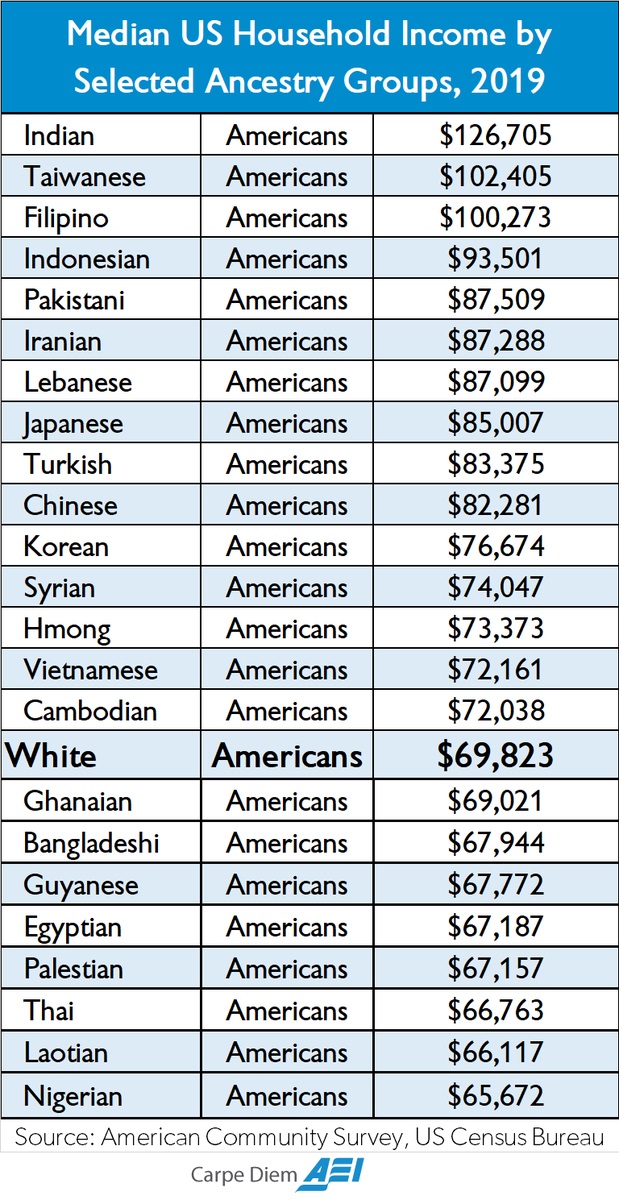
But let’s take a look at the data from the 2019 Census, and see the evidence:

Income By Ethnicity in America

White people are doing a bad job of keeping non-whites down

Well, it looks like at least SOME people of color are able to do well in America despite all the “systemic racism” that keeps non-whites down. And do you know what those non-white groups at the top have in common? They’ve made good decisions, they’ve worked hard, they haven’t blamed other people when they fail, and they’ve saved their money instead of spending it on shiny junk.

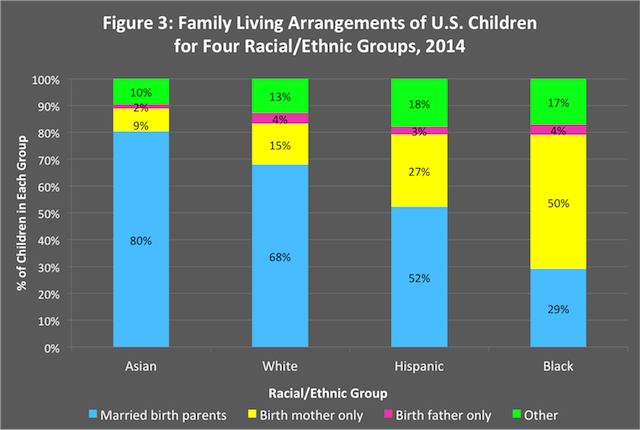
Let’s look at some decisions that the non-whites who are prosperous have made, that those further down have not.

Asians marry before they have children, so the kids have two parentsAsians marry before they have children, so the kids have two parents

Education and marriage

This article is written by the far-left radical Nicholas Kristof, writing in the radically-leftist New York Times (a former newspaper).

Excerpt:

A new scholarly book, “The Asian American Achievement Paradox,” by Jennifer Lee and Min Zhou, notes that Asian-American immigrants in recent decades have started with one advantage: They are highly educated, more so even than the average American. These immigrants are disproportionately doctors, research scientists and other highly educated professionals.

It’s not surprising that the children of Asian-American doctors would flourish in the United States. But Lee and Zhou note that kids of working-class Asian-Americans often also thrive, showing remarkable upward mobility.

[…]There’s also evidence that Americans believe that A’s go to smart kids, while Asians are more likely to think that they go to hard workers… Asian-American kids are allowed no excuse for getting B’s — or even an A-. The joke is that an A- is an “Asian F.”

One reason Asians students do so well is because their parents are usually married:

Strong two-parent families are a factor, too. Divorce rates are much lower for many Asian-American communities than for Americans as a whole, and there’s evidence that two-parent households are less likely to sink into poverty and also have better outcomes for boys in particular.

American blacks have a 73% out-of-wedlock birth rate. A huge difference compared to Asians.

So, when Nikole Hannah-Jones tells you that education and marriage don’t matter, she’s just wrong.

Compound interest

Education and marriage are important, but so is saving your money. The wealthiest people in America are typically the ones who are experts at saving money early, and investing it. They know about the law of compound interest. If you invest money early and leave it alone, then it will grow into a fortune by the time you are read to stop working.

This graph explains compound interest:

Don't trust people with non-STEM degrees to tell you how to get richInvesting $24,000 from age 21 to 41 vs investing $24000 from age 47 to 67

What does Nikole Hannah-Jones say when she looks at that graph? She doesn’t think that saving money makes a difference to having more or less wealth. She thinks skin color determines whether saving money makes you wealthy or not. The graph clearly shows what we should be recommending to young people of color. They need to stop spending money and start saving it, and the earlier the better. It doesn’t matter what your skin color is, saving money early JUST WORKS.

Similarly, when she says that home ownership doesn’t make you more wealthy, this is just terrible advice. It’s always better to pay down your own mortgage (at least when interest rates are low like they are now) than to pay someone else rent. You have to live somewhere, and paying for your own home is better because it costs about the same as rent, and then you get to keep the home when you’re done paying for it.

Communism

Nikole Hannah-Jones does have a “solution” to disparities in wealth. Her solution is communism. She wants to transfer money from those who earn, to those who don’t. But we already have tried that in the 20st century and it resulted in the deaths of over 100 million people. That’s not my opinion, that’s all documented in a book published by Harvard University Press.

Socialism Communism Countries Per Capita GDP Income

You don’t even have to read the book to know the truth – just look at countries that score low on the Index of Economic Freedom, and compare their GDP per capita to countries that score high on the Index of Economic Freedom. The more communist a nation goes, the less wealth there is for the citizens. That’s why people in Venezuela are eating zoo animals and selling their bodies in prostitution for food, while nearby capitalist countries like Panama and Chile prosper. Nikole Hannah-Jones wants to reduce economic freedom, but we know by looking at other countries that this lowers per-capita GDP.

There’s a lot more than could be said here, but the point is that we need to be telling American blacks to make decisions that match the decisions of other successful non-white communities in America. We need to start teaching young people basic economics so they don’t fall prey to charlatans.