Is the Biden administration good for evangelical Christians?

I remember during the election campaign, a whole group of very charismatic, respected Christian leaders all warned us against the scourge of Trump and his mean tweets. We were assured that it was more important to vote for elected officials based on how they made us feel, and whether they made people like us. And Biden was going to do that. Let’s see what results these Christian leaders got us.

Transgenderism

Here’s the latest news from the Daily Signal:

The Department of Health and Human Services recently released an order that said it would be adding federal protections to ensure “transgender youth receive the care they need.”

During a video commemorating the “Transgender Day of Visibility” and the HHS order, President Joe Biden lashed out at states that are looking to prevent “care,” as the cultural left defines it, from being extended to children who believe they are not the biological sex they were assigned at birth.

“The onslaught of anti-transgender state laws attacking you and your families is simply wrong,” Biden said. “This administration is standing up for you against all these hateful bills. And we’re committed to advancing transgender equality in the classroom, on the playing field, at work, in our military and our housing and health care systems.”

In addition to the HHS order, the Justice Department put out a memo to state attorneys general putting them on notice for lawsuits if their states go ahead and prevent “gender-affirming care.”

What’s “gender-affirming care”? Well Dr. Jay Richards, famous Christian apologist and scholar, explains:

  • Social Affirmation: Adopting gender-affirming hairstyles, clothing, name, gender pronouns, and restrooms and other facilities. When: At any age or stage. Reversible.

  • Puberty Blockers: Using certain types of hormones to pause pubertal development. When: During puberty. Reversible.
  • Hormone Therapy: Testosterone hormones for those who were assigned female at birth; Estrogen hormones for those who were assigned male at birth. When: Early adolescence onward. Partially reversible.
  • Gender-Affirming Surgeries: “Top” surgery—to create male-typical chest shape or enhance breasts. “Bottom” surgery—surgery on genitals or reproductive organs. Facial feminization or other procedures. When: Typically used in adulthood or case-by-case in adolescence. Not reversible.

Would the social affirmation be coerced by the government? Would all this “care” be paid for by Christian taxpayers? Are these policies worse than “mean tweets”?

Well, we have to assume that the people who obsessed over “mean tweets” during the 2020 campaign agree with Biden about coercing social approval and taxpayers paying for “care”: Russell Moore, Beth Moore, David French, John Piper, Tim Keller, Bob Mendelsohn, David Platt, Matt Chandler, etc. They think that Biden’s LGBT policies are no big deal, but mean tweets must be avoided. After all, elections are about feeling good, and being seen as virtuous. So, mean tweets really are more important than these policies.

Foreign policy

Here’s another article from the Daily Signal, this time about foreign policy:

Congress is considering several bills that would warp how the U.S. applies sanctions—through the Global Magnitsky Act—against foreigners who violate human rights. The changes would redefine human rights to enforce the left’s abortion-and-gender agenda. That would hobble the fight against real abuses of human rights.

[…]In the last few decades, the left has invoked human rights to promote abortion and policies based on sexual orientation and gender identity.

The Biden administration… often uses human rights language to pressure other countries to decriminalize “status or conduct” based on sexual orientation or gender identity. President Joe Biden issued a presidential memorandum in February 2021 that directed agencies of the U.S. government to “combat the criminalization by foreign governments of LGBTQI+ status or conduct” and to fight “discrimination, homophobia, transphobia, and intolerance.”

Again, we have to assume that the people who obsessed over “mean tweets” during the 2020 campaign agree with Biden about promoting abortion and LGBT activism in foreign policy: Russell Moore, Beth Moore, David French, John Piper, Tim Keller, Bob Mendelsohn, David Platt, Matt Chandler, etc.

Conscience rights

During the 2020 election, conservatives said that Democrat legislation like the Equality Act and the Women’s Health Protection Act would hurt Christians in areas like religious liberty and right to life. But Evangelicals for Biden told us that “mean tweets” were worse than this legislation.

Now we get this story, from Daily Caller:

Medical professionals are suing President Joe Biden’s administration over a mandate requiring doctors to perform transgender surgeries in violation of their religious beliefs or medical judgement.

Represented by the Alliance Defending Freedom, the American College of Pediatricians, the Catholic Medical Association and an OB-GYN doctor specializing in adolescent care filed suit in the U.S. District Court for the Eastern District of Tennessee at Chattanooga Thursday against the U.S. Department of Health and Human Services.

[…]The two medical associations represent 3,000 doctors and health care professionals, ADF said in a press release.

I’m just imagining myself being in a position where the secular left government forced me to violate my conscience. It makes me sick.

Abortion subsidies

I noticed that Life News – a pro-life web site – is pretty upset about Biden’s policies so far.

They write:

Joe Biden is rapidly becoming the most pro-abortion president in U.S. history as he takes multiple actions to expand abortions and force taxpayers to subsidize them.

On Wednesday, the Biden administration released a rule that will force taxpayers to fund the abortion industry through the Title X family planning program.

The rule, issued by the U.S. Department of Health and Human Services, will end a pro-life regulation that President Donald Trump put in place to ensure Title X grants are not used to subsidize the killing of unborn babies in abortions.

Pro-life groups like Susan B. Anthony List and National Right to Life considered Trump to be the most pro-life president ever. I even wrote about all the specific actions, policies and nominations he did to help the pro-life cause. But did any of that matter to Evangelicals for Biden? No. Because mean tweets got them in trouble with their Democrat atheist friends in New York and Los Angeles and Washington, D.C. So mean tweets had to go – whatever the cost.

Why does God let people suffer? Why is there so much evil in the world?

I just wanted to draw your attention to this 4 page essay by Joe Manzari, which is the best darn summary of the state of the art on the problems of evil and suffering I have seen. The problem of evil is an objection to the existence of God based on the presence of evil or suffering in the world. The arguments basically infer that if God is all-good and all-powerful, then there should not be any evil or suffering.

There are two kinds of problem of evil.

The Logical/Deductive Problem of Evil:

The first kind is called “the deductive problem of evil” or “the logical problem of evil”. An exampel of evil would be Saddam Hussein murdering some journalist who told the truth about him. This version of the problem of evil tries to introduce a logical contradiction between the attributes of God and the presence of evil, like this:

(1) God exists.
(2) God is omnipotent.
(3) God is omniscient.
(4) God is omni-benevolent.
(5) Evil exists.
(6) A good being always eliminates evil as far as it can.
(7) There are no limits to what an omnipotent being can do.

In order to avoid a contradiction, we need to explain how there could still be evil, since the conclusion of this argument is that there should not be any evil!So how are we going to get out of this mess? The solution is to attack premises 6 and 7.

Premise 6 is false because in order to eliminate human evil, you would have to eliminate free will. But eliminating free will is worse than allowing it, because good things like love are impossible without free will.

It is in response to this proposition that the Free Will Theodicy of G. W. Leibniz applies. God, valuing man’s freedom, decided to provide him with a will that was free to choose good over evil, rather than constraining his will, allowing him to choose only good.

Premise 7 is false because there are limits on what an omnipotent being can do. God cannot perform contradictory things, because contradictory things are impossible. God cannot make a married bachelor. Similarly, God cannot force free creatures to do his will.

In the same manner that God cannot create a square circle, he cannot make someone freely choose to do something. Thus, if God grants people genuine freedom, then it is impossible for him to determine what they will do. All that God can do is create the circumstances in which a person can make free choices and then stand back and let them make the choices.

One last point. In order to solve the problem of natural evil for this argument, you can point out that free will requires predictable and regular natural laws in order to make free will meaningful. Natural laws mean that individuals can predict what will happen when they act, allowing for moral responsibility. More on that next time.

Inductive/Probabilistic Problem of Evil

There is a second version of the problem of evil, though, which is more dangerous than the first. This is the one you see being argued in debates, whereas the first version is not used because it has been defused as seen above. Here is the second one:

(1) If God exists, gratuitous evil does not exist.
(2) Gratuitous evil exists.
(3) Therefore, God does not exist.

This argument tries to argue that while God may have some reason for allowing free will, there are other evils in the world that are not the result of human action that God has no reason for permitting. Theists usually like to argue that God has morally-sufficient reasons for allowing some evil in the world, in order for the character of humans to develop through suffering and endurance. But what about gratuitous evil, which doesn’t have any point?

Consider the case of a fawn running in the forest, who falls and breaks his leg. Ouch! Then a forest fire starts and the poor fawn suffocates to death in the smoke. Why would God allow this poor small animal suffer like that? And notice that there is no morally sufficient reason for allowing it, because no human knows about this and so no human’s character or relationship with God is impacted by it.

The solution to this problem is to deny premise 2. (You can also deny 1 if you want). The problem with premise 2 is that the atheist is claiming to know that some instance of evil really is gratuitous. But since they are making the claim to know, they have to be able to show that God’s permission of that evil achieves nothing. But how do they know 2 is true?

The problem with 2 is that the atheist is not in a position to know that the permission of some evil X really doesn’t achieve anything. This is because the atheist cannot look forward into the future, or see into other places, in order to know for certain that there is no morally sufficient reason for allowing God’s allowing evil X to occur. But since the atheist argues based on premise 2, he must be able to show that premise 2 is more probable than not.

Manzari’s article also argues why apparently gratuitous evil is less problematic for Christians in particular, because of certain Christian doctrines. He lists four doctrines that make the apparently gratuitous evil that we observe more compatible with an all-good, all-powerful God.

  1. The chief purpose of life is not happiness, but the knowledge of God.
    Some of the things that we experience may wreck our feelings of contentment, but we need to remember that God may be permitting those troubles in order to remind us not to get too comfortable with life on earth, and to think ahead to the after-life. And remember, even Jesus learned endurance through suffering. His suffering was not pointless and neither is ours.
  2. Mankind is in a state of rebellion against God and God’s purposes.
    We humans seem to be on a dead run away from God, trying to keep our autonomy by knowing as little about him as possible. Part of knowing God is knowing what he designed us to do – to love him and to love others. And so, the less we know about God, the more we stray from his design for our lives.
  3. God’s purpose is not restricted to this life but spills over beyond the grave into eternity.
    Sometimes it seems as if our sufferings really are catastrophic, but when you realize that you are offered eternal life without any suffering after you die, the sufferings of this life are a lot less upsetting than they would be if this life was all we had.
  4. The knowledge of God is an incommensurable good.
    This one is the biggest for me. Knowing God and knowing his actual character by studying the historical Jesus is a wonderful counterbalance for all the problems and sufferings of this life. A little bit of historical study reveals that Jesus was not spared the worst kind of suffering in his life, making it is a lot easier for us to bear with whatever God allows us to face.

In section 3, Manzari shows how you can also argue against this version of the problem by supplying evidence for God, such as from the big bang, the fine-tuning, the origin of life, the origin of free will, the origin of the first living organism, the origin of the mind, the sudden emergence of phyla in the fossil record, molecular machines, irreducible complexity, the resurrection miracle, and the objective morality argument.

The argument goes like this:

(1) If God exists, gratuitous evil does not exist.
(2) God exists.
(3) Therefore, gratuitous evil does not exist.

Just support 2 with some evidence, and you win, especially when they can’t support their claim to know that gratuitous evil exists.

The Argument for God from Evil

In the paper, Manzari actually makes an argument for God from evil. That’s right. Far from disproving God, the presence of evil (a departure from the way things out to be), actually affirms God’s existence. How?

(1) If God does not exist, then objective moral values do not exist.
(2) Evil exists.
(3) Therefore, objective moral values do exist.
(4) Therefore, God exists.

That’s right. If evil exists in any sense such that it is not a personal or cultural preference, then objective morality exists. If objective morality exists, then there is an objective moral lawgiver. Game over. If the atheist backtracks and says that the existence of evil is just his opinion or his cultural preference, then this standard does not apply to God, and you win again. Game over again.

So, although the problems of evil look pretty tough, they are actually easy. The toughest part of evil and suffering is the emotional problem. I could tell you stories about what I’ve been through… but then, that’s why the arguments matter. You can hold your position under tremendous fire when you have the arguments and evidence to ground you.

Two black economists explain how to end poverty in America

These days, everyone seems to think that being good to the poor means looking around to see what people are saying is good to the poor, then loudly shouting your agreement with it. People want to look good to others more than they want to help others. Besides, looking good by loud virtue signaling is free. If we really wanted to help people, though, we should tell them to do what will work.

So let’s talk about poverty in America, with help from famous black economist Walter Williams.

First, he says real poverty is not common in America:

There is no material poverty in the U.S. Here are a few facts about people whom the Census Bureau labels as poor. Dr. Robert Rector and Rachel Sheffield, in their study “Understanding Poverty in the United States: Surprising Facts About America’s Poor”, report that 80 percent of poor households have air conditioning; nearly three-quarters have a car or truck, and 31 percent have two or more. Two-thirds have cable or satellite TV. Half have one or more computers. Forty-two percent own their homes. Poor Americans have more living space than the typical non-poor person in Sweden, France or the U.K. What we have in our nation are dependency and poverty of the spirit, with people making unwise choices and leading pathological lives aided and abetted by the welfare state.

Second, the “poverty” is not caused by racism, but by poor choices:

The Census Bureau pegs the poverty rate among blacks at 35 percent and among whites at 13 percent. The illegitimacy rate among blacks is 72 percent, and among whites it’s 30 percent. A statistic that one doesn’t hear much about is that the poverty rate among black married families has been in the single digits for more than two decades, currently at 8 percent. For married white families, it’s 5 percent. Now the politically incorrect questions: Whose fault is it to have children without the benefit of marriage and risk a life of dependency? Do people have free will, or are they governed by instincts?

There may be some pinhead sociologists who blame the weak black family structure on racial discrimination. But why was the black illegitimacy rate only 14 percent in 1940, and why, as Dr. Thomas Sowell reports, do we find that census data “going back a hundred years, when blacks were just one generation out of slavery … showed that a slightly higher percentage of black adults had married than white adults. This fact remained true in every census from 1890 to 1940”? Is anyone willing to advance the argument that the reason the illegitimacy rate among blacks was lower and marriage rates higher in earlier periods was there was less racial discrimination and greater opportunity?

Third, avoiding poverty is the result of good choices:

No one can blame a person if he starts out in life poor, because how one starts out is not his fault.

If he stays poor, he is to blame because it is his fault. Avoiding long-term poverty is not rocket science. First, graduate from high school. Second, get married before you have children, and stay married. Third, work at any kind of job, even one that starts out paying the minimum wage. And finally, avoid engaging in criminal behavior. It turns out that a married couple, each earning the minimum wage, would earn an annual combined income of $30,000. The Census Bureau poverty line for a family of two is $15,500, and for a family of four, it’s $23,000. By the way, no adult who starts out earning the minimum wage does so for very long.

Fourth, what stops people from making good choices is big government:

Since President Lyndon Johnson declared war on poverty, the nation has spent about $18 trillion at the federal, state and local levels of government on programs justified by the “need” to deal with some aspect of poverty. In a column of mine in 1995, I pointed out that at that time, the nation had spent $5.4 trillion on the War on Poverty, and with that princely sum, “you could purchase every U.S. factory, all manufacturing equipment, and every office building. With what’s left over, one could buy every airline, trucking company and our commercial maritime fleet. If you’re still in the shopping mood, you could also buy every television, radio and power company, plus every retail and wholesale store in the entire nation”. Today’s total of $18 trillion spent on poverty means you could purchase everything produced in our country each year and then some.

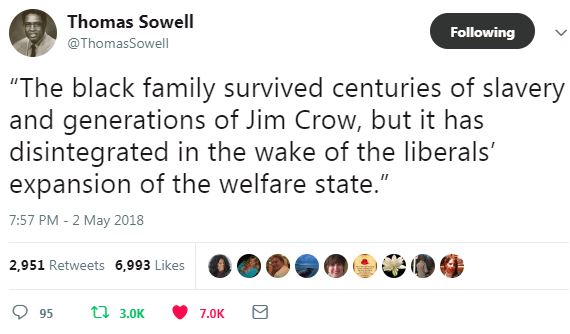
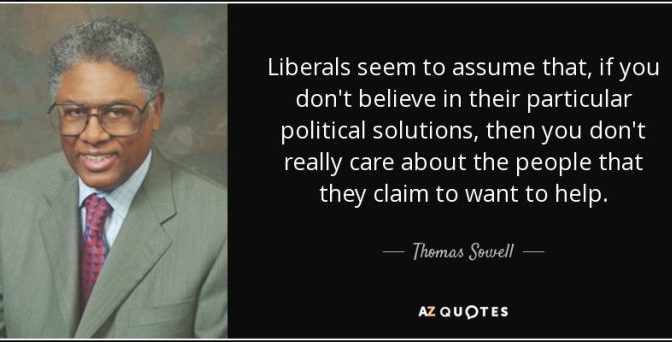
Regarding those last two points, here is another famous black economist, Thomas Sowell:

Economist Thomas Sowell blames welfare for killing the black family

To illustrate this point, here’s a graph with some helpful data taken from the U. S. Census.

In fact, there is a whole video featuring Thomas Sowell to go with this graph:

Black women were more likely to be married before welfare programs

And an article to go with it:

If we wanted to be serious about evidence, we might compare where blacks stood a hundred years after the end of slavery with where they stood after 30 years of the liberal welfare state. In other words, we could compare hard evidence on “the legacy of slavery” with hard evidence on the legacy of liberals.

Despite the grand myth that black economic progress began or accelerated with the passage of the civil rights laws and “war on poverty” programs of the 1960s, the cold fact is that the poverty rate among blacks fell from 87 percent in 1940 to 47 percent by 1960. This was before any of those programs began.

Over the next 20 years, the poverty rate among blacks fell another 18 percentage points, compared to the 40-point drop in the previous 20 years. This was the continuation of a previous economic trend, at a slower rate of progress, not the economic grand deliverance proclaimed by liberals and self-serving black “leaders.”

Ending the Jim Crow laws was a landmark achievement. But, despite the great proliferation of black political and other “leaders” that resulted from the laws and policies of the 1960s, nothing comparable happened economically. And there were serious retrogressions socially.

Nearly a hundred years of the supposed “legacy of slavery” found most black children being raised in two-parent families in 1960. But thirty years after the liberal welfare state found the great majority of black children being raised by a single parent.

The rest of the article points out how even crime rates among blacks were caused by the implementation of soft law enforcement policies by progressives. Just look at the big cities if you want to know what it is like for blacks to be ruled by Democrats. It sucks!

If everybody started to read more Thomas Sowell books, we would be much better off as a country! Only good things happen when people stop watching TV and listening to music and watching movies, and instead settle down in a chair with a Thomas Sowell book. I recommended a bunch of them in a previous post.